Fill out renewable energy permit forms
with AI.
Renewable energy permit forms are essential documents for anyone looking to transition to sustainable power sources. These forms facilitate the legal and technical integration of solar panels, wind turbines, and other generation systems into the existing electrical grid. They ensure that all installations meet safety standards, environmental regulations, and technical requirements set by regional energy and climate directorates. Proper documentation is the bridge between a conceptual project and a fully operational, grid-connected energy source.
By continuing, you acknowledge Instafill's Privacy Policy and agree to get occasional product update and promotional emails.
About renewable energy permit forms
Typically, these forms are required by electrical engineers, renewable energy contractors, and property owners during the planning and installation phases. For instance, technical memorandums for production installations—such as the Memòria Tècnica d’Instal·lació—are necessary to secure access and connection permits from local authorities. Whether you are managing a large-scale wind farm or a residential rooftop solar array, navigating these regulatory requirements is a mandatory step to verify equipment specifications and ensure that the local infrastructure can safely handle the additional power load.
Completing these detailed technical documents manually can be a time-consuming process prone to clerical errors. Tools like Instafill.ai use AI to fill these forms in under 30 seconds, handling complex data accurately and securely to streamline the permitting process. This allows professionals to focus on the engineering and implementation of green energy solutions rather than getting bogged down in repetitive paperwork.
Every form on this page can be completed without typing. Instafill is form filling software that reads a PDF and fills it for you — including flat and scanned documents that carry no fillable fields at all.
Forms in This Category
The forms in this category have a median Form Complexity Index of 79/100 (Complex), measured across 1 forms by field count, input difficulty, length, conditional logic and structure. See how it is calculated.
- Enterprise-grade security & data encryption
- 99%+ accuracy powered by AI
- 1,000+ forms from all industries
- Complete forms in under 60 seconds
How to Choose the Right Form
Navigating the regulatory landscape for renewable energy projects requires precise documentation to ensure your installation is approved and connected to the grid without delays. Depending on your project’s scope, you will need to provide detailed technical specifications to the relevant authorities.
For Electrical Power Generation and Grid Connection
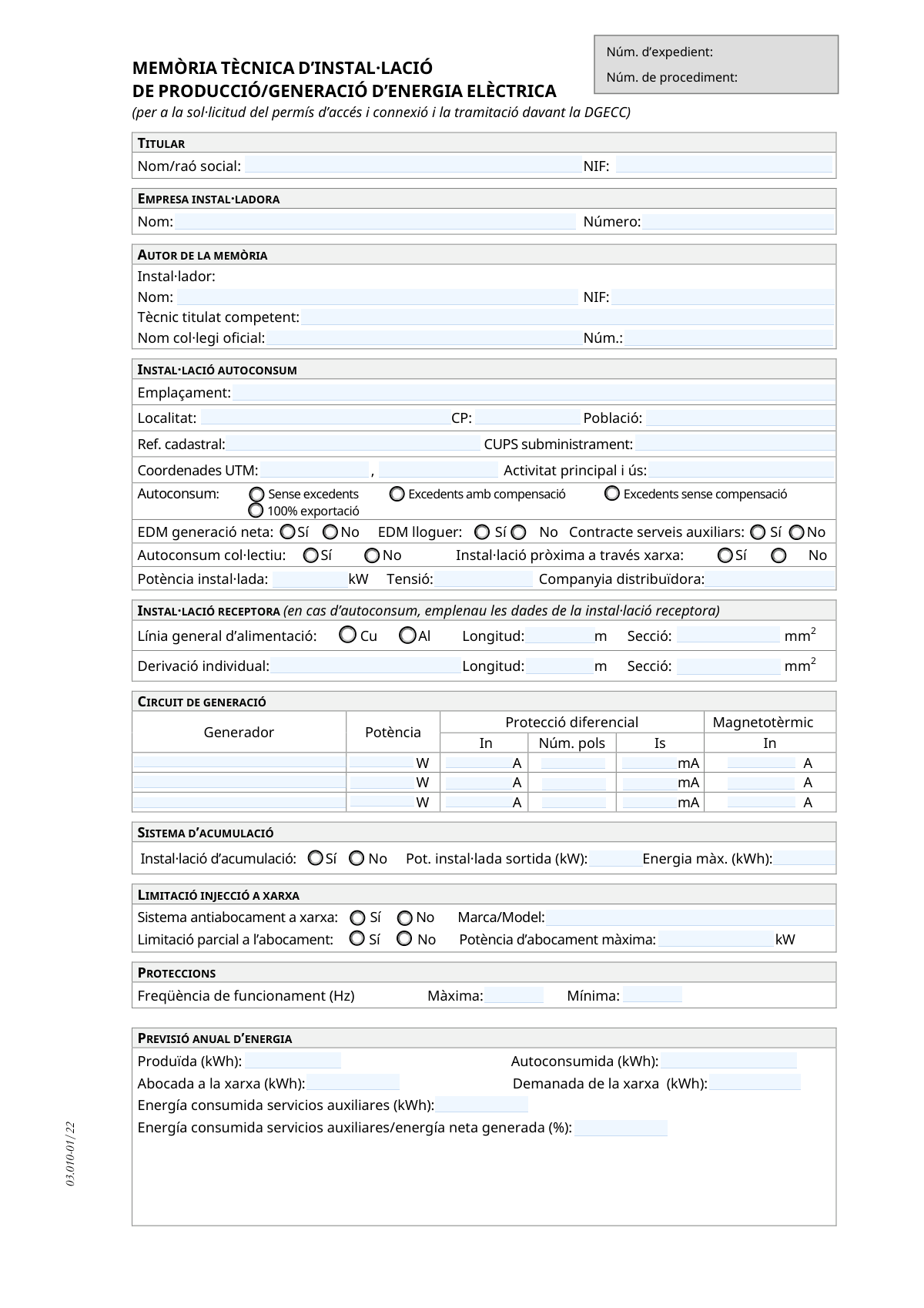
If you are overseeing the installation of a new electrical production system—such as a solar photovoltaic array or a wind turbine—the primary document you will need is the Memòria Tècnica d’Instal·lació de Producció/Generació d’Energia Elèctrica (per a la sol·licitud del permís d’accés i connexió i la tramitació davant la DGECC).
This form is essential for:
- Securing Grid Access: It is the standard document required to request access and connection permits from the utility provider.
- DGECC Compliance: It facilitates the formal processing of your installation with the General Directorate of Energy and Climate Change.
- Technical Documentation: It captures all vital hardware specifics, including inverter ratings, panel types, and safety configurations.
Who Should Use This Form?
This technical memory is typically completed by engineers, professional installers, or project managers. It is designed to bridge the gap between physical installation and legal operation. Whether you are working on a residential self-consumption project or a larger commercial energy farm, the Memòria Tècnica d’Instal·lació de Producció/Generació d’Energia Elèctrica serves as the official record of your system’s capabilities.
Streamlining Your Application
Filling out complex technical forms manually can lead to errors that stall your project. By using Instafill.ai, you can accurately complete the Memòria Tècnica d’Instal·lació de Producció/Generació d’Energia Elèctrica using AI-assisted tools. Our platform helps you organize technical data, equipment specs, and owner information into a professional, submission-ready PDF, ensuring your transition to renewable energy is as smooth as possible.
Form Comparison
| Form | Primary Purpose | Who Submits It | Key Technical Data | Target Authority |
|---|---|---|---|---|
| Memòria Tècnica d’Instal·lació de Producció/Generació d’Energia Elèctrica (per a la sol·licitud del permís d’accés i connexió i la tramitació davant la DGECC) | Requesting grid access and connection permits for renewable energy generation systems. | Project owners or qualified technical engineers managing the installation process. | Detailed technical specifications, equipment data, and site owner information. | General Directorate of Energy and Climate Change (DGECC) and grid operators. |
Tips for renewable energy permit forms
Double-check that the nominal power, equipment models, and inverter specifications match your project plans exactly. Any discrepancy between the Memòria Tècnica and the actual hardware installed can lead to permit denials or delays during the final inspection phase.
Administrative delays are often caused by simple typos in the NIE/CIF numbers or the physical location coordinates of the installation. Ensure that the site address and cadastral references are consistent across all pages of the permit application to avoid manual reviews.
AI-powered tools like Instafill.ai can complete these complex technical forms in under 30 seconds with high accuracy. This is a significant time-saver for professionals managing multiple installations, and your sensitive project data stays secure throughout the entire process.
While filling out the technical sections, keep your single-line diagrams and equipment datasheets open. Having these technical details at hand allows you to accurately transcribe protection settings and connection details required by the DGECC without guessing.
Pay close attention to the section regarding access and connection points. Providing precise information about where the installation will link to the grid helps authorities process your request faster and reduces the likelihood of them requesting additional technical clarifications.
Always save a digital copy of your completed form before final submission. Renewable energy projects often undergo minor design changes during construction, and having a digital record allows you to quickly update and re-submit technical reports without starting from scratch.
Frequently Asked Questions
Renewable energy permit forms are essential documents used to authorize the installation and operation of power generation systems like solar panels or wind turbines. They ensure that the proposed installation meets safety standards and is compatible with the existing electrical grid.
These forms are generally required by property owners, project developers, or licensed installers who are setting up a system to generate electricity. Whether the project is for self-consumption or selling back to the grid, a formal technical record is necessary for regulatory compliance.
In many regions, these documents are submitted to regional energy departments, such as the General Directorate of Energy and Climate Change (DGECC), and to the local utility provider. These bodies verify that the technical specifications align with regional energy policies and grid capacity.
It is best to begin the permit process during the design phase, before any physical installation work starts. Securing access and connection permits early ensures that your project is legally viable and that you have secured a spot on the local grid.
Most forms require detailed information regarding the owner, the location of the installation, and specific equipment data such as inverter ratings and solar panel capacities. They also often include technical calculations to demonstrate the system's efficiency and safety.
The grid access permit is the formal approval that allows your renewable energy system to physically connect to the public electrical infrastructure. Without this permit, you cannot legally export excess energy or receive compensation for the power your system produces.
Yes, you can fill out renewable energy permit forms using AI tools like Instafill.ai. These tools can automatically extract technical data from your project specifications and place it into the required fields, significantly reducing the risk of manual entry errors.
Using AI-powered services, these complex technical forms can be completed in under 30 seconds. The AI accurately extracts data from your source documents, such as equipment data sheets or project plans, and maps it directly onto the official PDF form.
Yes, technical memory forms are usually required for both residential rooftops and large-scale commercial arrays. While the complexity of the data might vary based on the size of the system, the fundamental requirement to document the technical setup remains the same.
Once submitted, the authorities review the technical memory to ensure it complies with the current electrical code and climate change regulations. If approved, you will receive the necessary authorization to proceed with the installation and eventually connect to the grid.
Glossary
- Form Complexity Index
- Instafill’s 0–100 measure of how much effort a form takes to complete, calculated deterministically from the form’s own structure rather than estimated. It combines the number of fillable fields (the largest factor), how difficult those fields are to complete based on their type, the number of pages that contain fields, the amount of conditional “fill-only-if” logic, and how many sections the form is divided into, then adds modifiers for tables and repeating lists, bundled instruction pages, and dense page layouts. A higher score means the form is harder to fill out by hand. The forms in this category have a median Form Complexity Index of 79/100 (Complex). See exactly how it is calculated.
- CUPS (Codi Unificat de Punt de Subministrament)
- A unique 20 or 22-character alphanumeric code that identifies a specific electricity supply point; it is essential for identifying the location of the installation on permit forms.
- Permís d’Accés i Connexió
- A mandatory authorization granted by the grid operator that allows a new energy generation facility to legally link to the existing electrical distribution network.
- DGECC
- The General Directorate of Energy and Climate Change, the administrative body responsible for reviewing technical documentation and regulating energy projects.
- Memòria Tècnica
- A detailed technical memorandum or report that describes the engineering specifications, safety measures, and design of the energy production system.
- Potència Nominal
- The maximum continuous power output that an electrical installation is designed to produce, usually measured in kilowatts (kW) or megawatts (MW).
- Autoconsum
- A configuration where energy is generated (often via solar panels) for the producer's own use, which may involve specialized administrative procedures for surplus energy.
- Punt de Connexió
- The specific physical and electrical location where the private generation facility meets the public utility's power lines.
- Inversor
- An essential component that converts the direct current (DC) electricity produced by renewable sources into the alternating current (AC) used by the grid.