Fill out shipping forms
with AI.
Shipping and logistics forms serve as the structural backbone of global trade, providing the necessary documentation to move goods and vessels across international borders. These forms ensure that every shipment or vessel registration complies with maritime laws, customs regulations, and safety standards. Whether it is documenting cargo details or registering a ship under a specific jurisdiction, accurate paperwork is essential to avoid costly delays, legal complications, or impounded freight. Without these standardized documents, the complex network of global transportation would lack the transparency and accountability required for modern commerce.
By continuing, you acknowledge Instafill's Privacy Policy and agree to get occasional product update and promotional emails.
About shipping forms
This category is vital for freight forwarders, logistics managers, and vessel owners who handle the complexities of transportation every day. These professionals often need specific documents, such as the Application for the Registration of a Ship, to establish legal status for vessels or to formalize ownership. These forms are typically used during the onboarding of new cargo, the formalization of maritime ownership, or when navigating the rigorous regulatory requirements of different ports and international authorities. Given the high stakes of international logistics, precision in these documents is non-negotiable.
Managing these extensive documents manually is often time-consuming and prone to human error. Tools like Instafill.ai use AI to fill these shipping forms in under 30 seconds, ensuring data is handled accurately and securely. By automating the data entry process, logistics professionals can focus on their core operations while maintaining the high level of precision required for international shipping documentation.
Every form on this page can be completed without typing. Instafill is form filling software that reads a PDF and fills it for you — including flat and scanned documents that carry no fillable fields at all.
Forms in This Category
The forms in this category have a median Form Complexity Index of 57/100 (Moderate), measured across 1 forms by field count, input difficulty, length, conditional logic and structure. See how it is calculated.
| Form Name | Pages | FCI | |
|---|---|---|---|
| 1. | MS(R) 21A, Application for the Registration of a Ship under the (Malta) Merchant Shipping Act, 1973 | 1 | Moderate 57 |
- Enterprise-grade security & data encryption
- 99%+ accuracy powered by AI
- 1,000+ forms from all industries
- Complete forms in under 60 seconds
How to Choose the Right Form
Navigating the complexities of maritime logistics requires precision, especially when it comes to vessel registration and international compliance. While shipping forms can encompass everything from simple bills of lading to complex customs declarations, the primary document in this category focuses on the formal legal status of a vessel.
Registering a Vessel in Malta
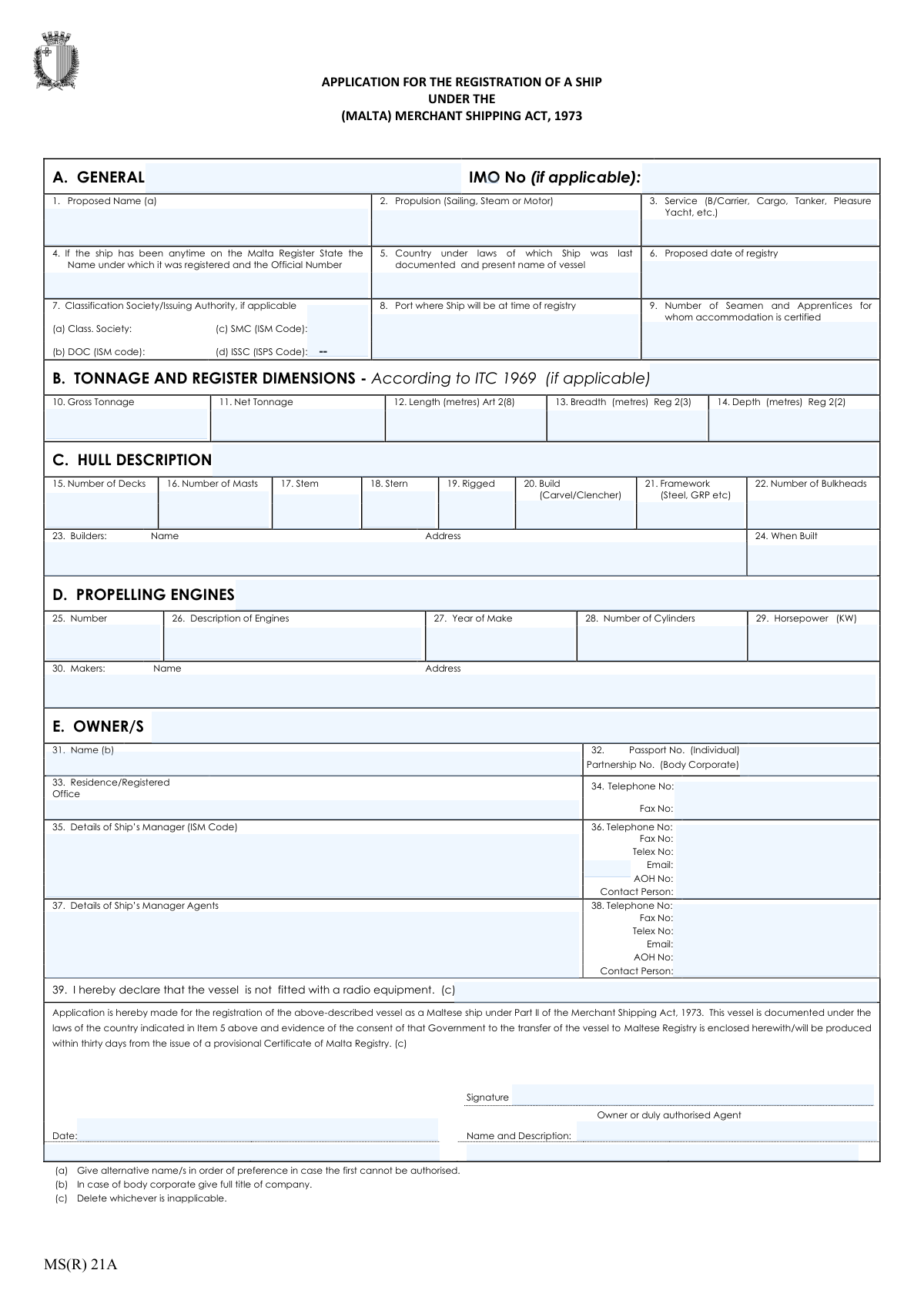
If your objective is to register a ship under the Maltese flag, the MS(R) 21A, Application for the Registration of a Ship is the essential document. This is not a standard freight form for daily transport; it is a comprehensive legal application required by the Malta Ship Registry under the Merchant Shipping Act of 1973.
You should select the MS(R) 21A form if you are:
- Establishing Flag State: You are an owner or legal representative seeking the benefits and legal standing of the Maltese flag for your vessel.
- Providing Technical Specifications: You need to submit official dimensions, engine details, and tonnage measurements to maritime authorities.
- Declaring Ownership: You are documenting the management and ownership structure of a ship for international compliance.
Ensuring Accuracy in Logistics
Because the MS(R) 21A is a multi-section document involving complex technical and legal data, accuracy is paramount. Errors in ship characteristics or ownership details can lead to significant delays in the registration process or issues with maritime insurance.
If you are searching for general transportation or freight forms—such as domestic bills of lading or logistics manifests—ensure you have the specific requirements from your carrier. However, for specialized maritime registration within the European Union's largest register, the MS(R) 21A is your primary requirement. Using Instafill.ai to complete this form helps ensure that all mandatory fields are filled accurately and that the final PDF is professional and ready for submission.
Form Comparison
| Form | Primary Purpose | Who Files It | Key Requirements |
|---|---|---|---|
| MS(R) 21A, Application for the Registration of a Ship under the (Malta) Merchant Shipping Act, 1973 | Legal application to register a vessel with the Malta Ship Registry. | Ship owners or authorized representatives and vessel managers. | Vessel dimensions, characteristics, ownership details, and management information. |
Tips for shipping forms
When filling out registration forms, ensure all dimensions and tonnage figures match the official builder's certificate or previous registry documents. Even a minor discrepancy in measurements can lead to delays or the rejection of your maritime application.
AI-powered tools like Instafill.ai can complete these detailed shipping forms in under 30 seconds with high accuracy. Your data stays secure during the process, providing a massive time-saving advantage for logistics professionals managing multiple vessel registrations.
Clearly define the relationship between the ship owner and the appointed manager or representative within the form. Ensure that all corporate names and addresses are typed exactly as they appear on official business registration papers to avoid administrative hurdles.
Shipping forms often require accompanying documents like bills of sale or deletion certificates from previous registries. Keeping these files organized and ready for reference will help you fill out the application faster and ensure all cross-referenced data is consistent.
Shipping forms often follow specific international standards for date formats and vessel nomenclature. Stick to a consistent format throughout the document to ensure the information is easily processed by maritime authorities without the need for clarification.
Leaving fields blank can stall the registration process indefinitely. If a section is truly not applicable to your specific vessel or situation, use standard notations like 'N/A' rather than leaving it empty to show the form was reviewed in full.
Frequently Asked Questions
Shipping forms are used to document the legal status, ownership, and technical specifications of vessels and cargo. They are essential for regulatory compliance and ensuring that transportation activities meet the requirements of national and international maritime laws.
Typically, ship owners, legal representatives, or authorized maritime managers are responsible for filling out these documents. In some cases, freight forwarders or logistics coordinators may also handle specific forms related to the movement of goods and vessel registration.
Most ship registration forms require comprehensive data, including the vessel's dimensions, engine specifications, and tonnage. You will also need to provide detailed information regarding the legal owners and the technical management of the ship to establish its status under a specific flag.
The correct form depends on the specific action you are taking, such as initial registration, renewal, or a change in ownership. For example, registering a ship under the Maltese flag requires specific applications like the MS(R) 21A, which is tailored to the Merchant Shipping Act requirements.
Yes, AI tools like Instafill.ai can fill out complex shipping and logistics forms in under 30 seconds. These tools accurately extract data from your source documents and place it into the correct fields, reducing the risk of manual entry errors.
While manually completing these forms can take a significant amount of time due to the technical detail required, using an AI-powered service reduces the process to less than a minute. AI can instantly map information from your records directly into the PDF fields.
Once completed and signed, these forms are usually submitted to the relevant national maritime authority, such as the Malta Ship Registry. Depending on the jurisdiction, submissions may be made via an official online portal, email, or by physical mail.
If you have a flat or scanned PDF that doesn't allow typing, services like Instafill.ai can convert these into interactive, fillable documents. This allows you to type directly into the form or use AI to populate the fields without needing specialized PDF editing software.
Yes, the logistics industry uses a variety of forms depending on whether the cargo is being moved by sea, air, or land. While some forms focus on the vessel registration, others focus on the cargo manifest, safety declarations, and customs clearance requirements.
Inaccurate information on shipping forms can lead to significant delays in registration, heavy fines, or even the rejection of a vessel's legal status. Ensuring that dimensions, ownership details, and technical specs are exact is vital for maintaining compliance with international maritime standards.
Glossary
- Form Complexity Index
- Instafill’s 0–100 measure of how much effort a form takes to complete, calculated deterministically from the form’s own structure rather than estimated. It combines the number of fillable fields (the largest factor), how difficult those fields are to complete based on their type, the number of pages that contain fields, the amount of conditional “fill-only-if” logic, and how many sections the form is divided into, then adds modifiers for tables and repeating lists, bundled instruction pages, and dense page layouts. A higher score means the form is harder to fill out by hand. The forms in this category have a median Form Complexity Index of 57/100 (Moderate). See exactly how it is calculated.
- IMO Number
- A unique seven-digit identifier assigned to a ship by the International Maritime Organization to maintain safety and prevent maritime fraud.
- Gross Tonnage (GT)
- A measurement of a ship's total internal volume, which is used to determine registration fees, manning requirements, and safety regulations.
- Classification Society
- An independent organization that establishes and maintains technical standards for the construction and operation of ships and offshore structures.
- Bareboat Charter
- An arrangement where a vessel is leased without a crew or provisions, often used to register a ship under a different flag for a set period.
- Representative Person
- A local resident or entity required by the Malta Ship Registry to act as the official point of contact for ship owners who are not residents of Malta.
- Call Sign
- A unique alphanumeric code assigned to a vessel for radio communication and identification purposes while at sea.
- Net Tonnage (NT)
- The total volume of a ship's cargo-carrying spaces, which is primarily used to calculate harbor dues and other taxes.
- Merchant Shipping Act
- The primary legislation that sets the legal requirements for the registration, safety, and operation of commercial vessels under a national flag.