Fill out UPS forms
with AI.
UPS forms cover the documentation needed to ship, export, and move goods through UPS's logistics and supply chain services. These forms serve a range of purposes — from authorizing carriers to act on a shipper's behalf, to satisfying customs and export compliance requirements for international shipments. Whether you're sending a single air freight package or managing complex cross-border logistics, having the right paperwork completed accurately is essential to avoid delays, fines, or liability issues.
By continuing, you acknowledge Instafill's Privacy Policy and agree to get occasional product update and promotional emails.
About UPS forms
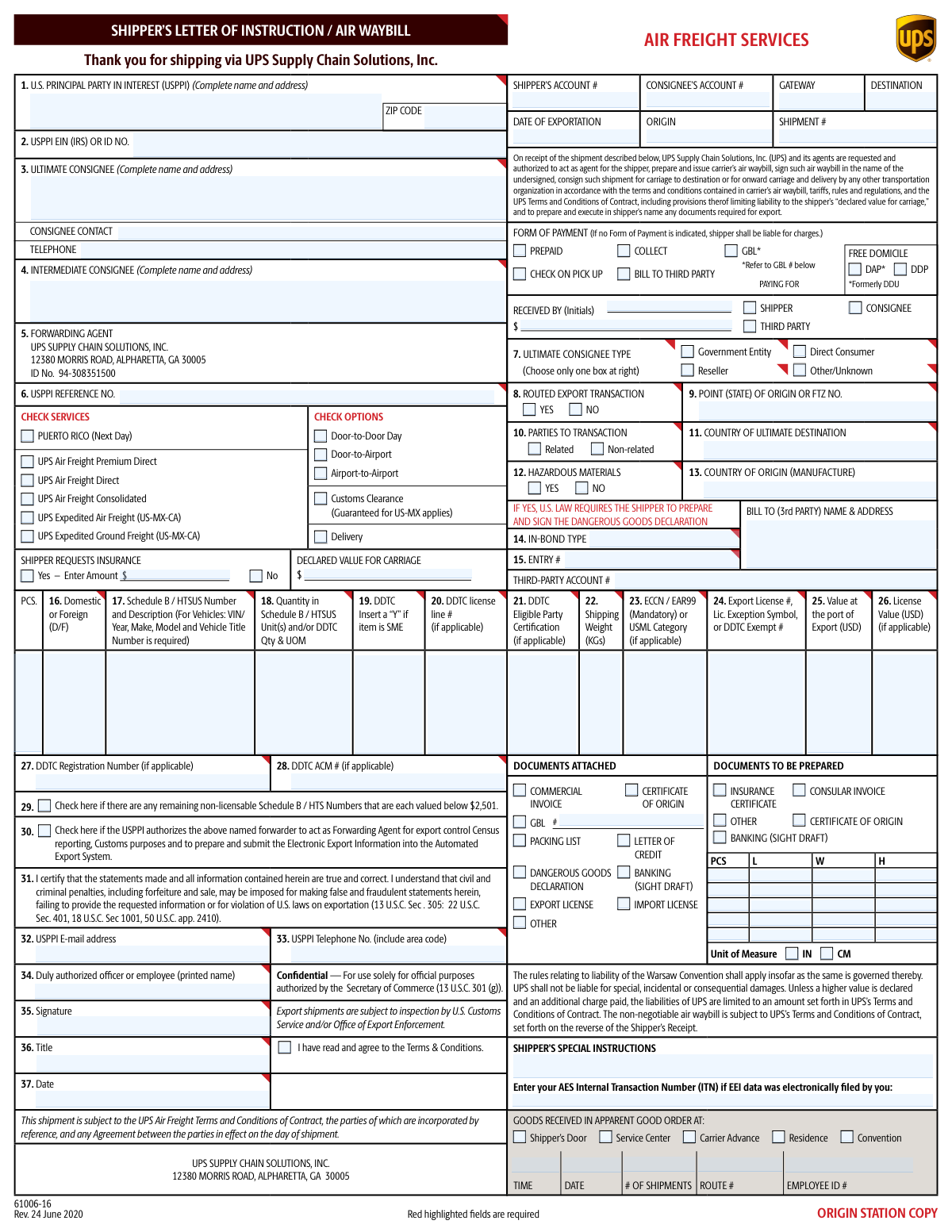
The forms in this category are most commonly used by businesses, freight forwarders, and export compliance teams that ship goods internationally via air freight. A key example is the UPS Supply Chain Solutions Shipper's Letter of Instruction and Air Waybill, which is required when UPS is handling your air freight and you need to authorize them to create the waybill, file Electronic Export Information (EEI) through the Automated Export System (AES), and ensure the shipment meets export control regulations. Getting details like Schedule B numbers, ECCN classifications, and declared values right the first time is critical.
Because these forms require precise data entry across multiple fields — commodity descriptions, routing instructions, payment terms, and licensing information — errors are common when filling them out manually. Tools like Instafill.ai use AI to fill these forms in under 30 seconds, helping shippers complete them accurately and securely without the usual back-and-forth.
Every form on this page can be completed without typing. Instafill is form filling software that reads a PDF and fills it for you — including flat and scanned documents that carry no fillable fields at all.
Forms in This Category
The forms in this category have a median Form Complexity Index of 67/100 (Complex), measured across 1 forms by field count, input difficulty, length, conditional logic and structure. See how it is calculated.
| Form Name | Pages | FCI | |
|---|---|---|---|
| 1. | UPS Supply Chain Solutions Shipper’s Letter of Instruction / Air Waybill (Air Freight Services) | 2 | Complex 67 |
- Enterprise-grade security & data encryption
- 99%+ accuracy powered by AI
- 1,000+ forms from all industries
- Complete forms in under 60 seconds
How to Choose the Right Form
Navigating UPS logistics requires understanding the difference between a standard parcel label and formal freight documentation. If you are handling large-scale shipments or international exports, the documentation in this category is designed to ensure your cargo moves through customs and air networks without delay.
Air Freight and Export Documentation
The primary document for high-value or large-scale international shipping via UPS Supply Chain Solutions is the UPS Supply Chain Solutions Shipper’s Letter of Instruction / Air Waybill (Air Freight Services).
You should choose this specific form if your shipment meets the following criteria:
- Air Freight Services: You are utilizing UPS Supply Chain Solutions for heavy air transport rather than standard small-package or ground delivery.
- Combined Documentation: You need a single, streamlined document that functions as both a Shipper’s Letter of Instruction (SLI) and an Air Waybill.
- Export Compliance: Your shipment requires the reporting of detailed export-control data, such as Schedule B/HTS codes, ECCN/EAR99 numbers, or specific license details.
- AES Filing Authorization: You intend to authorize UPS to file Electronic Export Information (EEI) in the Automated Export System (AES) on your behalf.
Why This Form is Necessary
The UPS Supply Chain Solutions Shipper’s Letter of Instruction / Air Waybill is more than just a tracking tool; it is a legal certification. It ensures that:
- Billing is Accurate: You can clearly define routing, payment terms, and service levels to avoid unexpected costs.
- Liability is Managed: It allows you to declare value and arrange for specific insurance coverage for your freight cargo.
- Customs Clearance is Streamlined: By providing detailed commodity data upfront, you significantly reduce the risk of your shipment being flagged or held by customs officials.
For standard domestic parcel shipping, a basic shipping label is usually sufficient. However, for professional logistics, international freight, and regulatory compliance, this document is the essential standard for UPS air freight operations.
Form Comparison
| Form | Primary Purpose | Key Information Needed | Service Type |
|---|---|---|---|
| UPS Supply Chain Solutions Shipper’s Letter of Instruction / Air Waybill (Air Freight Services) | Authorizes UPS to handle export compliance, billing, and air waybill creation for shippers. | Requires commodity descriptions, export-control data, HTS codes, and declared insurance value. | Specifically for international air freight shipments managed by UPS Supply Chain Solutions. |
Tips for UPS forms
Avoid vague terms like 'parts' or 'merchandise' when describing your goods. Use precise language that details the item's material and function to prevent customs delays and ensure accurate tariff classification.
Ensure your Schedule B or Harmonized Tariff Schedule codes are accurate before submitting the form. These codes are mandatory for export-control data and determine duty rates, so double-checking them prevents costly billing errors and regulatory fines.
AI-powered tools like Instafill.ai can complete these logistics forms in under 30 seconds with high accuracy. This is a major time-saver for shippers handling multiple air waybills, and your sensitive export data stays secure throughout the process.
Since the Shipper’s Letter of Instruction acts as a legal authorization, be explicit about service levels and payment terms. Clear instructions ensure UPS Supply Chain Solutions handles the shipment exactly as required without needing manual follow-ups.
Carefully indicate whether you are declaring a value for carriage or requesting specific insurance coverage. Misunderstanding these fields can lead to inadequate financial protection in the event of loss or damage during transit.
Determine if your shipment requires an EEI filing in the Automated Export System based on the cargo value or destination. Providing the correct ECCN or EAR99 classification on the form allows UPS to file correctly on your behalf.
Frequently Asked Questions
UPS shipping forms are documentation required to facilitate the movement of goods, particularly for freight and international logistics. They provide the carrier with essential details regarding the shipper, recipient, commodity descriptions, and handling instructions to ensure accurate delivery and billing.
The SLI is usually completed by the exporter or the party responsible for the shipment. It serves as a formal letter of instruction to the freight forwarder, authorizing them to act as the shipper's agent for export control and customs purposes.
Yes, AI tools like Instafill.ai can be used to fill out complex UPS logistics forms in under 30 seconds. The AI accurately extracts data from your source documents, such as invoices or packing lists, and places it into the correct fields on the PDF automatically.
An Air Waybill (AWB) acts as a receipt for goods by the airline and a contract of carriage between the shipper and the carrier. It contains specific details about the shipment's weight, dimensions, and destination, and it is non-negotiable.
Shippers must provide detailed commodity data, including Schedule B or Harmonized Tariff Schedule (HTS) codes and Export Control Classification Numbers (ECCN). This information is necessary for UPS to file Electronic Export Information (EEI) and ensure compliance with international trade regulations.
Manually filling out detailed logistics forms can take 15 to 20 minutes due to the technical data required. However, using an AI-powered filler can reduce this time to less than 30 seconds by automating the data entry process from your existing business records.
Completed forms should generally be submitted to UPS Supply Chain Solutions or the specific freight forwarder handling your cargo. Many forms can be uploaded digitally through the UPS portal or attached to the physical shipment depending on the service level selected.
Yes, the SLI serves as a written authorization and certification from the shipper. By signing it, you are certifying that the information provided is accurate and authorizing the carrier to handle customs and export filings on your behalf.
Declaring the correct value is vital for insurance purposes and determining the carrier's limit of liability. Inaccurate declarations can lead to issues with claims if the cargo is lost or damaged, or result in penalties during customs audits.
Yes, the UPS Supply Chain Solutions forms are specifically designed for air freight services, covering both domestic and international logistics. They include sections for routing, payment terms, and international export-control data required for cross-border transport.
Glossary
- Form Complexity Index
- Instafill’s 0–100 measure of how much effort a form takes to complete, calculated deterministically from the form’s own structure rather than estimated. It combines the number of fillable fields (the largest factor), how difficult those fields are to complete based on their type, the number of pages that contain fields, the amount of conditional “fill-only-if” logic, and how many sections the form is divided into, then adds modifiers for tables and repeating lists, bundled instruction pages, and dense page layouts. A higher score means the form is harder to fill out by hand. The forms in this category have a median Form Complexity Index of 67/100 (Complex). See exactly how it is calculated.
- Air Waybill (AWB)
- A non-negotiable document issued by an air carrier that serves as a receipt for goods and a contract of carriage between the shipper and the carrier.
- Shipper’s Letter of Instruction (SLI)
- A legal document provided by the exporter that authorizes a freight forwarder to act on their behalf and provides specific instructions for handling a shipment.
- Electronic Export Information (EEI)
- The digital data filed for international shipments to track export statistics and ensure compliance with U.S. trade regulations.
- Schedule B Number
- A 10-digit classification code used by the U.S. Census Bureau to categorize physical goods being exported to help monitor international trade.
- ECCN (Export Control Classification Number)
- An alphanumeric code used to identify items for export control purposes to determine if a specific license is required based on the product's technical characteristics.
- Automated Export System (AES)
- The electronic system used by the U.S. government to collect EEI data, which shippers or their agents must use to report export information.
- Consignee
- The individual or company officially designated as the recipient of the shipment at the final destination.
- Declared Value for Carriage
- The monetary value of the shipment as stated by the shipper, used to determine the carrier's liability limit and any applicable insurance premiums.