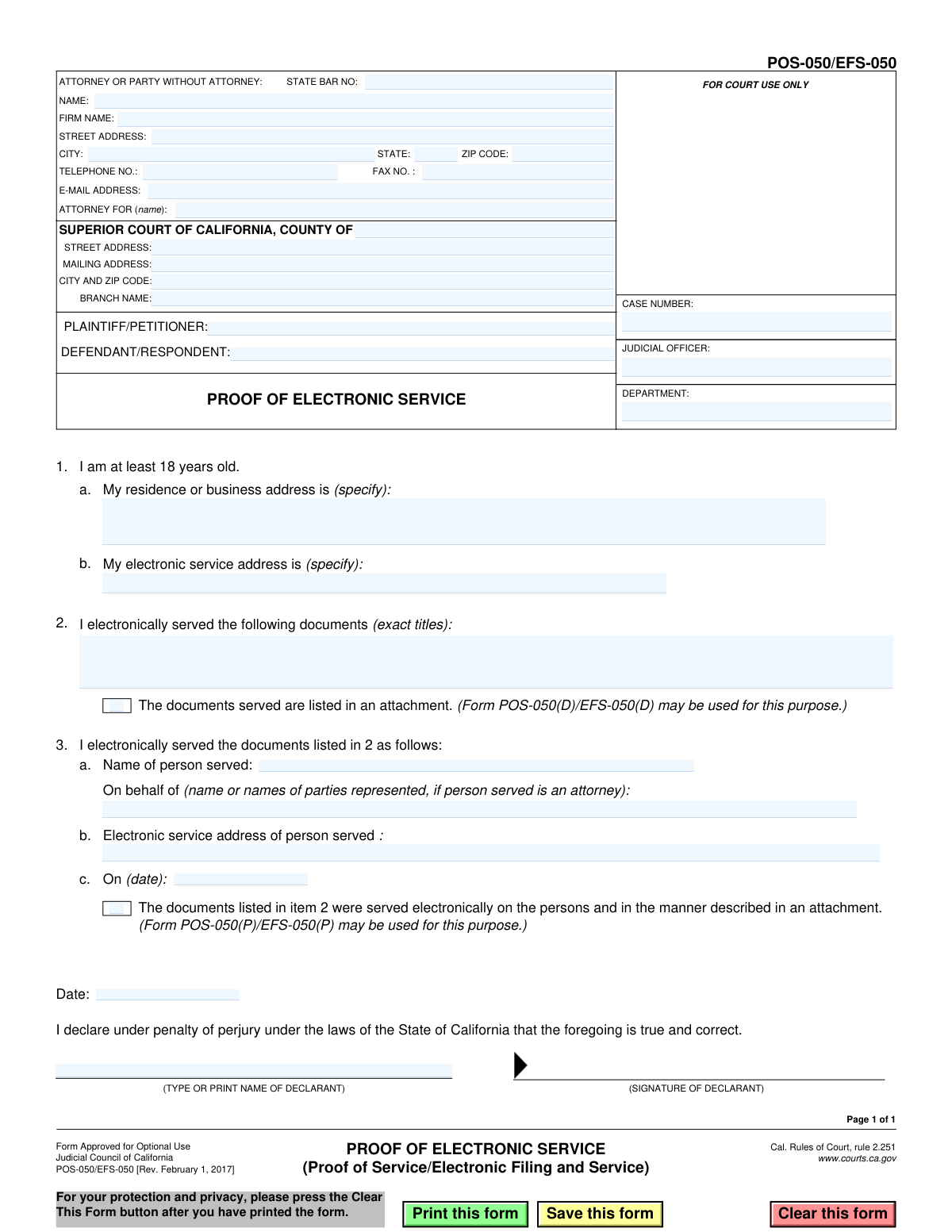
Yes! You can use AI to fill out Form POS-050/EFS-050, Proof of Electronic Service

Form POS-050/EFS-050 is a legal document filed in California courts to provide official proof that court documents were delivered to other parties electronically. This declaration is crucial for complying with court rules on service, ensuring all parties are properly notified and that the case can proceed without procedural delays. Today, this form can be filled out quickly and accurately using AI-powered services like Instafill.ai, which can also convert non-fillable PDF versions into interactive fillable forms.
POS-050/EFS-050 is part of the California court forms and proof of service forms categories on Instafill.
Our AI automatically handles information lookup, data retrieval, formatting, and form filling.
It takes less than a minute to fill out POS-050/EFS-050 using our AI form filling.
Securely upload your data. Information is encrypted in transit and deleted immediately after the form is filled out.

Form specifications

Form name: Form POS-050/EFS-050, Proof of Electronic Service
Number of fields: 36
Number of pages: 1
Language: English
main-image

Instafill Demo: How to fill out PDF forms in seconds with AI

How to Fill Out POS-050/EFS-050 Online for Free in 2026

Are you looking to fill out a POS-050/EFS-050 form online quickly and accurately? Instafill.ai offers the #1 AI-powered PDF filling software of 2026, allowing you to complete your POS-050/EFS-050 form in just 37 seconds or less.
Follow these steps to fill out your POS-050/EFS-050 form online using Instafill.ai:
  1. 1 Navigate to Instafill.ai and upload your POS-050/EFS-050 form or select it from the platform's template library.
  2. 2 Use the AI tool to populate the caption information, including the court name, party names (Plaintiff/Petitioner and Defendant/Respondent), and case number.
  3. 3 Enter your information as the declarant, including your name, address, and electronic service address.
  4. 4 List the exact titles of all documents that were served electronically. You can also check the box to indicate that the documents are listed on an attachment.
  5. 5 Provide the details of the person(s) served, including their name, the party they represent, their electronic service address, and the date of service.
  6. 6 Carefully review all the information you have entered for accuracy, then type or print your name, sign, and date the declaration under penalty of perjury.
  7. 7 Download the completed form, ready for electronic filing with the court and for service on other parties.

Our AI-powered system ensures each field is filled out correctly, reducing errors and saving you time.

Why Choose Instafill.ai for Your Fillable POS-050/EFS-050 Form?

Speed

Complete your POS-050/EFS-050 in as little as 37 seconds.

Up-to-Date

Always use the latest 2026 POS-050/EFS-050 form version.

Cost-effective

No need to hire expensive lawyers.

Accuracy

Our AI performs 10 compliance checks to ensure your form is error-free.

Security

Your personal information is protected with bank-level encryption.

Frequently Asked Questions About Form POS-050/EFS-050

This form is used to prove to the court that you have legally delivered case documents to other parties electronically. It acts as a sworn statement confirming the date and manner of service.

The person who actually sent the electronic documents, known as the 'declarant,' must fill out and sign this form. The declarant must be at least 18 years old.

An electronic service address is the email address or other electronic identifier (like a portal username) that the receiving party has agreed to use for accepting legal documents. You must use the address that the party has designated for service.

You must list the exact, full titles of the documents, such as 'Notice of Motion and Motion to Compel Further Responses.' If you have a long list of documents, you can check the box in Section 2 and use the attachment form POS-050(D)/EFS-050(D).

If you served multiple people, check the box in Section 2.b. and use the attachment form POS-050(P)/EFS-050(P) to list the service details for each person.

You will need the court and case information, the exact titles of the documents served, the name and electronic service address for each person served, and the specific date the service was completed.

Once you have completed and signed the form, you must file it with the court. This provides the official record that you have completed the required service on the other parties.

Yes, services like Instafill.ai use AI to accurately auto-fill repetitive form fields like your name, address, and case information, which saves time and helps prevent errors.

You can use a service like Instafill.ai to easily fill out this form online. Simply upload the PDF, and the platform's AI will make it an interactive, fillable form that you can type into directly.

If you have a non-fillable or 'flat' PDF, you can use a tool like Instafill.ai. It can convert the non-fillable PDF into an interactive, fillable form online so you can easily type in your information.

This line is used when you are serving an attorney. You would enter the name of the party or parties that the attorney is representing in the case.

You should sign and date the form on the day you are signing it, which must be on or after the date you electronically served the documents listed in Section 2.

Compliance POS-050/EFS-050
Validation Checks by Instafill.ai

1
Ensures Case Number is Provided
This check verifies that the 'CASE NUMBER' field (CaseNumber_ft) is not empty. The case number is a critical identifier that links this proof of service to the correct legal proceeding in the court's system. Failure to provide it would make the document impossible to file correctly, leading to rejection by the court clerk.
2
Validates Declarant's Age Confirmation
This validation ensures the declarant has affirmed they are at least 18 years old, as required by law to serve legal documents. This is typically a mandatory checkbox (CheckBox1). If not checked, the declaration is legally invalid, as the server does not meet the minimum age requirement.
3
Validates Declarant's Electronic Service Address Format
This check confirms that the 'My electronic service address is' field (FillText19) contains a string in a valid email format (e.g., [email protected]). This address is the source of the electronic service, and an invalid format would undermine the credibility of the proof. An invalid address would cause the form to be rejected as the service itself would be questionable.
4
Ensures Mutually Exclusive Document Listing
This is a logical check for section 2, ensuring that either the document titles are listed directly in field 2a (FillText20) OR the checkbox for an attachment (CheckBox2) is selected, but not both. Providing information in both fields creates ambiguity. The form should be rejected for clarification to ensure a clear record of which documents were served.
5
Requires Identification of Served Documents
This validation ensures that the served documents are identified in some way. It checks that either field 2a (FillText20) is filled out or checkbox 2b (CheckBox2) is checked. A proof of service that does not specify which documents were served is incomplete and legally insufficient.
6
Validates Served Person's Electronic Address Format
This check verifies that the 'Electronic service address of person served' (FillText23) is a valid email address. This is the most critical piece of information on the form, as it proves where the documents were sent. An invalid email address means service was not properly completed, invalidating the entire document.
7
Validates Service Date Format and Logic
This check ensures the 'On (date)' field for service (FillText25) contains a valid date and that the date is not in the future. A proof of service cannot be filed for an action that has not yet occurred. The form would be rejected if the date is invalid or set for a future time.
8
Ensures Declaration Date is Present and Logical
This validation confirms the 'Date' field in section 3 (FillText26) is filled with a valid date. It also performs a logical check to ensure this date is on or after the service date specified in field 2c (FillText25). A person cannot legally declare something happened before the event occurred, so a failing check would lead to rejection.
9
Requires Declarant's Printed Name
This check verifies that the 'TYPE OR PRINT NAME OF DECLARANT' field (T23) is completed. This field clearly identifies the individual making the sworn declaration, which is essential for accountability and legal validity. An anonymous declaration is not permissible.
10
Requires Presence of Declarant's Signature
This validation checks for the presence of a signature in the 'SIGNATURE OF DECLARANT' area. Whether digital or a scanned image, the signature is the formal act of making the declaration under penalty of perjury. A form without a signature is incomplete and has no legal effect.
11
Validates State Bar Number Format
This check ensures that if a 'STATE BAR NO' (AttyBarNo_dc) is provided, it consists only of numbers. This maintains data integrity and allows for correct identification of the attorney in the state's official records. An incorrectly formatted number could cause filing delays or rejections.
12
Requires At Least One Party Name
This validation ensures that either the 'PLAINTIFF/PETITIONER' (Party1_ft) or 'DEFENDANT/RESPONDENT' (Party2_ft) field is filled. The form must identify the parties to the case to be correctly associated with the court file. A form without party information is ambiguous and cannot be processed.
13
Requires Declarant's Physical Address
This check verifies that the declarant's residence or business address in section 1 (FillText18) is provided. This information is required by court rules to establish the declarant's identity and location for legal purposes. Failure to provide this address can render the proof of service defective.
14
Requires Name of Person Served
This validation ensures that the 'Name of person served' field in section 2c (FillText21) is not empty. It is essential to explicitly name the individual who was electronically served for the proof to be valid. Without this information, it is unclear who received the documents.

Common Mistakes in Completing POS-050/EFS-050

Incorrectly Filling Attorney-Specific Fields

Parties representing themselves (pro se) often mistakenly fill in fields meant for attorneys, such as 'FIRM NAME' or 'STATE BAR NO.' This can cause confusion and may lead to the clerk's office questioning the filing. To avoid this, pro se litigants should leave these fields blank and ensure their status as 'Party Without Attorney' is clear.

Omitting Specific Court Branch Information

Filers frequently enter just the county but leave the specific court 'STREET ADDRESS' or 'BRANCH NAME' blank. Many counties have multiple court locations, and omitting this detail can lead to the document being filed in the wrong courthouse, causing significant delays. Always verify the exact street address and branch name for your specific case on the court's website.

Using Inconsistent or Abbreviated Party Names

Users often use abbreviations or slight variations of the 'PLAINTIFF/PETITIONER' or 'DEFENDANT/RESPONDENT' names that differ from the official case caption. This inconsistency can lead to rejection of the filing, as all documents must match the court's record exactly. It is crucial to copy the names precisely as they appear on the initial complaint or other official court documents.

Entering an Incorrect or Incomplete Case Number

Transposing digits or using an incorrect format for the 'CASE NUMBER' is a critical error that can result in the document being filed in the wrong case or rejected entirely. This simple mistake can have severe consequences, including missed deadlines. AI-powered form filling tools like Instafill.ai can help prevent these errors by saving and auto-filling correct case information across multiple documents.

Confusing Physical and Electronic Addresses in Section 1

In Section 1, individuals often incorrectly enter their email address in the 'residence or business address' field or vice-versa. The form requires a physical address and a separate 'electronic service address' (email) for the declarant. This error can invalidate the proof of service if the declarant's required information is missing or incorrect.

Listing Vague Document Titles in Section 2

In Section 2, filers may list documents with generic descriptions like 'motion' instead of their 'exact titles' as required. This ambiguity can lead to disputes over what was actually served, potentially requiring re-service and causing delays. Always list the full, exact title of every document served, such as 'Notice of Motion and Motion for Summary Judgment; Memorandum of Points and Authorities.'

Incorrectly Identifying the Person Served in Section 3

A common error in Section 3a is listing the opposing party's name instead of their attorney's name. When a party is represented by counsel, service must be made upon their attorney of record. Listing the party directly can invalidate the service, so you must identify the correct attorney and list the party they represent in field 3b.

Typographical Errors in the Recipient's Email Address

A single typo in the 'Electronic service address of person served' in Section 3c will result in a failed service, even if all other information is correct. This can lead to missed deadlines and disputes over whether service was perfected. Using a tool like Instafill.ai can help by saving contact information for parties and attorneys, reducing the risk of manual typos on subsequent filings.

Using the Incorrect Date of Service

People sometimes mistakenly enter the date they are signing the form, rather than the actual date the electronic service was transmitted. The date in Section 3d, 'On (date):', must reflect the exact day the documents were electronically sent. An incorrect date can invalidate the proof of service and create disputes over timeliness.

Forgetting to Include Referenced Attachments

The form allows users to list served documents or parties on attachments by checking a box in Section 2 or 3. However, filers frequently check the box but then forget to include the corresponding attachment (e.g., Form POS-050(D) or POS-050(P)) with their filing. This omission makes the proof of service incomplete and can lead to its rejection.

Failing to Sign and Date the Declaration

An unsigned or undated Proof of Service is invalid and will be rejected by the court, as it is not a valid declaration under penalty of perjury. This oversight can cause you to miss a critical service deadline. Always ensure you sign the form, print your name clearly, and enter the date you are signing it.

Manual Data Entry on Non-Fillable PDFs

Often, users receive this form as a flat, non-fillable PDF, leading them to fill it out by hand, which can introduce illegible handwriting and errors. This manual process is inefficient and prone to mistakes that could invalidate the filing. To avoid this, AI-powered tools like Instafill.ai can convert non-fillable PDFs into interactive, fillable forms, ensuring data is entered clearly and accurately.
Saved over 80 hours a year

“I was never sure if my IRS forms like W-9 were filled correctly. Now, I can complete the forms accurately without any external help.”

Kevin Martin Green

Your data stays secure with advanced protection from Instafill and our subprocessors

Robust compliance program

Transparent business model

You’re not the product. You always know where your data is and what it is processed for.

ISO 27001, HIPAA, and GDPR

Our subprocesses adhere to multiple compliance standards, including but not limited to ISO 27001, HIPAA, and GDPR.

Security & privacy by design

We consider security and privacy from the initial design phase of any new service or functionality. It’s not an afterthought, it’s built-in, including support for two-factor authentication (2FA) to further protect your account.

Fill out POS-050/EFS-050 with Instafill.ai

Worried about filling PDFs wrong? Instafill securely fills form-pos-050efs-050-proof-of-electronic-service forms, ensuring each field is accurate.

Related forms by category

California court forms Judicial Council of California Form SC-105, Request for Court Order and Answer (Small Claims), Judicial Council of California Form SC-120, Defendant’s Claim and ORDER to Go to Small Claims Court (Small Claims), Judicial Council of California Form SER-001, Request for Sheriff to Serve Court Papers, Judicial Council of California Form SER-001, Request for Sheriff to Serve Court Papers, Affidavit for Collection of Personal Property California Probate Code Section 13100, Form POS-040, Proof of Service—Civil, Declaration of Facts of Death (California Superior Court), declaration-of-marriage-for-court-proceeding-california-family-law, ADOPT-200, Adoption Request, ADOPT-200, Stepparent Adoption Request, ADOPT-210, Adoption Agreement, ADOPT-310, Contact After Adoption Agreement, Judicial Council of California Form ADOPT-200, Adoption Request, Form ADR-107, Mediation Attendance Sheet, Form ADR-110, Order Appointing Referee, Form ADR-109, Stipulation or Motion for Order Appointing Referee, Form ADR-102, Request for Trial De Novo After Judicial Arbitration, Form ADR-108, Referee's Report (Code Civ. Proc., §§ 638, 639), Form ADR-106, Petition to Confirm, Correct, or Vacate Contractual Arbitration Award, Form ADR-104, Rejection of Award and Request for Trial After Attorney-Client Fee Arbitration · + 557 more →
proof of service forms Form POS-040, Proof of Service—Civil, Judicial Council of California Form SC-104, Proof of Service (Small Claims), Judicial Council of California Form SC-104, Proof of Service (Small Claims), Form DV-200, Proof of Personal Service (CLETS) (Domestic Violence Prevention), Illinois Circuit Court Eviction Summons and Proof of Service of Eviction Summons & Eviction Complaint (Form E-S 3507.3), proof-of-electronic-service-appellate, Form APP-009, Proof of Service (Appellate Division), Form APP-109, Proof of Service (Appellate Division), Form GC-020(P), PROOF OF PERSONAL SERVICE OF NOTICE OF HEARING— GUARDIANSHIP OR CONSERVATORSHIP, Form APP-109E, Proof of Electronic Service (Appellate Division), Proof of Personal Service of Notice of Initial Appearance—CARE Act Proceedings, Form CARE-116, Proof of Personal Service of Notice of Hearing—CARE Act Proceedings, Form CR-106, Proof of Service — Criminal Record Clearing, CARE-107, Proof of Personal Service of Notice of Order for CARE Act Report, Form CIV-120, Notice of Entry of Dismissal and Proof of Service, Form DAL-012, Proof of Service—Disability Access Litigation, Form DE-120(P), Proof of Personal Service of Notice of Hearing—Decedent's Estate or Trust, Form EA-200, Proof of Personal Service (Elder or Dependent Adult Abuse Prevention), Form EA-260, Proof of Service of Order After Hearing by Mail (Elder or Dependent Adult Abuse Prevention), Form FL-115, Proof of Service of Summons (Family Law—Uniform Parentage—Custody and Support) · + 30 more →