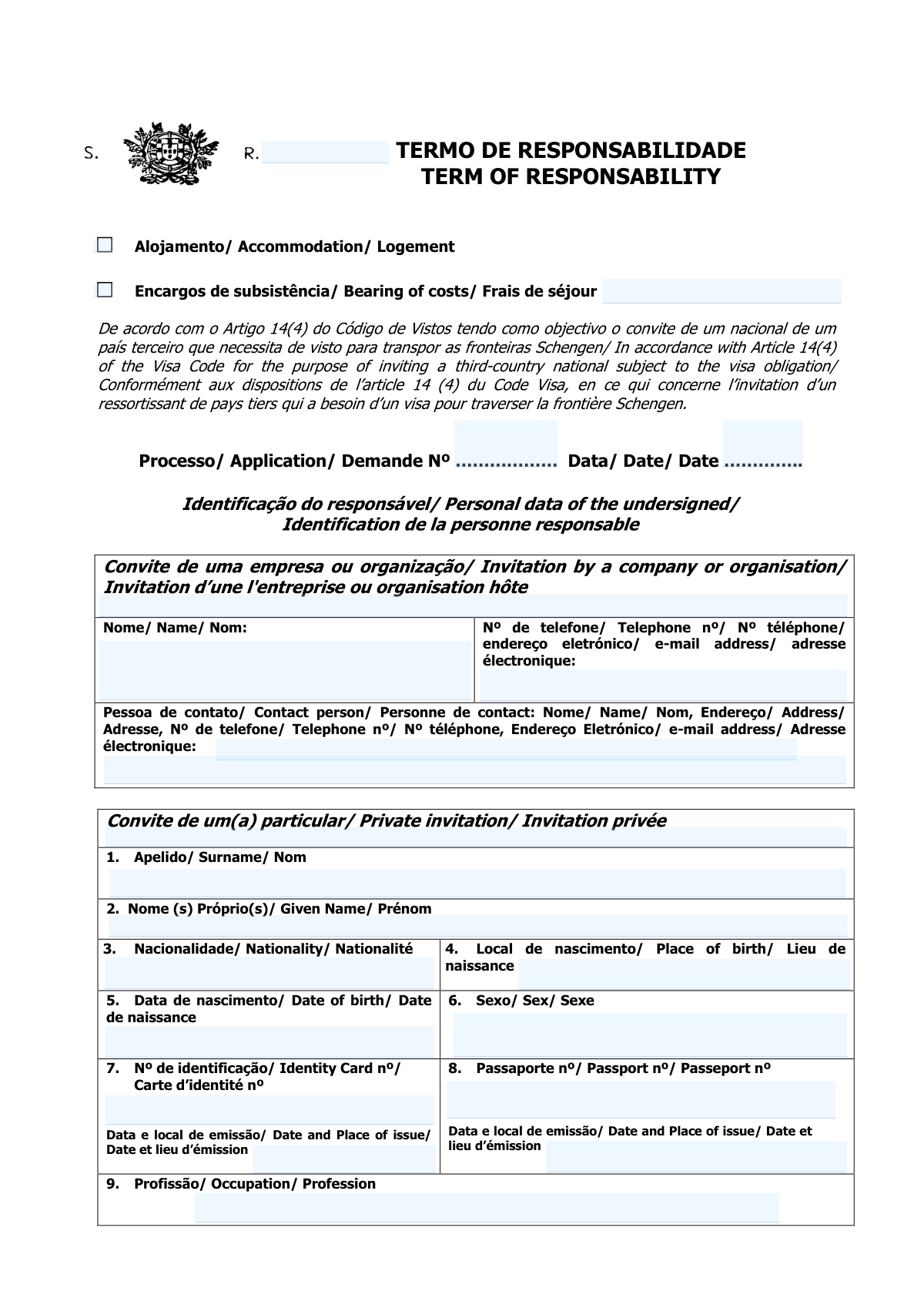
Yes! You can use AI to fill out Termo de Responsabilidade (Term of Responsability) – Alojamento e Encargos de Subsistência (Visa Code Article 14(4))
O Termo de Responsabilidade Ć© uma declaração formal (para efeitos do Artigo 14(4) do Código de Vistos) em que o responsĆ”vel/host (particular ou empresa/organização) confirma que pode assegurar o alojamento do convidado e, conforme aplicĆ”vel, suportar custos de subsistĆŖncia e/ou repatriamento durante a estadia no espaƧo Schengen. Ć importante porque serve como prova de meios e de condiƧƵes de estadia no Ć¢mbito da anĆ”lise do pedido de visto, e normalmente deve ser apresentado em original Ć s autoridades consulares competentes, com assinatura devidamente reconhecida/autenticada. O documento recolhe dados do responsĆ”vel e do convidado, perĆodo e local de alojamento, e a opção de assumir apenas alojamento/repatriamento ou todos os encargos. Hoje, este formulĆ”rio pode ser preenchido de forma rĆ”pida e precisa com serviƧos de IA como a Instafill.ai, que tambĆ©m conseguem converter PDFs nĆ£o editĆ”veis em formulĆ”rios interativos preenchĆveis.
Our AI automatically handles information lookup, data retrieval, formatting, and form filling.
It takes less than a minute to fill out Termo de Responsabilidade using our AI form filling.
Securely upload your data. Information is encrypted in transit and deleted immediately after the form is filled out.
Form specifications
| Form name: | Termo de Responsabilidade (Term of Responsability) – Alojamento e Encargos de Subsistência (Visa Code Article 14(4)) |
| Number of pages: | 3 |
| Language: | English |
| Categories: | immigration forms, visa forms, Portugal visa forms, Schengen visa forms |
Instafill Demo: filling out a legal form in seconds
How to Fill Out Termo de Responsabilidade Online for Free in 2026
Are you looking to fill out a TERMO DE RESPONSABILIDADE form online quickly and accurately? Instafill.ai offers the #1 AI-powered PDF filling software of 2026, allowing you to complete your TERMO DE RESPONSABILIDADE form in just 37 seconds or less.
Follow these steps to fill out your TERMO DE RESPONSABILIDADE form online using Instafill.ai:
- 1 Aceda a Instafill.ai e carregue o PDF do “Termo de Responsabilidade” (ou selecione-o a partir da biblioteca de formulários).
- 2 Escolha o tipo de convite (empresa/organização ou particular) e indique o número do processo (Processo Nº) e a data associada ao pedido.
- 3 Preencha os dados de identificação do responsável (nome, contactos, nacionalidade, nascimento, documento de identificação e/ou passaporte, profissão e morada permanente).
- 4 Indique o compromisso de alojamento: datas “De/Até”, e selecione se o alojamento será na morada permanente (secção 10) ou noutra morada (secção 11), preenchendo o endereço completo se aplicável.
- 5 Preencha os dados de identificação do convidado (apelido, nome(s), nacionalidade, local e data de nascimento, sexo), eventuais laços familiares e o motivo da deslocação (purpose of stay).
- 6 Selecione a declaração de encargos: (a) apenas alojamento e custos de repatriamento, ou (b) todos os encargos inerentes à estadia (custos de subsistência).
- 7 Revise os dados e a declaração de consentimento/privacidade (VIS/DGACCP), gere a versão final para impressão e assine; em seguida, providencie a autenticação/reconhecimento da assinatura conforme exigido e entregue o original no consulado competente.
Our AI-powered system ensures each field is filled out correctly, reducing errors and saving you time.
Why Choose Instafill.ai for Your Fillable Termo de Responsabilidade Form?
Speed
Complete your Termo de Responsabilidade in as little as 37 seconds.
Up-to-Date
Always use the latest 2026 Termo de Responsabilidade form version.
Cost-effective
No need to hire expensive lawyers.
Accuracy
Our AI performs 10 compliance checks to ensure your form is error-free.
Security
Your personal information is protected with bank-level encryption.
Frequently Asked Questions About Form Termo de Responsabilidade
It is a declaration used in Schengen visa applications (per Article 14(4) of the Visa Code) where a host/sponsor confirms they will provide accommodation and/or cover the inviteeās living costs during the stay.
The host/sponsor (the āresponsĆ”vel/undersignedā) completes and signs the form. The inviteeās personal details are included, but the invitee typically does not sign as the responsible party.
Submit it as part of the inviteeās visa application package when the invitee is being hosted and needs proof of accommodation and/or financial support. It should be provided to the consular authorities examining the visa.
The form states it must be presented in the original to the competent consular authorities. In many cases, a scanned copy may be used for pre-checks, but the original is typically required for the final submission.
āAccommodationā means you are providing a place to stay. āBearing of costsā means you are covering living expenses (and depending on the declaration selected, possibly all costs including repatriation), not just lodging.
Choose āonly accommodation and repatriationā if the invitee will pay their day-to-day expenses (food, transport, etc.) themselves. Choose āall living costsā if you will cover the inviteeās full expenses during the stay.
Enter the start and end dates for the period you will host the invitee, matching the intended travel dates as closely as possible. Make sure the day/month/year fields are consistent and legible.
If the invitee will stay at your permanent address, check āAt my above address.ā If they will stay elsewhere (e.g., another property), check āAt the following addressā and complete Section 11 fully.
Youāll need your full name, nationality, place/date of birth, sex, ID card and/or passport details (number and date/place of issue), occupation, and permanent address with contact telephone.
You must enter the inviteeās surname and given names exactly as in their passport, plus nationality, place/date of birth, sex, any family ties (optional), and the purpose of stay.
Noāthis field is marked as optional. If there is a relationship (spouse, child, sibling, etc.), adding it can help clarify the context of the invitation.
State the main reason for the visit (e.g., tourism, visiting family/friends, business) and add brief details if helpful (such as attending an event or family visit). Keep it consistent with the visa application and travel itinerary.
The form includes a section for āAutenticação da assinaturaā (witnessed/certified signature), indicating the signature must be recognized by a competent authority. Check the consulateās instructions on where and how to certify the signature.
YesāAI tools can help extract data from passports/IDs and place it into the correct fields, reducing typos and saving time. Services like Instafill.ai can auto-fill form fields accurately based on your provided information.
Upload the PDF to Instafill.ai, provide the host and invitee details (or upload supporting documents), and the AI will map the information into the correct fields for review before export. If the PDF is flat/non-fillable, Instafill.ai can convert it into an interactive fillable form so you can complete and sign it more easily.
Compliance Termo de Responsabilidade
Validation Checks by Instafill.ai
1
Validates Registry Number (R.) presence and allowed format
Checks that the Registry Number (R. 1) is provided when required by the receiving office and that it matches the expected short identifier format (e.g., 1ā6 characters, digits/letters only, no long free-text). This matters because the R. number is often used to index and retrieve the declaration in internal registries. If validation fails, the submission should be flagged for manual review or rejected with a prompt to enter the exact registry identifier as shown on the form.
2
Validates Application/Process Number is present and matches official pattern
Ensures the Application number (Processo NĀŗ) is not blank and contains only permitted characters (typically letters, digits, and separators like '/' or '-'), with reasonable length limits. This is important because the process number links the declaration to the visa application file and prevents misfiling. If the value is missing or contains invalid characters/length, the system should block submission and request the exact number as printed.
3
Validates Date of application format and plausibility
Checks that the Date of application is a valid calendar date in the accepted format (e.g., DD/MM/YYYY) and is not in the far future or unreasonably old relative to processing rules. Correct dating is essential for legal traceability and for matching the declaration to the correct application timeline. If invalid, the system should require correction and optionally warn if the date is outside an acceptable window.
4
Enforces invitation type completeness (Company/Organisation vs Private)
Validates that the submission contains a coherent set of fields for at least one invitation pathway: either company/organisation invitation details or private inviter personal details. This prevents partially completed forms where neither inviter identity is sufficiently established. If neither pathway is complete, the system should reject the submission and indicate which section must be completed.
5
Validates Company/Organisation invitation fields when provided
If any company/organisation invitation field is present (reference, name, contact person, phone/email), the check enforces that the minimum required set is complete: legal organisation name plus at least one reliable contact channel (phone or email) and contact person identification. This is important for verification and follow-up by consular authorities. If incomplete, the system should prompt for the missing organisation/contact details and prevent submission.
6
Validates email address syntax for all e-mail fields
Checks that any entered e-mail (organisation main email, contact person email, or combined contact details) matches a standard email pattern (local@domain) and does not contain spaces or invalid characters. Valid emails are critical for contacting the host/sponsor and for audit trails. If validation fails, the system should highlight the specific field and require a corrected email format.
7
Validates telephone number format and minimum digits
Ensures all telephone fields (permanent address phone, accommodation phone, organisation phone, contact person phone) contain only allowed characters (digits, spaces, '+', '-', parentheses) and meet a minimum digit count (e.g., 7ā15 digits excluding separators). This matters because consular services may need to reach the responsible party quickly and invalid numbers reduce verifiability. If invalid, the system should require correction and optionally suggest including country code.
8
Validates inviter (private) name fields are complete and non-placeholder
For private invitations, checks that Surname and Given name(s) are present, not identical, and not filled with placeholders (e.g., 'N/A', '---', 'unknown'). Accurate identity is essential for legal responsibility and signature certification. If validation fails, the system should block submission until real names matching official documents are provided.
9
Validates inviter (private) date of birth format and age plausibility
Checks that the inviterās Date of birth is a valid date and that the inviter is plausibly an adult (e.g., at least 18 years old) given they are assuming responsibility. This is important because minors generally cannot legally undertake financial/accommodation responsibility in many jurisdictions. If the date is invalid or indicates underage, the system should flag for manual review or reject per policy.
10
Validates sex field values against allowed set
Ensures Sex for both inviter and invitee is selected/entered from an allowed set (e.g., 'Male', 'Female', 'Other/Unspecified' as configured) and is not free-form noise. Standardized values are important for downstream systems and matching with travel documents. If invalid, the system should require selection from the permitted options.
11
Validates identity card number and issue details dependency
If an Identity card number is provided, validates that the corresponding 'date and place of issue' is also provided and that the issue date is a valid date. This dependency is important because document issuance details are used to verify authenticity and reduce ambiguity between similar numbers. If the dependency is not met or the date is invalid, the system should prompt for the missing/incorrect issue information.
12
Validates passport number and issue details dependency
If a Passport number is provided, validates that the corresponding 'date and place of issue' is present, with a valid issue date and non-empty place/authority. This is important for document verification and for aligning the declaration with the inviteeās travel documentation. If missing or malformed, the system should block submission until the issue details are completed correctly.
13
Validates permanent address completeness and postal code format
Checks that the permanent address (street, number, city, postal code, telephone) is sufficiently complete to locate the responsible person, and validates postal code format according to configured country rules (or at least enforces a reasonable alphanumeric length). Address completeness is critical for legal notifications and for assessing accommodation claims. If incomplete or postal code is invalid, the system should require correction and identify which address components are missing.
14
Validates accommodation period dates and logical order (From <= Until)
Ensures the accommodation 'From' date and 'Until' date components form valid dates and that the end date is on or after the start date. This matters because the declaration covers a specific stay period and inconsistent dates can invalidate the commitment. If invalid or reversed, the system should reject submission and request corrected dates.
15
Validates accommodation location choice and address dependency (Section 10 vs Section 11)
Checks that exactly one accommodation location option is selected: 'At my above address' or 'At the following address'. If 'At the following address' is selected, Section 11 address fields must be completed; if 'At my above address' is selected, Section 11 should be empty or ignored to avoid conflicting addresses. If the selection is missing, both selected, or dependencies are not met, the system should block submission and prompt for a single consistent choice.
16
Validates invitee identity completeness and basic plausibility
Ensures invitee fields (surname, given name(s), nationality, place of birth, date of birth, sex) are present and that the date of birth is a valid date not in the future. This is important because the declaration must clearly identify the person being invited and support matching to the visa application and passport. If incomplete or implausible, the system should reject submission and request the missing/corrected invitee details.
17
Enforces mutual exclusivity of cost responsibility declarations
Validates that exactly one of the two cost declarations is selected: (a) 'only accommodation and repatriation costs' or (b) 'all living costs inherent to the stay'. This is important because selecting both (or neither) creates ambiguity about financial responsibility and can affect visa assessment. If the rule is violated, the system should require the user to choose one clear responsibility option before submission.
Common Mistakes in Completing Termo de Responsabilidade
People often enter the inviteeās personal details (name, passport, address) in the āIdentificação do responsĆ”velā section, or they repeat the sponsorās details in the invitee section because both blocks ask for similar fields. This can invalidate the declaration or trigger requests for clarification, delaying the visa process. To avoid it, treat the form as two separate profiles: the undersigned/sponsor (who signs and guarantees) and the invitee (who is traveling). AI-powered form filling tools like Instafill.ai can help map each identity to the correct section and prevent cross-population errors.
Applicants sometimes complete both invitation types, thinking more information is better, or because the form is multilingual and the structure is confusing. This creates contradictions (e.g., a company host and a private host) and can lead the consulate to question who is legally responsible for accommodation/costs. Only complete the section that matches the real inviter (company/organisation OR private individual) and leave the other blank. Instafill.ai can guide conditional completion so only the relevant invitation pathway is filled.
The āProcesso/Application NĀŗā and date are often omitted or replaced with an appointment number, receipt number, or an internal note. Missing or incorrect references make it harder to link the declaration to the correct visa file, which can cause processing delays or rejection of the document at intake. Copy the official application/process number exactly as provided by the consulate/VFS system and use the associated date. Instafill.ai can prompt for the correct reference and validate that the format matches what the form expects.
Because the form is used internationally, people frequently write dates in their local format (MM/DD/YYYY) when the form context typically expects DD/MM/YYYY, or they mix formats across fields. This can create impossible timelines (e.g., accommodation āFromā after āUntilā) or mismatches with passport/ID issue dates, leading to requests for correction. Use a single, unambiguous format (preferably DD/MM/YYYY) and double-check that all dates match the supporting documents. Instafill.ai can automatically format dates consistently and flag invalid ranges.
Many users forget to check the āAlojamento/Accommodationā box or fail to choose between āAt my above addressā vs āAt the following address.ā If neither option is selected, the consulate may treat the accommodation guarantee as incomplete, which can weaken the applicationās proof of lodging. Always tick the accommodation responsibility if you are providing lodging, then select exactly one address option and complete section 11 only if the accommodation is at a different address. Instafill.ai can enforce the required checkbox logic and ensure the correct address block is completed.
Address fields are often partially filled (street only) or entered in a single line without the required components like house number, floor/apartment, city/locality, and postal code. Incomplete addresses can prevent verification of lodging and may cause the declaration to be rejected or require re-submission. Fill each address component in its dedicated field and include unit identifiers (e.g., 12A, Apt 3B) when applicable. Instafill.ai can standardize address formatting and highlight missing components before submission.
Sponsors often provide phone numbers without country code, use outdated numbers, or place an email in the phone field (or vice versa), especially in the company/organisation contact area. If the consulate cannot reach the sponsor/contact person, they may doubt the invitationās credibility or delay the case for verification. Use international format phone numbers (e.g., +351 ā¦) and provide a monitored email address; for companies, include the contact personās direct details where requested. Instafill.ai can validate phone/email formats and reduce field-mismatch errors.
A common error is transposing characters (O vs 0, I vs 1), truncating the number, or adding extra spaces/punctuation not present on the passport/ID. Any mismatch between the declaration and the inviteeās passport can cause the document to be considered unreliable and may lead to additional checks or refusal. Copy the passport/ID number exactly as printed, and ensure the ādate and place of issueā correspond to the same document. Instafill.ai can help by extracting and validating document numbers and ensuring consistent formatting.
People often write only a city for place of birth (without country) or use informal abbreviations for nationality that donāt match official records. This can create discrepancies with the inviteeās passport data and trigger manual review or correction requests. Enter nationality as the country of citizenship and place of birth as city/town plus country (as shown on the passport). Instafill.ai can normalize these entries and prompt for missing country information.
The form includes checkboxes for bearing living costs and separate declarations about covering only accommodation/repatriation vs all costs; users sometimes tick conflicting options or forget to identify the payer/party. Contradictions can undermine the financial support narrative and may lead to the consulate requesting additional proof of funds or rejecting the declaration. Choose the single statement that reflects reality and ensure the āBearing of costs ā payer/partyā field clearly names who pays (sponsor, company, or self). Instafill.ai can detect conflicting selections and require a consistent cost-responsibility configuration.
Applicants frequently sign but do not complete the required signature witnessing/certification (āAutenticação da assinaturaā), or they submit a scanned copy when the form states it must be presented as an original duly recognized by the competent authority. This can cause the consulate to refuse the document outright and request a properly authenticated original, delaying the visa decision. Arrange for the signature to be authenticated by the competent authority (as required locally) and submit the original document to the consulate/VAC. If the form is only available as a flat non-fillable PDF, Instafill.ai can convert it into a fillable version to reduce errors before printing and authentication.
Saved over 80 hours a year
āI was never sure if my IRS forms like W-9 were filled correctly. Now, I can complete the forms accurately without any external help.ā
Kevin Martin Green
Your data stays secure with advanced protection from Instafill and our subprocessors

Robust compliance program
Transparent business model
Youāre not the product. You always know where your data is and what it is processed for.
ISO 27001, HIPAA, and GDPR
Our subprocesses adhere to multiple compliance standards, including but not limited to ISO 27001, HIPAA, and GDPR.
Security & privacy by design
We consider security and privacy from the initial design phase of any new service or functionality. Itās not an afterthought, itās built-in, including support for two-factor authentication (2FA) to further protect your account.
Fill out Termo de Responsabilidade with Instafill.ai
Worried about filling PDFs wrong? Instafill securely fills termo-de-responsabilidade-term-of-responsability-alojamento-e-encargos-de-subsistncia-visa-code-article-144 forms, ensuring each field is accurate.