Fill out diagnostic imaging forms
with AI.
Diagnostic imaging forms are essential documents used to coordinate medical imaging services, clinical research, and specialized healthcare education. These forms serve as critical records that ensure patient safety, regulatory compliance, and the efficient allocation of radiological resources. Whether managing institutional research or navigating the requirements of a medical training program, accurate documentation is vital for maintaining the high standards required in modern diagnostic environments.
By continuing, you acknowledge Instafill's Privacy Policy and agree to get occasional product update and promotional emails.
About diagnostic imaging forms
Typically, these forms are utilized by healthcare professionals, clinical researchers, and prospective students in the medical field. For instance, a Principal Investigator might submit a Radiological Services Request (RSR) to organize imaging support for a clinical study, while an applicant to a School of Diagnostic Imaging must provide comprehensive educational and professional history to be considered for admission. Because these documents often involve complex technical details and strict deadlines, precision in every field is paramount to avoid administrative delays.
Managing this paperwork manually can be a significant burden on busy clinical and academic schedules. Tools like Instafill.ai use AI to fill these forms in under 30 seconds, handling data accurately and securely to streamline the entire process. This practical solution helps users move through administrative requirements quickly, allowing them to focus on their research, education, or clinical practice.
Every form on this page can be completed without typing. Instafill is form filling software that reads a PDF and fills it for you — including flat and scanned documents that carry no fillable fields at all.
Forms in This Category
The forms in this category have a median Form Complexity Index of 71/100 (Complex), measured across 2 forms by field count, input difficulty, length, conditional logic and structure. See how it is calculated.
| Form Name | Pages | FCI | |
|---|---|---|---|
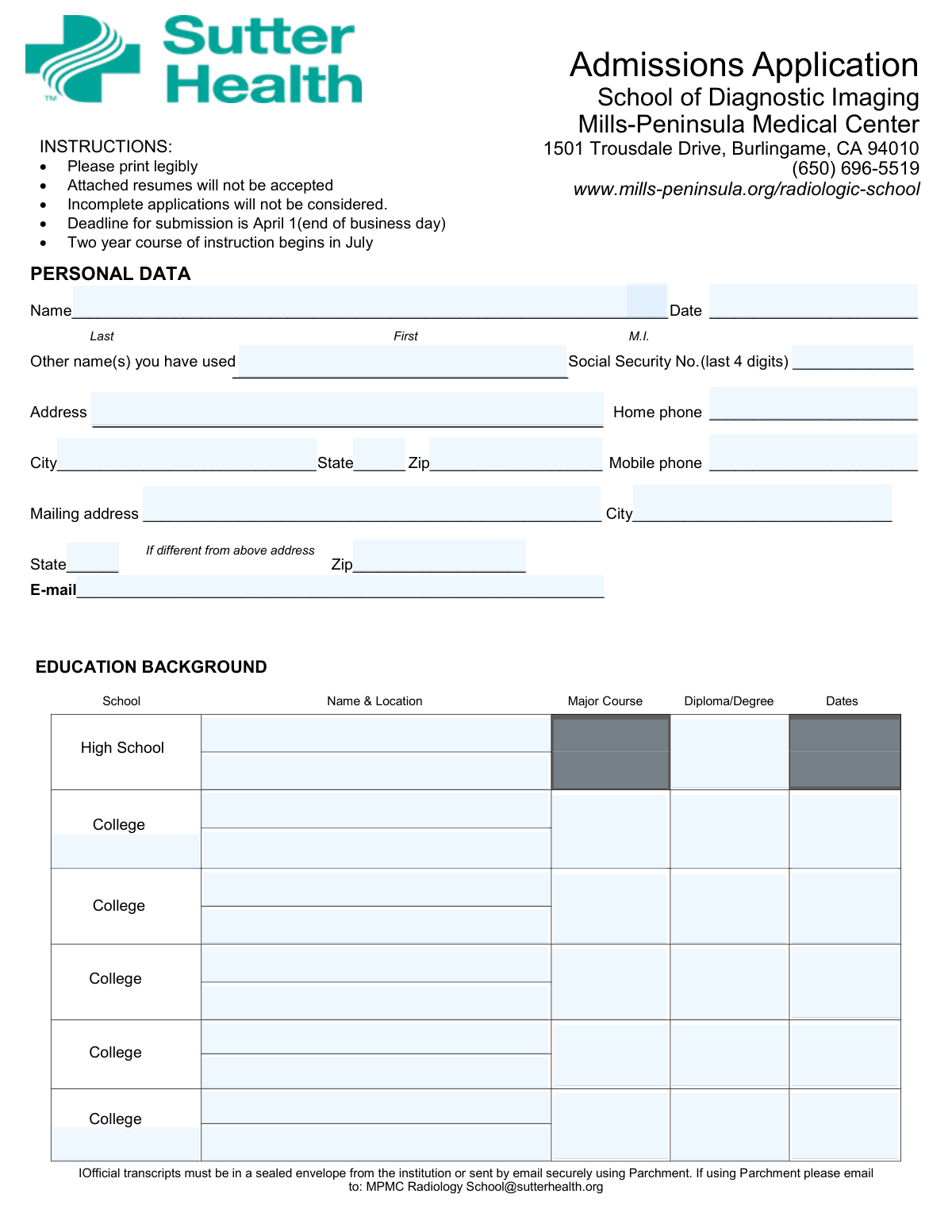
| 1. | Admissions Application, School of Diagnostic Imaging, Mills-Peninsula Medical Center | 6 | Complex 71 |
| 2. | Radiological Services Request (RSR) | 2 | Basic 44 |
- Enterprise-grade security & data encryption
- 99%+ accuracy powered by AI
- 1,000+ forms from all industries
- Complete forms in under 60 seconds
How to Choose the Right Form
Selecting the correct diagnostic imaging form depends entirely on your current objective—whether you are entering the field as a student or conducting advanced clinical research. Because these documents serve very different professional paths, identifying your use case is the first step.
For Prospective Students and Applicants
If you are looking to begin or advance your medical career, you will likely need the Admissions Application, School of Diagnostic Imaging, Mills-Peninsula Medical Center. This form is specifically designed for individuals seeking enrollment in a formal imaging program. You should choose this form if you need to:
- Submit personal data and educational history for program consideration.
- Detail your prerequisite coursework and previous work experience.
- Apply directly to the diagnostic imaging school at Mills-Peninsula.
For Clinical Researchers and Principal Investigators
If you are a healthcare professional or researcher at UCD Health, the Radiological Services Request (RSR) is the mandatory document for your workflow. This form is not for students, but for those managing active clinical trials or studies. Select this form when you need to:
- Request Department of Radiology services for a specific research project.
- Initiate a review by the Radiology Research Committee.
- Obtain a cost and scope determination for imaging support in a clinical setting.
Streamlining the Filing Process
Whether you are documenting academic prerequisites or technical research requirements, these forms often contain complex fields. Using Instafill.ai allows you to quickly complete the Admissions Application or the Radiological Services Request (RSR) by converting static PDFs into interactive, AI-assisted documents. This ensures that critical data, such as credit hours or research codes, is entered accurately and professionally every time.
Form Comparison
| Form | Purpose | Who Files It | Key Information Required |
|---|---|---|---|
| Admissions Application, School of Diagnostic Imaging, Mills-Peninsula Medical Center | Apply for enrollment in a professional diagnostic imaging training program. | Prospective students and educational program applicants. | Personal data, educational history, work experience, and prerequisite courses. |
| Radiological Services Request (RSR) | Request radiology department support for clinical research studies. | Principal Investigators at UCD Health conducting research. | Research study details, requested imaging services, and funding information. |
Tips for diagnostic imaging forms
For academic applications in diagnostic imaging, ensure all course titles, grades, and completion dates match your official transcripts exactly. Discrepancies can lead to delays in the review process or potential disqualification of your application.
When requesting radiological services for research, provide specific details regarding the types of scans and the frequency needed. This helps the review committee accurately estimate costs and resource availability for your specific project.
Gather all necessary attachments, such as digital transcripts, work history summaries, or research protocols, before you begin. Having these files ready allows you to complete the submission in one sitting without searching for records.
AI-powered tools like Instafill.ai can complete these complex forms in under 30 seconds with high accuracy. Your data stays secure during the process, providing a practical and time-saving solution for handling multiple diagnostic imaging documents.
Many forms in this category require approval from specific academic boards or radiology committees. Submit your forms well ahead of your personal deadlines to allow for the administrative review and follow-up questions common in clinical settings.
Incorrect billing codes or contact details can stall research requests or admission notifications. Carefully verify your department’s billing info and your primary contact details to ensure seamless communication with the imaging department.
Frequently Asked Questions
Diagnostic imaging forms are specialized documents used in medical and educational settings to manage requests for imaging services or applications for radiologic technology programs. These forms ensure that all necessary clinical, academic, and administrative data is captured to facilitate accurate imaging procedures or admissions decisions.
These forms are generally used by medical researchers, clinical staff, and prospective students. Researchers use them to request imaging support for clinical trials, while students use them to apply for specialized training programs in fields like radiography or sonography.
The correct form depends on your specific objective: academic or clinical. If you are seeking entry into a medical imaging educational program, you need an admissions application; if you are a principal investigator planning a research study, you will likely need a Radiological Services Request or similar clinical coordination form.
Most admission forms for imaging schools require detailed personal information, a history of prerequisite coursework, and professional or volunteer experience in healthcare. They may also ask for transcripts and references to evaluate an applicant's readiness for a rigorous clinical curriculum.
An RSR should be submitted during the planning phase of a clinical research project, well before any patient imaging begins. This allows the Radiology Research Committee to review the protocol, determine the feasibility of the request, and provide accurate cost estimates for the study budget.
Yes, diagnostic imaging forms can be efficiently completed using AI tools like Instafill.ai. These tools can accurately extract data from your source documents and place it directly into the required fields, ensuring that complex clinical or academic details are captured correctly.
Using AI-powered automation, these forms can often be filled in under 30 seconds. This significantly reduces the manual effort involved in typing out long lists of prerequisite courses or detailed research protocols, allowing for much faster submission.
Submission locations vary depending on the specific institution or medical center. Generally, admission forms go to the school's registrar or admissions office, while clinical request forms are submitted to the Department of Radiology or a specific research oversight committee within the hospital system.
After submission, the form typically undergoes a review process by a committee or department head to assess resource availability and technical requirements. Once approved, the submitter usually receives a confirmation or a quote for the services requested, allowing the project to proceed to the next phase.
Most programs require completion of core science and math courses, such as anatomy, physiology, and physics, before applying. The application forms help the admissions committee verify that these requirements have been met and that the applicant has the necessary foundation for advanced imaging training.
Yes, if you have a static or scanned PDF version of a diagnostic imaging form, AI services like Instafill.ai can convert these documents into interactive, fillable formats. This makes it much easier to enter information digitally without having to print and scan the document.
Glossary
- Form Complexity Index
- Instafill’s 0–100 measure of how much effort a form takes to complete, calculated deterministically from the form’s own structure rather than estimated. It combines the number of fillable fields (the largest factor), how difficult those fields are to complete based on their type, the number of pages that contain fields, the amount of conditional “fill-only-if” logic, and how many sections the form is divided into, then adds modifiers for tables and repeating lists, bundled instruction pages, and dense page layouts. A higher score means the form is harder to fill out by hand. The forms in this category have a median Form Complexity Index of 71/100 (Complex). See exactly how it is calculated.
- Diagnostic Imaging
- The process of creating visual representations of the interior of a body for clinical analysis and medical intervention using technologies like X-rays, MRIs, and CT scans.
- Principal Investigator (PI)
- The primary individual responsible for the preparation, conduct, and administration of a research grant or clinical study involving radiological services.
- Radiological Modality
- A specific type of medical imaging technology used for diagnosis or research, such as Ultrasound, Magnetic Resonance Imaging (MRI), or Computed Tomography (CT).
- Clinical Research
- Medical studies involving human participants designed to evaluate the safety and effectiveness of medications, devices, or diagnostic products.
- ARRT
- The American Registry of Radiologic Technologists, the credentialing organization that certifies and registers medical imaging professionals in the United States.
- Clinical Rotation
- A phase of medical education where students practice their skills in a hospital or clinic setting under the supervision of a certified professional.
- PACS
- An acronym for Picture Archiving and Communication System, which is a medical imaging technology used for storing and digitally transmitting electronic images and reports.
- DICOM
- The international standard for medical images and related information (Digital Imaging and Communications in Medicine) that ensures different imaging systems can communicate with one another.