Fill out Kinderzuschlag forms
with AI.
Kinderzuschlag (KiZ) is a German child supplement benefit designed to support families with lower incomes who can cover their own living costs but need additional financial assistance to provide for their children. The forms in this category are official documents issued by the Familienkasse (Family Benefits Office), a division of the Federal Employment Agency, and they play a critical role in determining whether a family qualifies for this benefit. Completing these forms accurately is essential, as the Familienkasse relies on the information provided to make eligibility assessments.
By continuing, you acknowledge Instafill's Privacy Policy and agree to get occasional product update and promotional emails.
About Kinderzuschlag forms
These forms are typically needed by parents or guardians in Germany who are applying for or renewing their Kinderzuschlag entitlement. A key example is the KiZ 1-AnA, which accompanies the main application and requires detailed information about the applicant and their partner — covering housing arrangements, assets, additional needs, and a full six-month income and expenditure record. Given the level of financial detail required, many applicants find these forms time-consuming and complex to complete correctly.
For those looking to simplify the process, tools like Instafill.ai use AI to fill out these forms in under 30 seconds, handling the data accurately and securely — a practical option for anyone who wants to avoid errors or simply save time when navigating German benefit applications.
Every form on this page can be completed without typing. Instafill is form filling software that reads a PDF and fills it for you — including flat and scanned documents that carry no fillable fields at all.
Forms in This Category
The forms in this category have a median Form Complexity Index of 61/100 (Moderate), measured across 2 forms by field count, input difficulty, length, conditional logic and structure. See how it is calculated.
| Form Name | Pages | FCI | |
|---|---|---|---|
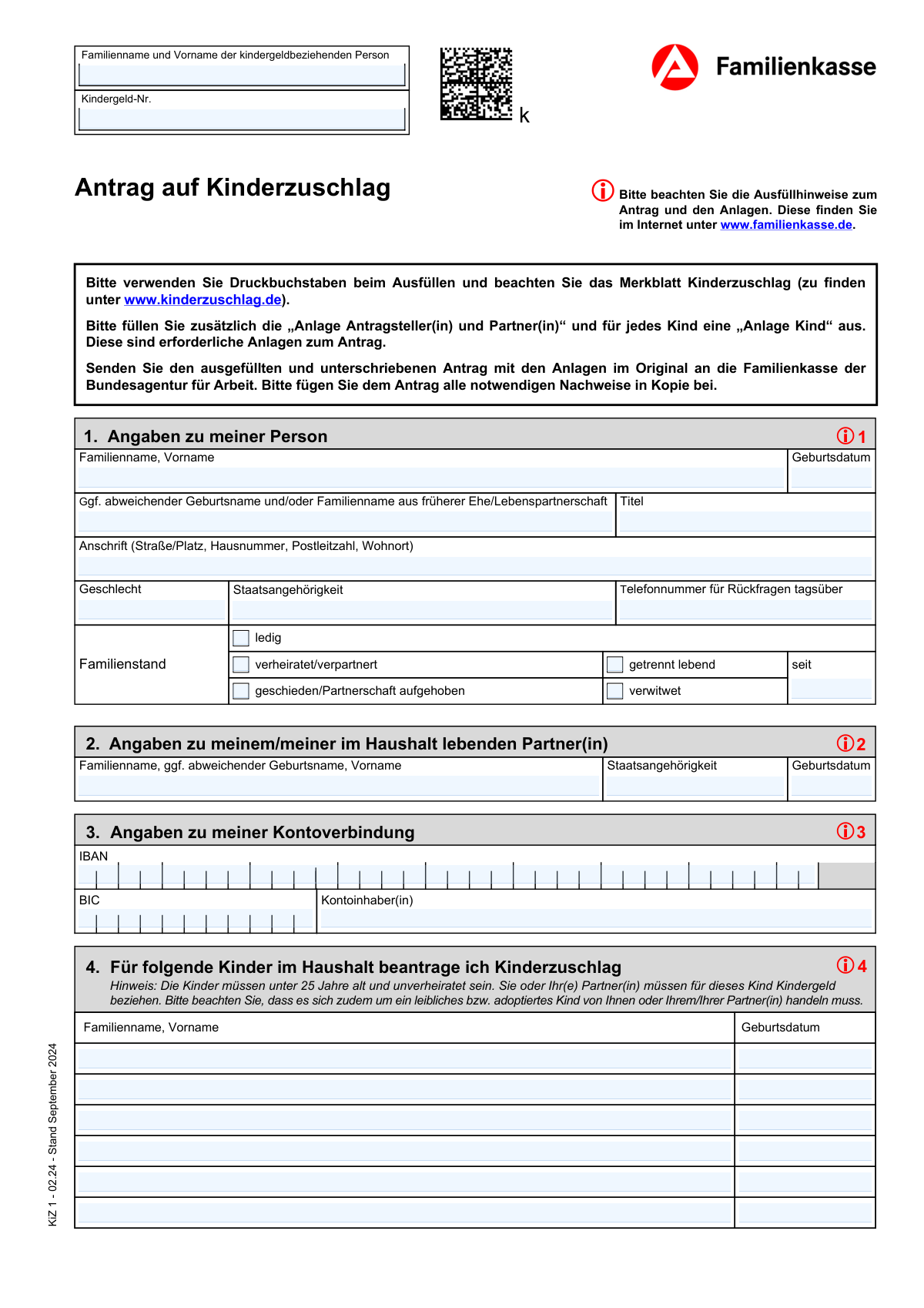
| 1. | Antrag auf Kinderzuschlag (KiZ 1) - Application for Child Supplement | 3 | Moderate 61 |
| 2. | KiZ 1-AnA – Anlage Antragsteller(in) und Partner(in) zum Antrag auf Kinderzuschlag | 3 | Moderate 51 |
- Enterprise-grade security & data encryption
- 99%+ accuracy powered by AI
- 1,000+ forms from all industries
- Complete forms in under 60 seconds
How to Choose the Right Form
With only one form in this category, the decision is straightforward — but understanding what this form is for and who needs to complete it will help you avoid mistakes before you start.
What Is the KiZ 1-AnA?
The KiZ 1-AnA (Anlage Antragsteller(in) und Partner(in)) is a mandatory supplementary form that must be submitted alongside the main Kinderzuschlag application. It is issued by the German Federal Employment Agency (Familienkasse).
Who Needs This Form?
- Single applicants applying for the Kinderzuschlag child supplement benefit
- Couples or partners — both individuals' details must be included in this single form
- Anyone whose household income, assets, or housing situation needs to be assessed by the Familienkasse
What Information Will You Need?
Before filling out the KiZ 1-AnA, gather the following:
- Current personal status (e.g., in education, inpatient care)
- Housing details — whether you rent or own your home
- Asset declarations for yourself and your partner
- Records of income and expenditure for the past six months
- Any additional needs (Mehrbedarf) that apply to your household
Important Notes
- This form cannot be submitted on its own — it accompanies the main Kinderzuschlag application
- Accuracy is critical: incomplete or incorrect information may delay or affect your eligibility assessment
- If you have a non-fillable PDF version, Instafill.ai can convert it into an interactive form and help you complete it correctly using AI assistance
Bottom line: If you are applying for Kinderzuschlag and need to provide applicant and partner details, the KiZ 1-AnA is the form you need. There are no alternative versions to choose between — simply ensure you have all financial and household information ready before you begin.
Form Comparison
| Form | Purpose | Who Files It | When to Use |
|---|---|---|---|
| KiZ 1-AnA – Anlage Antragsteller(in) und Partner(in) zum Antrag auf Kinderzuschlag | Collects applicant/partner details for Kinderzuschlag eligibility assessment | Parent or guardian applying for child supplement benefit | Submitted alongside main Kinderzuschlag application to Familienkasse |
Tips for Kinderzuschlag forms
The KiZ 1-AnA requires a detailed record of your income and expenditure over the preceding six months. Before you start filling out the form, collect all relevant bank statements, payslips, and receipts so you have everything on hand. Missing or estimated figures can delay your application or affect your eligibility assessment.
This form covers both the main applicant and their partner, so be prepared to provide complete information for both individuals. Leaving partner fields blank or incomplete — even if your partner has minimal income — is a common mistake that can cause your application to be returned. Double-check that names, addresses, and status details match official documents.
The form includes a section for declaring assets, which applicants sometimes underestimate or skip. Assets such as savings accounts, vehicles, or property can affect your Kinderzuschlag eligibility, so it is important to disclose them honestly and completely. Omitting assets — even unintentionally — can lead to complications or repayment demands later.
If you or your partner have additional needs (Mehrbedarf), such as those related to a disability or pregnancy, make sure to include these in the relevant section of the form. These additional needs can positively influence your benefit calculation, so failing to declare them means you may receive less than you are entitled to. Check the Familienkasse's guidance notes to understand which categories apply to your situation.
AI-powered tools like Instafill.ai can complete the KiZ 1-AnA form in under 30 seconds with high accuracy — a real time-saver if you are juggling multiple benefit applications. Your data stays secure throughout the process, and the tool can even convert non-fillable PDF versions into interactive forms. This is especially helpful given the form's length and the volume of financial detail required.
The KiZ 1-AnA is a supplementary annex and must accompany the main Kinderzuschlag application — it cannot be submitted on its own. Make sure both documents are complete and consistent with each other before sending them to the Familienkasse. Submitting one without the other will result in an incomplete application.
Always save or print a copy of the completed KiZ 1-AnA and any supporting documents before submitting your application. If the Familienkasse requests clarification or additional information, having your original submission on hand makes it much easier to respond quickly and accurately. Digital copies stored securely are just as useful as paper ones.
The form distinguishes between rental accommodation and owner-occupied housing, and each requires different information about costs and circumstances. Entering the wrong housing type or leaving out rent and utility details is a frequent source of errors. Review this section thoroughly, as housing costs are a key factor in calculating your entitlement.
Frequently Asked Questions
Kinderzuschlag (KiZ) is a German child supplement benefit administered by the Familienkasse, a branch of the Federal Employment Agency. It is designed for parents who earn enough to cover their own living expenses but whose income is not sufficient to also cover their children's needs, helping families avoid dependency on basic social welfare benefits.
This category currently contains the KiZ 1-AnA form, which is the official annex (Anlage) to the main Kinderzuschlag application. It collects detailed information about the applicant and their partner, covering housing, assets, income, and expenditure, and must be submitted alongside the main KiZ application.
Yes, the KiZ 1-AnA form covers both the applicant and their partner, but it is required as part of the Kinderzuschlag application process regardless of whether you have a partner. If you do not have a partner, you simply complete only the sections relevant to yourself and leave the partner sections blank or mark them as not applicable.
You should have documents related to your housing situation (rental contract or proof of home ownership), details of your assets and savings, records of all income sources and expenditures from the past six months, and information about any special additional needs (Mehrbedarf). Having payslips, bank statements, and housing cost documents on hand will make the process much smoother.
The Familienkasse uses a six-month income and expenditure overview to get an accurate picture of your household's financial situation and to determine whether you meet the eligibility criteria for Kinderzuschlag. This period helps account for fluctuations in income and ensures a fair assessment of your ongoing financial circumstances.
Completed Kinderzuschlag forms, including the KiZ 1-AnA annex, are submitted to your local Familienkasse office, which is part of the Federal Employment Agency (Bundesagentur für Arbeit). You can typically submit forms by mail, in person, or through the Familienkasse's online portal, depending on the options available in your region.
Yes, AI-powered tools like Instafill.ai can fill out Kinderzuschlag forms such as the KiZ 1-AnA in under 30 seconds by accurately extracting and placing data from your source documents. Instafill.ai can also convert non-fillable PDF versions of these forms into interactive, fillable formats, making the process faster and less error-prone.
Manually completing the KiZ 1-AnA can take considerable time due to the detailed financial and personal information required. Using AI tools like Instafill.ai, the form can be filled out in under 30 seconds, as the AI accurately extracts and populates the necessary data from your uploaded documents.
Errors or incomplete information on the KiZ 1-AnA can delay the processing of your Kinderzuschlag application or result in an incorrect eligibility assessment. The Familienkasse may request additional information or corrections, which can slow down the approval process, so it is important to review all entries carefully before submission.
No, the KiZ 1-AnA is an annex (Anlage) that must accompany the main Kinderzuschlag application form — it is not a standalone application. The main application form initiates the request for the benefit, while the KiZ 1-AnA provides the detailed personal and financial data the Familienkasse needs to assess eligibility.
Kinderzuschlag is not a permanent benefit and must be reapplied for periodically, as eligibility is assessed based on your current financial and family situation. The Familienkasse will inform you about the duration of your approved benefit period and when you need to submit a new application with updated documentation.
The official KiZ 1-AnA and related Kinderzuschlag forms are issued by the German Federal Employment Agency and are primarily available in German. If you need assistance understanding the forms, you may seek help from a social counseling service, a citizens' advice bureau (Bürgerberatung), or use AI-assisted tools that can help guide you through the form fields.
Glossary
- Form Complexity Index
- Instafill’s 0–100 measure of how much effort a form takes to complete, calculated deterministically from the form’s own structure rather than estimated. It combines the number of fillable fields (the largest factor), how difficult those fields are to complete based on their type, the number of pages that contain fields, the amount of conditional “fill-only-if” logic, and how many sections the form is divided into, then adds modifiers for tables and repeating lists, bundled instruction pages, and dense page layouts. A higher score means the form is harder to fill out by hand. The forms in this category have a median Form Complexity Index of 61/100 (Moderate). See exactly how it is calculated.
- Kinderzuschlag (KiZ)
- A German child supplement benefit paid in addition to Kindergeld (child benefit) to low-income parents who can cover their own living costs but not those of their children. It is administered by the Familienkasse and aims to prevent families from needing full Bürgergeld (basic income support).
- Familienkasse
- The family benefits office within the German Federal Employment Agency (Bundesagentur für Arbeit) responsible for processing applications for Kindergeld and Kinderzuschlag. All KiZ forms must be submitted to your regional Familienkasse.
- Anlage
- A supplementary attachment form that must be submitted together with a main application (Antrag). In the KiZ context, the KiZ 1-AnA is an Anlage that provides detailed personal and financial information to support the primary Kinderzuschlag application.
- Mehrbedarf
- A recognized additional financial need beyond standard living costs, such as expenses related to disability, pregnancy, or single parenthood. Declaring applicable Mehrbedarf on the KiZ form can increase the assessed benefit amount.
- Bedarfsgemeinschaft
- A 'needs community' — the household unit whose combined income and assets are assessed together when calculating Kinderzuschlag eligibility. It typically includes the applicant, their partner, and any dependent children living in the household.
- Vermögen (Asset Declaration)
- The section of the KiZ application where applicants must disclose all significant assets, including savings, property, and investments. The Familienkasse uses this information to determine whether the household's assets exceed the allowable threshold for receiving KiZ.
- Einnahmen und Ausgaben (Income and Expenditure)
- A detailed record of all household income sources and expenses over the preceding six months, required as part of the KiZ application. This includes wages, rental income, benefits received, housing costs, and other regular outgoings.
- Kindergeld
- The standard monthly child benefit paid to all eligible parents in Germany, regardless of income. Kinderzuschlag is a separate, means-tested top-up benefit paid on top of Kindergeld for qualifying low-income families.
- Antragsteller(in)
- The person formally submitting the Kinderzuschlag application, i.e., the applicant. The KiZ 1-AnA collects detailed information about both the Antragsteller(in) and their partner (Partner(in)) living in the same household.