Yes! You can use AI to fill out KiZ 1-AnA – Anlage Antragsteller(in) und Partner(in) zum Antrag auf Kinderzuschlag

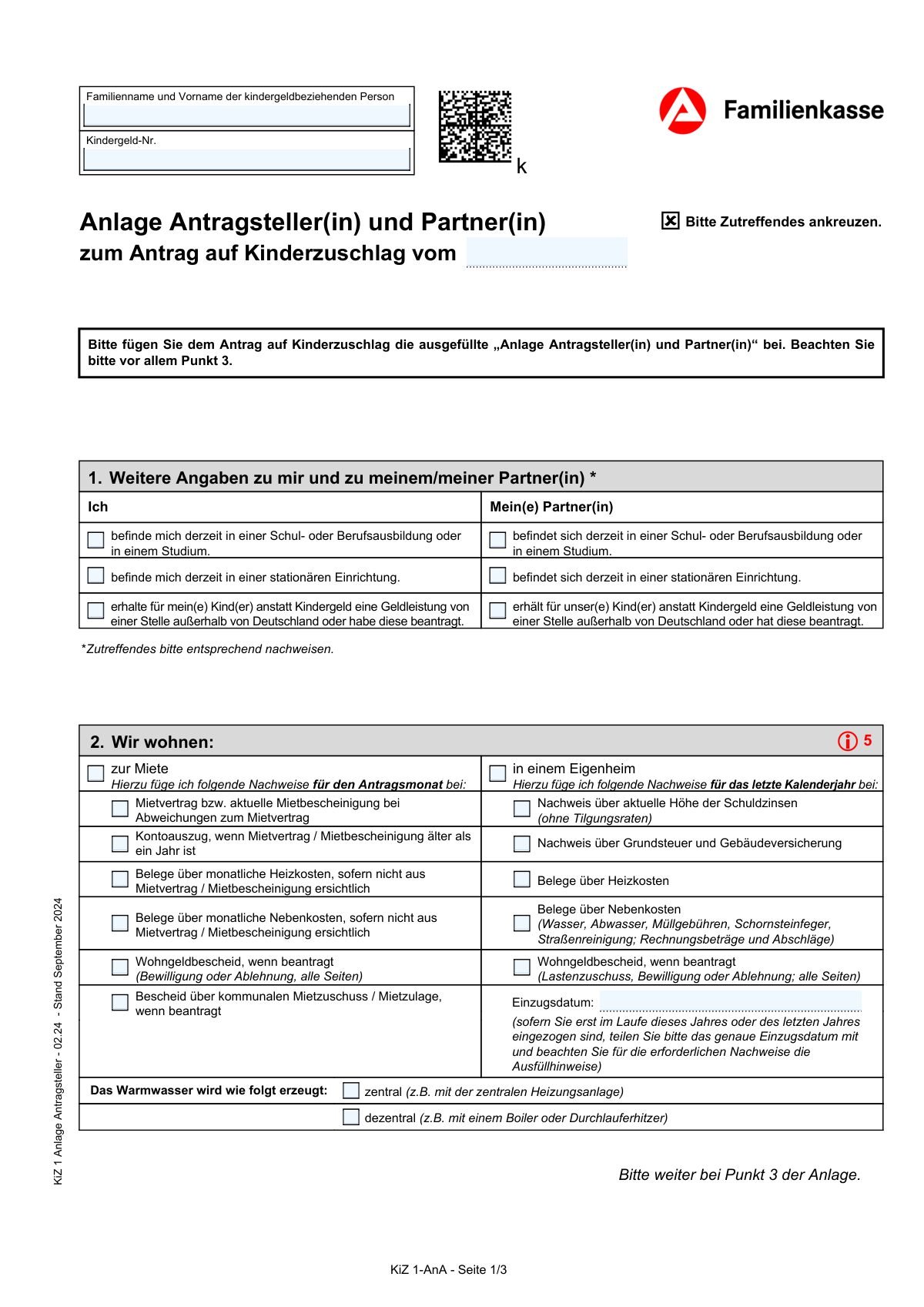
The KiZ 1-AnA (Anlage Antragsteller(in) und Partner(in)) is an official German Federal Employment Agency (Familienkasse) form that must accompany the main Kinderzuschlag application. It collects detailed information about the applicant and their partner, including current status (education, inpatient care), housing situation (rental or owner-occupied), asset declarations, additional needs (Mehrbedarf), and a comprehensive record of income and expenditure over the preceding six months. Accurate completion of this form is essential for the Familienkasse to assess eligibility for the child supplement benefit. Today, this form can be filled out quickly and accurately using AI-powered services like Instafill.ai, which can also convert non-fillable PDF versions into interactive fillable forms.
Our AI automatically handles information lookup, data retrieval, formatting, and form filling.
It takes less than a minute to fill out KiZ 1-AnA using our AI form filling.
Securely upload your data. Information is encrypted in transit and deleted immediately after the form is filled out.

Form specifications

Form name: KiZ 1-AnA – Anlage Antragsteller(in) und Partner(in) zum Antrag auf Kinderzuschlag
Number of pages: 3
Language: English
main-image

Instafill Demo: filling out a legal form in seconds

How to Fill Out KiZ 1-AnA Online for Free in 2026

Are you looking to fill out a KIZ 1-ANA form online quickly and accurately? Instafill.ai offers the #1 AI-powered PDF filling software of 2026, allowing you to complete your KIZ 1-ANA form in just 37 seconds or less.
Follow these steps to fill out your KIZ 1-ANA form online using Instafill.ai:
  1. 1 Navigate to Instafill.ai, search for or upload the KiZ 1-AnA form, and open it in the AI-powered form filling interface.
  2. 2 Enter the header information: the full family name and given name of the child benefit recipient, the Kindergeld number, and the application date.
  3. 3 Complete Section 1 by checking the applicable boxes for your own status and your partner's status (e.g., currently in education, in an inpatient facility, or receiving a foreign child benefit equivalent).
  4. 4 Fill in Section 2 by selecting your housing type (rented or owner-occupied), checking all relevant supporting document boxes, entering the move-in date if applicable, and indicating how hot water is generated.
  5. 5 Complete Sections 3 and 4 by declaring whether significant assets exist (and filling out the asset annex if required) and indicating any additional needs (Mehrbedarf), including the expected delivery date if pregnant.
  6. 6 Work through Sections 5 and 6 by checking the appropriate income and expenditure rows for yourself and your partner, entering commuting distances and workdays where required, and confirming which supporting documents you are attaching.
  7. 7 Review all entries for accuracy, sign and date the declaration at the bottom, then use Instafill.ai to save, print, or submit the completed form along with all required supporting documents.

Our AI-powered system ensures each field is filled out correctly, reducing errors and saving you time.

Why Choose Instafill.ai for Your Fillable KiZ 1-AnA Form?

Speed

Complete your KiZ 1-AnA in as little as 37 seconds.

Up-to-Date

Always use the latest 2026 KiZ 1-AnA form version.

Cost-effective

No need to hire expensive lawyers.

Accuracy

Our AI performs 10 compliance checks to ensure your form is error-free.

Security

Your personal information is protected with bank-level encryption.

Frequently Asked Questions About Form KiZ 1-AnA

The KiZ 1-AnA is the 'Anlage Antragsteller(in) und Partner(in)' (Attachment for Applicant and Partner), which must be submitted together with the main application for Kinderzuschlag (child supplement). It is required for anyone applying for Kinderzuschlag who needs to provide detailed information about their personal situation, housing, assets, income, and expenses.

The Kinderzuschlag is a supplementary benefit paid by the German Familienkasse to parents who receive child benefit (Kindergeld) but whose income is not sufficient to cover their family's needs. It is designed to help low-income families avoid relying on Bürgergeld (basic income support) solely because of their children's financial needs.

If you rent, you must provide your rental contract or a current rental certificate, a bank statement if the contract is older than one year, receipts for monthly heating costs (if not shown in the contract), receipts for monthly ancillary costs (if not shown in the contract), and — if applicable — the Wohngeld (housing benefit) decision notice and any municipal rent subsidy decision, all for the application month.

Homeowners must submit proof of current mortgage interest payments (excluding repayments), proof of property tax and building insurance, receipts for heating costs, and itemized statements for ancillary costs (water, sewage, waste, chimney sweep, street cleaning) — all for the last calendar year. If you applied for Wohngeld (Lastenzuschuss), include the full decision notice as well.

Significant assets include non-owner-occupied real estate, vehicles worth over €15,000, cash, bank accounts (including PayPal, crypto, and daily savings accounts), savings accounts and bonds, securities (stocks, funds, bonds), building savings contracts, insurance policies with premium refunds (e.g., life or private pension insurance), and other valuables like precious metals, antiques, or jewelry. The threshold is €55,000 for 2 persons, €70,000 for 3 persons, and increases by €15,000 for each additional person.

If you and your household members have assets that meet or exceed the thresholds listed in Section 3, you must check 'Ja' (Yes) and additionally complete the separate 'Anlage zum erheblichen Vermögen' (Attachment for Significant Assets) form. Failing to disclose significant assets could result in incorrect benefit payments.

Mehrbedarfe are additional financial needs arising from specific circumstances such as pregnancy, severe disability, inability to work, costly dietary requirements, or single parenthood. Reporting them in Section 4 is voluntary, but you should declare them if you want them to be considered in your benefit calculation. Supporting documents (e.g., disability ID, medical certificates) are required, except for the single-parent supplement.

You must report all income received by you and your partner in the six months before the application date, including wages/salary, self-employment income, voluntary service income, unemployment benefits, Bürgergeld, sick pay, pensions, parental allowance (Elterngeld), BAföG, maintenance payments, rental income, and other income such as interest, tax refunds, or tips. Each type of income requires specific supporting documents.

Deductible expenses listed in Section 6 include commuting costs (public transport tickets or distance/days for car use), costs for double household management, meal allowances, other work-related costs (e.g., union fees), car liability insurance, retirement savings contributions, health/care insurance premiums, maintenance payments, and childcare costs. Each expense category requires corresponding proof such as contracts, invoices, or bank statements.

Yes, you generally still need to provide income and expense documentation for the last six months before the new application. However, if your circumstances have not materially changed, a shorter 'Kurzantrag' (short application) may be available to you instead of the full form.

Yes, AI-powered services like Instafill.ai can help you accurately auto-fill the KiZ 1-AnA form, saving you time and reducing the risk of errors. Instafill.ai guides you through each field and ensures all required information is entered correctly before you submit.

Simply upload the KiZ 1-AnA PDF to Instafill.ai, and the AI will walk you through each section — from personal details and housing information to income, expenses, and asset declarations. Once completed, you can save or print the filled form and attach it to your Kinderzuschlag application.

If you have a flat, non-fillable version of the PDF, Instafill.ai can convert it into an interactive fillable form so you can complete it digitally. This eliminates the need to print and handwrite your answers, making the process faster and more convenient.

Your data is processed in accordance with the Bundeskindergeldgesetz (Federal Child Benefit Act) and the Sozialgesetzbuch (Social Code) solely for the purpose of assessing your Kinderzuschlag entitlement. The Familienkasse retains your records for up to 6 years after the last payment, and you can find full data protection information at www.arbeitsagentur.de/datenschutz-familienkasse.

The completed KiZ 1-AnA form, along with all required supporting documents, must be submitted to your local Familienkasse as an attachment to your main Kinderzuschlag application. You can submit it by post, in person, or — where available — electronically through the official portal. Make sure to sign and date the declaration on the last page before submitting.

Compliance KiZ 1-AnA
Validation Checks by Instafill.ai

1
Ensures Family Name and Given Name Field is Completed and Not Abbreviated
This check verifies that the 'Familienname und Vorname' field is filled in with the applicant's full legal family name followed by their given name(s), and that neither part is left blank or entered in an abbreviated form. The full legal name is required to correctly identify the applicant and match their record in the Familienkasse system. If this field is missing or incomplete, the form cannot be processed and the application will be rejected or returned.
2
Validates Kindergeld-Nr. Format and Presence
This check ensures that the Kindergeld number (Kindergeld-Nr.) is present and conforms to the expected format used by the Familienkasse (typically a numeric identifier of a defined length). The Kindergeld number is the primary reference linking this supplementary form to the main child benefit record. If the number is absent, incorrectly formatted, or does not match the applicant's name, the attachment cannot be associated with the correct application file.
3
Validates Application Date is a Valid Calendar Date and Not in the Future
This check confirms that the application date ('Datum der Antragstellung') is entered in a valid date format (DD.MM.YYYY), represents a real calendar date, and is not set to a future date. The application date determines the reference period for income and expense evidence (the six months prior to submission) and affects benefit eligibility timing. An invalid, missing, or future date would make it impossible to correctly assess the relevant income period and could invalidate the entire application.
4
Ensures Exactly One Housing Type is Selected (Zur Miete or Eigenheim, Not Both or Neither)
This check verifies that the applicant has selected exactly one of the two housing options — 'zur Miete' (renting) or 'in einem Eigenheim' (owner-occupied) — and that both options have not been checked simultaneously, nor left entirely blank. Housing type is a mandatory field because it determines which set of supporting documents must be submitted and how housing costs are calculated for the Kinderzuschlag assessment. Selecting both or neither would create an ambiguous or incomplete application that cannot be processed.
5
Validates Move-In Date (Einzugsdatum) is Present and Valid When Eigenheim is Selected
When the applicant selects 'in einem Eigenheim' as their housing type and indicates they moved in during the current or previous year, this check ensures the 'Einzugsdatum' field is filled in with a valid date in DD.MM.YYYY format that is not in the future and is logically consistent with the application date. The move-in date is required to determine which calendar year's cost documents are applicable and to correctly prorate annual housing costs. A missing or invalid move-in date would prevent accurate calculation of housing-related deductions.
6
Ensures Hot Water Supply Method is Selected (Zentral or Dezentral)
This check confirms that exactly one hot water supply option — 'zentral' (central, e.g., central heating system) or 'dezentral' (decentralized, e.g., boiler or instantaneous water heater) — has been selected, and that both or neither have not been chosen. The method of hot water generation directly affects how heating costs are calculated and allocated within the housing cost assessment for Kinderzuschlag. Leaving this field blank or selecting both options would result in an incomplete or contradictory submission.
7
Ensures Vermögen Declaration (Ja/Nein) is Completed with Exactly One Option Selected
This check verifies that the applicant has selected exactly one answer — either 'Ja' or 'Nein' — in Section 3 regarding whether the household holds significant assets (erhebliches Vermögen), and that neither both nor neither option has been marked. The asset declaration is a mandatory self-disclosure required to determine eligibility for Kinderzuschlag, as exceeding the asset thresholds disqualifies the household. If neither or both options are selected, the form is incomplete and the eligibility assessment cannot proceed.
8
Validates Conditional Requirement: 'Anlage zum erheblichen Vermögen' Must Be Indicated When Ja is Selected for Vermögen
This check ensures that when the applicant selects 'Ja' in Section 3 (indicating significant assets exist), they are flagged to also complete and attach the separate 'Anlage zum erheblichen Vermögen' form. Selecting 'Ja' without attaching the supplementary asset declaration form renders the application incomplete, as the authority requires detailed asset information to assess whether the threshold is exceeded. Failure to attach this form when 'Ja' is selected will result in the application being returned for completion.
9
Validates Conditional Requirement: Expected Delivery Date Must Be Provided When Mehrbedarf Due to Pregnancy is Indicated
This check confirms that when the applicant selects 'Ja' for Mehrbedarf (Section 4) and the reason includes pregnancy (Schwangerschaft), the field for the expected delivery date ('voraussichtlicher Entbindungstermin') is filled in with a valid future date in DD.MM.YYYY format. The expected delivery date is required to calculate the pregnancy-related additional need allowance and to verify the claim with supporting documentation. If this date is missing or invalid when pregnancy is cited as a reason, the Mehrbedarf for pregnancy cannot be assessed or approved.
10
Ensures At Least One Income Type is Declared for the Applicant in Section 5
This check verifies that at least one income category in Section 5 (Einnahmen der letzten sechs Monate) has been checked for the applicant ('für mich'), ensuring that the applicant has not left the entire income section blank. Disclosure of income for the six months prior to application is a mandatory requirement for assessing Kinderzuschlag eligibility and benefit amount. A completely blank income section would make it impossible to determine whether the minimum income threshold is met and would result in the application being rejected or returned.
11
Validates Commuting Distance (Einfache Wegstrecke) is a Positive Numeric Value When Car Use is Indicated for Werbungskosten
This check ensures that when the applicant or partner indicates use of a private vehicle (KfZ-Nutzung) for commuting under Werbungskosten in Section 6, the field for one-way commuting distance ('einfache Wegstrecke in km') contains a positive numeric value greater than zero. The commuting distance is used to calculate the deductible travel expense allowance, and an invalid, zero, or missing value would prevent accurate computation of this deduction. If the field is left blank or contains non-numeric input, the Werbungskosten for vehicle commuting cannot be processed.
12
Validates Working Days Per Week (Arbeitstage pro Woche) is a Numeric Value Between 1 and 7 When Commuting Costs Are Claimed
This check confirms that when commuting costs are claimed under Werbungskosten in Section 6, the 'Arbeitstage pro Woche' field contains a whole number between 1 and 7 (inclusive) for both the applicant and/or partner as applicable. The number of working days per week is a required input for calculating the annual commuting cost deduction under the flat-rate travel allowance rules. A value outside this range, a non-integer, or a blank entry would make the deduction calculation impossible and could lead to incorrect benefit assessment.
13
Ensures Supporting Document Checkboxes Are Consistent with Selected Income Types in Section 5
This check verifies that for each income type checked in Section 5 (e.g., Arbeitslohn, selbständige Arbeit, Unterhalt), at least one corresponding evidence checkbox has been marked for the relevant person (applicant and/or partner). Each income category requires specific documentation, and claiming an income type without indicating any supporting evidence creates an incomplete submission. If income is declared without any associated proof being indicated, the application will be flagged as incomplete and the relevant income cannot be verified.
14
Validates Logical Consistency: BAföG/Stipendium Income Consistent with Education/Training Status in Section 1
This check ensures logical consistency between Section 1 and Section 5: if the applicant or partner has checked that they are currently in school, vocational training, or university (Schul- oder Berufsausbildung / Studium) in Section 1, then any BAföG, Stipendium, or Berufsausbildungsbeihilfe income declared in Section 5 is plausible and expected. Conversely, if BAföG or similar training-related income is declared in Section 5 but no education status is indicated in Section 1, a warning should be raised for review. This cross-field consistency check helps identify potentially contradictory or incomplete disclosures that could affect benefit eligibility.
15
Ensures Signature Date Matches or Is Consistent with the Application Date
This check verifies that the 'Datum' field in the declaration section at the bottom of the form is filled in with a valid date in DD.MM.YYYY format and is consistent with (or the same as) the application date entered in the form header. The signature date serves as the legally binding confirmation of the applicant's declaration of accuracy and completeness, and a missing or inconsistent date could raise questions about the validity of the declaration. If the signature date is absent, in an invalid format, or significantly earlier than the application date, the form may be considered legally incomplete.
16
Validates Rental Documentation Consistency: Kontoauszug Required When Mietvertrag is Older Than One Year
This check ensures that when the applicant selects 'zur Miete' and indicates the rental contract or certificate is older than one year, the checkbox for 'Kontoauszug (bei Mietvertrag älter als 1 Jahr)' is also marked to confirm that a bank statement is being submitted as supplementary proof of current rent payments. A rental contract older than one year without a supporting bank statement is insufficient evidence of the current rent amount, which is a key input for the housing cost calculation. Failing to indicate this document when the contract is outdated will result in an incomplete evidence submission and may delay or prevent processing.

Common Mistakes in Completing KiZ 1-AnA

Missing or incorrect Kindergeld number

Many applicants leave the Kindergeld-Nr. field blank or enter an incorrect number because they cannot locate it on previous correspondence. This number is essential for linking the attachment to the correct benefit file, and a missing or wrong number can cause significant processing delays or the form being returned. Always check your most recent Kindergeld notification letter or your Familienkasse correspondence for the exact number before filling in the form. Tools like Instafill.ai can help by prompting you to locate and correctly enter this reference number.

Failing to check applicable status boxes for applicant and/or partner

Applicants often overlook Section 1 entirely or forget to mark the relevant boxes for their partner, especially when the partner is in education, in an inpatient facility, or receives a foreign child benefit equivalent. Leaving these boxes unchecked can lead to incorrect benefit calculations or requests for additional information. Carefully review each statement in Section 1 for both yourself and your partner, and tick every box that applies. Remember that supporting evidence must be provided for any box that is checked.

Selecting both 'zur Miete' and 'in einem Eigenheim' or neither

Some applicants accidentally check both housing options or leave both unchecked, which creates a contradiction or gap in the application. The form requires exactly one housing type to be selected, as the required supporting documents differ significantly between renting and owner-occupancy. Read Section 2 carefully and select only the option that matches your actual living situation. If you are unsure which category applies (e.g., subsidised housing), consult the official guidance notes before submitting.

Submitting outdated or incomplete housing documents

A very common error is attaching a rental contract that is more than one year old without also including a recent bank statement confirming the current rent payment. The form explicitly requires a bank statement (Kontoauszug) when the rental contract or Mietbescheinigung is older than one year. Failing to include this additional document will result in the application being incomplete and delayed. Check the date on your rental contract and, if it is over 12 months old, always attach a current bank statement showing the rent transfer.

Not providing the exact move-in date for owner-occupied homes

Homeowners who moved in during the current or previous year frequently leave the 'Einzugsdatum' field blank or enter only the year instead of the full date. The exact move-in date is required to determine which period's costs are relevant and which documents must be submitted. An incomplete or missing date can cause the authority to request clarification, delaying the decision. Always enter the precise day, month, and year of your move-in, and refer to your purchase contract or registration documents if needed.

Failing to indicate the hot water generation method

The question about whether hot water is produced centrally or decentrally (Section 2) is frequently skipped, as applicants do not realise it affects the calculation of housing costs. Leaving this field blank means the authority cannot correctly assess heating and ancillary cost components, which may result in an underestimation of allowable housing costs. Check your rental contract, utility bills, or ask your landlord if you are unsure whether your hot water is produced centrally (e.g., via a central boiler) or decentrally (e.g., via an individual boiler or instantaneous water heater).

Incorrectly assessing or declaring significant assets (Vermögen)

Many applicants either underestimate their total assets by forgetting to include items such as cryptocurrency, PayPal balances, life insurance surrender values, or jewellery, or they misapply the threshold by not accounting for all household members. Incorrectly ticking 'Nein' when assets actually exceed the threshold constitutes a false declaration and can lead to repayment demands or legal consequences. Carefully add up all asset types listed in Section 3 for all household members and compare the total against the applicable threshold for your household size. If in doubt, complete the 'Anlage zum erheblichen Vermögen' and seek advice.

Omitting the expected delivery date when claiming pregnancy Mehrbedarf

Applicants who tick 'Ja' for Mehrbedarf due to pregnancy often forget to also enter the expected delivery date (voraussichtlicher Entbindungstermin) in the dedicated field. Without this date, the authority cannot verify or calculate the pregnancy-related additional need, and the Mehrbedarf may not be granted. If you are claiming a pregnancy-related Mehrbedarf, always fill in the expected delivery date and attach supporting medical documentation. AI-powered form tools like Instafill.ai can flag this conditional field so it is not accidentally left blank.

Not covering the full six-month income period with pay slips

Applicants frequently submit only one or two recent pay slips instead of providing documentation for all six months prior to the application date, as explicitly required in Section 5. Incomplete income documentation leads to processing delays and may result in the application being rejected or an incorrect benefit amount being calculated. Count back exactly six calendar months from your application date and ensure you have a pay slip or equivalent proof for each month. If a month is missing, request a duplicate from your employer or use the 'Verdienstbescheinigung des Arbeitgebers' form.

Forgetting to declare all income types, especially minor or irregular income

Applicants often omit income sources they consider insignificant, such as tips, tax refunds, interest income, or one-off payments like severance pay, not realising these must be declared under 'Sonstige Einnahmen' in Section 5. Undeclared income can be discovered during processing and may lead to overpayment recovery, penalties, or a fraud investigation. Review all bank statements for the six-month reference period and declare every incoming payment, no matter how small or irregular. Instafill.ai can help by prompting you to consider each income category listed in the form.

Entering commuting distance or working days incorrectly in Section 6

When claiming travel costs (Fahrtkosten) as Werbungskosten, applicants frequently enter the total round-trip distance instead of the one-way distance (einfache Wegstrecke), or they enter the wrong number of working days per week. The authority uses the one-way distance and actual working days to calculate the deductible commuting allowance, so errors here directly affect the benefit amount. Always enter only the one-way distance from your home to your workplace in kilometres, and enter the actual number of days you travel to work each week, not the contractual working week.

Submitting the form without a signature or with an incorrect date

A surprisingly common mistake is printing and submitting the form without signing it, or entering the wrong date in the declaration section at the end. An unsigned form is legally invalid and will be returned by the Familienkasse, causing delays of several weeks. Always sign the form personally (or have your legal representative sign it) and ensure the date matches the actual submission date. If using a digital version, check whether a qualified electronic signature is accepted or whether a printed and handwritten signature is required.
Saved over 80 hours a year

“I was never sure if my IRS forms like W-9 were filled correctly. Now, I can complete the forms accurately without any external help.”

Kevin Martin Green

Your data stays secure with advanced protection from Instafill and our subprocessors

Robust compliance program

Transparent business model

You’re not the product. You always know where your data is and what it is processed for.

ISO 27001, HIPAA, and GDPR

Our subprocesses adhere to multiple compliance standards, including but not limited to ISO 27001, HIPAA, and GDPR.

Security & privacy by design

We consider security and privacy from the initial design phase of any new service or functionality. It’s not an afterthought, it’s built-in, including support for two-factor authentication (2FA) to further protect your account.

Fill out KiZ 1-AnA with Instafill.ai

Worried about filling PDFs wrong? Instafill securely fills kiz-1-ana-anlage-antragstellerin-und-partnerin-zum-antrag-auf-kinderzuschlag forms, ensuring each field is accurate.



