Fill out PTO forms
with AI.
The United States Patent and Trademark Office (USPTO) requires a specific set of standardized forms to manage the complex process of filing and maintaining intellectual property rights. These PTO forms are essential for documenting the bibliographic data, inventor information, and legal claims necessary to secure a patent. Because the USPTO relies on these documents as the primary source of truth for its records, ensuring every field is completed with precision is vital to avoid processing delays or potential legal challenges during the patent prosecution phase.
By continuing, you acknowledge Instafill's Privacy Policy and agree to get occasional product update and promotional emails.
About PTO forms
Inventors, patent attorneys, and legal professionals typically use these forms when submitting new patent application forms or updating existing records. Whether you are filing an Application Data Sheet (ADS) to establish priority or managing correspondence with the patent office, these documents serve as the formal bridge between your innovation and federal legal protection. Given the technical nature of intellectual property law, maintaining accurate and consistent data across all submissions is a top priority for anyone navigating the patent system.
Manually entering repetitive bibliographic data into these technical documents can be a tedious and error-prone process. Tools like Instafill.ai use AI to fill these PTO forms in under 30 seconds, handling sensitive information accurately and securely to save you time. This modern approach to paperwork allows you to focus on the technical aspects of your invention while ensuring your USPTO filings meet the necessary administrative standards.
Every form on this page can be completed without typing. Instafill is form filling software that reads a PDF and fills it for you — including flat and scanned documents that carry no fillable fields at all.
Forms in This Category
The forms in this category have a median Form Complexity Index of 65/100 (Complex), measured across 2 forms by field count, input difficulty, length, conditional logic and structure. See how it is calculated.
| Form Name | Pages | FCI | |
|---|---|---|---|
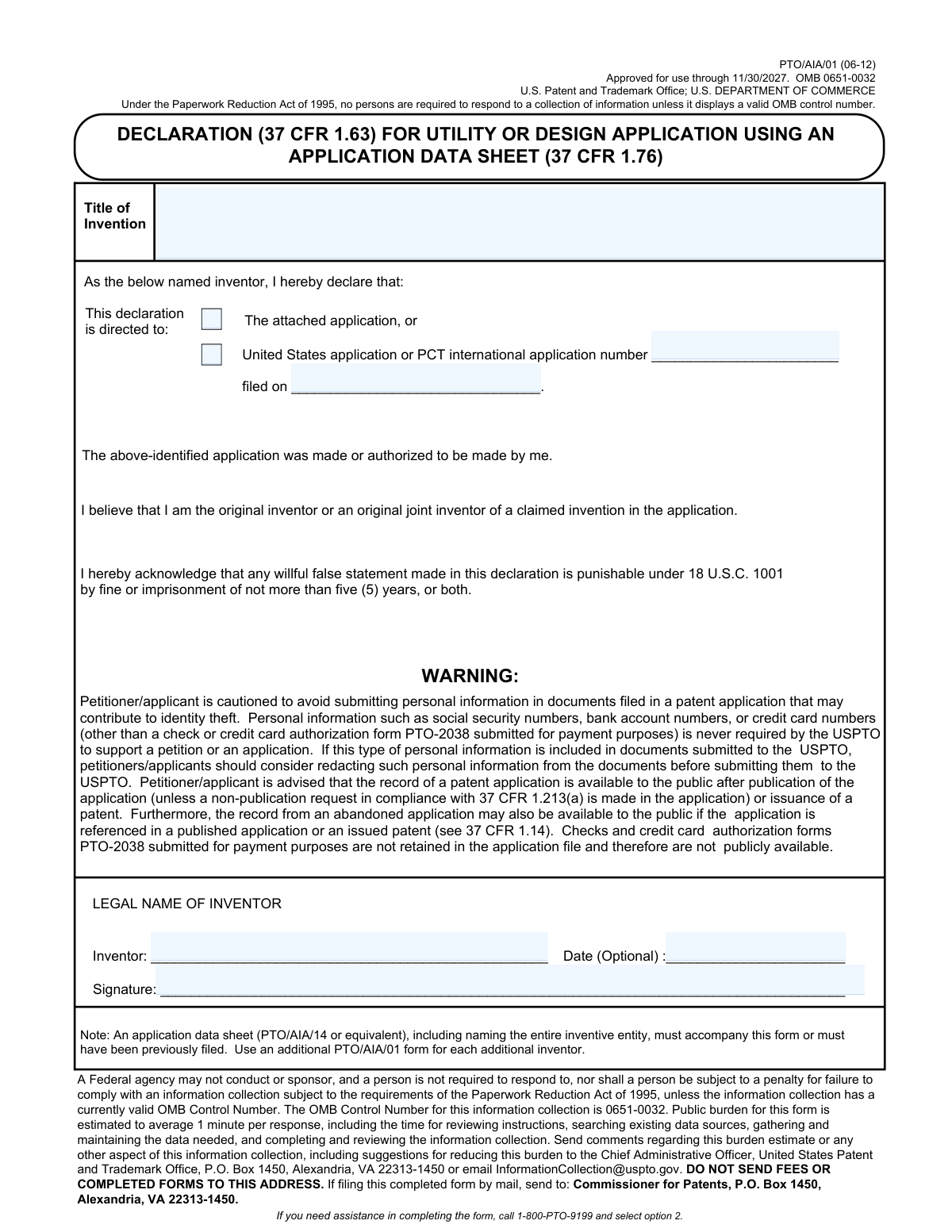
| 1. | Form PTO/AIA/01, Declaration (37 CFR 1.63) for Utility or Design Application Using an Application Data Sheet (37 CFR 1.76) | 1 | Basic 30 |
| 2. | Form PTO/AIA/14, Application Data Sheet (ADS) | 7 | Complex 65 |
- Enterprise-grade security & data encryption
- 99%+ accuracy powered by AI
- 1,000+ forms from all industries
- Complete forms in under 60 seconds
How to Choose the Right Form
Navigating the United States Patent and Trademark Office (USPTO) requirements can be complex, but choosing the right documentation is the first step toward a successful intellectual property filing. In this category, the primary focus is on the foundational data required for any new patent application.
The Foundational Filing Document
If you are starting a new patent application under the America Invents Act (AIA), your most critical document is Form PTO/AIA/14, Application Data Sheet (ADS). This form is not just a summary; it is the authoritative source of bibliographic information for the USPTO. You should choose this form if you need to provide:
- Inventor Information: Names and legal residences of all inventors.
- Correspondence Address: The official location where the USPTO should send all communications.
- Application Information: The specific title of the invention and relevant classification details.
- Priority Claims: If you are claiming the benefit of an earlier-filed domestic or foreign application, this data must be captured here.
Why the ADS is Essential
Unlike some supplemental forms, the Application Data Sheet (ADS) takes precedence. If there is a discrepancy between the ADS and other parts of your application (such as the oath or declaration), the USPTO will rely on the data provided in Form PTO/AIA/14. Using this form ensures that your filing is processed correctly from the start, avoiding costly delays in publication or examination.
When to Use This Form
While there are many specialized patent forms, the ADS is required for most non-provisional utility, design, and plant patent applications. If you are a solo inventor or representing a business filing for IP protection, ensuring the accuracy of Form PTO/AIA/14 via Instafill’s AI-powered tools will streamline your submission process and help you maintain a clean, professional record with the USPTO.
Form Comparison
| Form | Primary Purpose | Key Information | Usage Scenario |
|---|---|---|---|
| Form PTO/AIA/14, Application Data Sheet (ADS) | Provides a structured summary of bibliographic data for patent application processing. | Includes inventor details, correspondence address, and domestic or foreign priority claims. | Submitted at the time of filing a new patent application with the USPTO. |
Tips for PTO forms
The Application Data Sheet (ADS) serves as the primary source of truth for the USPTO. Ensure all inventor names and addresses are exact, as information on this form typically supersedes conflicting details found in other filing documents.
When filling out patent forms, clearly list any prior applications to secure your original filing dates. Failing to include these on the ADS can lead to complicated correction processes or the potential loss of priority benefits.
Verify that the names and the order of inventors on your ADS match the information provided in the Inventor’s Oath or Declaration. Inconsistencies between these documents can trigger USPTO notices of omitted items and delay the processing of your application.
Managing complex intellectual property forms is significantly faster with AI-powered tools like Instafill.ai, which can complete these forms in under 30 seconds with high accuracy. Your sensitive patent data stays secure throughout the process, providing a practical time-saving solution for inventors and legal professionals.
Select a correspondence address where you are certain to receive official mail for several years. If you must change your address during the prosecution process, ensure you update the USPTO immediately to avoid missing critical office actions or deadlines.
Before starting your PTO forms, gather all necessary inventor details, citizenship information, and related application numbers. Having this data organized in advance prevents common transcription errors and ensures you can fill out the structured ADS format without interruption.
Frequently Asked Questions
PTO forms are official documents used by the United States Patent and Trademark Office (USPTO) to manage the application, prosecution, and maintenance of intellectual property rights. These forms facilitate administrative tasks such as filing new patent applications, updating inventor information, and claiming priority from earlier filings.
The ADS is generally filed by inventors, patent attorneys, or authorized agents when submitting a new patent application. It serves as the primary source of bibliographic data, including inventor names, mailing addresses, and the specific correspondence information required for the USPTO to process the application.
Yes, AI tools like Instafill.ai can fill out these forms in under 30 seconds by accurately extracting data from your source documents and placing it into the correct fields. This technology helps reduce manual entry errors, which is critical for maintaining the integrity of legal patent records.
While manual entry can take significant time due to the precision required, using an AI-powered service allows you to complete the process in less than 30 seconds. These tools automatically map data from your existing records directly into the official PDF structure.
The USPTO treats the ADS as the authoritative source for bibliographic information; if there is a discrepancy between the ADS and other submitted documents, the data in the ADS usually takes precedence. This makes it the most critical form for ensuring inventor names and priority claims are recorded correctly.
You should have the full legal names and residences of all inventors, the title of the invention, and a designated correspondence address. Additionally, if you are claiming priority from a previously filed domestic or foreign application, you will need those specific application numbers and filing dates.
Most patent forms are submitted electronically through the USPTO's digital filing portals, such as Patent Center. It is important to ensure the forms are saved in a compatible PDF format and meet the agency's specific digital signature and formatting requirements.
While requirements differ, an Application Data Sheet is standard for non-provisional applications to provide a clear record of filing details. For provisional applications, an ADS is often recommended to ensure that inventor information and the title of the invention are captured accurately by the USPTO from the outset.
While an individual can legally file their own patent forms, the process is highly technical and carries significant legal weight. Many applicants use patent attorneys or agents to ensure that the bibliographic data and legal claims are structured in a way that provides the best protection for their intellectual property.
If bibliographic information changes after the initial submission, you may need to file a Corrected Application Data Sheet. This updated form must clearly identify the changes being made to ensure the USPTO's records remain accurate throughout the examination process.
Glossary
- Form Complexity Index
- Instafill’s 0–100 measure of how much effort a form takes to complete, calculated deterministically from the form’s own structure rather than estimated. It combines the number of fillable fields (the largest factor), how difficult those fields are to complete based on their type, the number of pages that contain fields, the amount of conditional “fill-only-if” logic, and how many sections the form is divided into, then adds modifiers for tables and repeating lists, bundled instruction pages, and dense page layouts. A higher score means the form is harder to fill out by hand. The forms in this category have a median Form Complexity Index of 65/100 (Complex). See exactly how it is calculated.
- USPTO
- The United States Patent and Trademark Office, the federal agency responsible for issuing patents and registering trademarks.
- Application Data Sheet (ADS)
- A standardized form used to submit essential bibliographic information, such as inventor names and correspondence addresses, to the patent office.
- AIA (America Invents Act)
- A major legislative overhaul of the U.S. patent system that transitioned it to a 'first-inventor-to-file' system and introduced new form requirements.
- Priority Claim
- A formal request to use the filing date of a previously filed patent application as the effective date for a new application.
- Assignee
- The individual or legal entity, such as a corporation, that holds the legal ownership rights to a patent application or granted patent.
- Bibliographic Data
- The descriptive information about a patent application, including the title of the invention, applicant details, and classification data.
- Small Entity Status
- A classification for individual inventors, small businesses, or non-profits that entitles them to pay reduced fees for many patent-related services.
- Micro Entity Status
- A fee-reduction category for applicants who meet specific income limits and have a limited number of previous patent filings.