How a subcontractor's prequalification forms went from 15–60 minutes to 30–60 seconds each
Fender Strategic Group (FSG) designs workflow automations for clients who rely on documents and forms. One of them is a specialty trade subcontractor that bids with general contractors such as SDB, Vision Builders and Emerson Construction, and fills 3–5 prequalification packets a day. Nick Fender built that client an email-to-PDF pipeline around Instafill.ai. A form that took 15–60 minutes by hand now fills in 30–60 seconds, and staff review it instead of typing it.
At a glance
- Company Fender Strategic Group
- Client A specialty trade subcontractor
- Industry Commercial construction
- Forms SDB, Vision Builders and Emerson Construction prequalification forms
- Volume 3–5 packets a day, 60–100 forms a month
-
Results
30–60 s per form, down from 15–60 minutes
60–100 prequalification forms a month
1 profile behind every general contractor's form - Catalog forms CHA Statement of Bidder's Qualifications
- Form categories Subcontractor forms, Contractor forms
The challenge
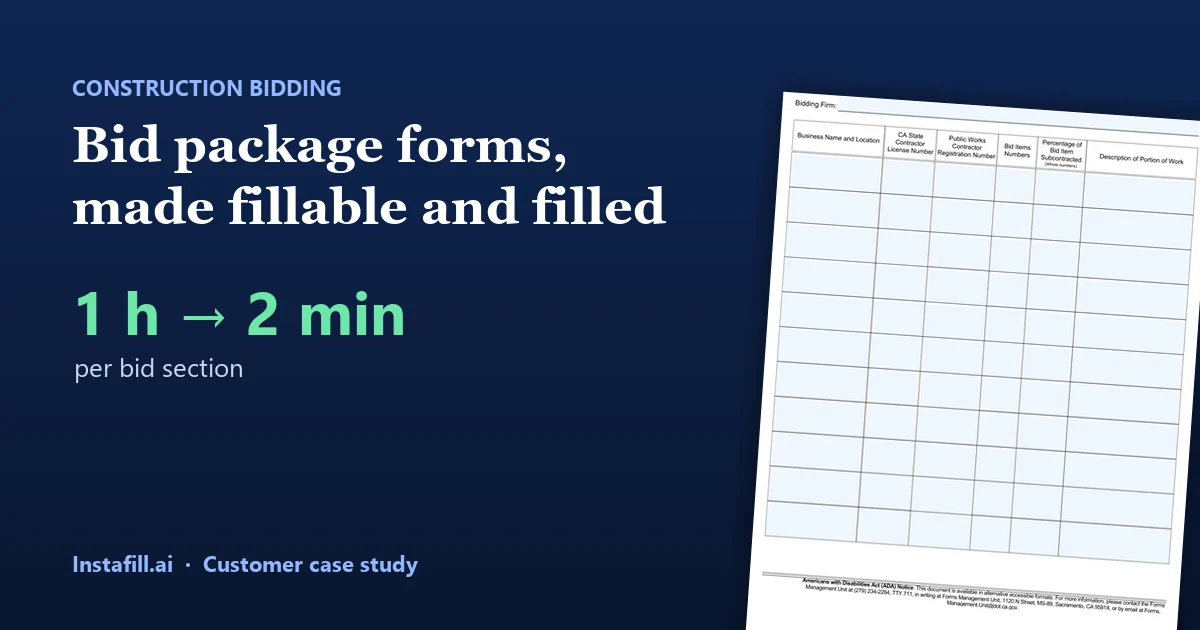
Every general contractor sends its own prequalification form. SDB's covers company information, licensing, EMR and safety metrics, banking and bonding, disadvantaged business certifications and references. Vision Builders asks about ownership, trades performed, certifications and diversity. Emerson Construction's runs to five pages: scope of work, project history, building type mix, financials, vendor and bank references, bonding capacity, EMR, OSHA citations and safety programs. The layouts and wording differ, but the core data is the same.
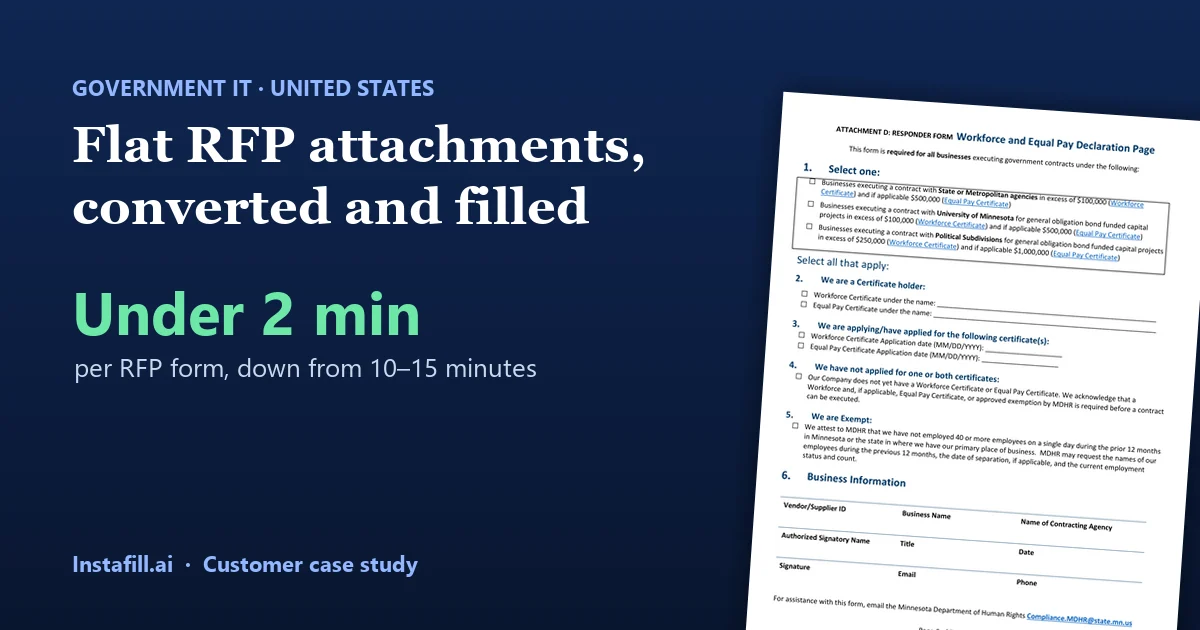
The whole process lived in email. A general contractor sent a PDF; someone downloaded and printed it, wrote or typed the answers, scanned the packet and emailed it back. A simple form took 15–20 minutes, and a packet with detailed tables up to an hour. Many forms were flat PDFs with nothing to type into, and others had complex tables with dependent fields and yes/no groups that generic tools could not keep intact.
The subcontractor already kept its data in a Word and CSV repository: company identity and ownership, licensing, insurance and bonding, safety statistics and EMR history, bank and vendor references. The problem was not a lack of data, but the time spent copying it into every new form.
The solution
FSG uploaded the client's main general contractor forms into Instafill.ai, and each was fine-tuned once so the AI knew its layout, fields and logic. Flat PDFs were made fillable with flat-to-fillable conversion. Tables were rebuilt row by row with table and list filling, which respects the dependencies inside each row and fills only the rows that should be filled.
The Word and CSV repository became one reusable profile: legal name and DBA, addresses and contacts, licensing and insurance, bonding limits and surety, EMR and incident history, vendor and bank references. Instafill.ai maps that data to the right fields of each form by their labels, context and layout, so no data file has to be attached to each job.
The pipeline runs through the Instafill.ai REST API. A dedicated inbox receives prequalification forms as PDF attachments, and each one is saved to a folder on Google Drive or OneDrive. For each PDF the workflow checks that the form is set up in Instafill.ai, starts a filling session with that form and the subcontractor's profile, and waits until it is completed. The team then gets a notification and a link to the filled PDF. FSG notes that the same backbone works whichever automation platform runs it: Pinkfish, n8n, Make or Zapier.
Because these packets carry sensitive financial and safety declarations, FSG kept a person in the loop. A new or especially complex form is checked once in Instafill.ai's editor right after conversion, and staff review every completed packet before it goes back to the general contractor.
The results
| By hand | With Instafill.ai | |
|---|---|---|
| Time per form | 15–60 minutes | 30–60 seconds, plus a short review |
| Company data | Looked up and retyped on every form | One profile |
| A new general contractor's form | Adjusted by hand every time | Set up and fine-tuned once |
| Capacity | Limited by staff time | More packets through the same pipeline |
Critical values such as EMR, bonding capacity, sales and references now come from one maintained profile, which sharply reduces the chance of one form contradicting another. Tables and yes/no sections behave the same way on every fill once they are tuned. Across 60–100 forms a month, the hours that went into data entry now go to estimating, coordinating with general contractors and managing relationships.
For Fender Strategic Group the project is now a pattern it can reuse: one profile behind many vendor forms, an API with a wait loop and storage behind it, and the review step placed wherever each client's risk tolerance calls for it.