How a special needs attorney fills Massachusetts guardianship forms in 1–2 minutes instead of 30–60
Karen Mariscal of Mariscal Special Needs Law plans estates and guardianships for people with disabilities in Massachusetts' Probate and Family Court. Every guardianship case means a set of official court forms, filled from the answers her clients write by hand on an intake questionnaire. Each form took 30–60 minutes to fill. With Instafill.ai it takes 1–2 minutes, from a scan of the same handwritten intake.
At a glance
- Company Mariscal Special Needs Law
- Industry Special needs planning: guardianship and estate planning
- Location Massachusetts, US
- Forms MPC 720, MPC 801, MPC 825 and MPC 826, plus guardianship petitions
- Volume 50+ guardianship and estate planning documents a year
-
Results
1–2 min per court form, down from 30–60 minutes
3–5 min of fine-tuning, once per form
50+ guardianship and estate planning documents a year - Catalog forms MPC 801 Bond, MPC 120 Petition for Appointment of Guardian
- Form categories Guardianship forms, Probate forms, Special needs forms
- Download Fillable MPC 826 (PDF) (Edition 6/17/11)
The challenge
Massachusetts requires the court's own forms for guardianship, among them the MPC 720 Decree and Order of Appointment, the MPC 801 Bond, the MPC 825 Treatment Plan and the MPC 826 Motion to Extend/Amend Treatment Order. They cannot be replaced with custom documents, and they came as flat PDFs with no fields to type into.
Karen described the work: "I have to fill out these guardianship petitions, and I have all the information. I send my clients a form and get all the information, and then I have to transfer it into the guardian petition, bond and other things."
The forms carry dozens of fields across ten or more pages, with sections that apply only when a box is ticked, long narrative answers and dates that must read the same everywhere. Karen found Instafill.ai through a Google search. As she put it: "Both of these things are kind of standardized. I would think I could get a system to do it."
The solution
Instafill.ai's team downloaded the official forms from the Massachusetts court websites, made them fillable with flat-to-fillable conversion and put them in Karen's account. Each form was then fine-tuned once, which takes 3–5 minutes and teaches the AI the form's logic, limits and tables.
Karen's clients still fill in their intake by hand. She scans or photographs it, uploads it and submits, and filling from documents reads the handwriting into the court form. When a case needs a judgment call, she adds a plain instruction, such as "Only the husband should be listed as petitioner, not the wife." The completed form comes back within 1–2 minutes. For clients who need forms again over time, such as treatment plan renewals, she can keep their details in a reusable profile.
The first test did not fill correctly: the court PDFs carried tiny fields added by accident when they were made, and these confused the AI. The team found the problem within hours, disabled those fields, regenerated the forms and told Karen when they were ready. Some narrative fields, such as "State your interest in the appointment", had room for fewer characters than a full answer, so Karen has the AI enter "See Clinical Team Report" there and attaches the full answer separately.
The results
| By hand | With Instafill.ai | |
|---|---|---|
| One court form | 30–60 minutes | 1–2 minutes |
| Client intake | Handwritten, then retyped | Handwritten, then scanned |
| Flat court PDFs | Typed into by hand | Converted once, fine-tuned in 3–5 minutes |
"I did the bond again and it worked great. Thank you!"
— Karen Mariscal, Mariscal Special Needs Law
Karen now uploads the intake form and downloads the completed court document. The time that went into copying answers can go to client consultations and to more guardianship cases, without hiring staff.
The MPC 826 Motion to Extend/Amend Treatment Order
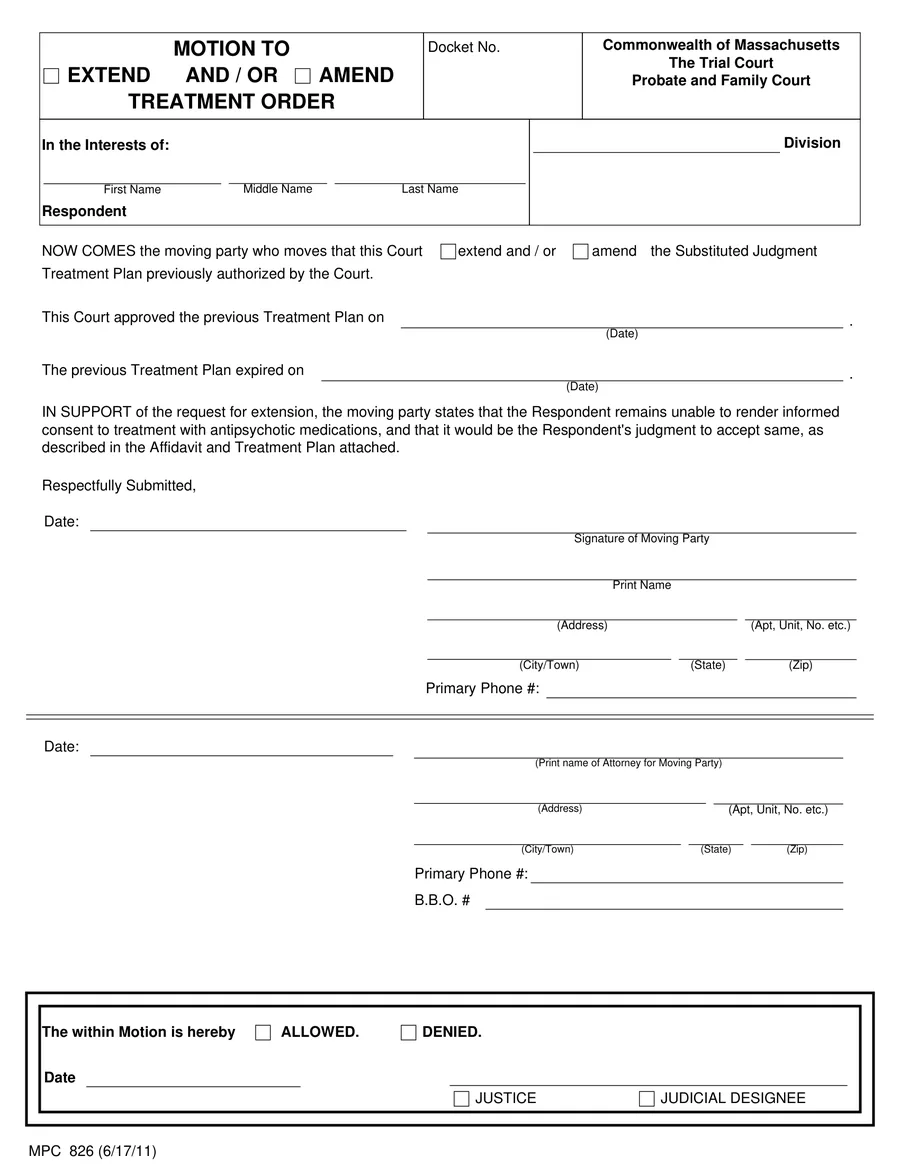
The MPC 826 is the Massachusetts Probate and Family Court motion that asks the court to extend or amend a substituted judgment treatment plan it has already authorized, for a respondent who remains unable to give informed consent to treatment with antipsychotic medications.
It asks for the respondent's name, the division and docket number, when the court approved the previous treatment plan and when it expired, and the moving party's and attorney's names, addresses, phone numbers and B.B.O. number. The supporting affidavit and treatment plan are attached to it.
You can download the fillable MPC 826 (PDF): edition 6/17/11. Check the court's guardianship and conservatorship forms list for the current version.