Fill out Minnesota health forms
with AI.
Minnesota health forms encompass a wide range of documents essential for navigating the state's healthcare landscape, from public assistance applications to administrative provider agreements. These documents are critical for ensuring that residents receive necessary medical coverage and that providers can communicate effectively with state agencies and insurance carriers. Whether you are applying for state-funded insurance or managing the secure release of patient data, these forms serve as the legal and administrative backbone of healthcare interactions within Minnesota.
By continuing, you acknowledge Instafill's Privacy Policy and agree to get occasional product update and promotional emails.
About Minnesota health forms
Typically, these forms are required by individuals seeking enrollment in programs like MinnesotaCare or Medical Assistance (MA), as well as healthcare professionals managing electronic data interchange (EDI) for billing. For example, the DHS-6696-ENG application is a vital tool for families determining eligibility for public health programs based on residency and income. Similarly, patients often need to complete the Minnesota Standard Consent Form to Release Health Information to ensure their medical records are shared securely between providers or for legal purposes.
Navigating these multi-page documents can be time-consuming, but tools like Instafill.ai use AI to fill these forms in under 30 seconds while ensuring data accuracy and security. This technology streamlines the process by automatically identifying required fields and populating them with precision, turning a complex administrative task into a quick, manageable step.
Every form on this page can be completed without typing. Instafill is form filling software that reads a PDF and fills it for you — including flat and scanned documents that carry no fillable fields at all.
Forms in This Category
The forms in this category have a median Form Complexity Index of 41/100 (Basic), measured across 3 forms by field count, input difficulty, length, conditional logic and structure. See how it is calculated.
| Form Name | Pages | FCI | |
|---|---|---|---|
| 1. | Medicaid of Minnesota (Administered by HealthPartners of Minnesota) EDI Trading Partner Enrollment Form | 1 | Simple 27 |
| 2. | DHS-6696-ENG, Minnesota Health Care Programs Application (MNsure/DHS) | 13 | Very Complex 95 |
| 3. | Minnesota Standard Consent Form to Release Health Information | 1 | Basic 41 |
- Enterprise-grade security & data encryption
- 99%+ accuracy powered by AI
- 1,000+ forms from all industries
- Complete forms in under 60 seconds
How to Choose the Right Form
Applying for State Health Coverage
If you are an individual or a head of household seeking health insurance through the state, the DHS-6696-ENG, Minnesota Health Care Programs Application (MNsure/DHS) is the form you need. This comprehensive application is used by the Department of Human Services to determine if you qualify for Medical Assistance (MA), MinnesotaCare, or other financial help. You will need to provide details regarding your residency, citizenship, income, and tax filing status to complete this process.
Managing and Sharing Medical Records
When you need to transfer your medical history between healthcare providers, or if you need to provide your records to an attorney or insurance company, use the Minnesota Standard Consent Form to Release Health Information. This document is a standardized form approved by the Minnesota Department of Health. It ensures compliance with the Minnesota Health Records Act and protects your privacy while allowing for the necessary continuity of care. It is the best choice for ensuring your protected health information is shared only with designated third parties.
Healthcare Provider & Billing Administration
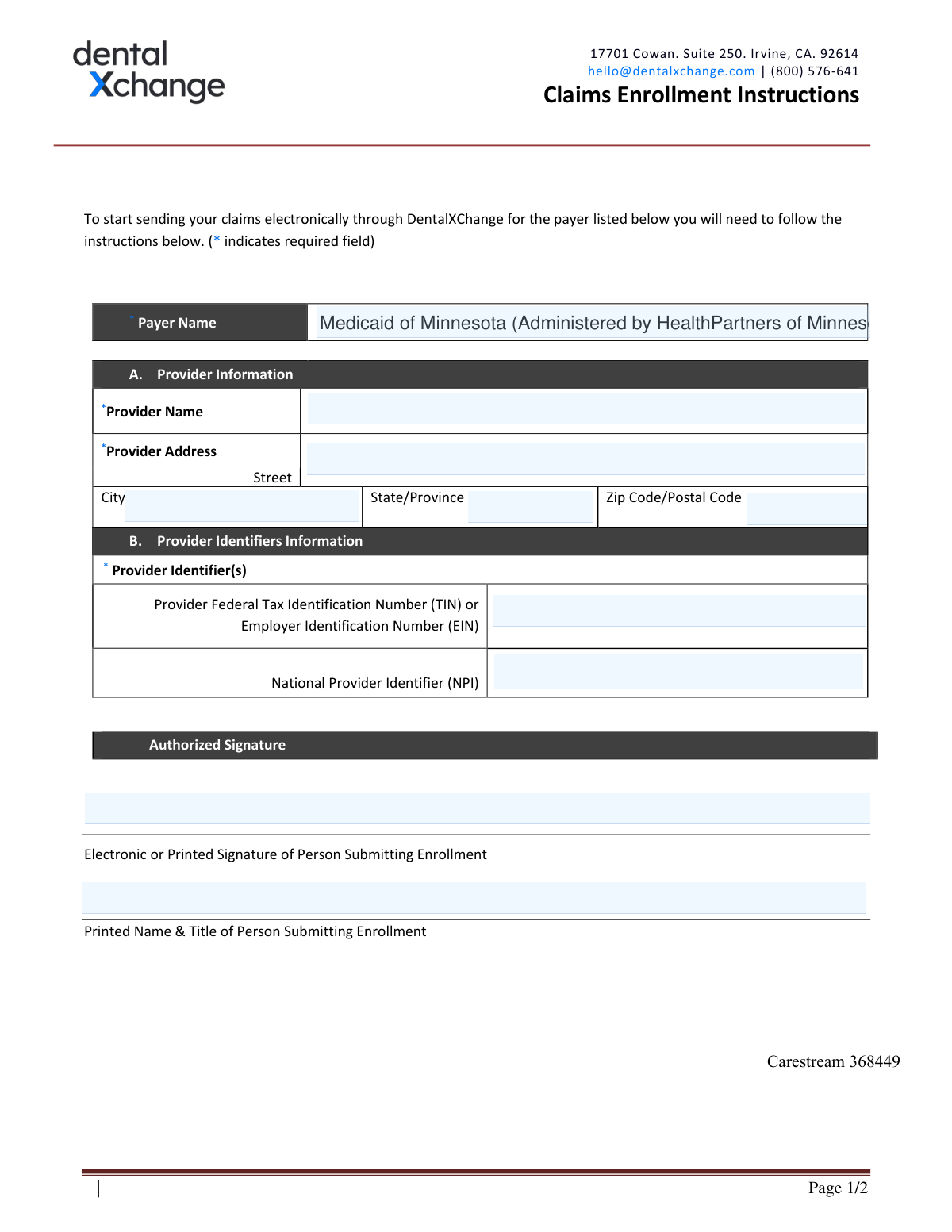
For healthcare providers and administrative staff looking to streamline their billing processes, the Medicaid of Minnesota (Administered by HealthPartners of Minnesota) EDI Trading Partner Enrollment Form is the appropriate document. This form is essential for setting up Electronic Data Interchange (EDI) capabilities. It allows providers to establish a connection through a clearinghouse, such as DentalXChange, ensuring that billing and claims information is transmitted securely and efficiently to HealthPartners.
Quick Selection Guide
- Seeking Health Insurance? Choose the DHS-6696-ENG to apply for state programs.
- Transferring Medical Records? Use the Minnesota Standard Consent Form to authorize the release of information.
- Setting up Electronic Billing? Select the EDI Trading Partner Enrollment Form to begin submitting electronic claims.
Form Comparison
| Form | Primary Purpose | Who Files It | Key Information Required |
|---|---|---|---|
| Medicaid of Minnesota (Administered by HealthPartners of Minnesota) EDI Trading Partner Enrollment Form | Establishes electronic connection for submitting healthcare claims to Medicaid via HealthPartners. | Healthcare providers or billing entities using clearinghouses for electronic claim submission. | Provider details, clearinghouse information, and designated EDI contact person data. |
| DHS-6696-ENG, Minnesota Health Care Programs Application (MNsure/DHS) | Applies for state health programs including Medical Assistance and MinnesotaCare coverage. | Individuals or families seeking public health insurance and financial assistance in Minnesota. | Household income, tax filing status, residency, and citizenship or immigration documentation. |
| Minnesota Standard Consent Form to Release Health Information | Authorizes the legal release of protected health information to a third party. | Patients or legal guardians authorizing the transfer of private medical records. | Patient identification, specific records to be released, and recipient organization details. |
Tips for Minnesota health forms
When filling out the DHS-6696 application, ensure your tax filing status and income details match your most recent records. Discrepancies between your form and state tax data can lead to lengthy manual verification requests and delays in receiving health coverage.
Under the Minnesota Health Records Act, consent forms must be specific about what information is being shared and for what purpose. Avoid broad or open-ended requests to ensure your provider can legally process the release without rejecting the form for lack of specificity.
If you are setting up electronic billing via the HealthPartners EDI form, double-check your clearinghouse ID and National Provider Identifier (NPI). Incorrect identifiers are the primary cause of enrollment delays in Minnesota’s Medicaid billing system.
AI-powered tools like Instafill.ai can complete these complex Minnesota health forms in under 30 seconds with high accuracy. Your sensitive medical and personal data stays secure during the process, making it a highly efficient solution for those managing multiple healthcare applications.
For multi-page applications like the Minnesota Health Care Programs form, have your residency proof and citizenship documents nearby. Having these details ready allows you to fill out the form sections consecutively without having to search for data in the middle of the process.
Many Minnesota health release forms require a specific end date for the authorization to remain valid. Always specify a timeframe that covers your anticipated needs to avoid having to re-file the paperwork if your legal or insurance matter takes longer than expected.
Frequently Asked Questions
These forms are designed for various individuals and entities within the Minnesota healthcare system, including residents applying for state-funded insurance, patients authorizing the release of medical records, and healthcare providers setting up electronic billing. Depending on your role, you may need one of these documents to access coverage, share information, or manage administrative tasks.
If you are seeking coverage through Minnesota Health Care Programs like Medical Assistance (MA) or MinnesotaCare, you should use the DHS-6696-ENG (MNsure/DHS) application. This comprehensive form gathers household, income, and residency information to determine your eligibility for public health programs.
You should use the Minnesota Standard Consent Form to Release Health Information. This document is approved by the Minnesota Department of Health and ensures that your health information is shared in compliance with the Minnesota Health Records Act.
When filling out the MNsure/DHS application, you will need to provide details regarding your household members, tax filing status, residency, and citizenship or immigration status. It also requires accurate income documentation to verify eligibility for financial assistance or specific programs.
This form is specifically for healthcare providers who want to submit electronic claims to Medicaid of Minnesota via HealthPartners. It establishes a secure connection through a clearinghouse, allowing for efficient digital billing and transmission of healthcare data.
Yes, you can use AI tools like Instafill.ai to complete these forms. The AI can accurately extract data from your source documents and place it into the correct fields, ensuring that complex forms like the MNsure application are filled out precisely.
While manual entry for multi-page documents can take significant time, using an AI-powered service like Instafill.ai can reduce the process to under 30 seconds. The tool automates data entry and can even convert static PDF forms into interactive, fillable documents.
Submission instructions vary by form: the MNsure application is usually sent to the Department of Human Services or your local county agency, while the EDI enrollment form is submitted to HealthPartners. Consent forms are typically provided directly to the healthcare provider or facility holding the records.
Most Minnesota health forms require a signature to be legally valid, especially those involving privacy consents or legal acknowledgments of rights and responsibilities. Many digital platforms now allow for secure electronic signatures that meet state and federal requirements.
Under the Minnesota Health Records Act, a specific legal framework must be followed to release protected health information. Using the state-approved standard consent form ensures that all legal requirements for privacy and authorization are met for both the provider and the patient.
Providing inaccurate data on forms like the DHS-6696-ENG can delay your eligibility determination or lead to an incorrect assessment of benefits. It is important to review all household and income information carefully before submitting the application to the state.
Providers must generally work with a recognized clearinghouse to facilitate the electronic transmission of claims. The enrollment form serves as the administrative bridge to authorize this digital connection between the provider and the payer, such as HealthPartners.
Glossary
- Form Complexity Index
- Instafill’s 0–100 measure of how much effort a form takes to complete, calculated deterministically from the form’s own structure rather than estimated. It combines the number of fillable fields (the largest factor), how difficult those fields are to complete based on their type, the number of pages that contain fields, the amount of conditional “fill-only-if” logic, and how many sections the form is divided into, then adds modifiers for tables and repeating lists, bundled instruction pages, and dense page layouts. A higher score means the form is harder to fill out by hand. The forms in this category have a median Form Complexity Index of 41/100 (Basic). See exactly how it is calculated.
- MA (Medical Assistance)
- Minnesota's version of Medicaid, which provides health care coverage for low-income residents, including children, families, and people with disabilities.
- MNsure
- The state's official health insurance marketplace used to apply for health coverage, compare private plans, and determine eligibility for financial assistance.
- MinnesotaCare
- A state-funded health program for Minnesotans who earn too much to qualify for Medical Assistance but do not have access to affordable employer-sponsored insurance.
- EDI (Electronic Data Interchange)
- The standardized computer-to-computer exchange of health care information, such as billing claims, between a provider and an insurance carrier.
- Trading Partner
- A healthcare provider, clearinghouse, or billing agency that has entered into an agreement to exchange electronic data with a health plan.
- PHI (Protected Health Information)
- Any individually identifiable health information, such as medical history or treatment records, that is protected by the Minnesota Health Records Act.
- DHS (Department of Human Services)
- The state agency in Minnesota responsible for overseeing public health care programs and determining eligibility for state-funded benefits.
- Clearinghouse
- A third-party organization that acts as an intermediary to process and format health care claims before they are sent to an insurance payer.