Fill out radiology forms
with AI.
Radiology forms serve as the critical bridge between clinical recommendations and the actual delivery of advanced imaging services. Whether it involves diagnostic procedures like MRIs and CT scans or specialized research protocols, these documents ensure that every radiological exam is medically justified and properly documented. They are essential for navigating the complex intersection of patient care, insurance reimbursement, and regulatory compliance, helping to prevent delays in treatment and ensuring that healthcare facilities receive proper compensation for their services.
By continuing, you acknowledge Instafill's Privacy Policy and agree to get occasional product update and promotional emails.
About radiology forms
These forms are typically handled by healthcare providers, medical billing specialists, and clinical researchers who must coordinate with insurance carriers or institutional review boards. For instance, a Radiology Prior Authorization Request or a Precertification Request is a standard requirement for verifying coverage before a procedure begins. Similarly, in academic settings, forms like the Radiological Services Request (RSR) are necessary for investigators to secure the resources needed for clinical trials. Because these documents often require precise data entry, including CPT codes and patient history, the administrative burden can be significant for busy medical offices.
To streamline this administrative workflow, tools like Instafill.ai use AI to accurately and securely complete these forms in under 30 seconds. This technology helps medical professionals focus more on patient outcomes and less on manual data entry, ensuring that even non-fillable PDF versions are handled with precision and speed.
Every form on this page can be completed without typing. Instafill is form filling software that reads a PDF and fills it for you — including flat and scanned documents that carry no fillable fields at all.
Forms in This Category
The forms in this category have a median Form Complexity Index of 40/100 (Basic), measured across 3 forms by field count, input difficulty, length, conditional logic and structure. See how it is calculated.
| Form Name | Pages | FCI | |
|---|---|---|---|
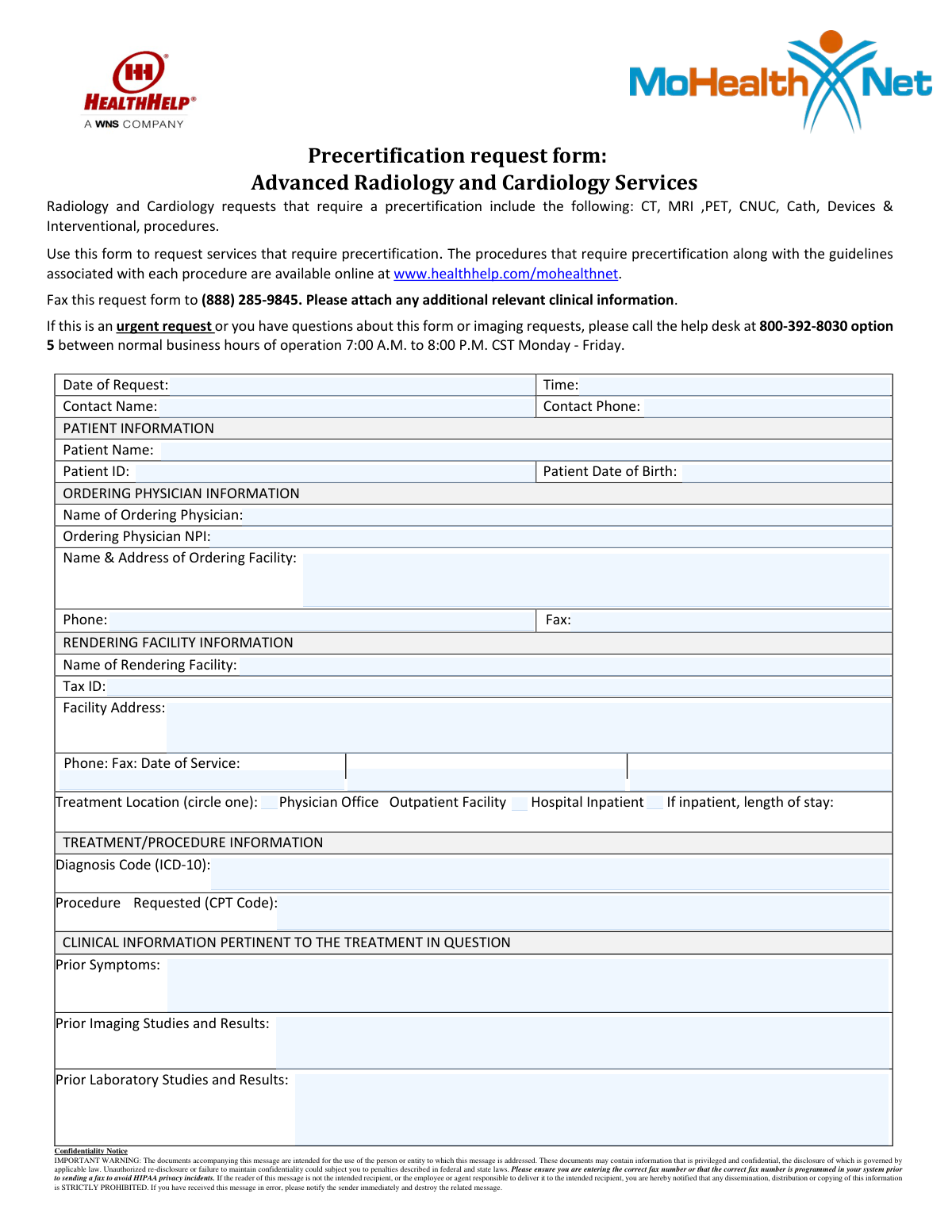
| 1. | Precertification request form: Advanced Radiology and Cardiology Services | 1 | Basic 37 |
| 2. | Radiological Services Request (RSR) | 2 | Basic 44 |
| 3. | Radiology Prior Authorization Request Form | 2 | Basic 40 |
- Enterprise-grade security & data encryption
- 99%+ accuracy powered by AI
- 1,000+ forms from all industries
- Complete forms in under 60 seconds
How to Choose the Right Form
Navigating radiology documentation requires identifying whether the request is for clinical insurance approval or academic research. Use the following guide to select the correct document for your specific administrative needs.
Insurance Pre-Approval and Prior Authorization
Most radiology forms in this category are designed to verify medical necessity before a procedure is performed. This is essential for ensuring reimbursement and avoiding billing issues for the patient.
- General Advanced Imaging: Use the Precertification request form: Advanced Radiology and Cardiology Services when you need to submit a formal request to an insurance provider or health plan administrator. This form covers a broad range of high-level diagnostic services to ensure they are deemed medically necessary before the service is rendered.
- Texas Medicaid Patients: If you are a healthcare provider in Texas, you must use the Radiology Prior Authorization Request Form (Form F00078). This specific document is required by the Texas Medicaid & Healthcare Partnership (TMHP) for obtaining pre-approval for imaging services such as PET scans, MRIs, and CT scans.
Clinical Research and Academic Requests
Not all radiology forms are related to standard patient billing; some are specific to the development of medical science and institutional resource management.
- UCD Health Research: If you are a Principal Investigator at UCD Health, you must use the Radiological Services Request (RSR). This form is mandatory for initiating the review process with the Radiology Research Committee to determine the cost and scope of radiology support for clinical research projects.
Quick Selection Summary
- Seeking approval for private insurance or cardiology? Choose the Precertification request form: Advanced Radiology and Cardiology Services.
- Submitting a claim to Texas Medicaid? Use the Radiology Prior Authorization Request Form (Form F00078).
- Conducting a research study at UCD Health? Select the Radiological Services Request (RSR).
By using Instafill.ai, you can quickly complete these forms or convert non-fillable versions into interactive documents to streamline your healthcare workflow.
Form Comparison
| Form | Primary Purpose | Intended User | Service Scope | Key Requirement |
|---|---|---|---|---|
| Precertification request form: Advanced Radiology and Cardiology Services | Secure insurance approval for advanced medical procedures. | Healthcare providers and medical facility staff. | Advanced radiology and cardiology imaging services. | Demonstration of medical necessity for insurance coverage. |
| Radiological Services Request (RSR) | Request radiology department support for clinical research. | Principal Investigators at UCD Health. | Imaging services specifically for research projects. | Review by the Radiology Research Committee for cost. |
| Radiology Prior Authorization Request Form | Obtain pre-approval for Texas Medicaid reimbursement. | Texas Medicaid healthcare providers. | High-tech imaging like CT, MRI, and PET scans. | Submission to TMHP to validate medical necessity. |
Tips for radiology forms
Ensure that the patient’s full name, date of birth, and insurance ID number match their official records exactly. Even a small typo in a policy number can lead to an immediate denial of a precertification or prior authorization request.
Most radiology forms require precise procedure codes (CPT) and diagnosis codes (ICD-10). Providing the most specific codes possible helps the reviewing committee or insurance provider understand the medical necessity without requesting further clarification.
AI-powered tools like Instafill.ai can complete these complex radiology forms in under 30 seconds with high accuracy. Your data stays secure during the process, making it an efficient way to handle multiple medical requests or research authorizations simultaneously.
For advanced imaging like MRIs or PET scans, simply filling out the form may not be enough. Always have clinical notes, previous test results, or a brief medical history ready to attach, as these are often required to justify the necessity of the service.
Double-check that the requesting physician’s National Provider Identifier (NPI) and contact details are accurate and legible. This ensures that the approval notification is sent to the correct office promptly, preventing delays in patient care.
Since radiology authorizations can take several days to process, organize your forms based on the urgency of the procedure. Submitting research-related requests well in advance of study start dates helps avoid administrative bottlenecks.
Frequently Asked Questions
Radiology forms are used to request specific imaging services, such as MRIs, CT scans, or PET scans, and to ensure these procedures meet medical necessity criteria. They facilitate communication between healthcare providers, insurance companies, and radiology departments to coordinate care and insurance billing.
In most cases, the referring physician or their clinical staff is responsible for filling out these forms. While patients may provide personal insurance information, the medical justification and diagnostic codes must be provided by a licensed healthcare professional to ensure clinical accuracy.
These forms are usually required before a non-emergency advanced imaging procedure is performed to confirm that the insurance provider will cover the costs. Submitting these early helps prevent unexpected medical bills for the patient and ensures the facility will be reimbursed for the service.
Most forms require the patient's demographic information, insurance member ID, and specific CPT codes for the requested procedure. Additionally, providers must include clinical documentation, such as previous test results or physical exam findings, to support the medical necessity of the scan.
Research forms, such as the Radiological Services Request (RSR), are used by investigators to coordinate imaging for clinical trials or studies rather than routine patient care. These forms often require information about the research protocol, funding sources, and specific technical requirements for the study's data collection.
Yes, AI-powered tools like Instafill.ai allow you to fill out complex radiology forms by automatically extracting data from medical records or source documents. This technology ensures that clinical codes and patient data are placed accurately into the correct fields, reducing the risk of manual entry errors.
Submitting a form with missing or incorrect information often leads to processing delays or immediate denials from insurance payers. This can result in the rescheduling of important diagnostic tests and may require the provider to restart the authorization process from the beginning.
Using modern AI tools like Instafill.ai, most radiology forms can be completed in under 30 seconds. The AI quickly maps information from your existing documents directly into the form, which is significantly faster than manual typing.
Submission instructions vary depending on the specific form; clinical forms are typically sent to the insurance payer or a third-party benefits manager via fax or an online portal. Institutional forms, like those for university research, are usually submitted directly to the facility's internal radiology committee.
While general X-rays often do not require advanced paperwork, these forms are specifically designed for high-tech imaging like MRI, CT, and nuclear medicine. Each form is tailored to the specific administrative requirements of the insurer or the medical facility performing the scan.
If a request is denied, the provider usually receives a notice explaining the reason, such as a lack of clinical evidence or incorrect coding. The provider can then submit an appeal or a peer-to-peer review, which may involve providing additional clinical documentation to support the patient's need for the scan.
Glossary
- Form Complexity Index
- Instafill’s 0–100 measure of how much effort a form takes to complete, calculated deterministically from the form’s own structure rather than estimated. It combines the number of fillable fields (the largest factor), how difficult those fields are to complete based on their type, the number of pages that contain fields, the amount of conditional “fill-only-if” logic, and how many sections the form is divided into, then adds modifiers for tables and repeating lists, bundled instruction pages, and dense page layouts. A higher score means the form is harder to fill out by hand. The forms in this category have a median Form Complexity Index of 40/100 (Basic). See exactly how it is calculated.
- Prior Authorization
- A process where a healthcare provider must get approval from a health insurance plan before a specific radiology service is performed. It confirms that the procedure is covered and avoids the denial of payment after the scan is complete.
- Medical Necessity
- The clinical justification that a specific imaging procedure is required to diagnose or treat a patient's condition according to standard medical guidelines. This is the primary criteria used by insurers to approve or deny a request.
- CPT Code
- Current Procedural Terminology codes are five-digit numbers used to identify the specific diagnostic service being requested, such as a CT scan or MRI. These codes ensure that the provider and the insurer are referencing the exact same procedure.
- ICD-10 Code
- A standardized system of alphanumeric codes used to classify every known disease and injury. These codes are used on radiology forms to provide the specific diagnosis or symptoms that justify the need for an imaging test.
- Modality
- The specific type of imaging technology being utilized for the request, such as Ultrasound, Computed Tomography (CT), Magnetic Resonance Imaging (MRI), or Positron Emission Tomography (PET).
- NPI (National Provider Identifier)
- A unique 10-digit identification number issued to healthcare providers in the United States. It is required on forms to identify the specific physician ordering the radiology service and the facility performing it.
- Principal Investigator (PI)
- The lead researcher responsible for a clinical study or research project. In the context of research radiology forms, the PI is the person accountable for the scope and funding of the requested imaging services.
- TMHP (Texas Medicaid & Healthcare Partnership)
- The organization that manages claims and prior authorizations for Texas Medicaid programs. Providers in Texas must submit specific forms to this entity to receive reimbursement for radiological services.