How to fill out a California rental application
California has no state rental application form: each landlord or property manager hands you its own, often a trade-association form such as the California Apartment Association's. The questions are much the same on all of them: who you are, where you have lived, what you earn, your credit and rental history, and who and what will live in the unit with you. State law decides what the landlord may charge to screen you, when that fee comes back, and how your credit and income may be weighed. This guide walks through the form in the order you fill it, then the rules, as checked against the statutes on October 28, 2026. It is general information, not legal advice.
At a glance
- Form No state form; each landlord or manager uses its own application
- Screening fee cap $30 per applicant, adjusted yearly for inflation since 1998 (Civil Code 1950.6)
- Fee refund Within 7 days to applicants not selected, unless applications are taken in order (AB 2493, 2025)
- Vouchers Section 8 and other housing subsidies are protected source of income (Gov. Code 12955)
- Security deposit One month's rent at most; two for some small landlords (Civil Code 1950.5)
- Catalog forms California Apartment Association Form B-15, Rental Application
- Form categories California rental forms, Rental application forms
What to have ready
Many applications, the California Apartment Association's among them, ask each co-applicant and each occupant 18 or older for a separate one. Gather these before you start, so each part is filled in one sitting:
| Part of the form | What it asks | Where to find it |
|---|---|---|
| About you | Full name as on your ID, driver's license or ID number, Social Security number, date of birth, email | Driver's license or state ID |
| Residence history | Current and previous addresses, rent paid, move-in and move-out dates, each landlord's name and phone | Your leases, rent receipts |
| Employment and income | Employer, address, position, start date, gross income, supervisor's contact | Recent pay stubs, offer letter, last year's tax return if self-employed |
| Other income | Retirement, Social Security, support, a housing voucher, other benefits | Award letters, voucher paperwork, bank statements |
| Credit history | Bank name, major credit cards, past credit problems to explain | Bank and card statements |
| Rental and criminal history | Yes/no questions on evictions, broken leases, bankruptcy, lawsuits | Your own records; answer exactly |
| Occupants, vehicles, animals | Everyone else who will live there, cars and plates, pets | Registration cards, pet records |
| Emergency contact and signature | A contact who will not live with you; consent to a credit check |
Filling in each part
Write your name exactly as it appears on your ID, since the screening company matches the two. Give gross income, before taxes, because that is what most forms ask for. Fill every residence and employment line with dates and a phone number that works: a landlord who cannot reach a reference often treats the application as incomplete. The yes/no history questions are the ones that most often sink an application when the answer turns out to be wrong, so answer them as they are written. The authorization lets the landlord pull your consumer reports, and the signature page usually binds you to the fee and deposit terms, so read it before signing.
What the landlord may charge
Civil Code 1950.6 sets the rules for the application screening fee:
- The cap is $30 per applicant, adjusted each year for the Consumer Price Index since January 1, 1998, and never more than the landlord's actual cost of screening you. The state publishes no adjusted figure; Berkeley's Rent Board, which calculates it under this section, puts the 2026 maximum at $68.96.
- No unit, no fee. A landlord may not charge when they know or should know no unit is or soon will be available.
- Since January 1, 2025 (AB 2493), a fee may be charged only if the landlord either considers completed applications in the order received, gives you the screening criteria in writing with the form and approves the first applicant who meets them, or returns the whole fee to every applicant not selected within 7 days of choosing a tenant or 30 days of your application, whichever is first.
- Receipts and reports. You get an itemized receipt, any part of the fee not spent on screening back, and a copy of your credit report within 7 days of the landlord receiving it.
A landlord may choose to accept a reusable tenant screening report that you bought within the last 30 days. If it does, it may not charge you a screening fee or a fee to read the report (Civil Code 1950.1).
Credit history, vouchers and income
Government Code 12955, part of the Fair Employment and Housing Act, treats source of income as protected, and that includes Section 8 vouchers, VASH vouchers and other public housing subsidies. List a voucher under other income. Where there is a government rent subsidy, a landlord may not:
- measure your income against the full rent instead of the part you pay, or
- use your credit history without first offering you the choice of showing your ability to pay another way, such as benefit payments, pay records or bank statements, giving you reasonable time to provide them, and weighing them in place of the credit history.
The same section requires a landlord to count the combined income of people who will live together the same way it counts a married couple's. Complaints go to the California Civil Rights Department.
After you are approved
The security deposit is capped at one month's rent, on top of the first month's rent. A landlord who is a person, or an LLC owned by people, with no more than two rental properties and four units may ask for two months, unless you are a service member (Civil Code 1950.5). Some cities, Berkeley among them, add their own rules, so check with the local rent board too.
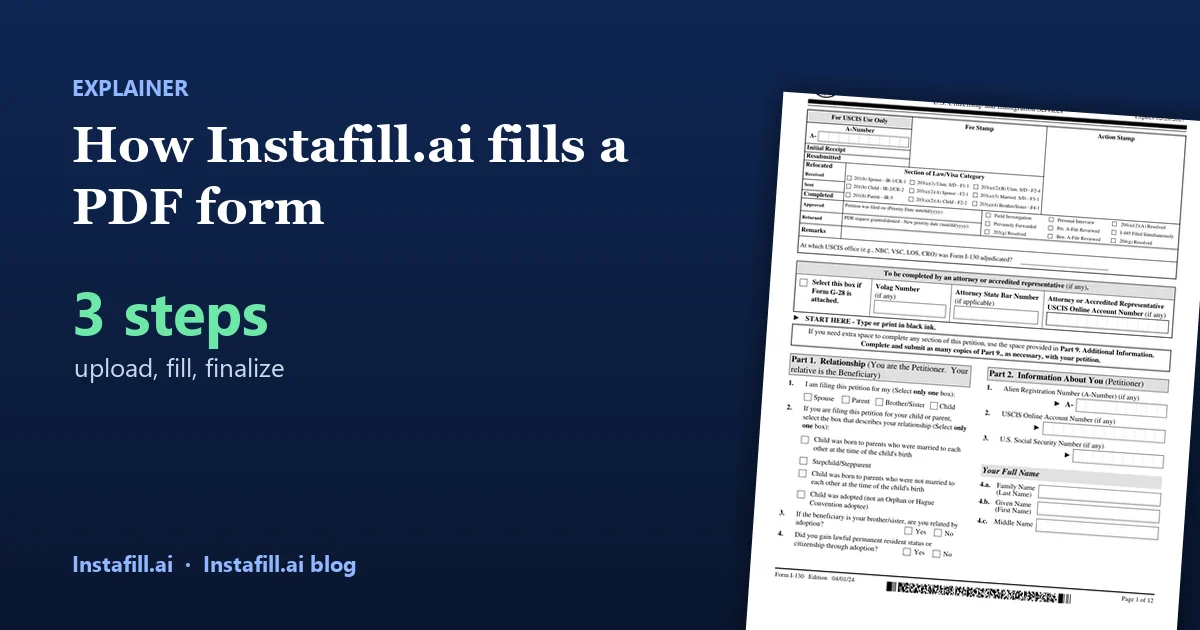
To fill one in from the documents you already have, the California Apartment Association rental application page on Instafill.ai completes the form from your ID, pay stubs and rental history, for you to check before you send it.