Fill out medical imaging forms
with AI.
Medical imaging forms are essential documents used to coordinate complex diagnostic procedures such as MRIs, CT scans, and PET scans. These forms ensure that critical clinical data is accurately shared between referring physicians, imaging facilities, and insurance providers. They play a vital role in maintaining patient safety, ensuring diagnostic accuracy, and verifying that advanced procedures are medically justified before they are performed. Without the proper documentation, patients may face delays in care or unexpected financial burdens.
By continuing, you acknowledge Instafill's Privacy Policy and agree to get occasional product update and promotional emails.
About medical imaging forms
Typically, these forms are managed by healthcare administrators, referring doctors, and patients preparing for specialized diagnostic tests. For example, a provider might need to submit a Prior Authorization Request to an insurance carrier to confirm coverage, or a facility might require specific clinical history to tailor the imaging protocol. In academic settings, these documents also include applications for diagnostic imaging programs. Tools like Instafill.ai use AI to fill these forms accurately and securely in under 30 seconds, streamlining the administrative process so that medical professionals and patients can focus on care instead of paperwork.
Every form on this page can be completed without typing. Instafill is form filling software that reads a PDF and fills it for you — including flat and scanned documents that carry no fillable fields at all.
Forms in This Category
The forms in this category have a median Form Complexity Index of 64/100 (Complex), measured across 4 forms by field count, input difficulty, length, conditional logic and structure. See how it is calculated.
| Form Name | Pages | FCI | |
|---|---|---|---|
| 1. | Admissions Application, School of Diagnostic Imaging, Mills-Peninsula Medical Center | 6 | Complex 71 |
| 2. | Advanced Imaging Prior Authorization Request Form | 1 | Moderate 52 |
| 3. | Massachusetts Collaborative — CT/CTA/MRI/MRA Prior Authorization Form | 2 | Complex 64 |
| 4. | Outpatient Imaging Prior Authorization Request Form | 1 | Moderate 51 |
- Enterprise-grade security & data encryption
- 99%+ accuracy powered by AI
- 1,000+ forms from all industries
- Complete forms in under 60 seconds
How to Choose the Right Form
Selecting the correct medical imaging form depends primarily on whether you are a healthcare provider seeking insurance approval for a patient or a student applying for professional training in the field.
Prior Authorization for Imaging Procedures
The majority of forms in this category are used by clinicians to document medical necessity before an imaging scan is performed. Choosing the right one depends on the patient's insurance plan and your geographic location:
- For Massachusetts-based Providers: Use the Massachusetts Collaborative — CT/CTA/MRI/MRA Prior Authorization Form for standardized requests involving CT and MRI scans within the state of Massachusetts.
- For HUSKY Health (Connecticut) or General Advanced Imaging: Select the Advanced Imaging Prior Authorization Request Form to ensure clinical justification is documented for state-specific or general advanced imaging needs.
- For Paramount Network Providers: If you are a provider within the Paramount insurance network, the Outpatient Imaging Prior Authorization Request Form is the required document for authorizing PET, CT, and MRI scans.
Academic and Career Applications
If you are an aspiring technician or radiologist rather than a practicing provider, your form needs are focused on enrollment:
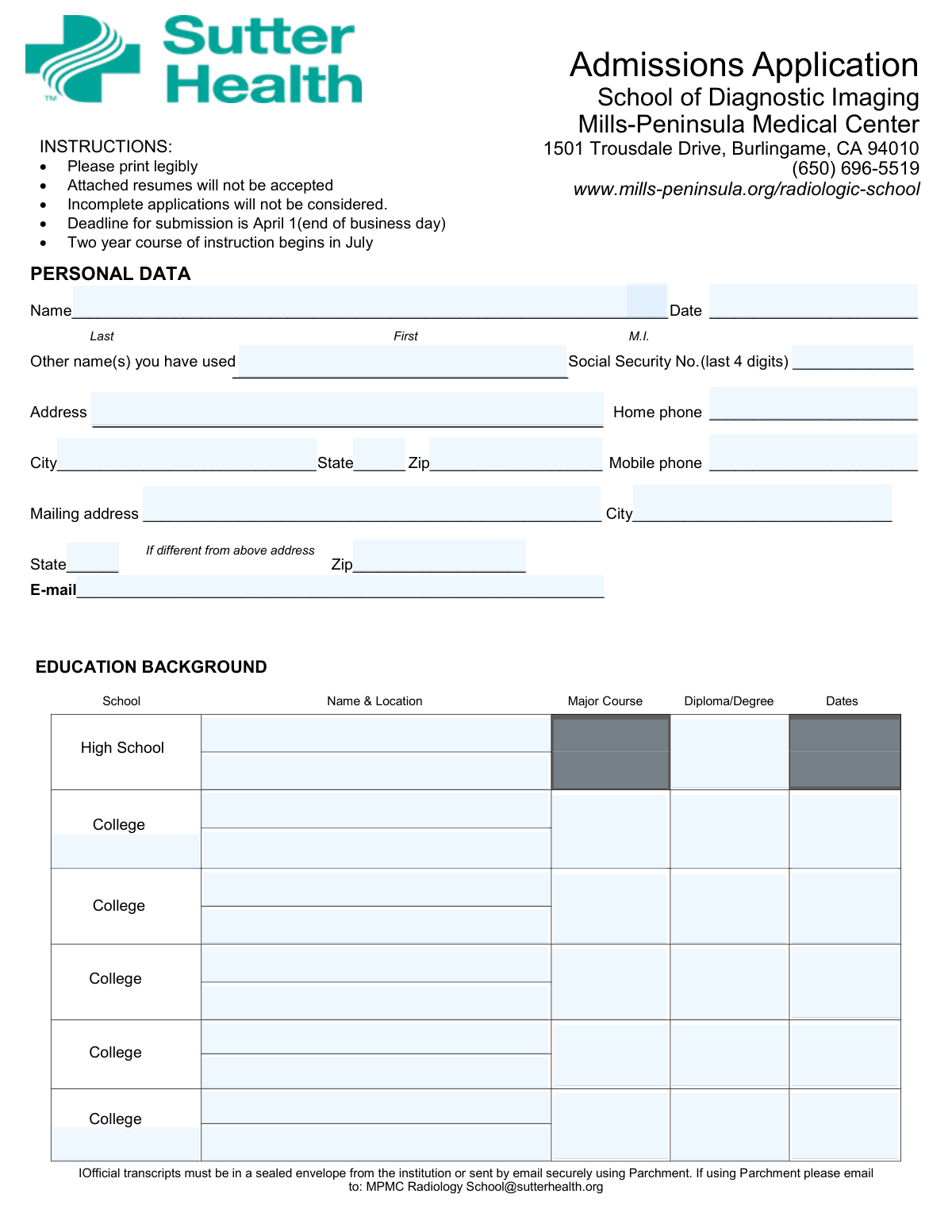
- Applying to Training Programs: Use the Admissions Application, School of Diagnostic Imaging, Mills-Peninsula Medical Center if you are seeking entry into their specific diagnostic imaging curriculum. This form requires your educational history, work experience, and prerequisite course details.
Quick Selection Tips
To ensure you choose the correct document, consider the following:
- Check the Insurance Carrier: Forms like the Outpatient Imaging Prior Authorization Request Form are specific to providers working with Paramount.
- Identify the Location: State-specific forms, such as the Massachusetts Collaborative form, are designed to meet local regulatory and payer standards.
- Verify the Modality: Confirm that the form covers the specific scan requested (e.g., ensuring PET scans are included if necessary).
Form Comparison
| Form | Primary Purpose | Who Files It | Key Information Required |
|---|---|---|---|
| Admissions Application, School of Diagnostic Imaging, Mills-Peninsula Medical Center | Applying for enrollment in a diagnostic imaging academic program. | Prospective students seeking admission to the imaging school. | Educational background, work history, and prerequisite course details. |
| Advanced Imaging Prior Authorization Request Form | Requesting insurance approval for advanced imaging procedures like MRI or CT. | Referring healthcare providers or their clinical administrative staff. | Patient clinical justification, provider details, and specific facility information. |
| Massachusetts Collaborative — CT/CTA/MRI/MRA Prior Authorization Form | Standardized authorization for advanced imaging studies within Massachusetts. | Healthcare providers ordering diagnostic scans for Massachusetts patients. | Medical necessity documentation for CT, CTA, MRI, or MRA scans. |
| Outpatient Imaging Prior Authorization Request Form | Securing pre-service approval for outpatient imaging through Paramount insurance. | Network healthcare providers ordering outpatient MRI, CT, or PET scans. | Clinical data supporting the necessity of outpatient diagnostic imaging services. |
Tips for medical imaging forms
Insurance providers require clear medical necessity to approve advanced imaging like MRIs or CT scans. Ensure you include specific symptoms, failed previous treatments, or relevant lab results to avoid immediate denials or requests for more information.
Incorrect procedure or diagnosis codes are a primary reason for imaging request rejections. Cross-reference the requested scan with the current billing codes to ensure the facility and the insurer are using the same terminology.
AI-powered tools like Instafill.ai can complete these complex forms in under 30 seconds with high accuracy, and your data stays secure during the process. This is a practical time-saver for healthcare providers dealing with high volumes of daily authorization requests.
When filling out outpatient imaging forms, verify that the selected imaging center is within the patient’s specific insurance network. Providing the correct NPI and tax ID for the facility ensures the prior authorization is valid for that specific location.
For diagnostic imaging admissions forms, have your prerequisite course details and GPA calculations ready before you begin. Ensuring your work history and educational background are listed chronologically helps the admissions committee review your application more efficiently.
Always save a copy of your completed authorization forms to track the status of the request with the insurer. Having the form on hand allows you to quickly answer follow-up questions from the insurance carrier or the imaging facility without starting over.
Frequently Asked Questions
This category includes a variety of forms ranging from educational applications for diagnostic imaging schools to prior authorization requests for procedures like MRIs and CT scans. These forms are used by both prospective students entering the medical field and healthcare providers coordinating patient care with insurance companies.
In most cases, the referring physician or their administrative staff is responsible for completing these forms and submitting them to the insurance provider. The forms require clinical justification and medical history that only the treating provider can accurately supply to ensure the procedure is covered.
It is best to submit these forms as soon as the imaging procedure is ordered, ideally several days or weeks before the appointment. Since insurance reviews can take time, early submission helps prevent delays in patient care and ensures that the financial responsibility is clarified before the scan takes place.
Providers in Massachusetts should use the Massachusetts Collaborative CT/CTA/MRI/MRA Prior Authorization Form. This standardized document is accepted by many health plans across the state to streamline the approval process for advanced diagnostic studies.
Most forms require the patient's insurance ID, the referring and performing provider information, and specific CPT and ICD-10 codes. Additionally, providers must often attach or summarize clinical notes that explain why the requested imaging is the most appropriate next step for the patient's diagnosis.
Prospective students can use the Admissions Application for the School of Diagnostic Imaging at Mills-Peninsula Medical Center to start their enrollment process. This form requires detailed personal data, a history of prerequisite coursework, and professional background information to be considered for the program.
Yes, AI tools like Instafill.ai allow you to fill out medical imaging and prior authorization forms in under 30 seconds. The AI accurately extracts data from your source documents and places it directly into the form fields, reducing manual entry errors.
Filling out complex medical imaging forms manually can take 10 to 15 minutes, but using an AI-powered service can complete the task in less than 30 seconds. This efficiency is particularly helpful for medical offices that handle a high volume of insurance paperwork daily.
Completed prior authorization forms are generally faxed or uploaded to the insurance carrier's provider portal or a designated third-party radiology benefits manager. Educational applications, such as those for Mills-Peninsula, should be sent directly to the school's admissions office as instructed on the form.
Yes, while some providers use a general 'Advanced Imaging' form, others have specific documents for different modalities. For example, the Paramount Outpatient Imaging form covers MRI, CT, and PET scans, while the Massachusetts Collaborative form is specifically tailored for CT and MRI studies.
Missing information is one of the most common reasons for a prior authorization denial or a delayed application. Insurance companies and educational institutions typically require all mandatory fields to be completed before they will begin the review process, which is why accuracy during the filling process is critical.
Glossary
- Form Complexity Index
- Instafill’s 0–100 measure of how much effort a form takes to complete, calculated deterministically from the form’s own structure rather than estimated. It combines the number of fillable fields (the largest factor), how difficult those fields are to complete based on their type, the number of pages that contain fields, the amount of conditional “fill-only-if” logic, and how many sections the form is divided into, then adds modifiers for tables and repeating lists, bundled instruction pages, and dense page layouts. A higher score means the form is harder to fill out by hand. The forms in this category have a median Form Complexity Index of 64/100 (Complex). See exactly how it is calculated.
- Prior Authorization
- A requirement by health insurance companies for patients to obtain approval for a medical procedure before it is performed to ensure the service is covered under their plan.
- Diagnostic Imaging
- A variety of non-invasive medical tests, such as X-rays, ultrasounds, or MRIs, used to create visual representations of the interior of a body for clinical analysis.
- Medical Necessity
- The standard used by insurers to determine if a specific medical service is required and appropriate for the diagnosis or treatment of a patient's condition.
- MRI and MRA
- MRI uses magnetic fields to create detailed images of organs and tissues, while MRA is a specialized version of the scan used specifically to look at blood vessels.
- CT and CTA
- A CT scan uses X-rays to create cross-sectional images of the body; a CTA is a specific type of CT scan that focuses on the flow of blood through the arteries and veins.
- Referring Provider
- The healthcare professional, usually a primary care doctor or specialist, who recommends and orders an imaging test for a patient.
- PET Scan
- An imaging test that uses a radioactive substance to show how your tissues and organs are functioning at a cellular level, often used to detect cancer or heart issues.
- Clinical Justification
- The detailed medical evidence and patient history provided by a doctor to explain why a specific imaging study is the best next step for a patient's care.