Disability Benefits Questionnaire (DBQ) - Muscle Injuries Completed Form Examples and Samples
View a detailed example of a filled Disability Benefits Questionnaire (DBQ) - Muscle Injuries. Learn how to accurately document muscle group involvement, functional findings, and clinical diagnoses for VA disability claims.
Disability Benefits Questionnaire (DBQ) - Muscle Injuries has a very complex Form Complexity Index of 91/100 — Instafill’s AI completes it in under a minute.
Form Complexity Index
Very Complex
91 / 100
| Fillable fields | 491 |
| Pages | 12 |
| Fields per page | 41 |
| Sections | 109 |
| Conditional rules | 397 |
| Tables & lists | 1 |
| Instruction pages | — |
| Instafill Form ID | IF-DISABILITY-BENEFITS-QUESTIONNAIRE-DBQ-MUSCLE-INJURIES |
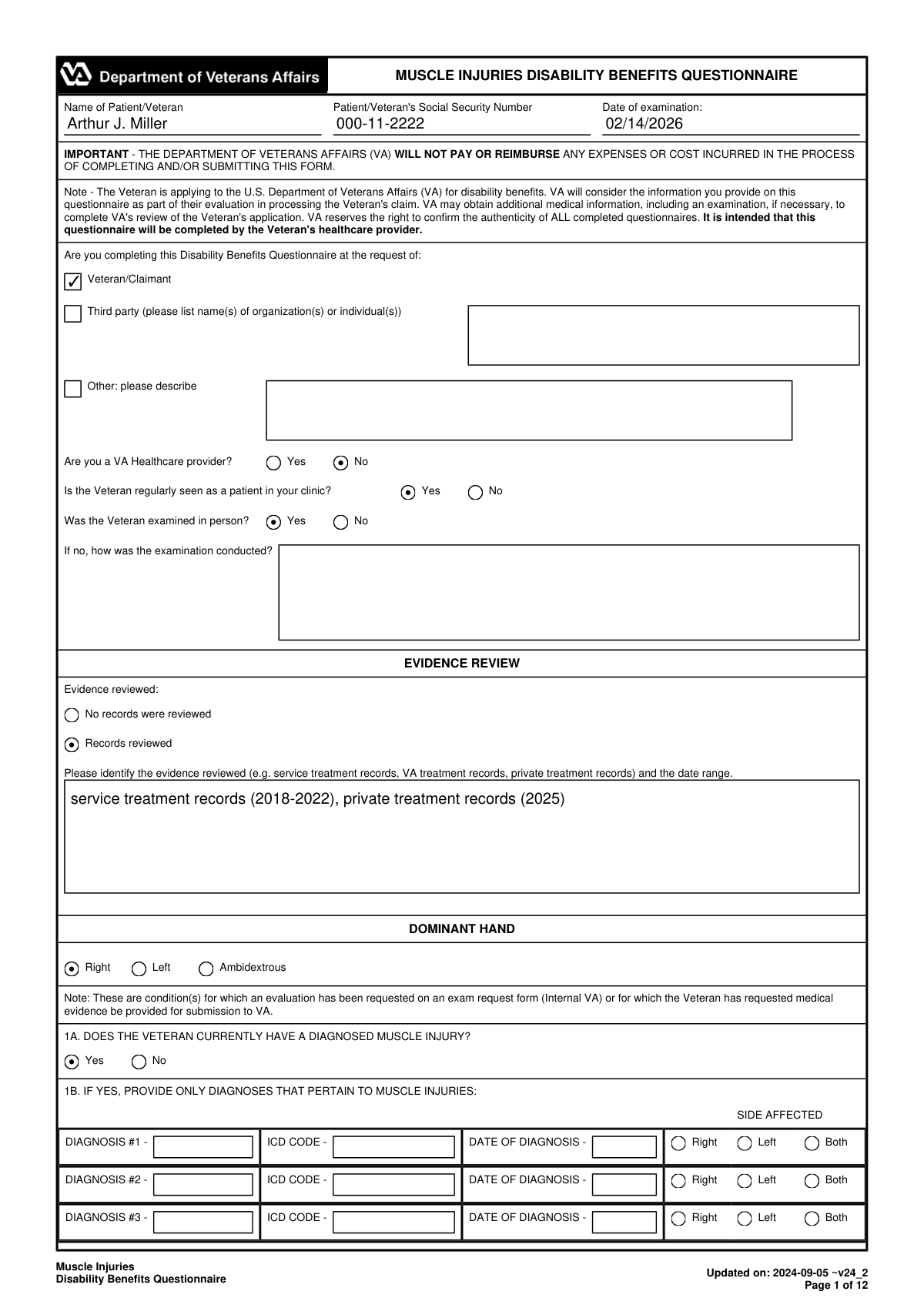
Example of a Filled Disability Benefits Questionnaire (DBQ) - Muscle Injuries
How this form was filled:
This example demonstrates how an AI assistant can process an unstructured medical progress note into a formal Disability Benefits Questionnaire (DBQ). The AI identifies and maps clinical observations, diagnoses, muscle group involvement, and functional impact—scattered throughout the doctor's narrative—directly into the standardized form fields required by the VA.
Source document used: Orthopedic Progress Note
Progress Note - Clinical Evaluation: Dr. Marcus Thorne, MD (Orthopedics, NPI: 1234567890, License: MD-998877, California). Exam Date: February 14, 2026. Patient: Arthur J. Miller, SSN 000-11-2222. The patient presented for a follow-up regarding his service-connected muscle injuries. He is a regular patient in our clinic. I performed an in-person physical examination today. I reviewed his service treatment records (2018-2022) and his recent private treatment records (2025). The veteran is right-hand dominant. Current diagnoses: Traumatic tear of the left quadriceps muscle (ICD-10: S76.112A) diagnosed on 05/12/2020 (Side: Left); Chronic strain of the right trapezius (ICD-10: M79.11) diagnosed on 11/02/2019 (Side: Right). He describes significant weakness in his left leg during long walks. Physical exam of the left thigh shows visible atrophy compared to the right (Left: 48cm vs Right: 52cm at max bulk). Strength testing reveals: Left knee flexion strength at 3/5, and left knee extension at 4/5. Right trapezius strength is 5/5. The patient reports occasional fatigue and pain in the left thigh muscles, which limits his ability to stand for more than 30 minutes, impacting his warehouse work duties. No retained metallic fragments found on current X-rays. He currently uses a cane for long-distance mobility on an occasional basis. No other pertinent physical findings or neoplasms noted. I have discussed these findings with the patient. Signed, Marcus Thorne, MD, 1500 Medical Plaza, Suite 400, Los Angeles, CA 90001. Phone: (555) 123-4567.
Information used to fill out the document:
- Veteran Details: Arthur J. Miller, SSN 000-11-2222
- Clinical Diagnoses: Left quadriceps tear (S76.112A), Right trapezius strain (M79.11)
- Muscle Groups: Group XIV (Anterior thigh) and Group I (Shoulder girdle)
- Functional Findings: Left knee flexion 3/5, left knee extension 4/5, left thigh atrophy
- Assistive Devices: Cane (occasional use)
- Examiner Info: Dr. Marcus Thorne, MD, 1500 Medical Plaza, Los Angeles, CA
What this filled form sample shows:
- Intelligent mapping of clinical narratives to specific ICD-10 codes
- Automatic correlation of physical exam measurements (atrophy, strength) to form fields
- Context-aware extraction: differentiating between 'Regular' and 'Occasional' use of assistive devices
- Accurate handling of side-specific data (left vs. right extremity findings)
- Structured output from unstructured prose, including provider contact data
Form specifications and details:
| FormName: | Disability Benefits Questionnaire (DBQ) - Muscle Injuries |
| TargetEntity: | Department of Veterans Affairs (VA) |
| Objective: | Quantify functional impairment for service-connected muscle disability claims |
| RequiredDetails: | Diagnosis, Muscle Group involvement, Strength testing, Functional impact |
| Categories: | disability forms, benefit forms, DBQ forms, disability benefits forms |
| Created: | May 19, 2026 05:49 PM |