Fill out DBQ forms
with AI.
Disability Benefits Questionnaires, or DBQ forms, are standardized medical evaluation tools used by the Department of Veterans Affairs (VA) to process disability compensation claims. These forms cover a wide range of medical conditions, from cardiovascular issues like hypertension and heart disease to orthopedic concerns involving the knee, ankle, or wrist. By providing a structured format for healthcare providers to document clinical findings, DBQs ensure that the VA receives the specific medical evidence required to determine the severity of a veteran's condition and assign an accurate disability rating.
By continuing, you acknowledge Instafill's Privacy Policy and agree to get occasional product update and promotional emails.
About DBQ forms
Veterans typically require these forms when filing an initial claim, requesting an increase in benefits, or responding to a VA request for updated medical information. Whether you are dealing with chronic conditions like Diabetes Mellitus or physical limitations resulting from service-related injuries, having a completed DBQ is essential for a smooth claims process. Because these documents require precise medical data and history, they are often completed during medical examinations by private physicians or VA-contracted examiners to ensure all diagnostic criteria are met.
Managing these complex documents can be time-consuming for both patients and providers, but modern technology has simplified the paperwork. Tools like Instafill.ai use AI to fill these forms in under 30 seconds, ensuring that data is handled accurately and securely while saving valuable time. This allows you to focus on the medical evidence and the claims process itself rather than the manual data entry required for each specific questionnaire.
Every form on this page can be completed without typing. Instafill is form filling software that reads a PDF and fills it for you — including flat and scanned documents that carry no fillable fields at all.
Forms in This Category
The forms in this category have a median Form Complexity Index of 87/100 (Very Complex), measured across 12 forms by field count, input difficulty, length, conditional logic and structure. See how it is calculated.
| Form Name | Pages | FCI | |
|---|---|---|---|
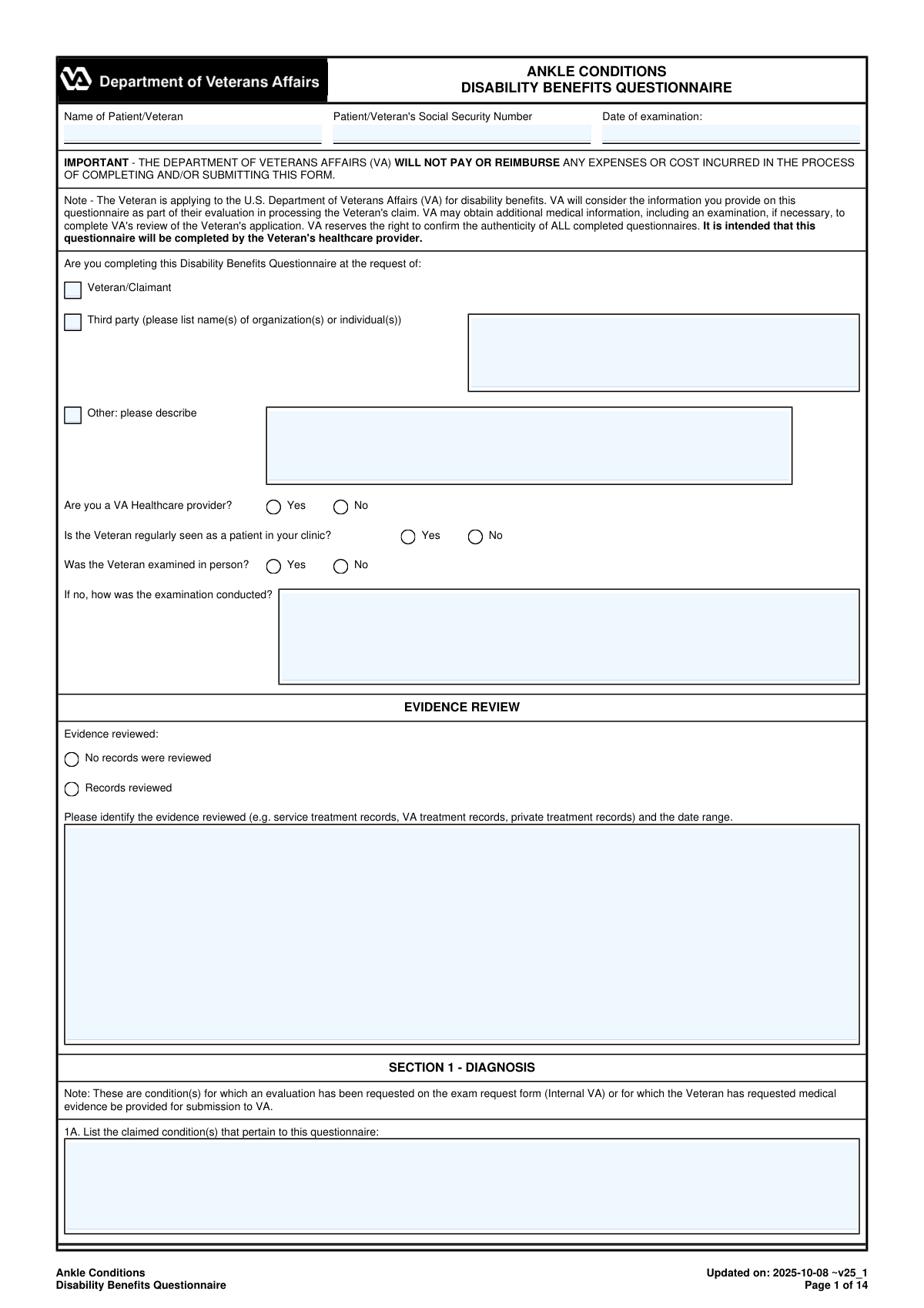
| 1. | Ankle Conditions Disability Benefits Questionnaire (DBQ) | 14 | Complex 75 |
| 2. | Form DBQ, Artery and Vein Conditions | 10 | Very Complex 84 |
| 3. | Form DBQ, Diabetes Mellitus Disability Benefits Questionnaire | 6 | Complex 69 |
| 4. | Disability Benefits Questionnaire (DBQ) - Muscle Injuries | 12 | Very Complex 91 |
| 5. | Form DBQ, Endocrine Diseases Disability Benefits | 9 | – |
| 6. | Form DBQ, Heart Conditions Disability Benefits | 10 | Very Complex 87 |
| 7. | Form DBQ, Hypertension Disability Benefits | 4 | – |
| 8. | Form DBQ, Knee and Lower Leg Disability Benefits | 14 | – |
| 9. | Form DBQ, Oral and Dental Conditions | 7 | Complex 75 |
| 10. | Form DBQ, Scars/Disfigurement Disability Benefits | 12 | – |
| 11. | Form DBQ, Thyroid and Parathyroid Conditions | 10 | Very Complex 88 |
| 12. | Wrist Conditions Disability Benefits Questionnaire (DBQ) | 13 | Very Complex 100 |
- Enterprise-grade security & data encryption
- 99%+ accuracy powered by AI
- 1,000+ forms from all industries
- Complete forms in under 60 seconds
How to Choose the Right Form
Disability Benefits Questionnaires (DBQs) are essential tools for veterans to provide medical evidence for VA disability claims. Choosing the right form depends entirely on the specific medical condition you are claiming. Most DBQs are categorized by body system or specific diagnosis.
Orthopedic and Joint Conditions
If your claim involves joint pain, limited range of motion, or injuries sustained during service, select the form that matches the specific body part. These forms require detailed measurements of movement and functional impact:
- Knee and Lower Leg Disability Benefits: Use this for stability issues or injuries affecting the knee joint and surrounding lower leg areas.
- Wrist Conditions Disability Benefits Questionnaire (DBQ): Specifically for capturing range-of-motion and repetitive-use limitations in the wrist.
- Ankle Conditions Disability Benefits Questionnaire (DBQ): Designed to document instability, flare-ups, and functional impact on the ankle.
Cardiovascular and Circulatory Health
These forms are used to evaluate heart health and blood pressure issues. Because the rating criteria differ significantly, ensure you pick the most precise diagnosis:
- Hypertension Disability Benefits: Specifically for veterans claiming high blood pressure.
- Heart Conditions Disability Benefits: Used for broader cardiac issues, including coronary artery disease or heart failure.
- Artery and Vein Conditions: Choose this for vascular diseases that affect blood flow outside of the heart itself.
Endocrine and Metabolic Disorders
If you are managing hormonal or metabolic conditions, the VA requires specific data points regarding your treatment and symptoms:
- Diabetes Mellitus Disability Benefits Questionnaire: Used to document blood sugar management and complications related to diabetes.
- Thyroid and Parathyroid Conditions: For conditions like hyperthyroidism, hypothyroidism, or other glandular issues.
- Endocrine Diseases Disability Benefits: A broader form for other hormonal system claims not covered by the thyroid or diabetes forms.
Specialized Physical Conditions
For conditions affecting the skin or oral health, use these targeted questionnaires:
- Scars/Disfigurement Disability Benefits: Used to evaluate the size, location, and severity of service-connected scarring.
- Oral and Dental Conditions: Use this for trauma or diseases affecting the mouth, tongue, or teeth.
Form Comparison
| Form | Condition Focus | Key Clinical Metrics | Assessment Goal |
|---|---|---|---|
| Form DBQ, Knee and Lower Leg Disability Benefits | Knee and lower leg musculoskeletal issues | Range of motion, joint stability, and weight-bearing capability | Determines disability rating for service-connected leg injuries |
| Form DBQ, Artery and Vein Conditions | Vascular diseases including arteries and veins | Blood flow, presence of ulcers, and circulatory efficiency | Documents vascular conditions to support medical evidence claims |
| Form DBQ, Heart Conditions Disability Benefits | Cardiovascular and heart-related health conditions | Heart function, METs testing, and cardiac rhythm | Provides clinical evidence for heart-related disability ratings |
| Form DBQ, Hypertension Disability Benefits | Chronic high blood pressure and hypertension conditions | Blood pressure readings over multiple days and severity | Establishes service connection for hypertension and related risks |
| Form DBQ, Oral and Dental Conditions | Mouth, lips, tongue, and dental structures | Service-related trauma, disease impact, and functional loss | Evaluates eligibility for dental and oral disability compensation |
| Form DBQ, Scars/Disfigurement Disability Benefits | Physical scars and visible disfigurement | Measurement of scar size, location, and functional limitation | Determines disability level based on physical appearance and pain |
| Form DBQ, Diabetes Mellitus Disability Benefits | Type 1 or Type 2 Diabetes Mellitus | Blood sugar control, insulin requirements, and secondary complications | Supports claims for metabolic disorders and health complications |
| Form DBQ, Endocrine Diseases Disability Benefits | Hormonal and endocrine system disorders | Gland function, hormone levels, and systemic health impact | Assesses work capability impact from hormonal system diseases |
| Form DBQ, Thyroid and Parathyroid Conditions | Thyroid and parathyroid gland dysfunctions | Metabolic rates, diagnostic imaging, and medication requirements | Evaluates specific glandular conditions for VA disability compensation |
| Wrist Conditions Disability Benefits Questionnaire (DBQ) | Wrist joints and surrounding musculoskeletal structures | Range of motion, grip strength, and repetitive-use limitations | Reports clinical findings to determine wrist disability severity |
| Ankle Conditions Disability Benefits Questionnaire (DBQ) | Ankle joints and lower extremity stability | Stability testing, ICD codes, and range of motion | Supports claims for ankle-related functional limitations and injuries |
Tips for DBQ forms
Each Disability Benefits Questionnaire is highly specialized for a single body system or condition, such as the heart, endocrine system, or specific joints. Ensure you select the form that matches your medical diagnosis exactly to prevent the VA from requesting a re-evaluation or a different form.
DBQ forms often require precise clinical data, such as Range of Motion (ROM) degrees for joints or specific blood pressure readings for hypertension. Having these medical records and imaging results ready before you start will help you provide the exact details needed for an accurate disability rating.
AI-powered tools like Instafill.ai can complete these complex medical forms in under 30 seconds with high accuracy. This is a massive time-saver for veterans or healthcare providers dealing with multiple forms, and your sensitive medical data stays secure throughout the entire process.
A common mistake is leaving the 'Functional Impact' section blank or being too brief. Clearly describe how the condition limits your daily activities and ability to work, as this information is vital for the VA to determine the appropriate compensation level.
Every DBQ must be completed and signed by a qualified healthcare professional to be considered valid evidence for a claim. Before submission, double-check that your doctor has fully filled out their contact information, license number, and signature block.
If you are filing for multiple related conditions, such as knee and ankle issues, ensure the medical history and dates provided are consistent across all forms. Discrepancies in your medical narrative can lead to processing delays or requests for additional clarification from the VA.
Frequently Asked Questions
Disability Benefits Questionnaires (DBQs) are standardized forms used by the Department of Veterans Affairs to gather specific medical evidence for disability claims. They are designed to ensure that healthcare providers document a veteran's condition in a way that directly addresses the VA's rating criteria. This structured format helps claims processors evaluate the severity of a disability more efficiently.
While the veteran is responsible for providing the correct form, the medical sections must be completed by a qualified healthcare professional. This can be a VA clinician during a Compensation and Pension (C&P) exam or a private physician who has reviewed the veteran's medical history. The provider must sign and date the form to certify the clinical findings.
You should select the DBQ that corresponds to the specific diagnosis or body system related to your claim. For instance, if you are filing for high blood pressure, you would use the Hypertension DBQ, whereas joint issues would require specific forms like the Knee and Lower Leg or Wrist Conditions DBQs. Reviewing your medical records first will help you identify the correct category of form for your condition.
Yes, AI tools like Instafill.ai can be used to fill out DBQ forms in under 30 seconds by accurately extracting data from your existing medical documents. This technology places information into the correct fields automatically, ensuring that the data matches your records precisely before you present the form to your doctor for review and signature.
After your healthcare provider has filled out and signed the form, you can upload it directly to the VA.gov portal as part of your disability claim. You may also submit it via mail to the VA's Evidence Intake Center or deliver it in person to a local VA regional office. Keeping a copy for your personal records is always recommended before submission.
Manually entering clinical data into these complex forms can take a significant amount of time, but using AI-powered platforms can complete the process in under 30 seconds. These tools help reduce manual entry errors by identifying relevant medical history from source documents and populating the PDF fields automatically.
While the VA does not strictly require a DBQ for every claim, submitting one can significantly strengthen your case by providing clear, organized evidence. Using these forms is especially helpful for 'Fully Developed Claims' (FDC), as they provide the VA with the exact information needed to make a rating decision without requesting additional records.
A DBQ is a document that captures medical evidence, while a Compensation and Pension (C&P) exam is a physical evaluation performed by a VA-appointed examiner. If you provide a completed DBQ from your own private physician, the VA may sometimes be able to process your claim without requiring you to attend a separate C&P exam, provided the evidence is sufficient.
If you have multiple service-connected conditions, such as issues with both your heart and your ankles, you will typically need a separate DBQ for each condition. The VA evaluates each body system or joint individually to determine the total disability rating. Providing specific forms for each issue ensures that every symptom and functional limitation is properly documented.
Yes, DBQs are frequently used to establish secondary service connections, which are conditions caused or aggravated by an existing service-connected disability. For example, if a veteran has a service-connected knee injury that leads to a back condition, a DBQ for the back can be used to document how the secondary issue is related to the primary injury.
Glossary
- Form Complexity Index
- Instafill’s 0–100 measure of how much effort a form takes to complete, calculated deterministically from the form’s own structure rather than estimated. It combines the number of fillable fields (the largest factor), how difficult those fields are to complete based on their type, the number of pages that contain fields, the amount of conditional “fill-only-if” logic, and how many sections the form is divided into, then adds modifiers for tables and repeating lists, bundled instruction pages, and dense page layouts. A higher score means the form is harder to fill out by hand. The forms in this category have a median Form Complexity Index of 87/100 (Very Complex). See exactly how it is calculated.
- DBQ
- Short for Disability Benefits Questionnaire, these are standardized forms used by the VA to collect clinical information from medical providers to evaluate disability claims.
- Service Connection
- The official determination that a veteran's current medical condition or disability was caused, or made worse, by their military service.
- C&P Exam
- A Compensation and Pension examination where a medical professional evaluates a veteran's condition to help the VA determine the level of disability rating.
- Range of Motion (ROM)
- A measurement of how far a joint can move in different directions, used frequently in DBQs for knees, wrists, and ankles to determine the severity of a physical limitation.
- Flare-ups
- Episodes where a veteran's symptoms become more severe; medical providers must document these on DBQs to show the condition's impact during its worst stages.
- ICD Code
- The International Classification of Diseases code used by doctors to provide a standardized, specific diagnosis for the condition being evaluated on the form.
- Ankylosis
- A medical term used in joint-related DBQs to describe the complete lack of movement or total stiffness in a joint like the wrist or ankle.
- Laterality
- A term indicating whether a condition affects the left side, right side, or both sides of the body, which can affect the final disability compensation amount.