Yes! You can use AI to fill out Wrist Conditions Disability Benefits Questionnaire (DBQ)
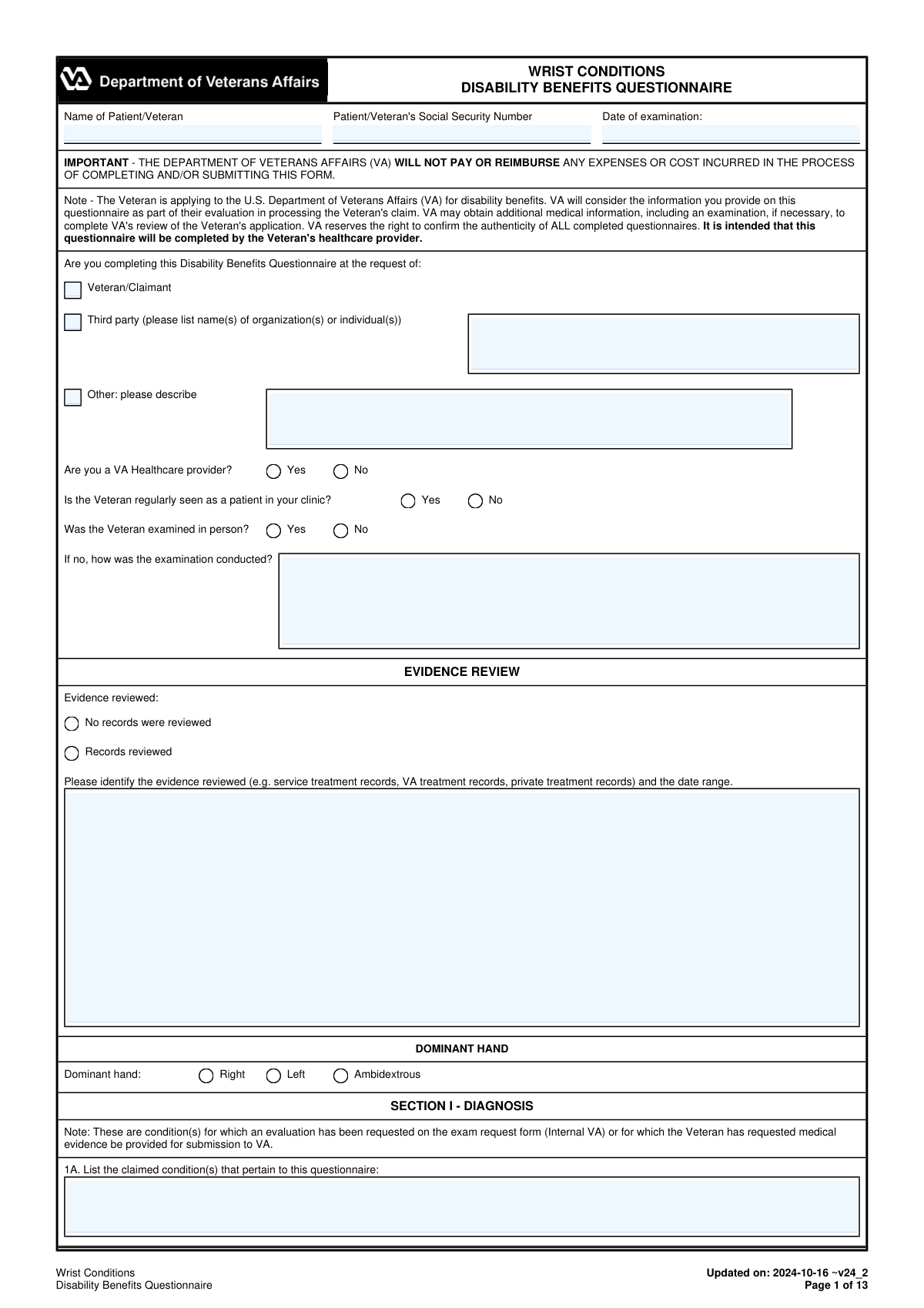
The Wrist Conditions DBQ is an official Department of Veterans Affairs medical questionnaire completed by a qualified healthcare provider to report clinical findings about a Veteran’s wrist condition(s). It captures key rating elements such as diagnoses, dominant hand, flare-ups, range-of-motion measurements (active/passive, weight-bearing/nonweight-bearing), repetitive-use limitations, ankylosis, surgeries, imaging, and functional impact. VA uses this standardized information to evaluate service-connected disability severity and determine compensation. Accurate, complete entries and supporting evidence review are important because the DBQ can significantly affect the claim outcome and rating level.
Our AI automatically handles information lookup, data retrieval, formatting, and form filling.
It takes less than a minute to fill out VA DBQ (Wrist Conditions) using our AI form filling.
Securely upload your data. Information is encrypted in transit and deleted immediately after the form is filled out.
Form specifications
| Form name: | Wrist Conditions Disability Benefits Questionnaire (DBQ) |
| Number of pages: | 13 |
| Language: | English |
Instafill Demo: filling out a legal form in seconds
How to Fill Out VA DBQ (Wrist Conditions) Online for Free in 2026
Are you looking to fill out a VA DBQ (WRIST CONDITIONS) form online quickly and accurately? Instafill.ai offers the #1 AI-powered PDF filling software of 2026, allowing you to complete your VA DBQ (WRIST CONDITIONS) form in just 37 seconds or less.
Follow these steps to fill out your VA DBQ (WRIST CONDITIONS) form online using Instafill.ai:
- 1 Enter Veteran/patient identifiers and exam details (name, SSN, date of exam) and indicate who requested the DBQ and whether the exam was in-person or remote (and how conducted).
- 2 Complete Evidence Review and Dominant Hand sections, listing records reviewed (types and date ranges) and selecting the Veteran’s dominant hand.
- 3 Document Section I (Diagnosis): list claimed wrist conditions, select all applicable diagnoses, specify side affected, ICD codes (if available), and dates of diagnosis; add any additional wrist diagnoses as needed.
- 4 Fill Section II (Medical History): summarize onset/course, note flare-ups (frequency, duration, triggers, alleviating factors), and describe functional loss after repeated use over time in the Veteran’s own words.
- 5 Complete Section III (Range of Motion): record right/left wrist ROM (active and passive), note pain on motion and testing conditions, perform repetitive-use testing (3 reps) when possible, and provide estimates for repeated use over time and flare-ups with supporting rationale/evidence.
- 6 Answer remaining clinical sections as applicable: muscle atrophy measurements, ankylosis severity, surgical procedures and residuals, other findings/scars, assistive devices, remaining effective function, and diagnostic testing/imaging results (including arthritis documentation).
- 7 Provide Functional Impact examples, add any Remarks, then complete Examiner Certification with signature, credentials, specialty, contact information, NPI, license details, and address; review for completeness before submitting with the Veteran’s claim.
Our AI-powered system ensures each field is filled out correctly, reducing errors and saving you time.
Why Choose Instafill.ai for Your Fillable VA DBQ (Wrist Conditions) Form?
Speed
Complete your VA DBQ (Wrist Conditions) in as little as 37 seconds.
Up-to-Date
Always use the latest 2026 VA DBQ (Wrist Conditions) form version.
Cost-effective
No need to hire expensive lawyers.
Accuracy
Our AI performs 10 compliance checks to ensure your form is error-free.
Security
Your personal information is protected with bank-level encryption.
Frequently Asked Questions About Form VA DBQ (Wrist Conditions)
This DBQ provides medical evidence about a Veteran’s wrist condition(s) for the VA to use when evaluating a disability benefits claim. The VA considers the information in this form as part of its decision-making and may still request additional exams or records.
The form is intended to be completed by the Veteran’s healthcare provider (examiner). The Veteran can provide symptom history (like flare-ups and functional loss), but the clinician must document findings, measurements, and certify the form.
No. The form states that the VA will not pay or reimburse any expenses or costs incurred to complete and/or submit the questionnaire.
No. The form asks whether the examiner is a VA healthcare provider, but it can also be completed by a non-VA (private) clinician as long as they can perform the exam and provide the required medical information.
Not always, but the form asks whether the Veteran was examined in person and, if not, how the examination was conducted. If an in-person exam or certain testing cannot be done, the examiner must explain why.
The examiner should indicate whether records were reviewed and list what was reviewed (for example, service treatment records, VA treatment records, and/or private treatment records) along with the date range. If no records were reviewed, that must be selected.
Dominant hand (right/left/ambidextrous) can affect how the VA evaluates functional impact and severity, especially when comparing limitations in the dominant versus non-dominant wrist.
Section I includes many wrist-related diagnoses (e.g., chronic wrist sprain, ganglion cyst, TFCC injury, DeQuervain’s, arthritis types, ankylosis, tendinopathy/tenosynovitis). If there is no current diagnosis related to the claimed condition(s), the examiner can select that option and must explain the findings in the Remarks section.
If the Veteran reports flare-ups, the examiner should record the Veteran’s description, including frequency, duration, triggers, relief factors, severity, and functional impact. Functional loss should be documented in the Veteran’s own words, including limitations after repeated use over time.
The form requests active and passive ROM values for dorsiflexion, palmar flexion, ulnar deviation, and radial deviation, and asks whether pain is present on active/passive motion and on weight-bearing/nonweight-bearing. If testing cannot be performed or is medically contraindicated, the examiner must provide an explanation.
Repetitive-use testing measures whether ROM or function worsens after at least three repetitions. The examiner must indicate whether the Veteran can perform it and whether there is additional loss of function/ROM, including the factors causing it (pain, fatigability, weakness, lack of endurance, incoordination, etc.).
The form still requires the examiner to estimate additional functional loss/ROM during flare-ups and after repeated use over time based on the Veteran’s statements, available records, and medical expertise. If an estimate cannot be provided, the examiner must give a case-specific explanation (not a general statement).
Ankylosis means the wrist joint is immobilized due to disease, injury, or surgery. If present, the examiner must indicate severity/position (e.g., favorable in 20–30 degrees dorsiflexion, unfavorable positions with palmar flexion or deviation) and provide degrees where requested.
Yes. The form asks about wrist surgeries (including total wrist replacement and other arthroscopic/wrist surgeries), residual symptoms, scars/disfigurement (and may require a dermatology questionnaire), and assistive devices like braces with frequency of use and the condition/side they are used for.
Imaging is required to confirm degenerative (osteoarthritis) or post-traumatic arthritis, and the examiner should list the type of test, date, and results. Once arthritis has been documented by imaging in the past, the VA does not require new imaging solely to reconfirm it, even if it has worsened.
Compliance VA DBQ (Wrist Conditions)
Validation Checks by Instafill.ai
1
Patient/Veteran Identification Fields Present (Name, SSN, Exam Date)
Validates that the Patient/Veteran name, Social Security Number, and Date of examination are all provided and not left blank. These fields are essential to correctly associate the DBQ with the correct claimant and to establish the timing of the medical findings. If any are missing, the submission should be rejected or routed to an exception queue because the form cannot be reliably matched to a claim or used for rating.
2
Social Security Number Format and Plausibility
Checks that the SSN is exactly 9 digits (optionally allowing standard hyphen formatting) and is not an obviously invalid value (e.g., all zeros, 123456789). This prevents misidentification and downstream matching failures with VA systems. If validation fails, the system should block submission and prompt for correction, since an invalid SSN can cause the record to be misfiled or rejected.
3
All Date Fields Use Valid Date Format and Are Chronologically Reasonable
Ensures all dates (Date of examination, Date of diagnosis, surgery dates, Date Signed, diagnostic test dates) are valid calendar dates in an accepted format (e.g., YYYY-MM-DD) and not in the future (except where explicitly allowed by policy). It also checks that key dates are logically ordered (e.g., Date Signed should be on/after Date of examination; surgery date should not be after exam date if described as historical). If a date is invalid or illogical, the form should be flagged for correction because it undermines medical timeline credibility and can affect adjudication.
4
Requestor Type Completeness (Veteran/Third Party/Other)
Validates that exactly one requestor option is selected (Veteran/Claimant, Third party, or Other). If 'Third party' is selected, at least one organization/individual name must be provided; if 'Other' is selected, a description must be provided. If this fails, the submission should be returned for completion because the provenance of the DBQ request affects authenticity review and recordkeeping.
5
Provider Status and Examination Modality Consistency
Checks that 'Are you a VA Healthcare provider?' and 'Was the Veteran examined in person?' are answered, and if 'Was the Veteran examined in person?' is 'No', the 'how was the examination conducted' field is completed. This ensures the VA can interpret the evidentiary weight of the findings and whether limitations apply to remote assessments. If inconsistent or incomplete, the form should be flagged because missing modality details can invalidate ROM and physical exam sections.
6
Evidence Review Selection Requires Supporting Details
Validates that one of 'No records were reviewed' or 'Records reviewed' is selected. If 'Records reviewed' is selected, the evidence types and date range must be provided (non-empty and date range formatted). If this fails, the system should request correction because the basis for medical opinions (history, diagnosis dates, imaging confirmation) depends on documented evidence review.
7
Dominant Hand Selection Required and Single-Choice
Ensures exactly one dominant hand option is selected (Right, Left, Ambidextrous). Dominance is used in rating considerations and functional impact interpretation for upper extremity conditions. If missing or multiple selections occur, the submission should be flagged for correction to avoid incorrect disability evaluation assumptions.
8
Claimed Conditions (1A) Must Be Provided
Checks that the clinician lists at least one claimed wrist-related condition in Section 1A. This anchors the scope of the DBQ and ensures the subsequent diagnoses and findings are tied to the claimed issues. If blank, the form should be rejected or routed for completion because the DBQ cannot be reliably interpreted without the claimed condition context.
9
Diagnosis Selection Logic (1B) and Required Side/ICD/Date Fields
Validates that either 'Veteran does not have a current diagnosis...' is selected OR at least one diagnosis row is selected, but not both. For each selected diagnosis, the affected side (Right/Left/Both) must be specified, and if the form captures ICD code and date of diagnosis, those fields must be populated in valid formats (ICD pattern and valid date). If this fails, the system should flag the record because incomplete diagnosis metadata prevents accurate coding, rating, and medical record integration.
10
Other Diagnosis Free-Text Required When 'Other' or 'Inflammatory other types' Selected
Ensures that when 'Other (specify)', 'Other diagnosis #1/#2', or 'Inflammatory other types (specify)' is selected, the corresponding free-text specification is not empty and is sufficiently descriptive (not just 'N/A' or a single character). This is important for clinical clarity and for mapping to appropriate diagnostic codes. If missing, the submission should be returned for clarification because unspecified 'Other' diagnoses are not actionable for adjudication.
11
Flare-Ups and Functional Loss Narrative Required When Answered 'Yes'
Checks that if the Veteran reports flare-ups (2B = Yes), the flare-up description includes at least frequency and duration (or an explicit statement that details are unknown). Similarly, if functional loss/impairment is reported (2C = Yes), a narrative description must be provided in the Veteran’s own words or clearly attributed summary. If absent, the form should be flagged because VA rating often depends on functional loss during flare-ups and repeated use over time.
12
ROM Testing Feasibility Requires Explanation When Not Performed
Validates that for each wrist, if ROM is marked 'Unable to test' or 'Not indicated', an explanation is provided. It also checks the 'Can testing be performed? Yes/No' prompts: if 'No', an explanation must be present and the contralateral/unclaimed joint damaged/undamaged selection must be consistent with whether ROM testing is required. If this fails, the submission should be flagged because missing rationale for absent ROM testing can render the exam inadequate.
13
ROM Degree Values Are Numeric and Within Physiologic Bounds
Ensures all entered ROM endpoints (dorsiflexion, palmar flexion, ulnar deviation, radial deviation) are numeric (allowing decimals if permitted) and within reasonable physiologic limits (e.g., not negative, not implausibly high such as >180). This prevents data entry errors that could distort severity assessment. If out of range or non-numeric, the system should block submission or require correction because invalid ROM values can directly affect disability evaluation.
14
Pain/Functional Loss Checkboxes Require Comments When Indicated
Validates that if 'evidence of pain' is 'Yes' and 'causes functional loss' is checked, the Comments field is completed with a brief description of how pain contributes to functional loss. It also checks that if localized tenderness is 'Yes', the explanation includes location and relationship to the condition. If missing, the form should be flagged because VA requires narrative support to interpret checkbox selections and to support medical conclusions.
15
Repetitive Use and Repeated Use Over Time Sections Require Estimates or Justified Infeasibility
Checks that if additional loss after three repetitions is 'Yes', the post-test ROM degrees and contributing factors are provided. For repeated use over time and flare-up estimate sections, if the examiner indicates significant limitation is suggested, estimated ROM values must be provided; if the examiner cannot provide an estimate, a case-specific explanation must be entered (not a generic refusal). If validation fails, the submission should be flagged because missing estimates/rationales are a common reason DBQs are deemed inadequate.
16
Muscle Atrophy Measurements Required When Atrophy Present
Validates that if muscle atrophy is 'Yes', the causation question (4B) is answered, and if atrophy is due to the claimed condition, the location and both circumference measurements (normal and atrophied side) are provided in centimeters and are positive numbers. If 4B is 'No', a rationale must be present. If missing, the form should be returned because atrophy findings require objective measurements to be clinically meaningful and rateable.
17
Ankylosis Severity Requires Degree Values/Descriptions When Applicable
Ensures that if ankylosis is 'Yes', exactly one severity category is selected and any category requiring degrees (palmar flexion/ulnar deviation/radial deviation) includes numeric degree values. If 'Any other position except favorable' is selected, a descriptive position statement must be provided. If this fails, the submission should be flagged because ankylosis classification is highly specific and directly impacts rating.
18
Surgical Procedure Details Required When Surgery Indicated
Validates that if 'Total wrist joint replacement' is selected, the date of surgery and residuals category are completed, and if 'Other residuals' is selected, a description is provided. If 'Arthroscopic or other wrist surgery' is selected, type of surgery, date, and residuals description must be present. If incomplete, the form should be flagged because surgical history and residual severity are critical for correct evaluation and may trigger additional required questionnaires.
19
Diagnostic Testing and Arthritis Confirmation Consistency
Checks that if diagnostic imaging/procedures were performed or reviewed (10A = Yes), then the type/date/results (10C) are provided. If degenerative or post-traumatic arthritis is documented (10B = Yes), a side (Right/Left/Both) must be selected and the imaging results should support the diagnosis; conversely, if an arthritis diagnosis is selected in Section I, the system should prompt for imaging documentation or a remark explaining prior documentation. If inconsistent, the submission should be flagged because arthritis diagnoses require imaging confirmation per the form instructions.
20
Examiner Certification Completeness (Signature, Credentials, Contact, NPI/License, Date Signed)
Validates that the examiner’s signature, printed name/title, specialty, date signed, and at least one contact number are present, and that NPI and medical license/state fields follow expected formats (NPI = 10 digits; license includes state). This supports authenticity verification and allows VA to contact the provider if clarification is needed. If missing or malformed, the submission should be rejected or held because an unsigned/uncredentialed DBQ may be considered invalid.
Common Mistakes in Completing VA DBQ (Wrist Conditions)
People often leave the Name of Patient/Veteran, Social Security Number, or Date of examination blank because they assume it’s already on file or will be added later. Missing identifiers can cause the DBQ to be rejected, misfiled, or delayed because VA cannot reliably match the form to the correct claim. Always complete these fields exactly as they appear in VA records and ensure the exam date reflects when the evaluation occurred (not when the form is submitted).
The requestor section is frequently checked incorrectly or left incomplete, especially when a law firm, VSO, or employer initiated the request. This can raise authenticity/administrative questions and may trigger follow-up requests for clarification. If “Third party” is selected, list the organization/individual name(s); if “Other” is selected, provide a clear description of who requested it and why.
A common error is checking “Was the Veteran examined in person? No” but then completing detailed physical exam findings (ROM, tenderness, crepitus) without explaining how they were obtained. This inconsistency can undermine credibility and lead VA to order a new C&P exam. If the exam was not in person, clearly document the method (telehealth, records-only, patient-reported) and avoid entering objective measurements unless they come from documented, reliable sources.
Clinicians often check “Records reviewed” but fail to identify which records were reviewed and the date range, or they list generic items without specifics. VA relies on this to understand the basis for opinions and estimates (especially for flare-ups and repeated use over time). List the exact record types (e.g., STRs, VA treatment notes, private ortho notes, imaging reports) and include an approximate date range (e.g., 2016–2024).
Dominant hand is sometimes skipped or marked incorrectly, and later sections may describe functional impact that doesn’t align with the dominant side. Dominance can affect functional impact and rating considerations, so inconsistencies can prompt clarification requests. Confirm with the Veteran which hand is dominant (including true ambidexterity) and ensure side-specific findings and narratives match that selection.
Many submissions select a diagnosis but leave the side affected, ICD code, and date of diagnosis blank, or they check “The Veteran does not have a current diagnosis” and provide no explanation in Remarks. This creates ambiguity about what is being evaluated and can delay adjudication or reduce probative value. For each diagnosis, specify right/left/both, provide an ICD code if available, and include an approximate diagnosis date; if no diagnosis applies, explain the clinical reasoning and supporting evidence in Remarks.
People often list the Veteran’s claimed condition in 1A but do not clarify when the current evaluation finds a different diagnosis (e.g., claimed “wrist sprain” but findings support TFCC injury or arthritis). VA expects the examiner to reconcile discrepancies and explain complications or changes. Use the Remarks section to explicitly state what was claimed, what is diagnosed now, and why (exam findings, imaging, history).
When “Yes” is checked for flare-ups, the narrative is often too brief (e.g., “has flare-ups”) and omits frequency, duration, triggers, alleviating factors, and functional impact. This is critical because VA must evaluate functional loss during flares, and missing details can lead to a new exam request. Record the Veteran’s description in their own words and include concrete examples (e.g., “2–3 times/week, lasts 1–2 hours, triggered by lifting >10 lbs, relieved by brace/NSAIDs, cannot grip tools”).
A frequent issue is selecting “Abnormal” or “All normal” but not providing the required degree values for dorsiflexion, palmar flexion, ulnar deviation, and radial deviation. Another common error is entering values that exceed normal endpoints or swapping movements (e.g., radial vs ulnar deviation). Always record numeric degrees for active and passive ROM (or select “Same as active ROM” appropriately), keep values within physiologic ranges unless clearly explained, and double-check each movement label before entering numbers.
Examiners often document pain generally but do not specify whether pain occurs on active motion, passive motion, weight-bearing, and nonweight-bearing, even though the form explicitly requires it. Missing this detail can make the DBQ noncompliant and trigger VA to request an addendum or schedule another exam. If any component cannot be tested or is medically contraindicated, provide a case-specific explanation (e.g., severe pain risk, post-op restrictions) rather than leaving it blank.
Sections 3C and 3D commonly have “Yes” for limiting factors but no estimated ROM in degrees, or the examiner states it is not feasible without explaining why using the Veteran’s statements and available evidence. VA guidance expects an estimate based on procurable information, not a refusal due to lack of direct observation. Provide best medical estimates in degrees when possible and, if not feasible, document a detailed, case-specific reason tied to the evidence limitations (not a generic statement).
Saved over 80 hours a year
“I was never sure if my IRS forms like W-9 were filled correctly. Now, I can complete the forms accurately without any external help.”
Kevin Martin Green
Your data stays secure with advanced protection from Instafill and our subprocessors
Robust compliance program
Transparent business model
You’re not the product. You always know where your data is and what it is processed for.
ISO 27001, HIPAA, and GDPR
Our subprocesses adhere to multiple compliance standards, including but not limited to ISO 27001, HIPAA, and GDPR.
Security & privacy by design
We consider security and privacy from the initial design phase of any new service or functionality. It’s not an afterthought, it’s built-in, including support for two-factor authentication (2FA) to further protect your account.
Fill out VA DBQ (Wrist Conditions) with Instafill.ai
Worried about filling PDFs wrong? Instafill securely fills wrist-conditions-disability-benefits-questionnaire forms, ensuring each field is accurate.




