
Yes! You can use AI to fill out Neck (Cervical Spine) Conditions Disability Benefits Questionnaire
Don't type 426 fields by hand. Tell our AI about yourself, or upload a document you already have, and it fills every field in seconds. You check it, then download, print or sign.
The AI does the filling. You just check it.
No typing into boxes, nothing to install.
What this form asks for
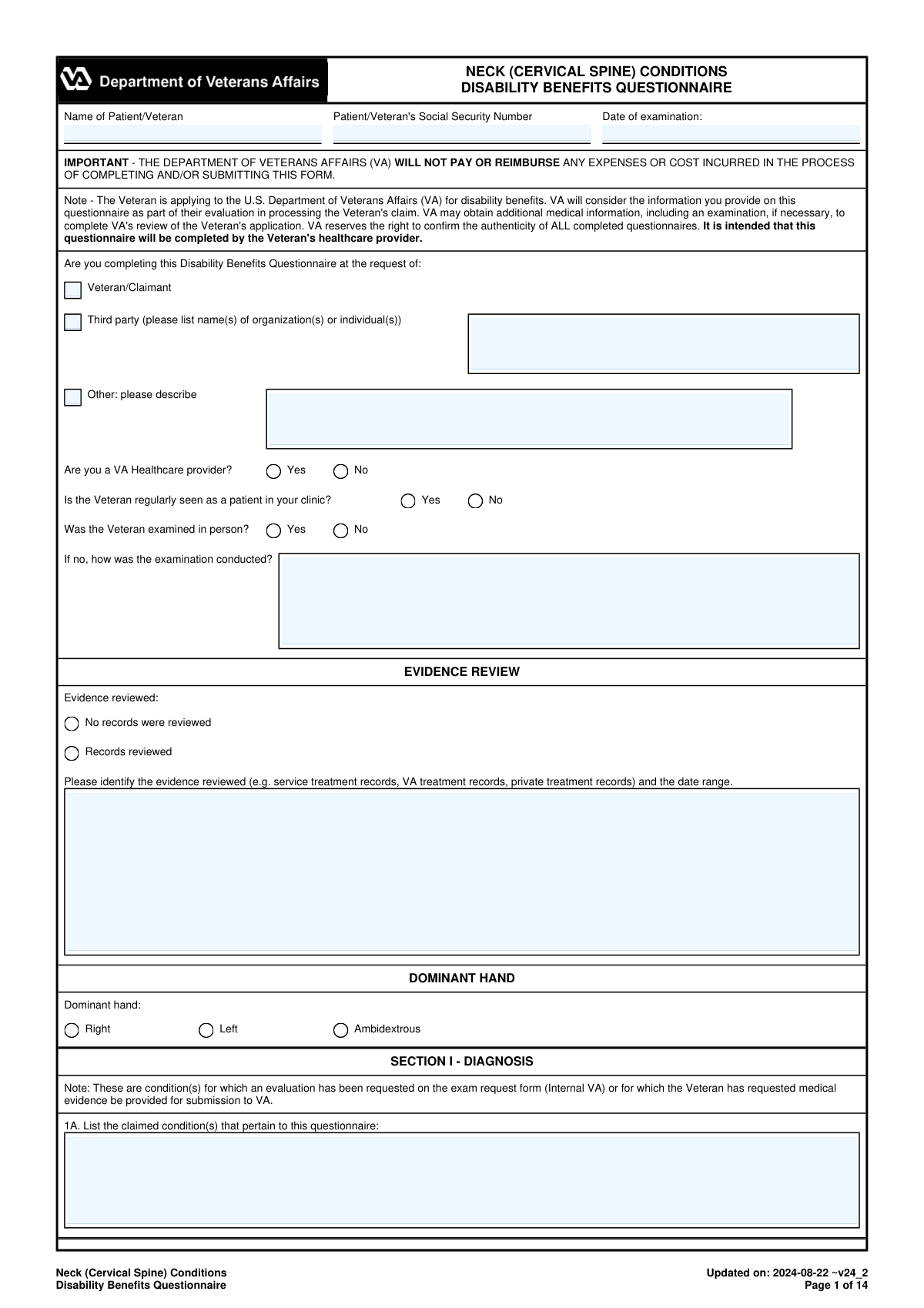
The AI fills all of it, from your answers or your documents.
The AI checks your answers before you download
16 checks built for this form, so a wrong date or a missing answer is caught before anyone else sees it.
Validates that the Patient/Veteran name is provided and that the Social Security Number is present and formatted as 9 digits (optionally with dashes as XXX-XX-XXXX). This is critical to correctly associate the DBQ with the right claimant and prevent misfiled medical evidence. If missing or malformed, the submission should be rejected or routed to manual review with a request for corrected identifiers.
Checks that the Date of examination and Date Signed are valid dates and not in the future, and that Date Signed is on or after the Date of examination. This ensures the report reflects a real clinical encounter and that certification occurred after the exam content was generated. If the dates are invalid or inconsistent, the form should fail validation and require correction before acceptance.
Ensures exactly one requester type is selected (Veteran/Claimant, Third party, or Other). If Third party is selected, at least one organization/individual name must be provided; if Other is selected, a description must be provided. If these dependencies are not met, the form should be flagged as incomplete because the request context is required for auditability and authenticity checks.
Validates that 'Was the Veteran examined in person?' is answered, and if 'No' is selected, the method of examination (e.g., telehealth, records review) is documented in the follow-up field. This is important because ROM and neurologic findings may be limited or interpreted differently without an in-person exam. If 'No' is selected without an explanation, the submission should be rejected or returned for completion.
Checks that the Evidence reviewed section is completed (No records were reviewed vs Records reviewed). If 'Records reviewed' is selected, the evidence types and a date range must be provided. If missing, the form should fail validation because VA adjudication relies on knowing what records informed the clinician’s conclusions.
Ensures the Dominant hand field has exactly one selection among Right, Left, or Ambidextrous. Dominance affects interpretation of strength, functional impact, and extremity impairment. If multiple or none are selected, the form should be flagged for correction to avoid ambiguous clinical interpretation.
And 10 more checks
- Diagnosis Section Consistency: 'No Current Diagnosis' vs. Selected Diagnoses
- ICD Code and Date of Diagnosis Format for Each Selected Diagnosis
- Flare-Ups and Functional Loss Narrative Required When Answered 'Yes'
- ROM Testing Feasibility and Explanation When Not Performed
- Active ROM Numeric Range and Unit Validation
- Passive ROM 'Performed' Dependency and 'Same as Active ROM' Logic
- Pain Evidence and Functional Loss Comment Requirement
- Repetitive Use Testing Consistency and Post-Test ROM Requirements
- Repeated Use Over Time / Flare-Up Estimates or Required 'Not Feasible' Explanation
- Examiner Credentialing and Contact Fields: NPI, License, Signature, and Phone/Fax Format
Let AI fill out your VA DBQ - Neck (Cervical Spine) Conditions
No typing. Every field filled in seconds, checked, ready to sign.
How to Fill Out VA DBQ - Neck (Cervical Spine) Conditions Online for Free in 2026
What the AI walks you through.
- Enter Veteran/patient identifiers and exam details (name, SSN, date of exam), then indicate who requested the DBQ and whether the examiner is a VA provider and performed an in-person exam.
- Complete Evidence Review and Dominant Hand sections by listing records reviewed (type and date range) and selecting the Veteran’s dominant hand.
- Document Section I (Diagnosis) by listing claimed cervical spine conditions, selecting all applicable diagnoses, and providing ICD codes and diagnosis dates; add any additional diagnoses as needed.
- Fill Section II (Medical History) by summarizing onset/course, noting flare-ups (frequency, duration, triggers, severity), and describing functional loss after repeated use over time in the Veteran’s own words.
- Record Section III (ROM and Functional Limitations) by entering active and passive ROM values, identifying where pain occurs, documenting repetitive-use testing results, and estimating ROM during repeated use over time and flare-ups with supporting rationale when required.
- Complete clinical findings sections (IV–XIV) including muscle strength/atrophy measurements, reflexes, sensory testing, radiculopathy details (symptoms and nerve roots), ankylosis, other neurologic abnormalities, IVDS/bed-rest history, assistive devices, remaining effective function, scars/other findings, and diagnostic imaging/test results.
- Finish Section XV–XVII by describing occupational functional impact, adding any remarks, and completing examiner certification with signature, credentials, specialty, contact information, NPI, license details, and address before generating the final submission-ready form.
Common Mistakes in Completing VA DBQ - Neck (Cervical Spine) Conditions
The ones the AI is built to catch.
Missing or inconsistent patient identifiers (name/SSN/exam date)
Not specifying who requested the DBQ (Veteran vs third party) and omitting third-party details
Contradictory exam modality answers (in-person vs not examined) without explanation
Evidence review left vague (no date ranges or record types)
Diagnosis section incomplete (missing ICD codes, dates, or remarks when no diagnosis)
Flare-up and functional loss narratives are too generic or not in the Veteran’s own words
ROM values entered incorrectly (wrong units, swapped sides, or exceeding normal limits)
Passive/active and weight-bearing/nonweight-bearing pain documentation omitted or inconsistent
Repetitive use and flare-up estimates left blank or “cannot determine” without a case-specific rationale
IVDS bed-rest episodes reported without physician-prescribed documentation
Radiculopathy section incomplete (severity checked but nerve roots/side not specified, or no cause explanation)
Examiner certification details missing (signature, credentials, NPI, license/state, contact info)
Frequently Asked Questions About VA DBQ - Neck (Cervical Spine) Conditions
Is it really free for 7 days?
Can I fill other forms too?
How do I cancel?
How does the AI fill out VA DBQ - Neck (Cervical Spine) Conditions?
What happens to my information?
How complex is VA DBQ - Neck (Cervical Spine) Conditions to fill out?
What is the Neck (Cervical Spine) Conditions Disability Benefits Questionnaire (DBQ) used for?
Who is supposed to complete this DBQ—can the Veteran fill it out?
Will the VA pay or reimburse my provider for completing this form?
Does the examiner have to be a VA healthcare provider?
Is an in-person exam required to complete this DBQ?
What medical records should be reviewed and listed in the Evidence Review section?
What diagnoses can be documented in Section I, and what if there is no current diagnosis?
Do I need imaging (X-ray/MRI) for this DBQ, especially for arthritis or IVDS?
How should flare-ups be documented, and what details matter most?
What is the difference between initial ROM, observed repetitive-use ROM, repeated use over time, and flare-up estimates?
What if ROM testing (active, passive, weight-bearing/nonweight-bearing) cannot be performed?
How is radiculopathy evaluated on this DBQ, and is an EMG required?
What counts as IVDS “incapacitating episodes” and bed rest for VA purposes?
How should assistive devices be reported (cane, brace, walker, wheelchair)?
What does the Functional Impact section mean, and what should be included?
Get your VA DBQ - Neck (Cervical Spine) Conditions filled out by AI
$0 today. Cancel before Nov 1 and you pay nothing.
Other forms like this one
disability forms: Form SSA-3368-BK, Disability Report - Adult, Form SSA-16, Application for Disability Benefits, Form SSA-3820-BK, Disability Report - Child, Form SSA-454-BK, Continuing Disability Review, Form 21-526EZ, Application for Disability Compensation, Form N-648, Medical Certification for Disability Exceptions, Form DBQ, Knee and Lower Leg Disability Benefits, Form DBQ, Heart Conditions Disability Benefits, Form DBQ, Hypertension Disability Benefits, Form DBQ, Scars/Disfigurement Disability Benefits, Form DBQ, Diabetes Mellitus Disability Benefits Questionnaire, Form DBQ, Endocrine Diseases Disability Benefits, Form DBQ, Diabetes Mellitus Disability Benefits Questionnaire, Back (Thoracolumbar Spine) Conditions Disability Benefits Questionnaire, Ankle Conditions Disability Benefits Questionnaire, Back (Thoracolumbar Spine) Conditions Disability Benefits Questionnaire, Elbow and Forearm Conditions Disability Benefits Questionnaire, Foot Conditions, Including Flatfoot (Pes Planus) Disability Benefits Questionnaire, Hip and Thigh Conditions Disability Benefits Questionnaire, Knee and Lower Leg Disability Benefits Questionnaire
benefit forms: Form SSA-16, Application for Disability Benefits, Form SSA-1-BK, Application for Retirement Benefits, Form SSA-2-BK, Application for Spouse's Benefits, Form SSA-4-BK, Application for Child's Insurance Benefits, Form SSA-10, Application for Widow's or Widower's Insurance Benefits, Form SSA-10, Widow's or Widower's Benefits, Form SSA-4-BK, Application for Social Security Benefits, Form SSA-5-BK, Application for Mother's or Father's Benefits, Form DBQ, Knee and Lower Leg Disability Benefits, Form DBQ, Heart Conditions Disability Benefits, Form DBQ, Hypertension Disability Benefits, Form DBQ, Scars/Disfigurement Disability Benefits, Form DBQ, Diabetes Mellitus Disability Benefits Questionnaire, Form DBQ, Endocrine Diseases Disability Benefits, Form DBQ, Diabetes Mellitus Disability Benefits Questionnaire, Back (Thoracolumbar Spine) Conditions Disability Benefits Questionnaire, Ankle Conditions Disability Benefits Questionnaire, Back (Thoracolumbar Spine) Conditions Disability Benefits Questionnaire, Elbow and Forearm Conditions Disability Benefits Questionnaire, Foot Conditions, Including Flatfoot (Pes Planus) Disability Benefits Questionnaire
disability benefits forms: Form SSA-769, Request for Change in Time/Place of Disability Hearing, Form SSA-16, Application for Disability Benefits, Form DBQ, Knee and Lower Leg Disability Benefits, Form DBQ, Heart Conditions Disability Benefits, Form DBQ, Hypertension Disability Benefits, Form DBQ, Scars/Disfigurement Disability Benefits, Form DBQ, Diabetes Mellitus Disability Benefits Questionnaire, Form DBQ, Endocrine Diseases Disability Benefits, Back (Thoracolumbar Spine) Conditions Disability Benefits Questionnaire, Ankle Conditions Disability Benefits Questionnaire, Back (Thoracolumbar Spine) Conditions Disability Benefits Questionnaire, Elbow and Forearm Conditions Disability Benefits Questionnaire, Foot Conditions, Including Flatfoot (Pes Planus) Disability Benefits Questionnaire, Hip and Thigh Conditions Disability Benefits Questionnaire, Knee and Lower Leg Disability Benefits Questionnaire, Shoulder and Arm Conditions Disability Benefits Questionnaire, Wrist Conditions Disability Benefits Questionnaire (DBQ), Back (Thoracolumbar Spine) Conditions Disability Benefits Questionnaire, Back (Thoracolumbar Spine) Conditions Disability Benefits Questionnaire, Ankle Conditions Disability Benefits Questionnaire (DBQ)
Let AI fill out your VA DBQ - Neck (Cervical Spine) Conditions
Your trial starts once a card is added. You pay nothing before Nov 1.
Our AI already knows this form, all 426 fields of it. Skip the typing: tell it about yourself, or upload what you have, and it fills the whole form in seconds.
- AI fills every field on all 14 pages, tables and checkboxes included
- No typing into boxes: answer a few questions, or upload a document you already have, an old copy of this form, a photo of a document
- The AI checks the answers; you review and change anything before you download
- Download the finished PDF, print it, or sign it online
- Encrypted, and never used to train AI
Cancel before Nov 1 and you pay nothing.
A card is needed to start the trial. Cancel in two clicks from your account.
Terms · Privacy