Fill out disability forms
with AI.
Disability forms serve as the essential gateway for individuals seeking financial support, medical accommodations, or legal exceptions due to physical, developmental, or mental impairments. These documents are vital for establishing a formal medical record and demonstrating how a condition impacts an individual's ability to work or perform daily activities. By providing structured evidence to government agencies and private insurers, these forms ensure that those in need can access critical resources like Social Security benefits, veterans' compensation, or specialized healthcare allowances.
By continuing, you acknowledge Instafill's Privacy Policy and agree to get occasional product update and promotional emails.
About disability forms
This category is most frequently used by veterans, aging adults, and individuals facing long-term health challenges. For instance, the Form SSA-3368-BK (Disability Report - Adult) is a foundational document for those entering the Social Security system, while veterans often require specific Disability Benefits Questionnaires (DBQs) to evaluate conditions like heart disease or joint injuries. Other forms, such as the N-648, are necessary for applicants seeking medical exceptions during the U.S. naturalization process. Whether you are filing an initial application or completing a Continuing Disability Review, having the right documentation is key to a successful claim.
Completing these extensive reports can be a daunting task, particularly when managing a health condition. Tools like Instafill.ai use AI to fill these forms in under 30 seconds, providing a practical way to handle your data accurately and securely without the manual effort usually required for complex paperwork.
Every form on this page can be completed without typing. Instafill is form filling software that reads a PDF and fills it for you — including flat and scanned documents that carry no fillable fields at all.
Forms in This Category
The forms in this category have a median Form Complexity Index of 73/100 (Complex), measured across 50 forms by field count, input difficulty, length, conditional logic and structure. See how it is calculated.
- Enterprise-grade security & data encryption
- 99%+ accuracy powered by AI
- 1,000+ forms from all industries
- Complete forms in under 60 seconds
How to Choose the Right Form
Disability forms vary widely depending on who is filing, what program they're applying to, and where they are in the process. Use the groups below to quickly find the right form.
Applying for Social Security Disability (SSDI/SSI)
If you're starting a new disability claim with the SSA:
- Form SSA-16 — Use this to formally apply for Social Security Disability Insurance benefits.
- Form SSA-3368-BK (Disability Report – Adult) — Describes your medical conditions, treatment history, and work limitations.
- Form SSA-3820-BK (Disability Report – Child) — Use this instead if the claim is for a child.
- Form SSA-3373-BK (Function Report – Adult) — Explains how your disability affects daily activities and work capacity.
- Form SSA-3380-BK (Function Report – Adult – Third Party) — Completed by a family member, friend, or caregiver who can describe your limitations.
- Form SSA-3369-BK (Work History Report) — Details your jobs from the past 5 years; required for most adult claims.
- Form SSA-827 — Authorizes SSA to access your medical and educational records.
Continuing or Updating an Existing SSA Disability Claim
If SSA is reviewing whether your benefits should continue:
- Form SSA-454-BK (Continuing Disability Review Report) — The main form for a full CDR; covers updated medical, work, and daily functioning information.
- Form SSA-455 (Disability Update Report) — A shorter check-in form SSA mails to beneficiaries to screen for changes in health or work status.
Veterans Applying for VA Disability Compensation
If you're a veteran filing or supporting a VA disability claim:
- Form 21-526EZ — The primary application for VA disability compensation; use this first.
- VA Form 21-0781 — Use this to document in-service traumatic events supporting a mental health disorder claim (e.g., PTSD, MST).
- Disability Benefits Questionnaires (DBQs) — Condition-specific medical forms completed by your healthcare provider. Choose the DBQ that matches your condition:
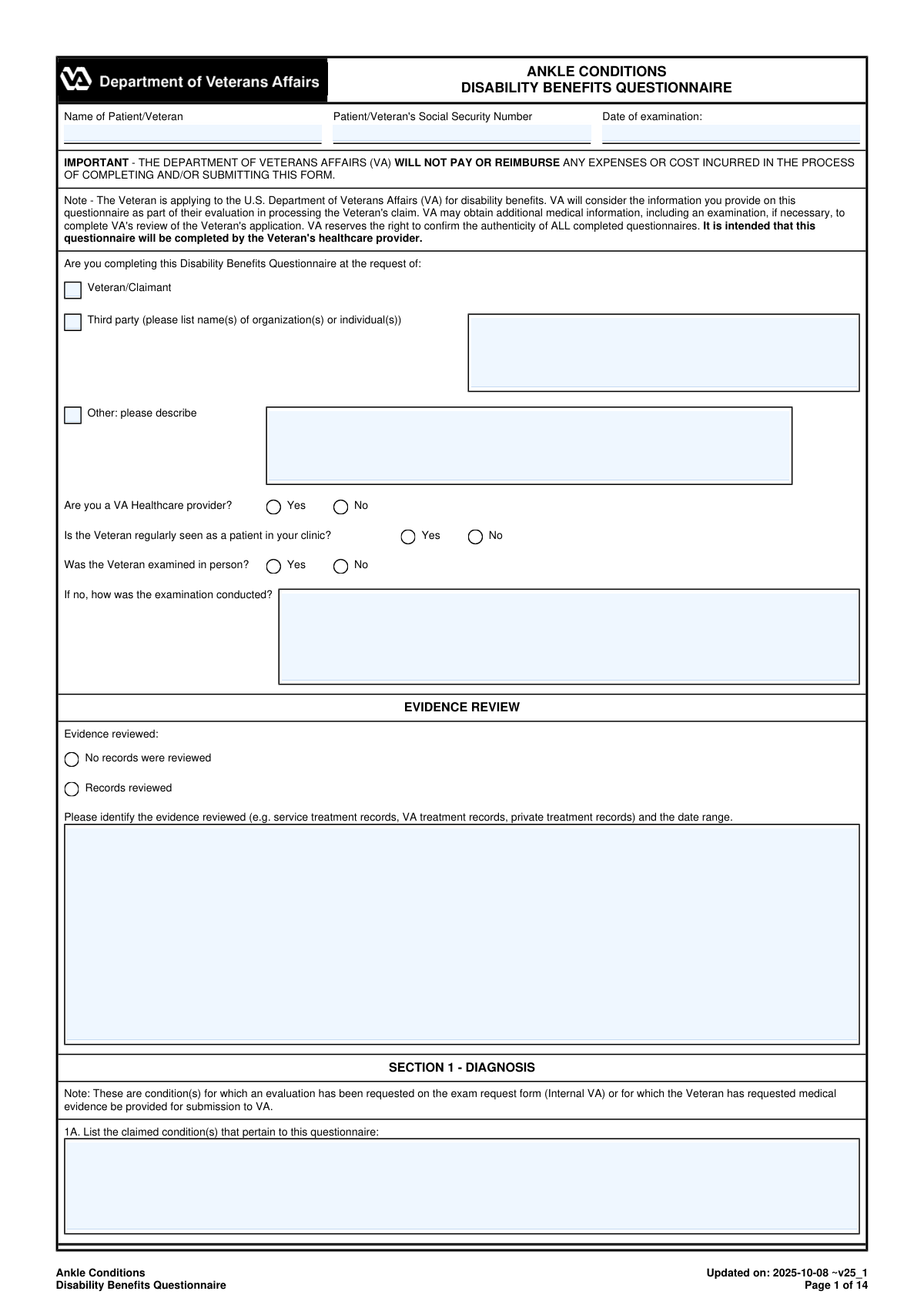
- *Musculoskeletal:* Back/Thoracolumbar Spine, Neck/Cervical Spine, Shoulder and Arm, Elbow and Forearm, Wrist, Hip and Thigh, Knee and Lower Leg, Ankle, Foot (including Flatfoot)
- *Cardiovascular:* Heart Conditions, Hypertension, Artery and Vein Conditions
- *Other medical:* Diabetes Mellitus, Endocrine Diseases, Thyroid and Parathyroid, Oral and Dental Conditions, Scars/Disfigurement
Disability Parking Placards (Missouri)
- Form 2769 — Apply for, renew, or replace a Missouri disabled person windshield placard.
- Form 1776 — Required physician's certification confirming the qualifying disability; submit alongside Form 2769.
Naturalization Disability Exception
- Form N-648 (Medical Certification for Disability Exceptions) — For immigration applicants seeking a waiver of the English/civics test due to a physical, developmental, or mental disability.
Canadian and Australian Programs
- SC ISP-2519 — Medical report for Canada Pension Plan (CPP) disability benefits; completed by your doctor or nurse practitioner.
- SA431 — Australian Centrelink medical report for Carer Payment/Allowance for a child under 16.
- Form 3111E — Ontario Works/ODSP application for a Special Diet Allowance.
Private Insurance Disability Claims
- Assurity Life Insurance Attending Physician's Statement — Your treating doctor completes this to support a private disability insurance claim.
- Prudential Education and Employment History Form (GL.2009.009) — Provides Prudential with your work and education background during a group disability claim review.
- Physician's Statement of Disability / Functional Limitations — A general medical provider statement used by insurers or employers to evaluate disability leave or work accommodations.
> Tip: Most SSA claims require several forms together — typically SSA-16 (or SSA-3820 for a child), a Disability Report, a Function Report, and SSA-827 at minimum.
Form Comparison
| Form | Purpose | Who Files It | When to Use |
|---|---|---|---|
| Form SSA-3820-BK, Disability Report - Child | Report child's disability for SSA benefits eligibility | Parent or guardian of disabled child | When applying for SSI benefits for a child |
| Form SSA-3368-BK, Disability Report - Adult | Gather adult disability info for SSA benefits assessment | Adult disability claimant | When applying for SSDI or SSI benefits |
| Form SSA-16, Application for Disability Benefits | Formally apply for Social Security disability insurance | Adult worker with qualifying disability | Initial application for SSDI benefits |
| Form SSA-455, Disability Update Report | Update health and work status for ongoing benefits review | Current SSA disability beneficiary | When SSA requests periodic eligibility update |
| Form SSA-454-BK, Continuing Disability Review | Evaluate whether individual still qualifies for benefits | Current SSA disability beneficiary | During SSA-initiated continuing disability review |
| Form SSA-3373, Function Report - Adult | Describe how disability affects daily activities and work | Adult disability claimant | During initial or review disability determination |
| Form 21-526EZ, Application for Disability Compensation | Apply for VA disability compensation for service injuries | Military veteran | When filing VA claim for service-connected disability |
| Form N-648, Medical Certification for Disability Exceptions | Certify disability exception to naturalization requirements | Physician or licensed clinician on behalf of applicant | When naturalization applicant cannot meet English/civics test |
| Form DBQ, Knee and Lower Leg Disability Benefits | Document knee/lower leg conditions for VA disability rating | VA or private healthcare provider | When filing or supporting VA knee disability claim |
| Form DBQ, Heart Conditions Disability Benefits | Assess heart conditions for VA disability compensation | VA or private healthcare provider | When filing VA claim for heart-related disability |
| Back (Thoracolumbar Spine) Conditions Disability Benefits Questionnaire | Document spinal findings for VA disability rating | VA or private healthcare provider | When filing VA claim for back/spine disability |
| Form SSA-3369-BK, Work History Report | Detail past work for SSA functional limitations assessment | Adult disability claimant | During SSA disability application or review process |
| Function Report - Adult - Third Party (Form SSA-3380-BK) | Third-party description of claimant's daily functioning | Family member, friend, or caregiver of claimant | During SSA disability determination process |
| Form 1776, Physician's Statement for Disabled License Plates or Placards | Certify disability for disabled parking plates or placards | Licensed physician or authorized clinician | When applying or renewing disabled parking credentials in Missouri |
| SC ISP-2519, Medical Report for Canada Pension Plan Disability Benefits | Document diagnoses and limitations for CPP disability | Applicant and treating physician or nurse practitioner | When applying for Canadian CPP disability benefits |
| Form SSA-827 (06-2024), Authorization to Disclose Information to the Social Security Administration (SSA) | Authorize SSA to access medical and educational records | Disability claimant or authorized representative | At start of or during SSA disability claim process |
| VA Form 21-0781, Statement in Support of Claimed Mental Health Disorder(s) Due to an In-Service Traumatic Event(s) | Support VA mental health disability claim with trauma details | Veteran filing mental health disability claim | When claiming VA benefits for PTSD or trauma-related disorder |
| Assurity Life Insurance Company Disability Claim Form — Attending Physician's Statement | Provide medical evidence for private disability insurance claim | Attending or treating physician | When patient files a disability claim with Assurity Life |
| Physician's Statement of Disability / Functional Limitations (ICD Diagnosis Codes, Treatment, ADLs, and Return-to-Work) | Document functional limitations for disability or leave review | Treating physician or medical provider | When employer or insurer requires medical disability statement |
| Carer Payment and Carer Allowance – Medical Report (SA431) for a child under 16 years | Document child's disability for Australian carer payment eligibility | Treating health professional for the child | When carer applies for Australian Centrelink carer payments |
| Form 3111E (2018/12), Ontario Works / Ontario Disability Support Program (ODSP) Application for Special Diet Allowance | Request special diet allowance under OW or ODSP | Applicant and approved healthcare professional | When OW/ODSP recipient has qualifying medical dietary need |
Tips for disability forms
Discrepancies between your form answers and your doctor's official records can cause significant delays or denials. Double-check that dates of diagnosis, treatment history, and medication lists align perfectly with your medical files before hitting submit.
Simply naming a condition is often not enough to qualify for benefits. Clearly describe how your symptoms specifically limit daily activities, such as your ability to walk, lift objects, or maintain a consistent work schedule.
Filling out dozens of pages manually is exhausting and prone to human error. AI-powered tools like Instafill.ai can complete these forms in under 30 seconds with high accuracy, and your data stays secure throughout the entire automated process.
Disability claims often require several related forms, such as the SSA-3368 and various medical reports, over many months. Maintain a digital or physical folder with copies of every submitted document to respond quickly to any follow-up inquiries.
Many forms, including VA DBQs and Attending Physician Statements, require specific clinical findings and signatures. Provide your doctor with a draft of your sections early so they have the necessary context to support your claim effectively.
Forms like the SSA-16 or private insurance history forms require precise job descriptions. Instead of just providing a job title, describe the physical and mental demands of your past roles to demonstrate why your condition prevents you from performing them.
Incomplete forms are frequently returned for clarification, which restarts your waiting period. If a section does not apply to your specific situation, write 'N/A' or 'None' to show the reviewer that the question was not accidentally overlooked.
Frequently Asked Questions
Disability forms are legal and medical documents used to apply for financial assistance, insurance payouts, or legal accommodations when a physical or mental impairment prevents someone from working. These forms gather personal history, work experience, and detailed medical evidence to help agencies like the Social Security Administration (SSA) or Department of Veterans Affairs (VA) determine eligibility.
You should use SSA forms, such as the SSA-16 or SSA-3368, if you are applying for federal Social Security Disability Insurance (SSDI) or Supplemental Security Income (SSI). VA forms, including Disability Benefits Questionnaires (DBQs), are specifically for veterans seeking compensation for injuries or illnesses that are connected to their military service.
A DBQ is a standardized form used by the VA to gather specific clinical information about a veteran's condition, such as range of motion, symptoms, and diagnosis codes. While a veteran may initiate the process, the clinical evaluation sections must be completed and signed by a qualified healthcare provider to be considered valid evidence.
Yes, you can use AI tools to streamline the process of completing complex disability paperwork. AI platforms like Instafill.ai can accurately extract data from your source documents and place it directly into the correct fields on the PDF, ensuring that your medical history and personal details are transcribed correctly.
When using AI-powered tools, you can often complete these forms in under 30 seconds by automating the data entry process. This is significantly faster than manual entry, as the AI can instantly identify and populate repetitive information across multiple pages of a report or application.
These forms, such as the SSA-455 or SSA-454, are part of a periodic review process to ensure that beneficiaries still meet the medical requirements for disability benefits. Completing these forms accurately and returning them on time is essential to prevent a lapse or termination of your monthly payments.
For Social Security benefits, you should use Form SSA-3820-BK (Disability Report - Child) to provide details about the child's medical condition and how it affects their daily functioning compared to other children of the same age. This report is typically filed alongside an application for Supplemental Security Income (SSI).
Submission instructions vary depending on the agency: SSA forms are typically mailed to a local Social Security office or filed via their online portal, while VA forms are sent to the Evidence Intake Center. Private insurance forms, like those from Prudential or Assurity, should be returned directly to the insurance carrier's claims department.
Private insurance forms are used to process Short-Term (STD) or Long-Term Disability (LTD) claims under a policy provided through your workplace. You will generally need to complete a claimant statement and have your doctor complete an 'Attending Physician’s Statement' to prove your inability to perform your job duties.
Yes, this category includes forms like the SC ISP-2519, which is the medical report required for Canada Pension Plan (CPP) disability benefits. There are also regional forms, such as Form 3111E for the Ontario Disability Support Program (ODSP), which are used for provincial-level assistance.
If you are unable to attend a scheduled hearing with the Social Security Administration, you must file Form SSA-769 to request a change in time or place. You should submit this as soon as possible with a valid reason to avoid the risk of having your disability claim dismissed for non-appearance.
Glossary
- Form Complexity Index
- Instafill’s 0–100 measure of how much effort a form takes to complete, calculated deterministically from the form’s own structure rather than estimated. It combines the number of fillable fields (the largest factor), how difficult those fields are to complete based on their type, the number of pages that contain fields, the amount of conditional “fill-only-if” logic, and how many sections the form is divided into, then adds modifiers for tables and repeating lists, bundled instruction pages, and dense page layouts. A higher score means the form is harder to fill out by hand. The forms in this category have a median Form Complexity Index of 73/100 (Complex). See exactly how it is calculated.
- ICD Codes
- Standardized alphanumeric codes used by healthcare providers to classify every diagnosis, symptom, and cause of injury for insurance and medical record purposes.
- DBQ (Disability Benefits Questionnaire)
- Standardized medical forms used by the Department of Veterans Affairs (VA) to capture specific clinical evidence needed to evaluate and rate a veteran's disability claim.
- CDR (Continuing Disability Review)
- A periodic evaluation conducted by the Social Security Administration to determine if an individual still meets the medical requirements to receive disability benefits.
- Service-Connected
- A status used by the VA to confirm that a veteran's disability resulted from or was aggravated by their active-duty military service.
- Elimination Period
- The specific length of time a person must be disabled before disability insurance benefit payments actually begin; essentially a waiting period.
- ADLs (Activities of Daily Living)
- Basic daily tasks such as eating, bathing, and dressing that are used by clinicians and insurers to measure the severity of a person's functional impairment.
- Radiculopathy
- A condition frequently mentioned in spine-related forms where compressed nerves in the spinal column cause pain, numbness, or weakness to radiate into the limbs.
- IVDS (Intervertebral Disc Syndrome)
- A clinical term for chronic back impairment caused by disc problems, often requiring documentation of 'incapacitating episodes' or bed rest for disability rating.