
Yes! You can use AI to fill out Knee and Lower Leg Disability Benefits Questionnaire
Don't type 785 fields by hand. Tell our AI about yourself, or upload a document you already have, and it fills every field in seconds. You check it, then download, print or sign.
The AI does the filling. You just check it.
No typing into boxes, nothing to install.
What this form asks for
The AI fills all of it, from your answers or your documents.
The AI checks your answers before you download
16 checks built for this form, so a wrong date or a missing answer is caught before anyone else sees it.
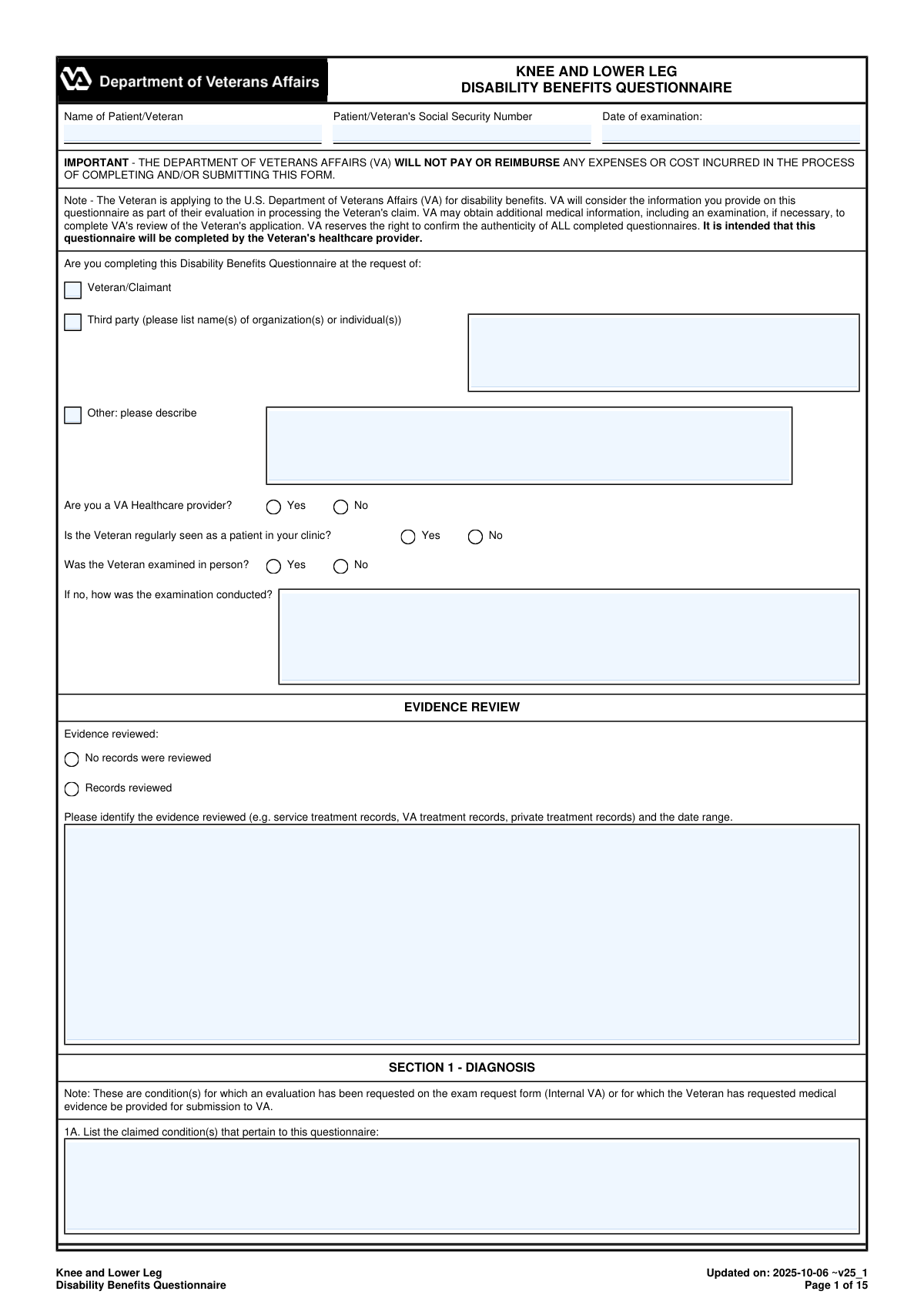
Validates that the Patient/Veteran name and Social Security Number are both present and not left blank. These identifiers are required to correctly associate the DBQ with the correct claimant and prevent misfiling into the wrong medical/claims record. If either field is missing, the submission should be rejected or routed to an exception queue for manual resolution before acceptance.
Ensures the Veteran’s SSN is exactly 9 digits (optionally allowing hyphens in the ###-##-#### format) and is not an invalid placeholder (e.g., 000000000, 123456789) or contains non-numeric characters. This reduces downstream matching errors and prevents ingestion of obviously incorrect identifiers. If validation fails, the form should be blocked and the submitter prompted to correct the SSN.
Checks that all dates (Date of examination, Date signed, Date of diagnosis, Date of surgery, diagnostic test dates) follow an accepted format (e.g., YYYY-MM-DD or MM/DD/YYYY) and represent real calendar dates. Also enforces logical chronology: signature date should be on/after exam date, and surgery/diagnosis/test dates should not be in the future relative to the exam date unless explicitly allowed by system policy. Failures should trigger a hard error for impossible dates and a soft/hard error for inconsistent chronology depending on business rules.
Validates that when 'Third party' is selected, at least one organization/individual name is provided, and when 'Other' is selected, a description is provided. This is important for auditability and to document who initiated the DBQ, which can affect evidentiary handling. If the required conditional text is missing, the submission should be flagged as incomplete and returned for correction.
Ensures that if 'Was the Veteran examined in person?' is marked 'No', the 'If no, how was the examination conducted?' field is completed with a meaningful method (e.g., telehealth, records review). This supports clinical credibility and VA review requirements for how findings were obtained. If 'No' is selected without a method, the form should fail validation due to missing required context.
Checks that the 'Evidence reviewed' section is internally consistent: if 'Records reviewed' is selected, the evidence types and date range are provided; if 'No records were reviewed' is selected, the evidence list/date range should be empty. This prevents contradictory documentation and supports adjudicators in understanding the basis of the opinion. If inconsistent, the system should prompt the examiner to correct the selection or supply the missing evidence details.
And 10 more checks
- Diagnosis Selection vs 'No Current Diagnosis' Mutual Exclusivity
- Diagnosis Detail Completeness (Side, ICD Code, Date of Diagnosis)
- ‘Other Diagnosis’ Requires Free-Text Specification
- History/Flare-ups/Functional Loss Conditional Narratives
- ROM Testing Feasibility and Explanation Requirements
- ROM Numeric Range and Unit Validation (Flexion/Extension)
- Pain/Functional Loss Consistency in ROM Sections
- Repetitive-Use Testing Logic (3B) and Required Follow-Ups
- Repeated Use Over Time / Flare-Up Estimation Requirements (3C/3D)
- Examiner Certification Completeness and Credential Validation (Signature, NPI, License, Contact)
Let AI fill out your VA DBQ (Knee and Lower Leg)
No typing. Every field filled in seconds, checked, ready to sign.
How to Fill Out VA DBQ (Knee and Lower Leg) Online for Free in 2026
What the AI walks you through.
- Enter Veteran/patient identifiers and exam details (name, SSN, date of examination) and indicate who requested the DBQ and whether the examiner is a VA provider.
- Complete the Evidence Review section by listing which records were reviewed (service, VA, private) and the applicable date ranges.
- Fill out Section 1 (Diagnosis) by selecting all applicable knee/lower leg diagnoses, specifying side affected, ICD codes, and diagnosis dates; add any additional diagnoses as needed.
- Document Section 2 (Medical History) including onset/course, flare-ups, functional loss, instability/subluxation history, and effusion details.
- Record Section 3 (ROM and Functional Limitation) for each knee: active/passive ROM, pain with weight-bearing/nonweight-bearing, repetitive-use testing results, estimated limitations after repeated use and during flare-ups, and any additional disability factors.
- Complete remaining clinical sections as applicable: muscle atrophy, ankylosis, joint stability (including ligament tears and prescribed devices), tibial/fibular impairment, meniscal conditions, surgeries and residuals, scars/other findings, assistive devices, remaining effective function, and diagnostic testing/imaging results.
- Finish Section 14 (Functional Impact), add any Section 15 remarks, then complete Section 16 examiner certification with signature, credentials, specialty, contact information, NPI, license details, and address before generating the final submission copy.
Common Mistakes in Completing VA DBQ (Knee and Lower Leg)
The ones the AI is built to catch.
Missing or inconsistent patient identifiers (name/SSN/exam date)
Not specifying who requested the DBQ (Veteran vs third party) and omitting third-party details
Contradictory exam method answers (in-person vs not examined) without explanation
Evidence review section left vague (no record types or date ranges)
Diagnosis section incomplete: missing side, ICD code, or date of diagnosis
Selecting “no current diagnosis” without using Remarks to justify
ROM values entered incorrectly (wrong units, swapped flexion/extension, or impossible numbers)
Failing to document active vs passive and weight-bearing vs nonweight-bearing pain testing (or not explaining why not done)
Repetitive use/flare-up sections left as “cannot estimate” without case-specific rationale
Instability and assistive device sections completed inconsistently (prescription requirement misunderstood)
Surgery history missing dates, procedure type, or residuals (especially knee replacement residual category)
Frequently Asked Questions About VA DBQ (Knee and Lower Leg)
Is it really free for 7 days?
Can I fill other forms too?
How do I cancel?
How does the AI fill out VA DBQ (Knee and Lower Leg)?
What happens to my information?
How complex is VA DBQ (Knee and Lower Leg) to fill out?
What is the Knee and Lower Leg Disability Benefits Questionnaire (DBQ) used for?
Who is supposed to complete this DBQ—can the Veteran fill it out?
Will the VA pay or reimburse the cost of getting this DBQ completed?
Does the examiner have to be a VA healthcare provider?
Does the Veteran need to be examined in person to complete the DBQ?
What records or evidence should be reviewed for the “Evidence Review” section?
What if the Veteran has knee symptoms but no current diagnosis?
How do we document which knee is affected (right, left, or both)?
How should flare-ups be described on this DBQ?
What is the difference between initial ROM, repetitive-use testing, repeated use over time, and flare-up estimates?
What if range-of-motion testing can’t be performed or is unsafe?
Does the examiner need to record pain on active vs. passive motion and weight-bearing vs. nonweight-bearing?
How is knee instability documented, and does it matter if a brace/cane is prescribed?
When do we need imaging or diagnostic testing for arthritis?
What should be included in the “Functional Impact” section?
Get your VA DBQ (Knee and Lower Leg) filled out by AI
$0 today. Cancel before Oct 31 and you pay nothing.
Other forms like this one
disability forms: Form SSA-3368-BK, Disability Report - Adult, Form SSA-16, Application for Disability Benefits, Form SSA-3820-BK, Disability Report - Child, Form SSA-454-BK, Continuing Disability Review, Form 21-526EZ, Application for Disability Compensation, Form N-648, Medical Certification for Disability Exceptions, Form DBQ, Knee and Lower Leg Disability Benefits, Form DBQ, Heart Conditions Disability Benefits, Form DBQ, Hypertension Disability Benefits, Form DBQ, Scars/Disfigurement Disability Benefits, Form DBQ, Diabetes Mellitus Disability Benefits Questionnaire, Form DBQ, Endocrine Diseases Disability Benefits, Form DBQ, Diabetes Mellitus Disability Benefits Questionnaire, Back (Thoracolumbar Spine) Conditions Disability Benefits Questionnaire, Ankle Conditions Disability Benefits Questionnaire, Back (Thoracolumbar Spine) Conditions Disability Benefits Questionnaire, Elbow and Forearm Conditions Disability Benefits Questionnaire, Foot Conditions, Including Flatfoot (Pes Planus) Disability Benefits Questionnaire, Hip and Thigh Conditions Disability Benefits Questionnaire, Neck (Cervical Spine) Conditions Disability Benefits Questionnaire
benefit forms: Form SSA-16, Application for Disability Benefits, Form SSA-1-BK, Application for Retirement Benefits, Form SSA-2-BK, Application for Spouse's Benefits, Form SSA-4-BK, Application for Child's Insurance Benefits, Form SSA-10, Application for Widow's or Widower's Insurance Benefits, Form SSA-10, Widow's or Widower's Benefits, Form SSA-4-BK, Application for Social Security Benefits, Form SSA-5-BK, Application for Mother's or Father's Benefits, Form DBQ, Knee and Lower Leg Disability Benefits, Form DBQ, Heart Conditions Disability Benefits, Form DBQ, Hypertension Disability Benefits, Form DBQ, Scars/Disfigurement Disability Benefits, Form DBQ, Diabetes Mellitus Disability Benefits Questionnaire, Form DBQ, Endocrine Diseases Disability Benefits, Form DBQ, Diabetes Mellitus Disability Benefits Questionnaire, Back (Thoracolumbar Spine) Conditions Disability Benefits Questionnaire, Ankle Conditions Disability Benefits Questionnaire, Back (Thoracolumbar Spine) Conditions Disability Benefits Questionnaire, Elbow and Forearm Conditions Disability Benefits Questionnaire, Foot Conditions, Including Flatfoot (Pes Planus) Disability Benefits Questionnaire
disability benefits forms: Form SSA-769, Request for Change in Time/Place of Disability Hearing, Form SSA-16, Application for Disability Benefits, Form DBQ, Knee and Lower Leg Disability Benefits, Form DBQ, Heart Conditions Disability Benefits, Form DBQ, Hypertension Disability Benefits, Form DBQ, Scars/Disfigurement Disability Benefits, Form DBQ, Diabetes Mellitus Disability Benefits Questionnaire, Form DBQ, Endocrine Diseases Disability Benefits, Back (Thoracolumbar Spine) Conditions Disability Benefits Questionnaire, Ankle Conditions Disability Benefits Questionnaire, Back (Thoracolumbar Spine) Conditions Disability Benefits Questionnaire, Elbow and Forearm Conditions Disability Benefits Questionnaire, Foot Conditions, Including Flatfoot (Pes Planus) Disability Benefits Questionnaire, Hip and Thigh Conditions Disability Benefits Questionnaire, Neck (Cervical Spine) Conditions Disability Benefits Questionnaire, Shoulder and Arm Conditions Disability Benefits Questionnaire, Wrist Conditions Disability Benefits Questionnaire (DBQ), Back (Thoracolumbar Spine) Conditions Disability Benefits Questionnaire, Back (Thoracolumbar Spine) Conditions Disability Benefits Questionnaire, Ankle Conditions Disability Benefits Questionnaire (DBQ)
Let AI fill out your VA DBQ (Knee and Lower Leg)
Your trial starts once a card is added. You pay nothing before Oct 31.
Our AI already knows this form, all 785 fields of it. Skip the typing: tell it about yourself, or upload what you have, and it fills the whole form in seconds.
- AI fills every field on all 15 pages, tables and checkboxes included
- No typing into boxes: answer a few questions, or upload a document you already have, an old copy of this form, a photo of a document
- The AI checks the answers; you review and change anything before you download
- Download the finished PDF, print it, or sign it online
- Encrypted, and never used to train AI
Cancel before Oct 31 and you pay nothing.
A card is needed to start the trial. Cancel in two clicks from your account.
Terms · Privacy