Yes! You can use AI to fill out Form 3111E, Application for Special Diet Allowance (Ontario Disability Support Program / Ontario Works)
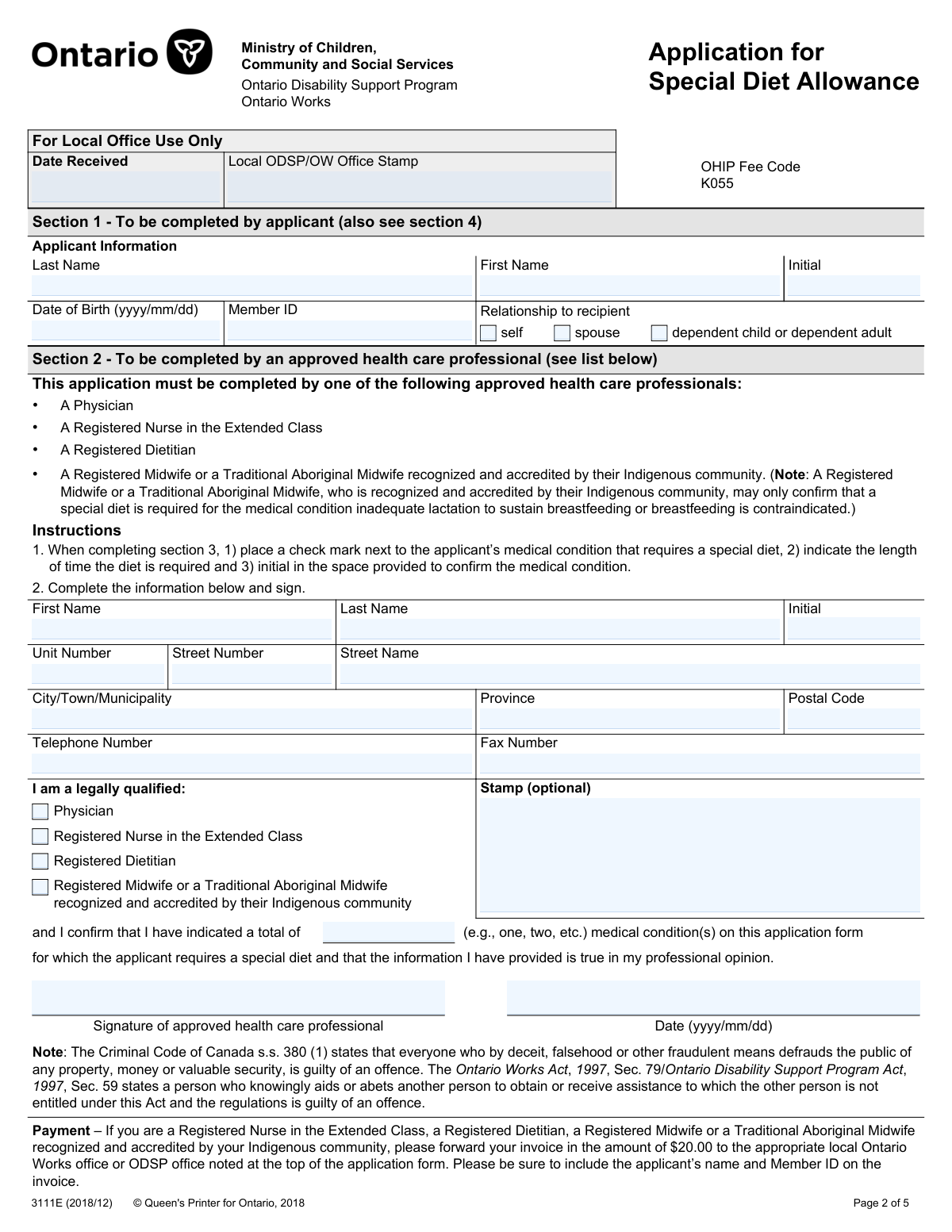
Form 3111E, Application for Special Diet Allowance, is an Ontario government form issued by the Ministry of Children, Community and Social Services that allows ODSP and Ontario Works recipients to apply for additional financial assistance to cover the costs of medically required special diets. The form must be completed jointly by the applicant and an approved health care professional (such as a physician, registered nurse in the extended class, registered dietitian, or registered midwife) who confirms the qualifying medical condition and the duration of the dietary need. It covers a wide range of conditions including diabetes, celiac disease, renal failure, chronic wounds, and many others. Today, this form can be filled out quickly and accurately using AI-powered services like Instafill.ai, which can also convert non-fillable PDF versions into interactive fillable forms.
Our AI automatically handles information lookup, data retrieval, formatting, and form filling.
It takes less than a minute to fill out 3111E using our AI form filling.
Securely upload your data. Information is encrypted in transit and deleted immediately after the form is filled out.
Form specifications
| Form name: | Form 3111E, Application for Special Diet Allowance (Ontario Disability Support Program / Ontario Works) |
| Number of pages: | 5 |
| Language: | English |
Instafill Demo: filling out a legal form in seconds
How to Fill Out 3111E Online for Free in 2026
Are you looking to fill out a 3111E form online quickly and accurately? Instafill.ai offers the #1 AI-powered PDF filling software of 2026, allowing you to complete your 3111E form in just 37 seconds or less.
Follow these steps to fill out your 3111E form online using Instafill.ai:
- 1 Navigate to Instafill.ai and upload or select the Ontario Form 3111E (Application for Special Diet Allowance) to begin filling it out online.
- 2 Complete Section 1 by entering the applicant's personal information, including last name, first name, initial, date of birth, Member ID, and relationship to the recipient (self, spouse, or dependent).
- 3 Have an approved health care professional complete Section 2 by entering their name, address, contact information, professional qualification, and signing and dating the form to confirm the applicant's medical condition(s).
- 4 In Section 3, have the health care professional check the applicable medical condition(s) requiring a special diet, indicate the required duration (6 months, 12 months, or indefinite), and provide their initials to confirm each condition.
- 5 The applicant (or lawfully authorized individual) must sign and date Section 4, the Applicant Declaration and Consent for Release of Information, acknowledging that the information is true and consenting to the release of relevant health records.
- 6 Review the completed form to ensure all required sections are filled out, all signatures are present, and no sections have been left blank, as incomplete forms will not be approved.
- 7 Submit the original completed and signed form (photocopies are not accepted) to your local Ontario Works or ODSP office either in person or by mail.
Our AI-powered system ensures each field is filled out correctly, reducing errors and saving you time.
Why Choose Instafill.ai for Your Fillable 3111E Form?
Speed
Complete your 3111E in as little as 37 seconds.
Up-to-Date
Always use the latest 2026 3111E form version.
Cost-effective
No need to hire expensive lawyers.
Accuracy
Our AI performs 10 compliance checks to ensure your form is error-free.
Security
Your personal information is protected with bank-level encryption.
Frequently Asked Questions About Form 3111E
The Special Diet Allowance is a financial benefit available to Ontario Works (OW) and Ontario Disability Support Program (ODSP) recipients who require a special diet due to a specific medical condition. You can apply if you, your spouse, or a dependent child or adult in your household has one of the qualifying medical conditions listed on the form, such as diabetes, celiac disease, renal failure, or chronic wounds.
There are four steps: First, complete Section 1 with your personal information. Second, take the form to an approved health care professional to complete Section 2 and Section 3. Third, sign Section 4 (the applicant declaration) after the health care professional has finished. Finally, return the original completed form to your local Ontario Works or ODSP office either in person or by mail — photocopies are not accepted.
The form can only be completed by a Physician, a Registered Nurse in the Extended Class, a Registered Dietitian, or a Registered Midwife/Traditional Aboriginal Midwife recognized and accredited by their Indigenous community. Note that Registered Midwives and Traditional Aboriginal Midwives may only confirm the condition of inadequate lactation to sustain breastfeeding or that breastfeeding is contraindicated.
The application will not be approved if Section 4 (the Applicant Declaration & Consent for Release of Information) is not signed. This signature is mandatory and authorizes the health care professional to release relevant health information to the Ministry to determine your eligibility for the allowance.
If the Special Diet Allowance is being applied for on behalf of a child under 16, Section 4 must be signed by the social assistance applicant/recipient or another individual who is lawfully authorized to sign on behalf of the child, such as the child's parent or guardian.
There are many qualifying conditions, including allergy to wheat, celiac disease, diabetes, gestational diabetes, extreme obesity (Class III, BMI>40), hypertension, hypercholesterolemia/hyperlipidemia, renal failure, Prader-Willi Syndrome, dysphagia requiring thickened fluids, osteoporosis, Rett Syndrome, chronic hepatitis C, chronic wounds or burns, and unintended weight loss due to conditions such as HIV/AIDS, Crohn's Disease, Cystic Fibrosis, multiple sclerosis, and others. A health care professional must confirm the condition on the form.
It depends on the conditions. For some grouped conditions (e.g., allergy to wheat and celiac disease, or multiple renal failure conditions), only one allowance — typically the highest — will be provided. However, certain conditions from different groups may be combined. Your health care professional should indicate all applicable conditions, and the office will determine the total allowance based on the rules outlined in Section 3.
The duration depends on the medical condition and is determined by the health care professional, who can indicate 6 months, 12 months, or indefinite. Some conditions have restrictions — for example, Rett Syndrome and Chronic Hepatitis C (BMI <25) are only eligible for 6 or 12 month durations. Gestational Diabetes is covered during pregnancy and for 3 months postpartum, and the infant formula allowance is available for the first 12 months of an infant's life.
Physicians are compensated through the OHIP fee code K055. Registered Nurses in the Extended Class, Registered Dietitians, and Registered Midwives/Traditional Aboriginal Midwives should submit an invoice for $20.00 to the appropriate local Ontario Works or ODSP office, and must include the applicant's name and Member ID on the invoice.
No, photocopies are not accepted. You must submit the original completed and signed form to your local Ontario Works or ODSP office. You can either drop it off in person or mail it.
Yes, AI-powered services like Instafill.ai can help you accurately auto-fill the applicant sections of this form, saving you time and reducing errors. Instafill.ai can pre-populate fields such as your name, date of birth, Member ID, and relationship to recipient, so you can focus on getting the medical sections completed by your health care professional.
You can visit Instafill.ai, upload the Special Diet Allowance form (form 3111E), and the AI will guide you through filling in the required fields accurately. Once the applicant sections are completed, you can print the form and bring it to your health care professional to complete the medical sections and sign it before submitting to your local OW or ODSP office.
If you have a flat, non-fillable PDF version of this form, Instafill.ai can convert it into an interactive fillable form, allowing you to type directly into the fields on screen. This makes it much easier to complete the applicant sections before printing and taking the form to your health care professional.
Providing false or fraudulent information is a serious offence. Under the Criminal Code of Canada s.s. 380(1), defrauding the public is a criminal offence. Additionally, under the Ontario Works Act, 1997 and the Ontario Disability Support Program Act, 1997, knowingly obtaining assistance you are not entitled to is also an offence. Both the applicant and the health care professional are subject to these laws.
Your personal information is collected under the authority of the Ontario Disability Support Program Act, 1997 and the Ontario Works Act, 1997, and is used solely to determine and monitor your eligibility for the Special Diet Allowance. The information is protected under the Freedom of Information and Protection of Privacy Act and the Municipal Freedom of Information and Protection of Privacy Act. You can contact your local OW or ODSP office for more information about how your data is handled.
Compliance 3111E
Validation Checks by Instafill.ai
1
Applicant Required Fields Completeness Check
Validates that all mandatory applicant fields in Section 1 are completed, including Last Name, First Name, Date of Birth, and Member ID. These fields are essential for identifying the applicant and linking the application to their social assistance file. If any of these fields are missing, the application cannot be processed or matched to an existing ODSP/OW record, resulting in rejection or significant processing delays.
2
Date Format Validation (yyyy/mm/dd)
Ensures that all date fields — including the Applicant Date of Birth, Health Care Professional Signature Date, Gestational Diabetes Expected Delivery Date, Infant's Date of Birth, and Applicant Declaration Signature Date — conform strictly to the yyyy/mm/dd format. Incorrect date formats can cause data entry errors, misinterpretation of eligibility timelines, and system processing failures. Any date field not matching this format should trigger an error requiring correction before submission.
3
Applicant Date of Birth Logical Validity Check
Verifies that the Applicant Date of Birth represents a valid calendar date that is not in the future and reflects a plausible age for a social assistance applicant. The date must correspond to a real date (e.g., no February 30th) and the applicant must have been born before the current date. An invalid or future date of birth would indicate a data entry error and would prevent accurate eligibility determination.
4
Relationship to Recipient Selection Requirement
Confirms that exactly one relationship option — Self, Spouse, or Dependent Child or Dependent Adult — has been selected in Section 1. This field is required to establish the applicant's connection to the social assistance recipient and determines who must sign Section 4. If no relationship is selected or multiple conflicting options are checked, the form is incomplete and cannot be properly adjudicated.
5
Health Care Professional Qualification Selection Requirement
Validates that exactly one professional qualification checkbox has been selected in Section 2, confirming the health care professional is one of the four approved types: Physician, Registered Nurse in the Extended Class, Registered Dietitian, or Registered Midwife/Traditional Aboriginal Midwife. Only these designated professionals are authorized to complete the form, and an unqualified or unidentified professional renders the entire application invalid. Selecting more than one qualification or none at all should trigger a validation error.
6
Registered Midwife Condition Restriction Check
Enforces the rule that if the health care professional identifies as a Registered Midwife or Traditional Aboriginal Midwife, the only medical condition they may confirm is 'Inadequate lactation to sustain breastfeeding or breastfeeding is contraindicated.' If a Registered Midwife has initialled any other medical condition in Section 3, the application is non-compliant with program rules and must be flagged for review. This restriction is explicitly stated in the form instructions and is critical to maintaining the integrity of the allowance program.
7
At Least One Medical Condition Selected with Duration and Initials
Verifies that at least one medical condition checkbox in Section 3 has been selected, accompanied by a corresponding diet duration selection (6 months, 12 months, or indefinite) and the health care professional's initials. All three components — condition, duration, and initials — must be present together for each indicated condition. A condition checked without a duration or initials, or initials provided without a condition being checked, represents an incomplete entry that cannot be approved.
8
Total Medical Conditions Count Accuracy Check
Validates that the written total number of medical conditions entered by the health care professional in the confirmation statement matches the actual count of medical conditions checked and initialled in Section 3. A discrepancy between the stated total and the actual number of checked conditions suggests an error or oversight by the health care professional. This mismatch must be flagged as it affects the calculation of the allowance amount and the credibility of the professional's declaration.
9
Gestational Diabetes Expected Delivery Date Requirement and Validity
Ensures that when Gestational Diabetes is selected as a medical condition, the Expected Delivery Date field is completed with a valid date in yyyy/mm/dd format. Since the allowance for gestational diabetes is provided during pregnancy and for 3 months post-partum, the delivery date is essential for calculating the eligibility period. A missing or invalid delivery date makes it impossible to determine the correct duration of the allowance and should prevent form submission.
10
Inadequate Lactation Infant Date of Birth Requirement and Age Eligibility Check
Validates that when 'Inadequate lactation to sustain breastfeeding or breastfeeding is contraindicated' is selected, the Infant's Date of Birth field is completed with a valid date. Additionally, the system should verify that the infant is under 12 months of age at the time of application, as the allowance is only payable during the first 12 months of the infant's life. An infant older than 12 months at the time of application would render this condition ineligible for the allowance.
11
Rett Syndrome and Chronic Hepatitis C Duration Restriction Check
Enforces the rule that Rett Syndrome (BMI <18.5) and Chronic Hepatitis C (BMI <25) are only eligible for 6-month or 12-month diet durations, and the 'Indefinite' duration option must not be selected for these conditions. Selecting an indefinite duration for either of these conditions violates the program's eligibility rules as explicitly noted in the form. If the indefinite checkbox is selected alongside either of these conditions, a validation error must be raised requiring correction.
12
Unintended Weight Loss Degree of Weight Loss Selection Requirement
Confirms that when any unintended weight loss condition is selected — whether due to Renal Failure (GFR<30) or other listed conditions — the degree of weight loss (either >5% and ≤10% or >10%) has also been checked. The degree of weight loss directly determines the allowance amount, and without this selection the application cannot be correctly adjudicated. If a weight loss condition is checked but no degree is indicated, the form must be flagged as incomplete.
13
Health Care Professional Required Contact Information Completeness
Validates that the health care professional's mandatory contact fields in Section 2 are all completed, including First Name, Last Name, Street Number, Street Name, City/Town/Municipality, Province, Postal Code, and Telephone Number. This information is required to verify the professional's identity, contact them if clarification is needed, and process payment invoices for non-physician professionals. Missing contact details prevent verification of the professional's credentials and delay or block application processing.
14
Canadian Postal Code Format Validation
Ensures the health care professional's Postal Code follows the standard Canadian format of alternating letter-number-letter space number-letter-number (e.g., A1A 1A1). An incorrectly formatted postal code may indicate a data entry error and could prevent correspondence or payment from reaching the health care professional. The validation should reject any postal code that does not conform to this pattern and prompt the user to re-enter a valid Canadian postal code.
15
Section 4 Applicant Signature and Date Presence Check
Verifies that both the Applicant Signature field and the corresponding Signature Date in Section 4 have been completed. The form explicitly states that the application will not be approved if Section 4 is not signed, making this one of the most critical validation checks on the entire form. If either the signature or the date is missing, the application must be rejected outright, as the applicant's consent for release of health information and their declaration of truthfulness are legally required for processing.
16
Child Under 16 Authorized Signatory Consistency Check
Validates that when the Relationship to Recipient is 'Dependent Child or Dependent Adult' and the applicant's date of birth indicates they are under 16 years of age, the signature in Section 4 must be provided by a lawfully authorized individual (such as a parent or guardian) rather than the child themselves. This check ensures compliance with the form's instruction that children under 16 cannot sign on their own behalf. If the applicant is under 16 and no authorized representative information is indicated, the form should be flagged for review to confirm proper authorization.
Common Mistakes in Completing 3111E
Many applicants return the form without signing Section 4, often because they hand the form to the health care professional and forget to sign it afterward, or they assume the professional's signature is sufficient. The form explicitly states the application will not be approved if Section 4 is not signed. Always ensure the applicant (or their lawfully authorized representative) signs and dates Section 4 after the health care professional completes their portion. Tools like Instafill.ai can flag unsigned required fields before submission.
The form requires dates in yyyy/mm/dd format for fields such as Date of Birth, Signature Date, Gestational Diabetes Expected Delivery Date, and Infant's Date of Birth. People commonly enter dates in dd/mm/yyyy or mm/dd/yyyy formats out of habit, which can cause processing errors or rejection. Always double-check that every date field follows the yyyy/mm/dd format. AI-powered tools like Instafill.ai can automatically format dates correctly to prevent this error.
Section 3 requires the health care professional to both check the condition box and provide their initials in the designated space to confirm each medical condition. Professionals often check the condition but forget to add their initials, or vice versa, leaving the confirmation incomplete. An incomplete confirmation can result in that condition being disqualified from the allowance. The health care professional must ensure every selected condition has their initials entered in the corresponding confirmation field.
The health care professional must write out the total number of medical conditions (e.g., 'one,' 'two') in words in the declaration at the bottom of Section 2. People frequently leave this field blank, enter a numeral instead of a word, or enter an incorrect count that doesn't match the conditions checked in Section 3. This discrepancy can raise flags during processing. Carefully count all checked conditions in Section 3 and write the corresponding word in the declaration field.
The instruction sheet clearly states that photocopies will not be accepted, yet applicants sometimes submit copies because they want to keep a record or because the original was misplaced. This results in automatic rejection of the application. Always submit the original completed and signed form to the local Ontario Works or ODSP office, and make a photocopy for your own records before submitting. Instafill.ai can help you complete and print the original form correctly the first time.
When the Special Diet Allowance is for a child under 16, Section 4 must be signed by the social assistance applicant/recipient or another lawfully authorized individual (e.g., parent or guardian), not the child. People sometimes have the child sign, or an unauthorized family member signs, which invalidates the application. Carefully read the signing instructions and ensure the correct authorized adult signs on behalf of the child.
A Registered Midwife or Traditional Aboriginal Midwife is only permitted to confirm the condition of inadequate lactation to sustain breastfeeding or that breastfeeding is contraindicated. Applicants sometimes have a midwife complete the form for other conditions such as diabetes or hypertension, which renders those sections invalid. Ensure the health care professional completing the form is authorized for the specific condition being confirmed, and that they check the correct qualification box in Section 2.
For each medical condition checked in Section 3, the health care professional must also select the length of time the diet is required (6 months, 12 months, or indefinite). It is common for the condition to be checked but no duration to be selected, leaving the field incomplete. Without a duration, the allowance period cannot be determined and the application may be delayed or rejected. Always ensure a duration checkbox is selected for every condition indicated.
The form contains several notes explaining that when multiple related conditions are indicated (e.g., allergy to wheat and celiac disease, or multiple renal failure conditions), only one allowance—typically the highest—will be provided. Applicants and health care professionals sometimes expect separate allowances for each condition, leading to confusion or disputes when only one payment is issued. Carefully read all the notes in Section 3 to understand which conditions are grouped and how allowances are calculated.
The Member ID is a critical identifier used to link the application to the correct social assistance file. Applicants frequently leave this field blank because they don't know their Member ID, or they enter it incorrectly. A missing or wrong Member ID can delay processing or result in the application being unmatched to the correct recipient record. Check your Ontario Works or ODSP correspondence for your Member ID before completing the form, and verify the number carefully.
Section 2 requires the health care professional's full address including unit number, street number, street name, city/town/municipality, province, and postal code. Professionals often omit the unit number or postal code, or write an abbreviated address. An incomplete address can prevent the office from contacting the professional for verification or sending payment. Ensure all address fields are fully and accurately completed, and that the postal code follows the standard Canadian format (e.g., A1A 1A1).
When the inadequate lactation condition is selected in Section 3, the infant's date of birth must be entered in yyyy/mm/dd format to verify that the infant is within the first 12 months of life, as the allowance is only paid during this period. Applicants and health care professionals frequently check the condition box but leave the infant's date of birth blank, which makes it impossible to confirm eligibility. Always enter the infant's date of birth when this condition is selected. Similarly, the expected delivery date must be provided for gestational diabetes.
Saved over 80 hours a year
“I was never sure if my IRS forms like W-9 were filled correctly. Now, I can complete the forms accurately without any external help.”
Kevin Martin Green
Your data stays secure with advanced protection from Instafill and our subprocessors

Robust compliance program
Transparent business model
You’re not the product. You always know where your data is and what it is processed for.
ISO 27001, HIPAA, and GDPR
Our subprocesses adhere to multiple compliance standards, including but not limited to ISO 27001, HIPAA, and GDPR.
Security & privacy by design
We consider security and privacy from the initial design phase of any new service or functionality. It’s not an afterthought, it’s built-in, including support for two-factor authentication (2FA) to further protect your account.
Fill out 3111E with Instafill.ai
Worried about filling PDFs wrong? Instafill securely fills form-3111e-application-for-special-diet-allowance-ontario-disability-support-program-ontario-works forms, ensuring each field is accurate.