Fill out disability benefits forms
with AI.
Disability benefits forms are essential documents used to bridge the gap between a medical diagnosis and the financial or healthcare support an individual deserves. This category covers a wide range of official paperwork required by agencies like the U.S. Department of Veterans Affairs (VA), the Social Security Administration (SSA), and Service Canada. These forms serve as the primary evidence for adjudicators to evaluate the severity of a condition, establish a service connection, and determine the appropriate level of compensation or assistance.
By continuing, you acknowledge Instafill's Privacy Policy and agree to get occasional product update and promotional emails.
About disability benefits forms
Typically, these forms are needed by veterans, workers who have suffered a career-ending injury, or individuals managing long-term illnesses that impact their ability to maintain employment. For example, a veteran may need to submit a Back (Thoracolumbar Spine) Conditions DBQ to document a service-connected injury, while others might use an Application for Disability Insurance Benefits (SSA-16) to seek federal support. Because many of these documents require detailed clinical findings—such as range-of-motion measurements, ICD codes, and functional impact assessments—completing them accurately is critical to preventing delays or denials in the claims process.
Managing the paperwork for a disability claim can be a significant burden when you are already dealing with health challenges. Tools like Instafill.ai use AI to fill these forms in under 30 seconds, handling your data accurately and securely to streamline the application process. This allows claimants and healthcare providers to focus on the medical details that matter most without getting bogged down by manual data entry.
Every form on this page can be completed without typing. Instafill is form filling software that reads a PDF and fills it for you — including flat and scanned documents that carry no fillable fields at all.
Forms in This Category
The forms in this category have a median Form Complexity Index of 84/100 (Very Complex), measured across 28 forms by field count, input difficulty, length, conditional logic and structure. See how it is calculated.
- Enterprise-grade security & data encryption
- 99%+ accuracy powered by AI
- 1,000+ forms from all industries
- Complete forms in under 60 seconds
How to Choose the Right Form
Navigating disability benefits requires matching your specific medical condition or administrative request to the correct agency's paperwork. Most forms on this page are for U.S. Veterans, but there are also options for Social Security and Canadian residents.
VA Disability Benefits Questionnaires (DBQs)
If you are a U.S. Veteran filing a claim for a service-connected disability, you will likely need a Disability Benefits Questionnaire (DBQ). These are intended to be completed by your healthcare provider to provide objective medical evidence for rating purposes. Choose the form based on the specific body part or condition:
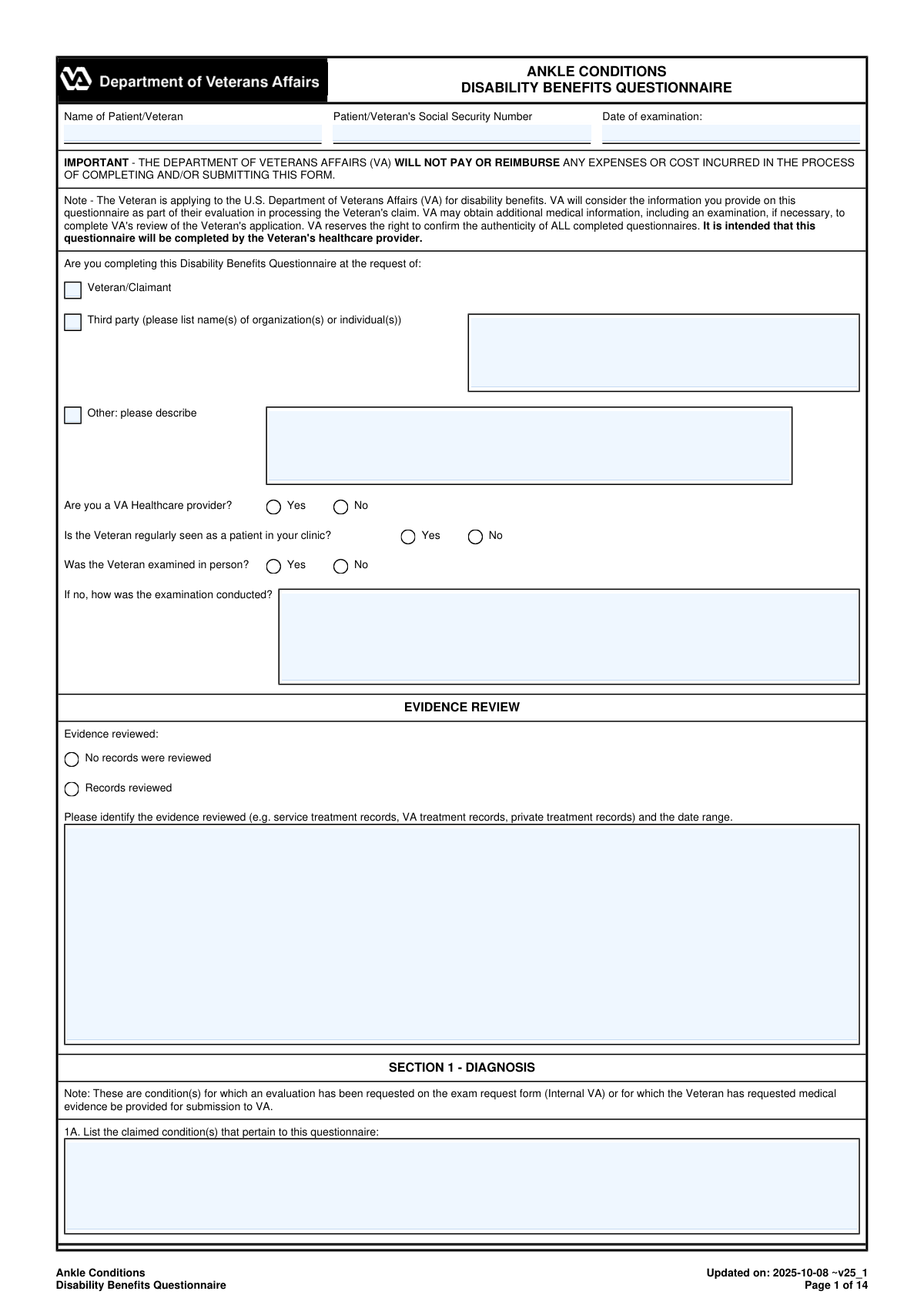
- Orthopedic & Joint Conditions: Use the Back (Thoracolumbar Spine) Conditions DBQ, Neck (Cervical Spine) Conditions DBQ, or specific joint forms like the Ankle Conditions DBQ, Knee and Lower Leg DBQ, Wrist Conditions DBQ, or Shoulder and Arm Conditions DBQ.
- Chronic Illnesses: For internal health issues, select the Diabetes Mellitus Disability Benefits Questionnaire, Heart Conditions DBQ, Endocrine Diseases DBQ, or Hypertension Disability Benefits Questionnaire.
- Foot & Lower Extremity: If you are claiming flatfoot or related issues, use the Foot Conditions, Including Flatfoot (Pes Planus) DBQ.
Social Security Administration (SSA) Forms
For civilians or veterans applying for federal disability insurance (SSDI), the primary starting point is Form SSA-16 (Application for Disability Benefits). If you have already applied and need to adjust your legal schedule due to an inability to travel, use Form SSA-769 (Request for Change in Time/Place of Disability Hearing).
Specialized Insurance and International Claims
- Government Life Insurance: If you are a veteran with a VA life insurance policy and have become totally disabled, use VA Form 29-357 (Claim for Disability Insurance Benefits) to request a waiver of premiums or claim insurance payments.
- Canadian Residents: If you are applying for the Canada Pension Plan, your doctor must complete SC ISP-2519 (Medical Report for Canada Pension Plan Disability Benefits) to document that your condition meets the legal definition of "severe and prolonged."
Frequently Asked Questions
These forms are used to gather standardized medical and personal information to determine an individual's eligibility for financial assistance or disability ratings. They help agencies like the VA or the Social Security Administration evaluate how a medical condition affects a person's ability to work and perform daily activities.
While the applicant provides their personal information, the medical sections of a DBQ must be completed by a qualified healthcare provider. The provider records clinical findings, such as range of motion and diagnoses, and certifies the accuracy of the information with their signature.
Yes, you can use AI tools like Instafill.ai to fill out disability benefits forms. These tools can accurately extract data from your source documents and place it into the correct fields in under 30 seconds, ensuring that complex medical forms are completed efficiently.
Manually filling out detailed medical forms can take a significant amount of time, but using an AI-powered service can complete the process in seconds. Instafill.ai allows users to generate filled-out forms quickly by extracting relevant data from existing records and placing it directly into the PDF.
VA DBQs are specific to Veterans and are used by the Department of Veterans Affairs to assign disability ratings for service-connected conditions. SSA forms, such as the SSA-16, are used by the Social Security Administration to evaluate claims for Social Security Disability Insurance (SSDI) or Supplemental Security Income (SSI).
Submission instructions vary depending on the agency and the specific form. VA forms are typically uploaded through the VA.gov portal or mailed to a regional processing center, while Social Security forms are submitted to the SSA and Canada Pension Plan forms are sent to Service Canada.
Forms for conditions like the back, neck, or knees generally require a diagnosis, medical history, and objective measurements of range of motion. The healthcare provider will also note any flare-ups, functional loss, and the impact the condition has on your ability to maintain employment.
Form SSA-769 is used when you need to request a change to the scheduled time or location of a disability hearing. It is important to file this form as soon as you realize you cannot attend the original hearing to avoid a potential dismissal of your case.
Yes, it is highly recommended to include supporting medical evidence such as X-rays, lab results, and treatment histories. Providing comprehensive documentation alongside the official forms helps the agency make a more informed and timely decision on your claim.
The SC ISP-2519 is the Medical Report for Canada Pension Plan (CPP) Disability Benefits. It is completed by a physician or nurse practitioner to provide Service Canada with the medical evidence needed to determine if a disability is 'severe and prolonged' under the law.
This form is specifically for veterans who hold Government Life Insurance and have become totally disabled. It allows them to apply for disability insurance benefits and request a waiver of their insurance premiums so their coverage continues without further cost.
Inaccurate or incomplete forms can lead to significant delays, requests for additional medical exams, or even a denial of benefits. Ensuring that every field is filled correctly and matches your medical records is essential for a successful application process.
Glossary
- Form Complexity Index
- Instafill’s 0–100 measure of how much effort a form takes to complete, calculated deterministically from the form’s own structure rather than estimated. It combines the number of fillable fields (the largest factor), how difficult those fields are to complete based on their type, the number of pages that contain fields, the amount of conditional “fill-only-if” logic, and how many sections the form is divided into, then adds modifiers for tables and repeating lists, bundled instruction pages, and dense page layouts. A higher score means the form is harder to fill out by hand. The forms in this category have a median Form Complexity Index of 84/100 (Very Complex). See exactly how it is calculated.
- DBQ (Disability Benefits Questionnaire)
- A standardized medical form used by the VA to gather specific clinical information from a healthcare provider to support a veteran's disability claim.
- Service-Connected
- A status indicating that a veteran’s disability or illness was caused or made worse by their military service, which is a requirement for receiving VA benefits.
- Range of Motion (ROM)
- A measurement of how far a joint can move in different directions, often used by examiners to determine the severity of physical impairments in the spine or limbs.
- Severe and Prolonged
- The specific legal criteria used for Canada Pension Plan (CPP) disability benefits, meaning a condition is long-term and prevents you from working any job regularly.
- ICD Codes
- Standardized medical codes (International Classification of Diseases) used by healthcare providers to identify specific diagnoses on benefit applications.
- Radiculopathy
- A condition where a nerve root in the spine is compressed, often leading to pain or numbness that must be documented in back and neck disability forms.
- IVDS (Intervertebral Disc Syndrome)
- A term used by the VA to evaluate back conditions based on the frequency of physician-prescribed bed rest or incapacitating episodes.
- Functional Impact
- A description of how a medical condition limits your ability to perform daily tasks or maintain employment, which is used to calculate disability ratings.