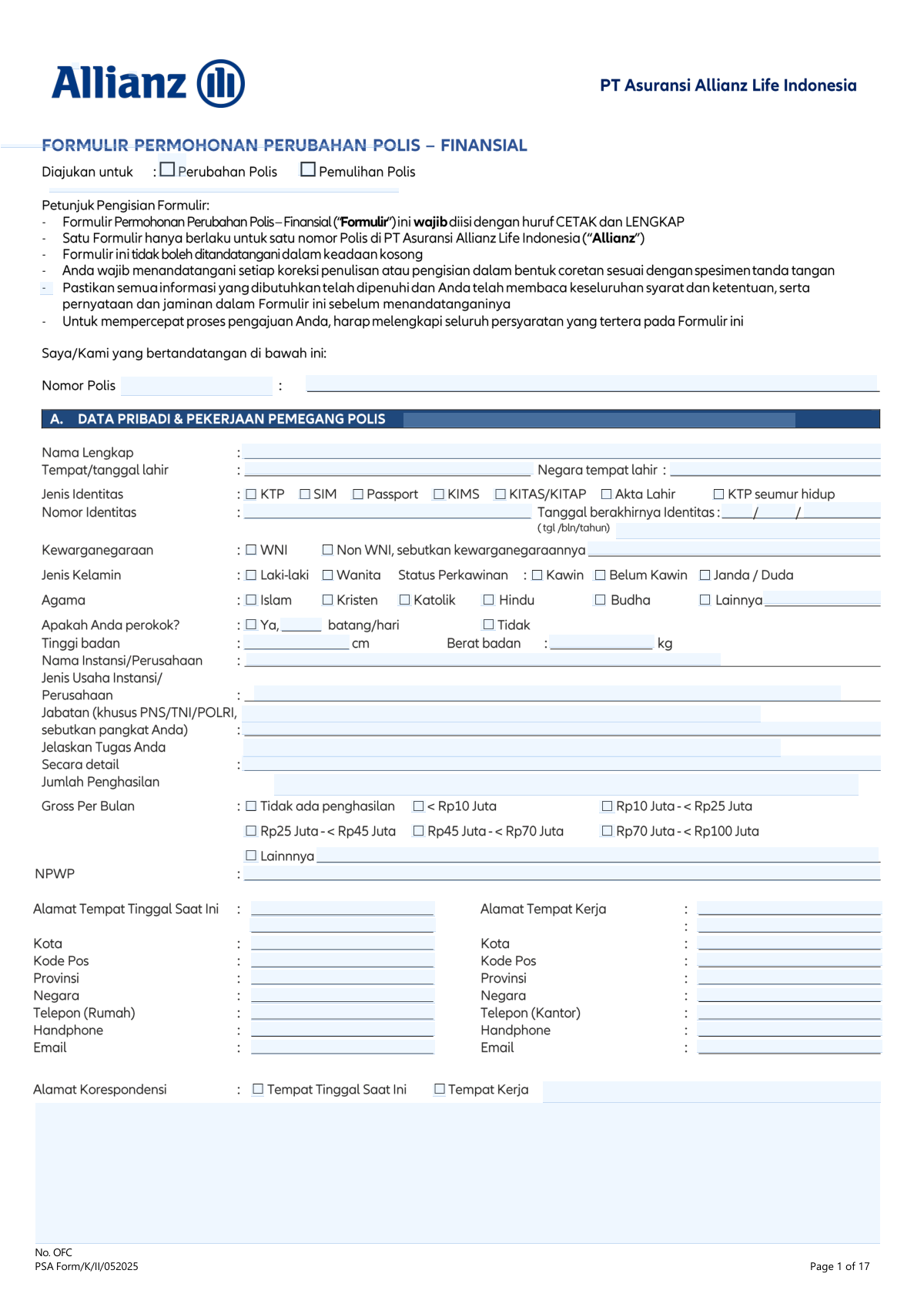
Yes! You can use AI to fill out PSA Form/K/II/052025 - Formulir Pembukaan Rekening / Account Opening Form
PSA Form/K/II/052025 is a 17-page Indonesian financial services form used for account opening, customer identification, and regulatory compliance purposes, including collection of personal data, tax residency information (NPWP), and declarations related to foreign tax jurisdictions under FATCA/CRS frameworks. The form requires applicants to provide identity details, correspondence address, tax identification numbers, and information about tax obligations in partner countries or jurisdictions outside Indonesia. It is an important document for financial institutions to fulfill Know Your Customer (KYC) and anti-money laundering obligations. Today, this form can be filled out quickly and accurately using AI-powered services like Instafill.ai, which can also convert non-fillable PDF versions into interactive fillable forms.
Our AI automatically handles information lookup, data retrieval, formatting, and form filling.
It takes less than a minute to fill out PSA Form/K/II/052025 using our AI form filling.
Securely upload your data. Information is encrypted in transit and deleted immediately after the form is filled out.
Form specifications
| Form name: | PSA Form/K/II/052025 - Formulir Pembukaan Rekening / Account Opening Form |
| Number of pages: | 1 |
| Language: | English |
Instafill Demo: filling out a legal form in seconds
How to Fill Out PSA Form/K/II/052025 Online for Free in 2026
Are you looking to fill out a PSA FORM/K/II/052025 form online quickly and accurately? Instafill.ai offers the #1 AI-powered PDF filling software of 2026, allowing you to complete your PSA FORM/K/II/052025 form in just 37 seconds or less.
Follow these steps to fill out your PSA FORM/K/II/052025 form online using Instafill.ai:
- 1 Navigate to Instafill.ai and upload the PSA Form/K/II/052025 PDF or select it from the available form library to begin the AI-assisted filling process.
- 2 Enter your personal identification details, including full name, date of birth, nationality, and identity document number as required in the early sections of the form.
- 3 Provide your correspondence address and, if different, your identity-based residential address including city, province, postal code, and country fields.
- 4 Enter your Indonesian Tax Identification Number (NPWP) and indicate whether you are a taxpayer in any foreign partner country or jurisdiction outside Indonesia.
- 5 Complete the foreign tax residency section by providing your Tax Identification Number (TIN) for each applicable foreign jurisdiction and any explanatory notes if a TIN is unavailable.
- 6 Review and complete any additional compliance declarations, checkboxes, and supporting information sections (pages 14–17) related to account type, beneficial ownership, and regulatory disclosures.
- 7 Review all entered information for accuracy, then submit or print the completed form for signing and submission to the relevant financial institution.
Our AI-powered system ensures each field is filled out correctly, reducing errors and saving you time.
Why Choose Instafill.ai for Your Fillable PSA Form/K/II/052025 Form?
Speed
Complete your PSA Form/K/II/052025 in as little as 37 seconds.
Up-to-Date
Always use the latest 2026 PSA Form/K/II/052025 form version.
Cost-effective
No need to hire expensive lawyers.
Accuracy
Our AI performs 10 compliance checks to ensure your form is error-free.
Security
Your personal information is protected with bank-level encryption.
Frequently Asked Questions About Form PSA Form/K/II/052025
PSA Form/K/II/052025 is an official form issued by a financial institution or government agency (PSA) in Indonesia, used for customer data collection and tax compliance purposes. Based on its content, it includes sections for personal identification, correspondence address, tax identification (NPWP), and information related to foreign tax residency (CRS/FATCA compliance). It is typically required when opening an account or updating customer records.
This form must be filled out by individuals who are customers or prospective customers of the issuing institution, particularly those who may be tax residents in countries other than Indonesia that are Partner Countries or Partner Jurisdictions. It is also required for Indonesian citizens who need to declare their tax residency status and provide their NPWP (Tax Identification Number).
The form asks whether you are a citizen or taxpayer in a country other than Indonesia that is a Partner Country or Partner Jurisdiction — this relates to international tax information exchange agreements (such as CRS - Common Reporting Standard). If you answer 'Yes,' you will need to provide additional information about your foreign tax residency, including your TIN (Tax Identification Number) from that country.
NPWP (Nomor Pokok Wajib Pajak) is the Indonesian Tax Identification Number assigned to individuals and entities by the Directorate General of Taxes. It is required on this form to verify your tax status in Indonesia and to comply with local and international tax reporting obligations.
If your residential address (based on your identity document) is different from your correspondence address, you must answer 'No' to the relevant question and then fill in your identity-based address details, including street address, city, province, postal code, and country in fields 3 through 7. If they are the same, answer 'Yes' and proceed to question 8.
In section 9 of the form, you must provide details about the country or countries where you are a taxpayer outside of Indonesia, including your TIN (Tax Identification Number / Nomor Wajib Pajak) for each country. If a TIN is not available, you are required to provide an explanation for why it is not available.
The form explicitly states that if the form is insufficient, you may make copies (fotokopi) of the relevant pages to fill in additional information. This is particularly noted for the foreign tax residency section where multiple countries may need to be listed.
This form consists of 17 pages and covers multiple sections including personal data, address information, tax identification, foreign tax residency declarations, and additional compliance-related questions. Pages 13 onward contain the tax residency declaration sections in Indonesian language, while earlier pages contain checkbox-based data fields.
Yes, AI-powered services like Instafill.ai can help you fill out this form accurately and efficiently. Instafill.ai uses AI to auto-fill form fields based on your information, reducing errors and saving time — especially useful for a multi-page form like this one with many checkboxes and data fields.
To fill out this form online, visit Instafill.ai and upload the PSA Form/K/II/052025 PDF. The AI will guide you through each field, auto-filling information where possible based on your inputs. Once completed, you can download the filled form, print it, and submit it to the relevant institution.
If you have a non-fillable or flat PDF version of this form, Instafill.ai can convert it into an interactive fillable form. Simply upload the flat PDF to Instafill.ai, and the platform will make the fields editable so you can type in your information digitally without needing to print and handwrite everything.
Before filling out this form, you should have your national identity card (KTP) or passport, your NPWP (Indonesian Tax ID), your current residential and correspondence addresses, and if applicable, your foreign Tax Identification Number (TIN) from any country where you are also a taxpayer. Having these documents on hand will help you complete the form accurately.
Based on the visible content, portions of this form (particularly from page 13 onward) are written in Indonesian (Bahasa Indonesia). Some sections may have bilingual elements. If you need assistance understanding the Indonesian sections, consider using a translation tool or consulting with the issuing institution for guidance.
The completed form should be submitted to the institution that requested it — typically a bank, financial services company, or government agency associated with PSA. Contact the institution directly for specific submission instructions, whether in person, by mail, or through an online portal.
Providing incorrect or false information on this form, particularly regarding tax residency status, may result in legal consequences under Indonesian tax law and international tax compliance regulations. Always ensure the information you provide is accurate and up to date, and consult a tax professional if you are unsure about any section.
Compliance PSA Form/K/II/052025
Validation Checks by Instafill.ai
1
Foreign Tax Residency Status Checkbox Completion
Validates that the question 'Apakah Anda adalah warga negara/wajib pajak di luar negeri selain Indonesia yang merupakan Negara Mitra/Yurisdiksi Mitra?' has exactly one checkbox selected (Ya or Tidak). This field is critical for CRS/FATCA compliance and determines whether additional foreign tax information must be provided. If neither or both options are selected, the form must be rejected as the applicant's tax residency status cannot be determined.
2
Correspondence Address vs. Identity Address Consistency Check
Validates that the question regarding whether the residential address matches the correspondence address has exactly one response selected (Ya or Tidak). If 'Tidak' is selected, fields 3 through 7 (identity-based address, city, province, postal code, and country) must all be populated. Failure to complete these conditional fields when 'Tidak' is chosen renders the address information incomplete and may cause compliance or delivery issues.
3
Identity-Based Address Field Completeness
When the applicant indicates their identity address differs from their correspondence address, field 3 (Alamat berdasarkan identitas) must contain a non-empty, non-whitespace string. This address must correspond to a valid residential or registered address as shown on the applicant's official identification document. Leaving this field blank when required invalidates the CRS self-certification and may trigger regulatory non-compliance.
4
City Field Population When Address Differs
Validates that field 4 (Kota) is completed whenever the applicant's identity address differs from their correspondence address. The city name should be a recognizable municipality name and must not contain numeric-only values or special characters. An empty or invalid city field prevents proper address verification and may cause issues with identity document cross-referencing.
5
Province Field Population When Address Differs
Validates that field 5 (Provinsi) is populated when the identity address differs from the correspondence address. The province entered should correspond to a valid administrative province or region within the declared country. If the country is Indonesia, the province must match one of the 38 recognized Indonesian provinces; failure to provide a valid province may result in form rejection.
6
Postal Code Format Validation
Validates that field 6 (Kode Pos) is completed and conforms to the expected postal code format for the declared country. For Indonesian addresses, the postal code must be exactly 5 numeric digits. If the country is non-Indonesian, the postal code format should be validated against the respective country's standard. An incorrectly formatted or missing postal code can cause mail delivery failures and identity verification errors.
7
Country Field Completeness and Validity
Validates that field 7 (Negara) is populated with a recognized country name or ISO country code when the identity address differs from the correspondence address. The country entered must be a valid, internationally recognized nation and should be consistent with the foreign tax residency declaration made earlier in the form. An empty or unrecognized country value prevents proper CRS jurisdiction mapping and regulatory reporting.
8
NPWP (Indonesian Tax Identification Number) Format Validation
Validates that field 8 (NPWP) is completed and follows the correct Indonesian NPWP format, which consists of 15 digits in the pattern XX.XXX.XXX.X-XXX.XXX. The NPWP is a mandatory tax identifier for Indonesian residents and must be present unless the applicant has declared they are not an Indonesian tax resident. An incorrectly formatted or missing NPWP may result in tax reporting failures and regulatory penalties.
9
Foreign Tax Country Information Completeness (Section 9)
Validates that section 9 (Informasi negara dimana Anda adalah sebagai wajib pajak selain Indonesia) is completed when the applicant has indicated they are a tax resident of a foreign partner jurisdiction. This section must include the foreign country name and the corresponding TIN (Tax Identification Number) or a valid explanation for why the TIN is unavailable. Incomplete foreign tax information violates CRS reporting obligations and may expose the institution to regulatory sanctions.
10
TIN Unavailability Explanation Requirement
When a foreign TIN is not provided in section 9, validates that the explanation field (*Penjelasan alasan apabila TIN/Nomor Wajib Pajak tidak tersedia) is populated with a substantive reason. Acceptable reasons typically include that the jurisdiction does not issue TINs, the applicant has applied but not yet received one, or the applicant is exempt under domestic law. A blank explanation without a TIN is non-compliant with CRS standards and must be flagged for review.
11
Multi-Page Checkbox Selection Completeness
Validates that all mandatory checkbox groups across pages 1 through 8 have at least one option selected where a response is required. The form contains numerous checkbox fields across 17 pages, and unanswered mandatory sections indicate an incomplete submission. Any page with required checkbox groups left entirely blank should trigger a validation error identifying the specific page and section that requires attention.
12
Mutually Exclusive Checkbox Group Enforcement
Validates that checkbox groups presenting mutually exclusive options (such as Yes/No questions throughout the form) do not have multiple conflicting options selected simultaneously. Selecting both 'Ya' and 'Tidak' for any binary question creates an ambiguous response that cannot be processed. The system must detect and reject any instance where more than one option is selected within a mutually exclusive group.
13
Form Version and OFC Number Consistency
Validates that the form version identifier 'PSA Form/K/II/052025' is consistent across all 17 pages and that the OFC number field is populated on each page header. Inconsistent form version numbers across pages may indicate that pages from different form versions have been mixed together. A missing or inconsistent OFC number prevents proper document tracking and filing within the institution's records management system.
14
Sections 14–16 Completeness on Final Pages
Validates that numbered items 14, 15, and 16 on pages 16 and 17 are completed, as these appear to represent final declarations, signatures, or summary fields critical to form submission. These terminal sections often contain applicant declarations, date fields, or authorization signatures that are legally required for the form to be valid. Incomplete final sections render the entire form submission invalid regardless of the completeness of earlier sections.
15
Supplementary Copy Indication When Form Is Insufficient
Validates that if the instruction 'Jika formulir ini tidak mencukupi, dapat dibuat salinan (copy) untuk diisi' has been acted upon, all supplementary copies are properly identified, numbered, and attached to the primary submission. Each copy must reference the same OFC number and applicant identity to ensure all pages are associated with the correct record. Unlinked or unnumbered supplementary pages may be lost during processing, resulting in incomplete tax residency declarations.
16
Logical Consistency Between Foreign Residency Declaration and Address Country
Validates that if the applicant declares they are a tax resident of a foreign partner jurisdiction (section 1 answer is 'Ya'), the country listed in field 7 (Negara) must be a non-Indonesian country that is a recognized CRS partner jurisdiction. Conversely, if the applicant answers 'Tidak', the country field should reflect Indonesia or be consistent with a non-partner jurisdiction. A mismatch between the tax residency declaration and the address country indicates a logical inconsistency that requires manual review.
Common Mistakes in Completing PSA Form/K/II/052025
Many applicants overlook the 'No. OFC' field that appears on every page of this 17-page form, either because they don't know where to obtain it or assume it will be filled in by the institution. This can cause the form to be rejected or pages to become disassociated during processing. Always confirm with the issuing institution whether this number is pre-assigned or must be obtained before submission. Tools like Instafill.ai can help flag required fields like this so nothing is accidentally left blank.
On page 13, applicants are asked whether they are a taxpayer in a country outside Indonesia that is a Partner Country/Partner Jurisdiction. Many people misunderstand what qualifies as a 'Partner Jurisdiction' under Indonesia's tax information exchange agreements and answer incorrectly. Answering 'Yes' or 'No' incorrectly can trigger wrong follow-up requirements or compliance issues. Applicants should verify their tax residency status and consult the official list of Indonesia's partner jurisdictions before answering.
Page 13 asks whether the identity-based residential address is the same as the correspondence address. Applicants who answer 'No' frequently forget to fill in fields 3–7 (address, city, province, postal code, and country), leaving them blank. This omission can delay processing or result in form rejection. Read the conditional instruction carefully: if 'No' is selected, all address fields must be completed before proceeding to question 8.
Field 8 on page 13 requires the NPWP, which follows a specific 15-digit format (XX.XXX.XXX.X-XXX.XXX). Applicants commonly enter it without the required dots and dashes, enter an outdated format, or leave it blank if they believe they are exempt. An incorrectly formatted NPWP can cause data validation failures and processing delays. Double-check your NPWP card or official tax documents and enter the number exactly as formatted. Instafill.ai can automatically validate NPWP format to prevent such errors.
Question 9 on page 13 requires information about countries where the applicant is a taxpayer outside Indonesia, including the TIN for each jurisdiction. Many applicants leave the TIN field blank without providing the mandatory explanation for why it is unavailable, as required by the form's instructions. Omitting both the TIN and the explanation can result in non-compliance with AEOI (Automatic Exchange of Information) regulations. If a TIN is not available, always complete the explanation field marked with an asterisk (*) to avoid rejection.
Page 13 explicitly states that if the form is insufficient, copies can be made to accommodate additional information, particularly for listing multiple foreign tax jurisdictions. Applicants frequently try to cram information into limited spaces or simply omit additional jurisdictions, which constitutes an incomplete and potentially non-compliant submission. If you are a taxpayer in more than one foreign jurisdiction, photocopy the relevant page and attach it to the original form. Since this is a flat PDF form, Instafill.ai can convert it into a fillable digital version that dynamically accommodates additional entries.
This form contains dozens of checkboxes across pages 1–8 and 14–17. A very common mistake is either checking multiple boxes when only one is allowed, failing to check any box when one is required, or accidentally marking the wrong option. These errors can misrepresent the applicant's status, product selection, or declarations. Carefully read each checkbox group's instructions to determine whether single or multiple selections are permitted, and review all selections before submission.
The form collects address data in multiple sections (correspondence address and identity-based address on page 13, and potentially in earlier sections). Applicants often enter different formats or abbreviations across sections, or forget to fill in the postal code (Kode Pos) and province (Provinsi) fields. Inconsistent address data can cause identity verification failures. Ensure all address fields are filled completely and consistently throughout the entire form, using the full official address as it appears on your national ID (KTP).
Pages 14–17 contain a numbered list of up to 16 items with sub-items (a through f and beyond), which appear to cover declarations, agreements, or detailed product/service information. Applicants frequently stop partway through, skip sub-items (especially items 3a–3e and 10a–10b), or leave item 14–16 blank because they assume the form ends earlier. Incomplete declarations can invalidate the entire submission. Carefully work through every numbered item and sub-item on pages 14–17 before signing.
After completing all 17 pages, many applicants forget to provide their signature and date on the final page (page 17), particularly because the signature section may appear after a long list of declarations. An unsigned form is legally invalid and will be returned for completion, causing significant delays. Always review the last page specifically for signature, date, and any witness or acknowledgment fields before submitting the form.
PSA Form/K/II/052025 appears to be a flat, non-fillable PDF, which means applicants must either print and handwrite their responses or use workarounds to type into it. This often results in illegible handwriting, misaligned text, or fields being skipped because they are hard to locate on a printed page. Instafill.ai can convert this flat PDF into a fully fillable digital form, making it easier to complete all fields accurately, validate data formats, and submit a clean, professional document.
Page 13 includes conditional instructions such as 'If No, please state your address; if Yes, proceed to question 8.' Applicants frequently misread these instructions and either fill in address fields unnecessarily when they answered 'Yes,' or skip to question 8 when they answered 'No' and should have completed fields 3–7. Following the wrong conditional path results in missing required data or redundant entries that can confuse reviewers. Read each conditional instruction carefully and follow only the path that corresponds to your answer.
Saved over 80 hours a year
“I was never sure if my IRS forms like W-9 were filled correctly. Now, I can complete the forms accurately without any external help.”
Kevin Martin Green
Your data stays secure with advanced protection from Instafill and our subprocessors
Robust compliance program
Transparent business model
You’re not the product. You always know where your data is and what it is processed for.
ISO 27001, HIPAA, and GDPR
Our subprocesses adhere to multiple compliance standards, including but not limited to ISO 27001, HIPAA, and GDPR.
Security & privacy by design
We consider security and privacy from the initial design phase of any new service or functionality. It’s not an afterthought, it’s built-in, including support for two-factor authentication (2FA) to further protect your account.
Fill out PSA Form/K/II/052025 with Instafill.ai
Worried about filling PDFs wrong? Instafill securely fills psa-formkii052025-formulir-pembukaan-rekening-account-opening-form forms, ensuring each field is accurate.