Fill out account opening forms
with AI.
Account opening forms are the gateway to establishing financial and investment accounts, whether at a bank, brokerage, or asset management firm. These documents collect the personal, financial, and tax-related information that institutions need to verify your identity, meet regulatory requirements, and set up your account correctly. They typically cover everything from basic identification and contact details to tax residency declarations under international frameworks like FATCA and CRS, as well as anti-money laundering (AML) compliance checks. Getting these details right the first time matters — errors or omissions can delay account setup or trigger additional verification steps.
By continuing, you acknowledge Instafill's Privacy Policy and agree to get occasional product update and promotional emails.
About account opening forms
The forms in this category serve a range of applicants and situations. Individual investors opening a personal investment account — such as with Vanguard — will find forms tailored to their personal tax status and financial profile. Businesses, institutions, and professional counterparties have their own dedicated forms that address corporate structures, MiFID II classification, and entity-level compliance. International applicants, such as those navigating Indonesian financial regulations through forms like the PSA Form/K/II/052025, also need to provide jurisdiction-specific information including local tax identification numbers.
Because these forms are often lengthy, multi-section documents with precise data requirements, tools like Instafill.ai use AI to fill them out accurately in under 30 seconds, reducing the risk of errors and saving considerable time for individuals and compliance teams alike.
Every form on this page can be completed without typing. Instafill is form filling software that reads a PDF and fills it for you — including flat and scanned documents that carry no fillable fields at all.
Forms in This Category
The forms in this category have a median Form Complexity Index of 69/100 (Complex), measured across 4 forms by field count, input difficulty, length, conditional logic and structure. See how it is calculated.
| Form Name | Pages | FCI | |
|---|---|---|---|
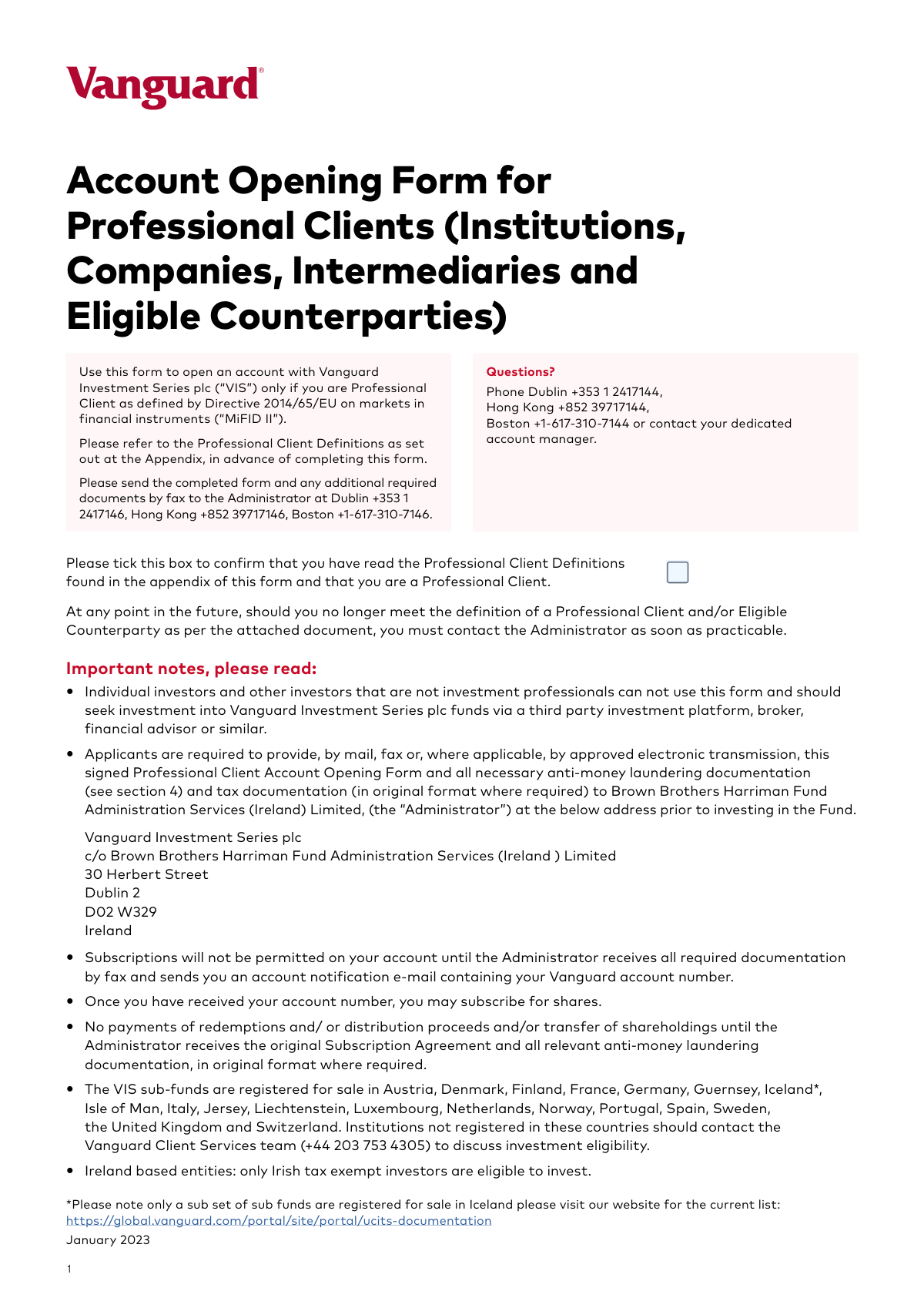
| 1. | Account Opening Form for Professional Clients (Institutions, Companies, Intermediaries and Eligible Counterparties) | 1 | Complex 63 |
| 2. | New Account Agreement | 1 | Complex 69 |
| 3. | PSA Form/K/II/052025 - Formulir Pembukaan Rekening / Account Opening Form | 1 | Very Complex 83 |
| 4. | Vanguard Account Opening Form for Individual Investors | 1 | Complex 66 |
- Enterprise-grade security & data encryption
- 99%+ accuracy powered by AI
- 1,000+ forms from all industries
- Complete forms in under 60 seconds
How to Choose the Right Form
Opening a Personal Investment Account?
If you're an individual investor looking to open a new investment account, start with the Vanguard Account Opening Form for Individual Investors. This form is designed for personal account setup with Vanguard Investment Series plc and walks you through personal details, financial information, tax residency status, and AML documentation.
Representing a Business, Institution, or Organization?
If you're applying on behalf of a company, financial institution, or eligible counterparty, use the Account Opening Form for Professional Clients (Institutions, Companies, Intermediaries and Eligible Counterparties). This form establishes your entity's status as a Professional Client under MiFID II and covers the additional compliance requirements — including AML checks and FATCA/CRS tax reporting — that apply to corporate and institutional applicants.
Opening an Account with an Indonesian Financial Institution?
For customers of Indonesian financial services providers, the PSA Form/K/II/052025 - Formulir Pembukaan Rekening / Account Opening Form is the right choice. This 17-page form handles:
- Customer identification (KYC) and anti-money laundering obligations
- NPWP (Indonesian tax identification) collection
- FATCA/CRS declarations for foreign tax jurisdictions
It is specifically tailored for regulatory compliance within Indonesia's financial system.
---
Quick Decision Summary:
- Individual investor → Vanguard individual form
- Business/institution/intermediary → Vanguard professional clients form
- Indonesian financial account → PSA Form/K/II/052025
All three forms can be filled out quickly and accurately using AI-powered tools on Instafill.ai, which can also convert non-fillable PDFs into interactive forms — saving you time and reducing errors during the application process.
Form Comparison
| Form | Purpose | Who Files It | When to Use |
|---|---|---|---|
| PSA Form/K/II/052025 - Formulir Pembukaan Rekening / Account Opening Form | Open account with KYC, FATCA/CRS, and NPWP compliance | Individual customers of Indonesian financial institutions | Opening a new account under Indonesian regulatory requirements |
| Vanguard Account Opening Form for Individual Investors | Establish individual investment account with Vanguard | Individual retail investors | Opening a personal Vanguard Investment Series plc account |
| Account Opening Form for Professional Clients (Institutions, Companies, Intermediaries and Eligible Counterparties) | Open investment account and establish MiFID II professional client status | Institutions, companies, and eligible counterparties | Opening a Vanguard account as a professional or institutional client |
Tips for account opening forms
Account opening forms typically require government-issued ID, proof of address, and tax identification numbers (such as NPWP, SSN, or equivalent). Having these documents on hand before you start will prevent you from leaving sections incomplete or submitting inaccurate details that could delay your application.
Forms like these often include FATCA and CRS sections that ask about tax obligations in multiple countries or jurisdictions. If you hold accounts, assets, or citizenship in more than one country, be prepared to disclose all relevant tax residency information — incomplete declarations can trigger compliance issues or account rejection.
Anti-money laundering (AML) and Know Your Customer (KYC) sections are mandatory for regulatory compliance and cannot be left blank. Financial institutions are legally required to verify your identity, so missing or vague responses in these sections are among the most common reasons applications are returned or delayed.
If you are applying as a professional client — such as an institution, company, or eligible counterparty — verify that you meet the MiFID II professional client criteria before completing the form. Misclassification can result in your application being rejected or reclassified, which may affect the products and services available to you.
AI-powered tools like Instafill.ai can fill out account opening forms with high accuracy in under 30 seconds, saving significant time especially when dealing with lengthy multi-section forms like the PSA or Vanguard applications. Your data stays secure throughout the process, and Instafill.ai can even convert non-fillable PDFs into interactive forms you can complete online.
Ensure that your name, date of birth, and identification numbers are entered exactly as they appear on your official documents. Even minor discrepancies — such as a missing middle name or a transposed digit in a tax ID — can cause verification failures and significantly slow down the account opening process.
Always save or print a copy of your completed account opening form before submitting it. If your application is queried or additional information is requested, having a record of what you submitted makes it much easier to respond accurately and consistently.
Many account opening forms distinguish between your residential address and your correspondence address, and some institutions have restrictions on P.O. boxes or addresses in certain jurisdictions. Confirm which address type is required in each field to avoid having important account communications sent to the wrong location.
Frequently Asked Questions
This category includes three account opening forms: the PSA Form/K/II/052025 for Indonesian financial services accounts, the Vanguard Account Opening Form for Individual Investors, and the Vanguard Account Opening Form for Professional Clients (institutions, companies, and eligible counterparties). Each form is tailored to a specific type of applicant and financial institution.
Your choice depends on who you are and where you're opening an account. If you're an individual investor looking to invest with Vanguard, use the Vanguard Individual Investors form. If you represent an institution, company, or eligible counterparty opening a Vanguard account, use the Professional Clients form. If you're opening an account with an Indonesian financial institution regulated under PSA requirements, use the PSA Form/K/II/052025.
The PSA Form/K/II/052025 is intended for individuals opening accounts with Indonesian financial services institutions. It is required for customer identification, KYC compliance, and regulatory obligations including FATCA and CRS tax reporting. Applicants must provide personal identity details, a tax identification number (NPWP), and declarations about foreign tax residency.
The Vanguard Individual Investors form is designed for personal investors opening a new investment account, while the Professional Clients form is for institutions, companies, intermediaries, and eligible counterparties. The Professional Clients form additionally establishes the applicant's status under MiFID II regulations, which is a requirement specific to institutional and corporate account holders.
Most account opening forms in this category require personal or organizational identification details, contact and correspondence addresses, tax identification numbers, and tax residency status. You may also need to provide anti-money laundering (AML) documentation and declarations related to international tax frameworks such as FATCA and CRS.
FATCA (Foreign Account Tax Compliance Act) and CRS (Common Reporting Standard) are international frameworks that require financial institutions to identify and report accounts held by foreign tax residents. By collecting this information upfront, institutions fulfill their legal obligations and help prevent tax evasion across borders.
Yes. AI-powered tools like Instafill.ai can fill out account opening forms in under 30 seconds by accurately extracting and placing data from your source documents. This reduces manual entry errors and speeds up the account setup process significantly, whether you're completing an Indonesian PSA form or a Vanguard investment account form.
Manually completing a multi-section account opening form can take 20–40 minutes, especially for forms with 17+ pages like the PSA Form/K/II/052025. Using an AI tool like Instafill.ai, the same form can be filled out in under 30 seconds, with data accurately extracted and placed from existing documents.
You will generally need a government-issued photo ID, proof of address, your tax identification number (such as a TIN, NPWP, or equivalent), and any relevant corporate documents if applying as a business or institution. Having these ready before you start will make the process faster and help ensure accuracy.
Submission requirements vary by form and institution. Vanguard forms are typically submitted directly to Vanguard Investment Series plc through their designated channels, while the PSA form is submitted to the relevant Indonesian financial institution. Always follow the submission instructions provided by the specific institution to ensure your application is processed correctly.
Some versions of these forms may be distributed as non-fillable PDFs. Services like Instafill.ai can convert non-fillable PDF versions into interactive fillable forms, making it easier to complete and submit them digitally without needing to print and handwrite your responses.
Filling out account opening forms online is safe when using reputable, secure platforms. Always ensure the website you use employs encryption and data protection measures. When using AI-powered form-filling services, verify their privacy policy to understand how your personal and financial data is handled.
Glossary
- Form Complexity Index
- Instafill’s 0–100 measure of how much effort a form takes to complete, calculated deterministically from the form’s own structure rather than estimated. It combines the number of fillable fields (the largest factor), how difficult those fields are to complete based on their type, the number of pages that contain fields, the amount of conditional “fill-only-if” logic, and how many sections the form is divided into, then adds modifiers for tables and repeating lists, bundled instruction pages, and dense page layouts. A higher score means the form is harder to fill out by hand. The forms in this category have a median Form Complexity Index of 69/100 (Complex). See exactly how it is calculated.
- KYC (Know Your Customer)
- A mandatory process financial institutions use to verify the identity of their clients before opening an account. It typically requires submitting government-issued ID, proof of address, and other personal information to prevent fraud and money laundering.
- AML (Anti-Money Laundering)
- A set of laws and procedures that financial institutions must follow to detect and prevent illegal funds from being disguised as legitimate income. Account opening forms often require documentation specifically to satisfy AML compliance checks.
- FATCA (Foreign Account Tax Compliance Act)
- A U.S. law requiring foreign financial institutions to report accounts held by U.S. taxpayers or foreign entities in which U.S. taxpayers hold a substantial interest. Account holders may need to declare whether they have U.S. tax obligations.
- CRS (Common Reporting Standard)
- An international standard developed by the OECD requiring financial institutions to collect and automatically share tax-related information about account holders with foreign tax authorities. It is the global equivalent of FATCA.
- Tax Residency
- The country or jurisdiction where an individual or entity is considered a taxpayer under local law. Account opening forms ask for this information to determine which tax reporting obligations (such as FATCA or CRS) apply to the account holder.
- NPWP (Nomor Pokok Wajib Pajak)
- Indonesia's Tax Identification Number assigned to individuals and entities for tax administration purposes. It is required on Indonesian financial forms such as the PSA Form to link the account holder to their tax records.
- MiFID II (Markets in Financial Instruments Directive II)
- A European Union regulatory framework governing investment services and financial markets. It requires financial firms to classify clients (e.g., Retail, Professional, or Eligible Counterparty) before providing services, a classification that must be established during account opening.
- Professional Client
- A regulatory classification under MiFID II for entities such as institutions, large companies, and intermediaries that are deemed to have sufficient financial expertise to make their own investment decisions. This classification affects the level of regulatory protection and documentation required.
- Eligible Counterparty
- A specific MiFID II client category reserved for highly sophisticated financial entities such as investment firms, credit institutions, and insurance companies. These entities receive the least regulatory protection but face fewer compliance restrictions when opening accounts.
- TIN (Tax Identification Number)
- A unique number assigned by a government authority to identify an individual or entity for tax purposes. Account opening forms across jurisdictions require applicants to provide their TIN(s) to comply with international tax reporting standards like CRS and FATCA.