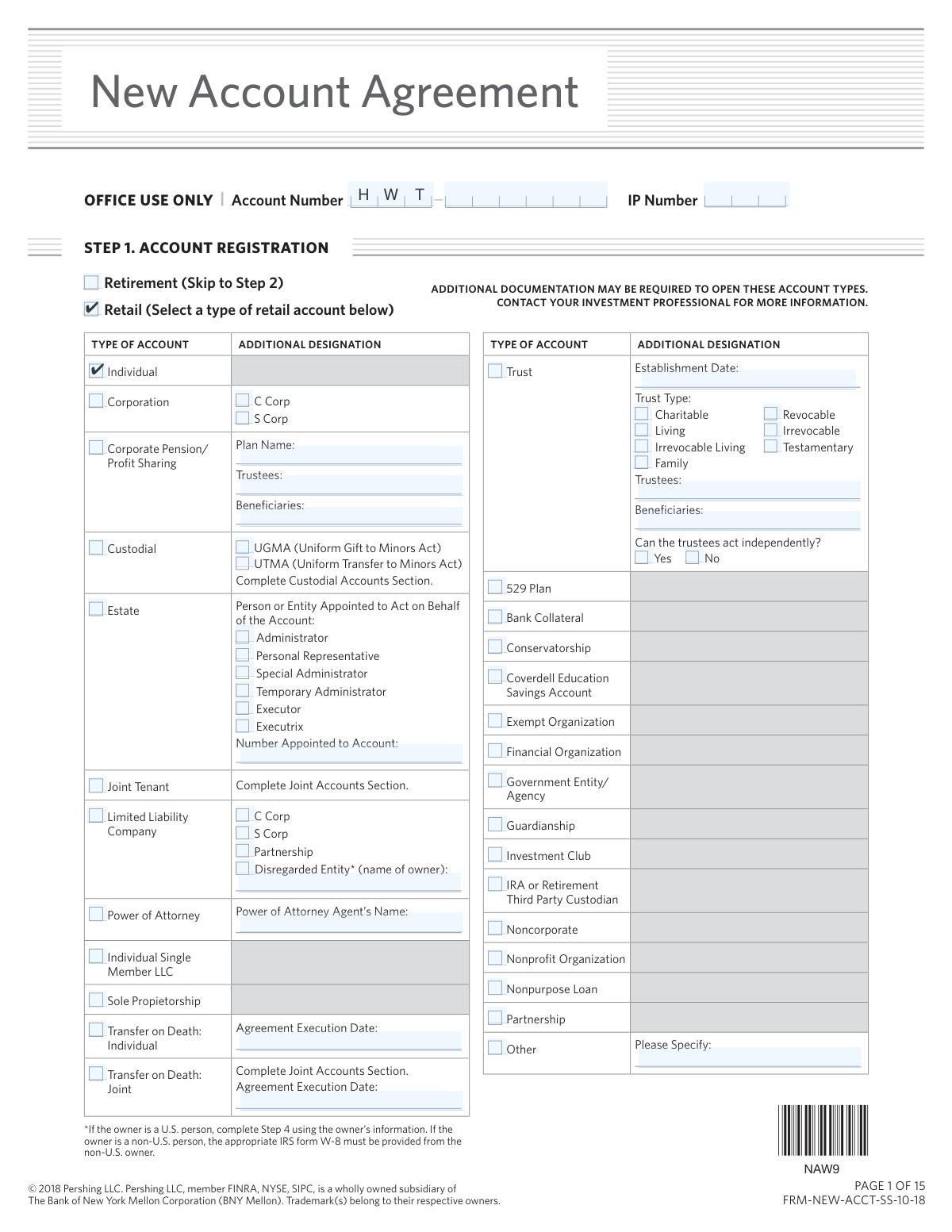
Yes! You can use AI to fill out New Account Agreement

The New Account Agreement is a comprehensive form required by financial institutions like Pershing LLC to establish a new brokerage account for an individual or entity. It gathers critical information mandated by regulations such as the USA PATRIOT Act, including identity verification, financial standing, investment objectives, and risk tolerance. Completing this agreement is a crucial step in formalizing the client-broker relationship and ensuring regulatory compliance. Today, this form can be filled out quickly and accurately using AI-powered services like Instafill.ai, which can also convert non-fillable PDF versions into interactive fillable forms.
Our AI automatically handles information lookup, data retrieval, formatting, and form filling.
It takes less than a minute to fill out FRM-NEW-ACCT-SS-10-18 using our AI form filling.
Securely upload your data. Information is encrypted in transit and deleted immediately after the form is filled out.

Form specifications

Form name: New Account Agreement
Number of pages: 1
Language: English
main-image

Instafill Demo: How to fill out PDF forms in seconds with AI

How to Fill Out FRM-NEW-ACCT-SS-10-18 Online for Free in 2026

Are you looking to fill out a FRM-NEW-ACCT-SS-10-18 form online quickly and accurately? Instafill.ai offers the #1 AI-powered PDF filling software of 2026, allowing you to complete your FRM-NEW-ACCT-SS-10-18 form in just 37 seconds or less.
Follow these steps to fill out your FRM-NEW-ACCT-SS-10-18 form online using Instafill.ai:
  1. 1 Navigate to Instafill.ai and upload or select the New Account Agreement form.
  2. 2 Use the AI assistant to automatically populate personal and contact information for the primary and secondary account holders in Steps 4 and 5.
  3. 3 Complete the Account Registration (Step 1), USA PATRIOT Act Information (Step 3), and Investment Objective sections (Step 9) by answering the guided questions.
  4. 4 Specify your preferences for cash management (Step 7), tax lot disposition methods (Step 10), and bond elections (Step 11).
  5. 5 Review all the auto-filled information for accuracy, particularly the U.S. Taxpayer Number Certification in Step 14.
  6. 6 Electronically sign and date the agreement in Step 15 to complete the application process and submit it to your financial organization.

Our AI-powered system ensures each field is filled out correctly, reducing errors and saving you time.

Why Choose Instafill.ai for Your Fillable FRM-NEW-ACCT-SS-10-18 Form?

Speed

Complete your FRM-NEW-ACCT-SS-10-18 in as little as 37 seconds.

Up-to-Date

Always use the latest 2026 FRM-NEW-ACCT-SS-10-18 form version.

Cost-effective

No need to hire expensive lawyers.

Accuracy

Our AI performs 10 compliance checks to ensure your form is error-free.

Security

Your personal information is protected with bank-level encryption.

Frequently Asked Questions About Form FRM-NEW-ACCT-SS-10-18

This form is used to open a new brokerage account with a financial organization that uses Pershing LLC for clearing and custody services. It gathers all the necessary personal, financial, and legal information required to establish your account.

Any individual, joint party, or entity (like a corporation or trust) wishing to open a new brokerage account through a financial institution serviced by Pershing must complete this form.

You must provide a physical street address for your permanent residence or your entity's physical location. Post office (P.O.) boxes are not acceptable for the legal address.

No, if you are a nonresident alien or foreign entity, you should not sign the U.S. Taxpayer Certification. Instead, you must submit the appropriate IRS Form W-8 (such as W-8BEN) with your application.

You may be asked to provide a copy of your unexpired driver’s license or other government-issued photo ID to verify your identity. Non-U.S. persons will also need to provide an appropriate IRS Form W-8.

Yes, for a joint account, both the primary and secondary account holders must sign the form in Step 15. If there are more than two owners, an additional participant form must be completed and signed.

This is the method used to determine which shares of a security are sold first for tax purposes, which affects your capital gains or losses. You should consult a tax advisor to choose the best method for your situation, such as FIFO (First-In, First-Out).

In Step 8, you can create a User ID for online access via the NetXInvestor website. You will need to provide your mother's maiden name and date of birth to establish the User ID.

You must be consistent in how you report your financial information. If you provide a combined annual income for both account holders, you must also provide a combined net worth.

This section is required by federal law to help the government fight terrorism and money laundering activities. Financial institutions must obtain, verify, and record information that identifies each person who opens an account.

Yes, you can designate a 'Trusted Contact' by completing the separate Trusted Contact Form mentioned in Step 5. This allows your financial institution to contact that person if they have concerns about your well-being or potential financial exploitation.

Yes, services like Instafill.ai use AI to accurately auto-fill form fields with your saved information, which can save you significant time and reduce errors on complex forms like this one.

Simply upload the New Account Agreement PDF to the Instafill.ai platform. The AI will identify the fields and automatically populate them with information stored in your secure profile.

If you have a non-fillable or 'flat' PDF, you can use a service like Instafill.ai. It can convert the document into an interactive, fillable form that you can complete online easily.

Compliance FRM-NEW-ACCT-SS-10-18
Validation Checks by Instafill.ai

1
Legal Address Must Be a Physical Street Address
This validation ensures the 'Legal Address' field in Step 4 and Step 5 does not contain 'P.O. Box' or similar variations. Financial regulations, such as the USA PATRIOT Act, require a physical residence or business address to verify a customer's identity and prevent fraud. If a P.O. Box is detected, the form submission will be rejected with an error message prompting the user to provide a valid street address.
2
Government ID Must Be Unexpired
This check verifies that the 'Date of Expiration' for both Government Photo ID #1 and #2 in the account holder sections is a date in the future. This is crucial for complying with Customer Identification Program (CIP) rules, which require valid, unexpired identification to open an account. A submission with an expired ID will fail validation and require the user to provide current identification documents.
3
Conditional SSN/EIN Requirement and Format
This validation checks that if 'Person' is selected in Step 4 or 5, a Social Security Number (SSN) in the format XXX-XX-XXXX is provided. If 'Entity' is selected, an Employer Identification Number (EIN) in the format XX-XXXXXXX must be provided. This ensures the correct type of Taxpayer Identification Number (TIN) is collected for IRS reporting and account setup. A mismatch or missing number will block the account creation process.
4
Joint Account Requires Secondary Holder Information
This check ensures that if a joint account type (e.g., 'Joint Tenant', 'Transfer on Death: Joint') is selected in Step 1, the entire 'Secondary Account Holder Information' section (Step 5) is completed. Opening a joint account requires collecting and verifying the identity of all owners. If Step 5 is incomplete, the application will be flagged as missing required information and cannot be processed.
5
Financial Information Aggregation Consistency
Based on the instructions for joint accounts, this validation confirms that if the 'Check box if aggregated with other joint tenants' is checked in Step 4, then values are provided for both 'Annual Income' and 'Net Worth'. The instructions state that if one is provided as a combined figure, the other must be as well. This ensures financial data consistency for suitability and risk assessment; failure will prompt the user to provide both figures or uncheck the box.
6
User ID Length Constraint
This validation verifies that the 'User ID Desired' fields in Step 8 contain a string that is a minimum of 7 and a maximum of 15 characters. This is a system requirement for creating a valid User ID for the NetXInvestor online portal. If the entered User ID is too short or too long, the user will receive an immediate error and must choose a different ID that meets the criteria.
7
Applicant Legal Age Verification
This check calculates the age of the primary and secondary account holders based on their 'Date of Birth' to ensure they are of legal age to enter into a contract (typically 18 years or older). Financial institutions are legally prohibited from opening brokerage accounts for minors without a custodian. If an applicant is underage, the system will prevent the account from being opened, except for specific custodial account types.
8
Conditional Employment Details Requirement
This validation ensures that if an applicant's employment status in Step 4 or 5 is marked as 'Employed' or 'Self-Employed', the corresponding fields for 'Occupation', 'Employer Name', and 'Type of Business' are not empty. This information is required by FINRA for 'Know Your Customer' (KYC) rules to understand the client's financial situation and potential conflicts of interest. An incomplete profile will halt the application pending completion of these fields.
9
Broker-Dealer Affiliation Disclosure
This check verifies that if an applicant answers 'Yes' to being an employee of, or related to an employee of, a broker-dealer (Step 4 or 5), the subsequent fields requiring the firm name and relationship are filled out. This is a critical regulatory requirement under FINRA rules to monitor for potential conflicts of interest and insider trading. Failure to provide these details when required will result in the application being rejected for compliance review.
10
Tax Lot Method Restriction for 'All Other Securities'
This validation enforces the business rule that the 'Average Cost (using FIFO)' disposition method cannot be selected for the 'All other securities' category in Step 10. The form instructions specify this method is only available for mutual funds and dividend reinvestment plans. If a user attempts to select this invalid option, the system will display an error and prevent the selection, guiding them to choose a valid method.
11
Distribution Method Dependency Check
This validation ensures that if 'Third-Party Check' or 'Journal' is selected as the method for 'Income Distribution' or 'Principal Distribution' in Step 13, the required follow-up information is provided. For a third-party check, the name and address are mandatory; for a journal, the target account number is mandatory. This prevents creating ambiguous or incomplete payment instructions that could lead to misdirected funds.
12
Signature Requirement for All Account Owners
This check confirms that the signature fields in Step 15 are completed by the Primary Account Holder and, if it is a joint account, by the Secondary Account Holder. A signature indicates agreement to the terms, including the arbitration clause, and is legally required to execute the agreement. An application missing any required signatures is legally incomplete and cannot be accepted.
13
USA PATRIOT Act Information Completeness
This validation confirms that the mandatory questions in Step 3, 'USA PATRIOT Act Information,' have been answered. This includes the 'initial source of funds' and the series of 'Yes/No' questions regarding foreign financial institutions and politically exposed persons. This information is federally mandated to help the government fight the funding of terrorism and money laundering activities, and an incomplete section will stop the application process.
14
Non-U.S. Person Tax Certification Logic
This check cross-references the 'U.S. Resident Alien' status in Step 4 with the signature in the 'U.S. Taxpayer Number Certification' in Step 14. If an applicant indicates they are not a U.S. resident alien, the system should prevent them from signing the U.S. taxpayer certification. The instructions state that non-U.S. persons must submit an IRS Form W-8 instead. This validation prevents incorrect tax certification and ensures compliance with IRS regulations.

Common Mistakes in Completing FRM-NEW-ACCT-SS-10-18

Using a P.O. Box for the Legal Address

Applicants often enter a P.O. Box in the 'Legal Address' field (Step 4) out of habit or for privacy. The form explicitly states that the legal address must be a physical street address for identity verification and compliance with federal law. Using a P.O. Box will lead to the application being rejected and cause significant processing delays until a valid physical residence address is provided.

Incorrect U.S. Taxpayer Number Certification

Step 14 is a frequent source of errors, especially for joint or custodial accounts. Applicants may mistakenly provide the SSN of the secondary account holder, fail to use the minor's SSN for a custodial account, or have a non-U.S. person sign it instead of submitting the required W-8 form. These errors can lead to incorrect tax reporting, backup withholding, and rejection of the application pending correction.

Missing Secondary Signature on Joint Accounts

For joint accounts, it is a very common oversight for only the primary account holder to sign the form in Step 15. The instructions clearly require signatures from both the primary and secondary owners to legally bind all parties to the agreement. A missing signature renders the agreement incomplete and will prevent the account from being opened until all required parties have signed.

Inconsistent Financial Information for Joint Filers

In the Financial Information section (Step 4), if applicants check the box to aggregate financial data for a joint account, they often provide a combined annual income but forget to also provide a combined net worth and liquid net worth. The instructions require this data to be provided in the same manner (either individual or combined). This inconsistency can trigger compliance reviews and delay the account approval process.

Forgetting to Attach Required Supplemental Forms

The application frequently references the need for additional forms, such as the 'Additional Holder/Participant Information Supplement,' 'Trusted Contact Form,' or 'ACH authorization form.' Applicants often overlook these requirements and submit only the main application. This results in an incomplete package, halting the account opening process until all necessary documentation is received.

Skipping Mandatory USA PATRIOT Act Sections

Steps 2 and 3, which cover account type and USA PATRIOT Act information, are explicitly marked as mandatory. Due to the density of the form, applicants may accidentally skip over these pages, assuming they are not relevant. Failure to complete these sections will result in an automatic rejection of the application, as this information is legally required to fight the funding of terrorism and money laundering activities.

Ignoring Tax Lot Disposition Method Selection

The options in Step 10 for tax lot disposition can seem complex, causing many applicants to skip the section entirely. This results in the account being assigned a federally mandated default method (usually FIFO), which may not be the most tax-efficient strategy for the investor's situation. Making a conscious choice here is critical for managing future capital gains taxes, and failing to do so is a missed opportunity for financial planning.

Failing to Specify Joint Account Tenancy

In the 'For Joint Accounts Only' section (Step 1), applicants must select a tenancy clause such as 'Joint Tenants with Rights of Survivorship' or 'Tenants in Common.' Many people leave this blank, not understanding the legal implications. This creates ambiguity regarding asset ownership and inheritance, which can lead to significant legal complications and probate court involvement upon the death of an account holder.

Incomplete Broker-Dealer Affiliation Disclosures

The questions in Steps 4 and 5 regarding employment or relation to an employee at a broker-dealer are often answered incorrectly or incompletely. Applicants may not realize their employer is considered a broker-dealer or may forget to obtain the required employer authorization letter. Incomplete disclosure can lead to compliance violations and delays while the firm verifies the information and obtains the necessary approvals.

Missing Government ID for Non-U.S. Persons

The form notes in Steps 4 and 5 clearly state that a copy of an unexpired government-issued photo ID is required for non-resident aliens and U.S. citizens living abroad. This is a critical piece of documentation for identity verification under the USA PATRIOT Act. Forgetting to include a clear copy of the ID and the corresponding IRS Form W-8BEN is a frequent mistake that brings the application process to a complete stop.
Saved over 80 hours a year

“I was never sure if my IRS forms like W-9 were filled correctly. Now, I can complete the forms accurately without any external help.”

Kevin Martin Green

Your data stays secure with advanced protection from Instafill and our subprocessors

Robust compliance program

Transparent business model

You’re not the product. You always know where your data is and what it is processed for.

ISO 27001, HIPAA, and GDPR

Our subprocesses adhere to multiple compliance standards, including but not limited to ISO 27001, HIPAA, and GDPR.

Security & privacy by design

We consider security and privacy from the initial design phase of any new service or functionality. It’s not an afterthought, it’s built-in, including support for two-factor authentication (2FA) to further protect your account.

Fill out FRM-NEW-ACCT-SS-10-18 with Instafill.ai

Worried about filling PDFs wrong? Instafill securely fills new-account-agreement-1 forms, ensuring each field is accurate.