Fill out banking forms
with AI.
Banking forms cover a broad range of official documents that financial institutions require to open accounts, process loan applications, verify customer identities, and meet regulatory obligations. These forms are a critical part of how banks and financial services companies collect the information they need to assess risk, comply with anti-money laundering (AML) laws, and fulfill international reporting requirements like FATCA and CRS. Whether you're applying for a home loan or opening a new account, the paperwork involved is often detailed and legally significant — errors or omissions can delay processing or even result in rejection.
By continuing, you acknowledge Instafill's Privacy Policy and agree to get occasional product update and promotional emails.
About banking forms
People who typically need these forms include individuals applying for personal or housing loans, new customers going through the account opening process, and anyone subject to cross-border tax reporting requirements. For example, the China Banking Corporation's HomePlus Loan Application requires borrowers to disclose income, assets, liabilities, and property details, along with multiple legal declarations. Similarly, account opening forms like the PSA Form/K/II/052025 used in Indonesian financial services require applicants to provide identity documents, tax identification numbers, and foreign tax residency information under KYC compliance frameworks.
Because these forms are lengthy and require precise, consistent information, tools like Instafill.ai use AI to fill them out accurately in under 30 seconds — a practical time-saver when you're dealing with multi-page documents that ask for the same details in different formats.
Every form on this page can be completed without typing. Instafill is form filling software that reads a PDF and fills it for you — including flat and scanned documents that carry no fillable fields at all.
Forms in This Category
The forms in this category have a median Form Complexity Index of 51/100 (Moderate), measured across 14 forms by field count, input difficulty, length, conditional logic and structure. See how it is calculated.
| Form Name | Pages | FCI | |
|---|---|---|---|
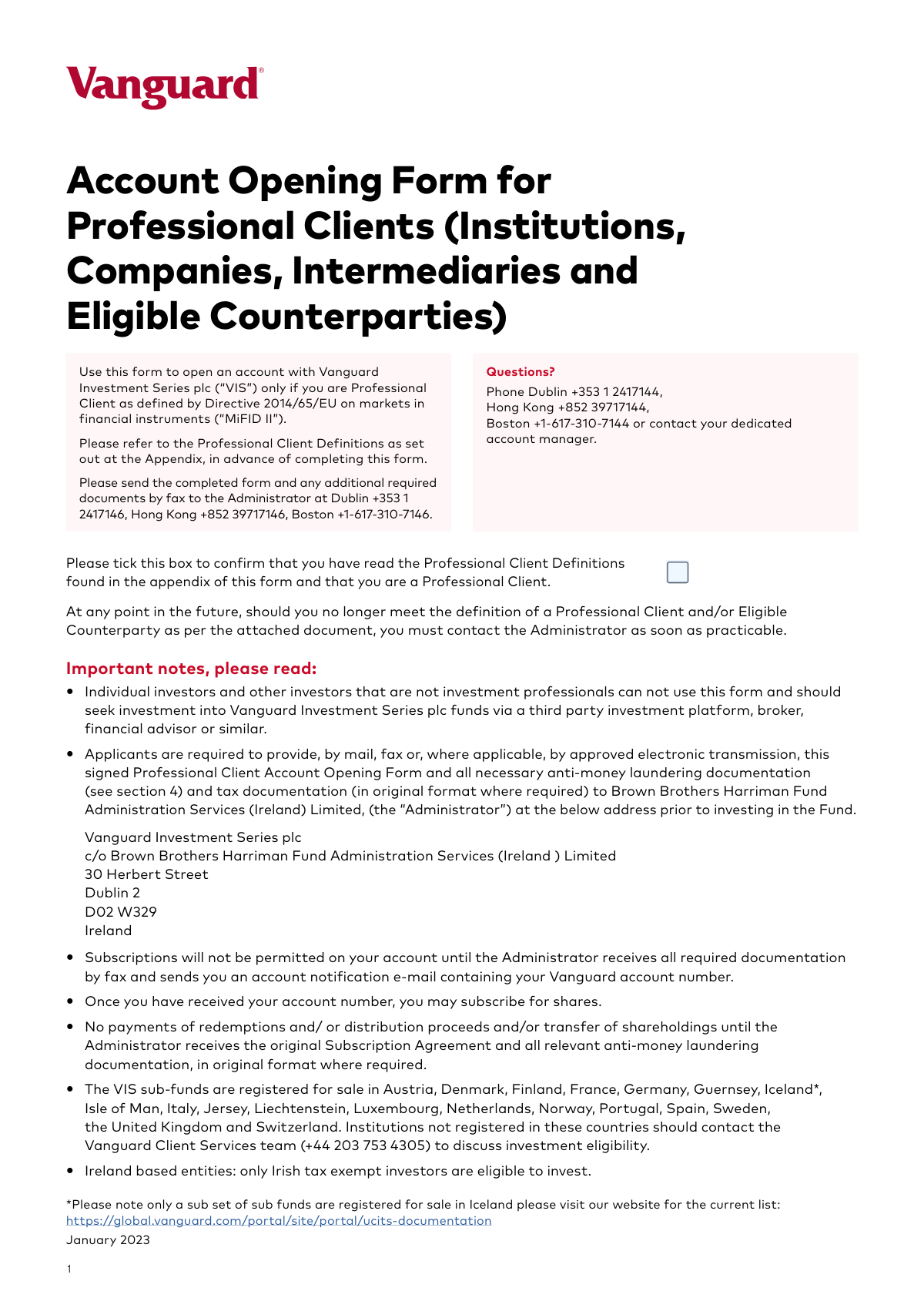
| 1. | Account Opening Form for Professional Clients (Institutions, Companies, Intermediaries and Eligible Counterparties) | 1 | Complex 63 |
| 2. | ACH and Electronic Funds Transfer Instructions and Agreement | 1 | Basic 44 |
| 3. | ACH Authorization Agreement | 1 | Basic 38 |
| 4. | Application form for Trust investment | 1 | Moderate 60 |
| 5. | Corestone® Electronic Only Account Application | 1 | Basic 40 |
| 6. | Electronic Funds Transfer (EFT) Form | 1 | Basic 30 |
| 7. | Employee Direct Deposit Banking Authorization Form (RUN Powered by ADP®) | 1 | Basic 33 |
| 8. | Form F1C, Account Application Supplemental | 4 | Moderate 56 |
| 9. | Funds Transfer Service Enrollment Form | 1 | Basic 37 |
| 10. | HomePlus Loan Application (Individuals) – China Banking Corporation (CBC) | 2 | Complex 74 |
| 11. | Navy Federal Voluntary Removal of Joint Owner Request | 1 | Moderate 58 |
| 12. | New Account Agreement | 1 | Complex 69 |
| 13. | Standing Letter of Authorization / Instruction Enrollment Form | 1 | Moderate 51 |
| 14. | TIAA Trust, N.A. Authorization to receive client account information | 1 | – |
- Enterprise-grade security & data encryption
- 99%+ accuracy powered by AI
- 1,000+ forms from all industries
- Complete forms in under 60 seconds
How to Choose the Right Form
Whether you're applying for a home loan or opening a new bank account, choosing the right form depends on what you're trying to accomplish. Here's a quick breakdown:
Applying for a Housing Loan
If you're an individual looking to finance a home purchase or property in the Philippines, you need the HomePlus Loan Application (Individuals) – China Banking Corporation (CBC). This form is specifically for:
- Borrowers applying for a CBC HomePlus housing loan
- Applicants who need to disclose personal, employment, and financial details
- Co-borrowers or those with an attorney-in-fact arrangement
- Anyone subject to FATCA screening (e.g., U.S. persons or dual citizens)
Be thorough when completing this form — incomplete or inaccurate information can result in loan disapproval.
Opening a New Bank or Financial Account
If you need to open an account with an Indonesian financial institution, the PSA Form/K/II/052025 - Formulir Pembukaan Rekening / Account Opening Form is what you need. This form is designed for:
- New customers undergoing KYC (Know Your Customer) verification
- Applicants required to provide tax identification (NPWP) and residency information
- Individuals with tax obligations in foreign jurisdictions under FATCA/CRS compliance rules
- Anyone needing to submit identity and correspondence details to a financial services provider in Indonesia
Quick Decision Summary
| I want to… | Use this form |
|---|---|
| Apply for a home loan in the Philippines | HomePlus Loan Application (CBC) |
| Open a financial account in Indonesia | PSA Form/K/II/052025 |
Both forms can be filled out quickly and accurately using Instafill.ai's AI-powered tools, which help ensure no required fields are missed.
Form Comparison
| Form | Purpose | Who Files It | When to Use |
|---|---|---|---|
| HomePlus Loan Application (Individuals) – China Banking Corporation (CBC) | Apply for a HomePlus housing loan with CBC | Individual borrowers seeking a home loan in the Philippines | When applying for a new housing loan from China Banking Corporation |
| PSA Form/K/II/052025 - Formulir Pembukaan Rekening / Account Opening Form | Open a bank account and fulfill KYC/AML compliance requirements | Individual customers opening an account at an Indonesian financial institution | When opening a new financial account in Indonesia under FATCA/CRS regulations |
Tips for banking forms
Banking forms like loan applications and account opening forms require a wide range of supporting details — government-issued IDs, tax identification numbers, proof of income, and property documents. Having everything on hand before you begin prevents incomplete submissions and reduces back-and-forth with the bank.
Both the HomePlus Loan Application and the PSA Account Opening Form include FATCA and CRS-related questions about tax residency and foreign tax obligations. Errors or omissions in tax identification numbers (like TIN or NPWP) can trigger compliance flags and delay processing, so verify these details carefully before submitting.
Banking forms often include multiple consent clauses — such as bank secrecy waivers, credit investigation authorizations, and data privacy acknowledgments. Read each declaration carefully, as signing them grants the institution specific rights to access and share your financial information.
If you are applying for a loan with a co-borrower or spouse, ensure their personal, employment, and income information is just as complete as your own. Incomplete co-borrower sections are a common reason for delays or requests for resubmission.
AI-powered tools like Instafill.ai can fill out complex banking forms — including multi-page account opening forms and loan applications — in under 30 seconds with high accuracy. Your data stays secure throughout the process, making it a practical time-saver whether you're handling one form or several.
Banks cross-check information across different sections of the same form — for example, your declared income against your listed assets and liabilities. Inconsistencies, even unintentional ones, can raise red flags during credit assessment or KYC review.
Always save or print a completed copy of any banking form you submit, whether digitally or in person. This protects you in case of disputes, follow-up queries, or the need to reference previously declared information for future applications.
Some banking forms are distributed as scanned, non-fillable PDFs that cannot be typed into directly. Services like Instafill.ai can convert these into interactive fillable forms, saving you from having to print, handwrite, and rescan documents before submission.
Frequently Asked Questions
This category currently includes two banking forms: the HomePlus Loan Application (Individuals) from China Banking Corporation (CBC) for housing loan requests, and the PSA Form/K/II/052025, an Indonesian account opening form used for customer identification and regulatory compliance. Both forms serve distinct purposes — one for loan applications and one for new account setup.
Anyone applying for a housing loan with China Banking Corporation or opening a new account with a financial institution covered by the PSA form would need to complete the relevant form. These forms are typically required by individuals, including employed applicants, business owners, or foreign nationals with tax obligations in multiple jurisdictions.
A loan application form, like the CBC HomePlus form, is used to request credit and requires detailed financial disclosures including income, assets, liabilities, and collateral information. An account opening form, like the PSA Form/K/II/052025, is used to establish a new financial account and focuses on identity verification, tax residency, and KYC/AML compliance rather than creditworthiness.
FATCA (Foreign Account Tax Compliance Act) is a U.S. regulation that requires financial institutions worldwide to identify and report accounts held by U.S. persons. Both forms in this category include FATCA-related questions to screen for U.S. tax indicia, ensuring the financial institution meets its international reporting obligations.
Generally, you should have a valid government-issued ID, tax identification numbers (such as a TIN or NPWP), proof of income or employment, and details about any assets or liabilities. For loan applications, you may also need property or collateral information, while account opening forms may require details about your tax residency in foreign jurisdictions.
For the CBC HomePlus Loan Application, the form includes dedicated sections for a spouse or co-borrower and an attorney-in-fact if applicable, so their details are captured within the same document. Whether a co-borrower is required depends on the loan amount, the applicant's financial profile, and the bank's lending policies.
Yes — AI-powered tools like Instafill.ai can fill out banking forms in under 30 seconds by accurately extracting and placing data from your source documents. This is especially useful for multi-page forms like the 17-page PSA account opening form, where manual entry can be time-consuming and error-prone.
Manually completing a detailed banking form can take anywhere from 20 minutes to over an hour, depending on the complexity and the information required. Using AI tools like Instafill.ai, the same forms can be populated accurately in under 30 seconds, significantly reducing the time and effort involved.
The CBC HomePlus Loan Application should be submitted directly to a China Banking Corporation branch or through the bank's official loan application process. The PSA account opening form should be submitted to the relevant Indonesian financial institution. Always confirm submission requirements — including supporting documents — with the respective institution before filing.
Incomplete or inaccurate information on banking forms can lead to delays in processing, requests for resubmission, or outright rejection of your application. For loan applications specifically, misrepresentation of information can result in disapproval or cancellation of an already approved loan, so accuracy is critical.
Yes, banking forms typically collect sensitive information such as tax identification numbers, income details, identity documents, and foreign tax residency disclosures. When filling them out online, ensure you use a secure, reputable platform and review the privacy policy to understand how your data is handled and protected.
Some banking forms are provided as non-fillable PDFs, which can make digital completion difficult. Platforms like Instafill.ai can convert non-fillable PDF versions into interactive fillable forms, allowing users to complete and save them digitally without needing to print and handwrite their responses.
Glossary
- Form Complexity Index
- Instafill’s 0–100 measure of how much effort a form takes to complete, calculated deterministically from the form’s own structure rather than estimated. It combines the number of fillable fields (the largest factor), how difficult those fields are to complete based on their type, the number of pages that contain fields, the amount of conditional “fill-only-if” logic, and how many sections the form is divided into, then adds modifiers for tables and repeating lists, bundled instruction pages, and dense page layouts. A higher score means the form is harder to fill out by hand. The forms in this category have a median Form Complexity Index of 51/100 (Moderate). See exactly how it is calculated.
- KYC (Know Your Customer)
- A regulatory requirement that banks and financial institutions must verify the identity, background, and financial profile of their clients before opening an account or extending credit. KYC helps prevent fraud, money laundering, and other financial crimes.
- FATCA (Foreign Account Tax Compliance Act)
- A U.S. federal law requiring foreign financial institutions to identify and report accounts held by U.S. persons to the IRS. Banking forms often include FATCA screening questions to detect 'U.S. indicia' such as a U.S. address, phone number, or citizenship.
- CRS (Common Reporting Standard)
- An international framework developed by the OECD that requires financial institutions to collect and automatically exchange tax residency information about account holders with relevant foreign tax authorities. CRS is similar to FATCA but applies globally across participating countries.
- CIC (Credit Information Corporation)
- A Philippine government-owned corporation that collects and maintains credit data on borrowers. When you sign a CIC disclosure on a loan application, you authorize the bank to submit and retrieve your credit information from the CIC database.
- Bank Secrecy Waiver
- A signed authorization that allows a bank to share or disclose a borrower's account and financial information with third parties, such as credit bureaus or partner institutions, for purposes like credit assessment. Without this waiver, Philippine law (Republic Act 1405) restricts banks from disclosing account details.
- Co-Borrower
- A person who jointly applies for and shares legal responsibility for repaying a loan alongside the primary borrower. Co-borrowers' income and creditworthiness are also evaluated by the bank, which can improve loan approval chances or increase the approved amount.
- NPWP (Nomor Pokok Wajib Pajak)
- Indonesia's Tax Identification Number assigned to individuals and entities registered with the Directorate General of Taxes. It is required on Indonesian account opening forms to verify tax residency and compliance.
- Collateral
- An asset (such as a property or vehicle) pledged by a borrower to secure a loan, which the bank can seize and sell if the borrower fails to repay. In housing loan applications, the property being purchased typically serves as the collateral.
- Attorney-in-Fact
- A person legally authorized through a Special Power of Attorney (SPA) to act on behalf of another person in financial or legal transactions. In banking forms, an attorney-in-fact may sign documents or manage a loan application on behalf of the borrower.
- Data Privacy Consent
- A declaration signed by the applicant authorizing the bank to collect, store, process, and share their personal information in accordance with applicable data protection laws. This consent is required before the bank can legally use your information for credit checks or marketing.