Yes! You can use AI to fill out Standing Letter of Authorization / Instruction Enrollment Form

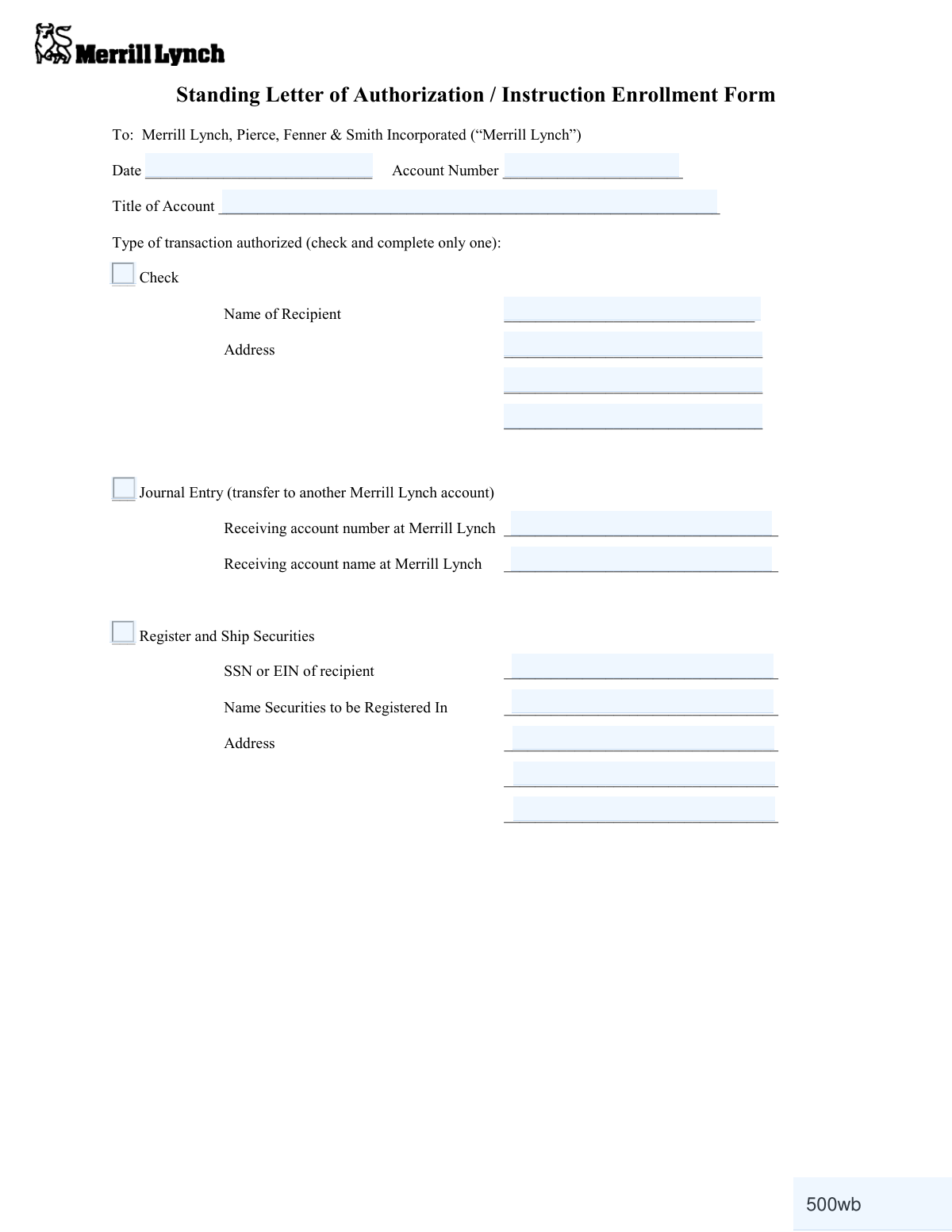
This form allows a Merrill Lynch account holder to provide standing instructions to transfer funds or securities to a third party or another account. It can be used to set up recurring, periodic transfers (Standing Letter of Instruction) or to pre-authorize variable transfers that can be initiated by oral instruction (Standing Letter of Authorization). Today, this form can be filled out quickly and accurately using AI-powered services like Instafill.ai, which can also convert non-fillable PDF versions into interactive fillable forms.
Our AI automatically handles information lookup, data retrieval, formatting, and form filling.
It takes less than a minute to fill out Merrill Lynch Standing Letter of Authorization using our AI form filling.
Securely upload your data. Information is encrypted in transit and deleted immediately after the form is filled out.

Form specifications

Form name: Standing Letter of Authorization / Instruction Enrollment Form
Number of pages: 1
Language: English
Categories: authorization forms, enrollment forms
main-image

Instafill Demo: How to fill out PDF forms in seconds with AI

How to Fill Out Merrill Lynch Standing Letter of Authorization Online for Free in 2026

Are you looking to fill out a MERRILL LYNCH STANDING LETTER OF AUTHORIZATION form online quickly and accurately? Instafill.ai offers the #1 AI-powered PDF filling software of 2026, allowing you to complete your MERRILL LYNCH STANDING LETTER OF AUTHORIZATION form in just 37 seconds or less.
Follow these steps to fill out your MERRILL LYNCH STANDING LETTER OF AUTHORIZATION form online using Instafill.ai:
  1. 1 Navigate to Instafill.ai and upload or select the Merrill Lynch Standing Letter of Authorization form.
  2. 2 Use the AI assistant to automatically fill in your personal and Merrill Lynch account information, such as the account number and title.
  3. 3 Select the type of transaction you wish to authorize: Check, Journal Entry (transfer to another Merrill Lynch account), or Register and Ship Securities, and provide the recipient's details.
  4. 4 Choose between a 'Standing Letter of Instruction' for fixed, periodic transfers or a 'Standing Letter of Authorization' for variable transfers, and input the specific amounts, frequency, or authorized persons.
  5. 5 Enter an expiration date for the authorization if desired.
  6. 6 Carefully review all the information pre-filled by the AI for accuracy, then electronically sign and date the form in the designated fields.
  7. 7 Download the completed and signed form to submit directly to Merrill Lynch, Pierce, Fenner & Smith Incorporated.

Our AI-powered system ensures each field is filled out correctly, reducing errors and saving you time.

Why Choose Instafill.ai for Your Fillable Merrill Lynch Standing Letter of Authorization Form?

Speed

Complete your Merrill Lynch Standing Letter of Authorization in as little as 37 seconds.

Up-to-Date

Always use the latest 2026 Merrill Lynch Standing Letter of Authorization form version.

Cost-effective

No need to hire expensive lawyers.

Accuracy

Our AI performs 10 compliance checks to ensure your form is error-free.

Security

Your personal information is protected with bank-level encryption.

Frequently Asked Questions About Form Merrill Lynch Standing Letter of Authorization

This form allows you to give Merrill Lynch pre-approved instructions to transfer funds or securities from your account. It's used to set up recurring, scheduled transfers or to authorize on-demand transfers via a phone call.

Any Merrill Lynch account holder who wants to establish a convenient way to make repeated or regular transfers to another person, entity, or another Merrill Lynch account should complete this form. It eliminates the need for new paperwork for each individual transaction.

A 'Standing Letter of Instruction' is for transfers of a fixed amount on a recurring schedule (e.g., monthly, quarterly). A 'Standing Letter of Authorization' is for transfers where the amount and timing will vary and will be initiated by a phone call from an authorized person.

No, the form specifies that you must complete one form for each standing authorization you are establishing. If you want to set up transfers to different recipients or with different rules, you will need to fill out a separate form for each one.

You will need your Merrill Lynch account number and title. You will also need the recipient's information, which may include their name, address, Merrill Lynch account number, or Social Security/Employer Identification Number (SSN/EIN) depending on the transfer type.

Yes, the 'Standing Letter of Authorization' section allows you to list the names and titles of individuals who are permitted to request transactions based on your instructions. They can then initiate transfers via oral instruction (a phone call).

If a scheduled transfer exceeds the available balance or purchasing power in your account at the time of the transfer, the entire transaction will be cancelled. Merrill Lynch will not attempt to make a partial transfer.

You can stop a recurring transfer by telephoning or writing to the sales office that services your account. Your request must be received with enough time for Merrill Lynch to act, which is generally at least two business days before the transfer date.

A change to your account title will be treated as a request to cancel all existing transfer instructions. You must execute a new Standing Letter of Authorization form with the new account title to resume any transfers.

No, providing an expiration date is optional. If you do not specify one, the authorization will remain in effect until you submit a written request to cancel it.

Yes, services like Instafill.ai use AI to auto-fill form fields accurately and save time. This can help you complete the form more efficiently and reduce the chance of errors.

To fill this form out online, you can upload the PDF to the Instafill.ai platform. Their service will make the document interactive, allowing you to type your information directly into the fields before downloading the completed form.

If you have a non-fillable or 'flat' PDF, you can use a service like Instafill.ai to convert it into an interactive, fillable form. This allows you to easily type your information instead of having to print the form and fill it out by hand.

According to the form, there are no charges for establishing the authorization or for transfers by check or journal entry. However, a standard fee may apply for wire transfers, and you should consult your Financial Advisor for details.

The form does not specify a submission address. You should contact your Merrill Lynch Financial Advisor or your local branch office to get instructions on how to submit the completed form securely.

Compliance Merrill Lynch Standing Letter of Authorization
Validation Checks by Instafill.ai

1
Exclusive Transaction Type Selection
Verifies that only one of the three transaction types ('Check', 'Journal Entry', 'Register and Ship Securities') is selected. The form explicitly instructs the user to complete only one section to avoid ambiguity. If more than one type is selected, the form is considered invalid and must be rejected to prevent incorrect processing.
2
Exclusive Authorization Method Selection
Ensures the user has filled out details in either the 'Standing Letter of Instruction' section (for periodic transfers) or the 'Standing Letter of Authorization' section (for variable transfers), but not both. Completing both sections creates conflicting instructions for how transfers should be initiated. This check prevents the submission of an ambiguous and unenforceable authorization.
3
Required Header Information
Confirms that the 'Date', 'Account Number', and 'Title of Account' fields are all completed. This information is fundamental for identifying the client, the specific account for the transaction, and the effective date of the instruction. A form missing any of these details cannot be processed as it cannot be correctly attributed.
4
Valid Merrill Lynch Account Number Format
Validates that the 'Account Number' field conforms to the standard format for a Merrill Lynch account. This is a critical security and accuracy check to ensure funds or securities are debited from the correct source account. An invalid or malformed account number will cause the entire transaction to fail.
5
Conditional Requirement for Journal Entry
Checks that if 'Journal Entry' is selected as the transaction type, both the 'Receiving account number' and 'Receiving account name' fields are filled. These details are essential for correctly routing the transfer to another Merrill Lynch account. Failure to provide this information makes the instruction impossible to execute, resulting in a failed transaction.
6
SSN or EIN Format Validation
Validates that the 'SSN or EIN of recipient' field contains a correctly formatted 9-digit number. This is a legal and operational requirement for registering securities to a new owner for tax reporting purposes. An incorrectly formatted number will cause the registration to fail and require manual correction.
7
Logical Expiration Date
Ensures that if an 'Expiration Date' is provided, it is a valid date that occurs after the form's main 'Date'. An expiration date in the past would render the authorization invalid from the moment it is processed. This validation prevents the creation of immediately expired or logically inconsistent instructions.
8
Completeness of Standing Letter of Instruction
If the 'Standing Letter of Instruction' section is used, this check verifies that either a fund 'Amount' or security details ('Quantity' and 'Description') are provided, along with a 'Frequency' and 'Day transaction is to be executed'. These fields are the core components of a recurring instruction. Missing any of this information makes the instruction incomplete and unenforceable.
9
Completeness of Standing Letter of Authorization
If the 'Standing Letter of Authorization' section is used, this check verifies that a maximum transaction limit (for funds, shares, or bonds) is specified and at least one 'Authorized Person' name is listed. This defines the scope of the authorization and who is permitted to give oral instructions. Without this information, the authorization is undefined and poses a significant security risk.
10
Self-Transfer Prevention for Journal Entries
Verifies that the 'Receiving account number' for a Journal Entry is not identical to the primary 'Account Number' from which funds are being sent. Transferring assets to the same account is a logically flawed and redundant action. This check prevents pointless transactions that likely indicate user error.
11
Frequency 'Other' Specification Requirement
Validates that if the 'Other' checkbox is selected for 'Frequency of transaction', the corresponding 'specify' text field is filled out. This ensures that the custom frequency is clearly defined for scheduling the recurring transfer. An empty specification field would leave the timing of the transaction ambiguous, making it impossible to process correctly.
12
Security Details Completeness
When securities are being transferred, this check ensures that all necessary details like 'Security Description' and 'Symbol' are provided. These identifiers are critical for accurately locating and transferring the correct asset from the account. Incomplete security information would lead to ambiguity and transaction failure.
13
Valid Date Formatting
Ensures that all date fields on the form (e.g., 'Date', 'Expiration Date', 'Day transaction is to be executed') are entered in a recognized and valid date format like MM/DD/YYYY. Consistent and correct date formatting is essential for record-keeping, auditing, and scheduling transactions accurately. Invalid date entries would cause processing errors and could lead to missed or incorrectly timed transfers.
14
Numeric Amount and Quantity Validation
Ensures that all fields intended for monetary amounts or quantities (e.g., 'Amount', 'Quantity', 'Maximum amount') contain valid numeric data. This prevents data entry errors, such as entering text into a dollar amount field, which would cause calculation and processing failures. The validation ensures the system can correctly interpret the financial values specified in the instruction.

Common Mistakes in Completing Merrill Lynch Standing Letter of Authorization

Filling Out Both Instruction and Authorization Sections

The form has two distinct shaded boxes: 'Standing Letter of Instruction' for fixed, periodic transfers and 'Standing Letter of Authorization' for variable, on-demand transfers. A frequent error is filling out both sections, which creates a conflicting request and leads to automatic rejection. To avoid this, you must choose only one path: either the fixed schedule or the variable authorization, and complete only the corresponding box on the form.

Providing an Incorrect or Incomplete Account Title

The 'Title of Account' must match the official account registration at Merrill Lynch exactly, including all initials, suffixes (e.g., Jr., Sr.), and ownership types (e.g., 'JT TEN WROS'). People often use a shortened or informal version of their name, causing a data mismatch that results in the form being rejected. Always reference a recent account statement to copy the title precisely to ensure successful processing.

Selecting Multiple Transaction Types

The form clearly states to 'check and complete only one' transaction type (Check, Journal Entry, or Register and Ship Securities). However, applicants sometimes check multiple boxes, intending to authorize different kinds of future transfers with one form. This invalidates the submission, as each form can only establish one specific transfer instruction. A separate form must be completed for each unique transfer type and destination.

Using Ambiguous Frequency or Execution Dates

In the 'Standing Letter of Instruction' section, fields for frequency and execution day are often filled with vague terms like 'bi-monthly' or 'end of month'. These instructions are not specific enough for financial processing systems and will cause the setup to be delayed or rejected. You must provide a concrete date, such as 'the 15th day of the month' or 'the last business day of the quarter', to ensure transfers occur as intended.

Missing Required Signatures for Joint or Fiduciary Accounts

For accounts with multiple owners (joint tenants) or those held in a trust, all required signatories must sign the form. A very common reason for rejection is having only one account owner or an incomplete set of trustees sign the document. This failure to meet the account's legal signature requirements will halt the process until a correctly signed form is resubmitted, causing significant delays.

Incorrect Recipient Account or Address Details

A single mistyped digit in a 'Receiving account number' for a journal entry can send funds or securities to a completely wrong account, which can be difficult or impossible to recover. Similarly, an incomplete or incorrect address for a 'Check' recipient will cause the payment to be lost or returned. It is critical to double- and triple-check all recipient information for accuracy before submission.

Misunderstanding the 'Maximum Amount' Field

When completing the 'Standing Letter of Authorization' for variable transfers, the 'Maximum amount of each transaction' field sets a ceiling for a single transfer, not a total limit over time. Applicants often enter a large number thinking it's a lifetime cap, or a small number that is too restrictive for a single transaction. This mistake can lead to declined transfer requests that are otherwise valid, forcing the user to file a new form to correct the limit.

Illegible Handwriting on a Printed Form

Since this form is a non-fillable PDF, many users print it and complete it by hand, often with poor handwriting. This leads to data entry errors by the processing team when trying to decipher account numbers, names, and amounts, resulting in incorrect transfers or form rejection. To avoid this, use a tool like Instafill.ai, which can convert the PDF into a fillable format, ensuring all entries are legible, properly aligned, and validated.

Forgetting to List Authorized Persons for Oral Instructions

The 'Standing Letter of Authorization' section for variable transfers requires you to list the names and titles of all individuals authorized to make oral requests. A common oversight is leaving this section blank, even when that is the primary intent of the form. If a person is not explicitly listed, Merrill Lynch will deny their telephoned transaction request for security reasons, rendering the authorization useless.

Leaving the Top Date Field Blank

The form has a prominent 'Date' field at the very top, separate from the signature dates at the bottom. It is easy to overlook this field while focusing on the transaction details. A missing date creates ambiguity about when the authorization becomes effective, which can cause compliance issues and lead to processing delays or rejection of the entire form.
Saved over 80 hours a year

“I was never sure if my IRS forms like W-9 were filled correctly. Now, I can complete the forms accurately without any external help.”

Kevin Martin Green

Your data stays secure with advanced protection from Instafill and our subprocessors

Robust compliance program

Transparent business model

You’re not the product. You always know where your data is and what it is processed for.

ISO 27001, HIPAA, and GDPR

Our subprocesses adhere to multiple compliance standards, including but not limited to ISO 27001, HIPAA, and GDPR.

Security & privacy by design

We consider security and privacy from the initial design phase of any new service or functionality. It’s not an afterthought, it’s built-in, including support for two-factor authentication (2FA) to further protect your account.

Fill out Merrill Lynch Standing Letter of Authorization with Instafill.ai

Worried about filling PDFs wrong? Instafill securely fills standing-letter-of-authorization-instruction-enrollment-form forms, ensuring each field is accurate.