Fill out standing instruction forms
with AI.
Standing instruction forms are essential financial documents used to establish pre-authorized, recurring, or future transfers of funds and securities. These forms act as a permanent record of your intent, allowing financial institutions to execute transactions—such as moving cash between brokerage accounts or sending international wire transfers—without requiring a new set of paperwork for every single request. By setting up these instructions, account holders ensure that their financial obligations and investment strategies are managed consistently and efficiently, reducing the administrative burden on both the individual and the institution.
By continuing, you acknowledge Instafill's Privacy Policy and agree to get occasional product update and promotional emails.
About standing instruction forms
These forms are typically required by investors, corporate treasurers, and individuals who manage multiple accounts across platforms like Fidelity or Merrill Lynch. They are particularly useful in situations involving periodic transfers to third parties, regular contributions to secondary investment accounts, or complex foreign currency transactions. For many, these documents provide a layer of security and convenience, ensuring that transfers are handled according to specific legal and indemnification terms. Using modern tools like Instafill.ai, these forms can be filled out with AI in under 30 seconds, ensuring that sensitive data is handled accurately and securely while saving significant time.
Every form on this page can be completed without typing. Instafill is form filling software that reads a PDF and fills it for you — including flat and scanned documents that carry no fillable fields at all.
Forms in This Category
The forms in this category have a median Form Complexity Index of 34/100 (Basic), measured across 3 forms by field count, input difficulty, length, conditional logic and structure. See how it is calculated.
| Form Name | Pages | FCI | |
|---|---|---|---|
| 1. | Fidelity Investments Standing Transfer Instructions Form | 1 | Basic 33 |
| 2. | Outgoing Foreign Currency Wire Standing Instructions | 1 | Basic 34 |
| 3. | Standing Letter of Authorization / Instruction Enrollment Form | 1 | Moderate 51 |
- Enterprise-grade security & data encryption
- 99%+ accuracy powered by AI
- 1,000+ forms from all industries
- Complete forms in under 60 seconds
How to Choose the Right Form
Choosing the right standing instruction form ensures that your future fund or security transfers are handled automatically and securely. The correct document depends primarily on which financial institution holds your account and whether you are moving assets domestically or internationally.
Fidelity Investments Account Holders
If you are managing assets through Fidelity, your choice is determined by the destination of the funds:
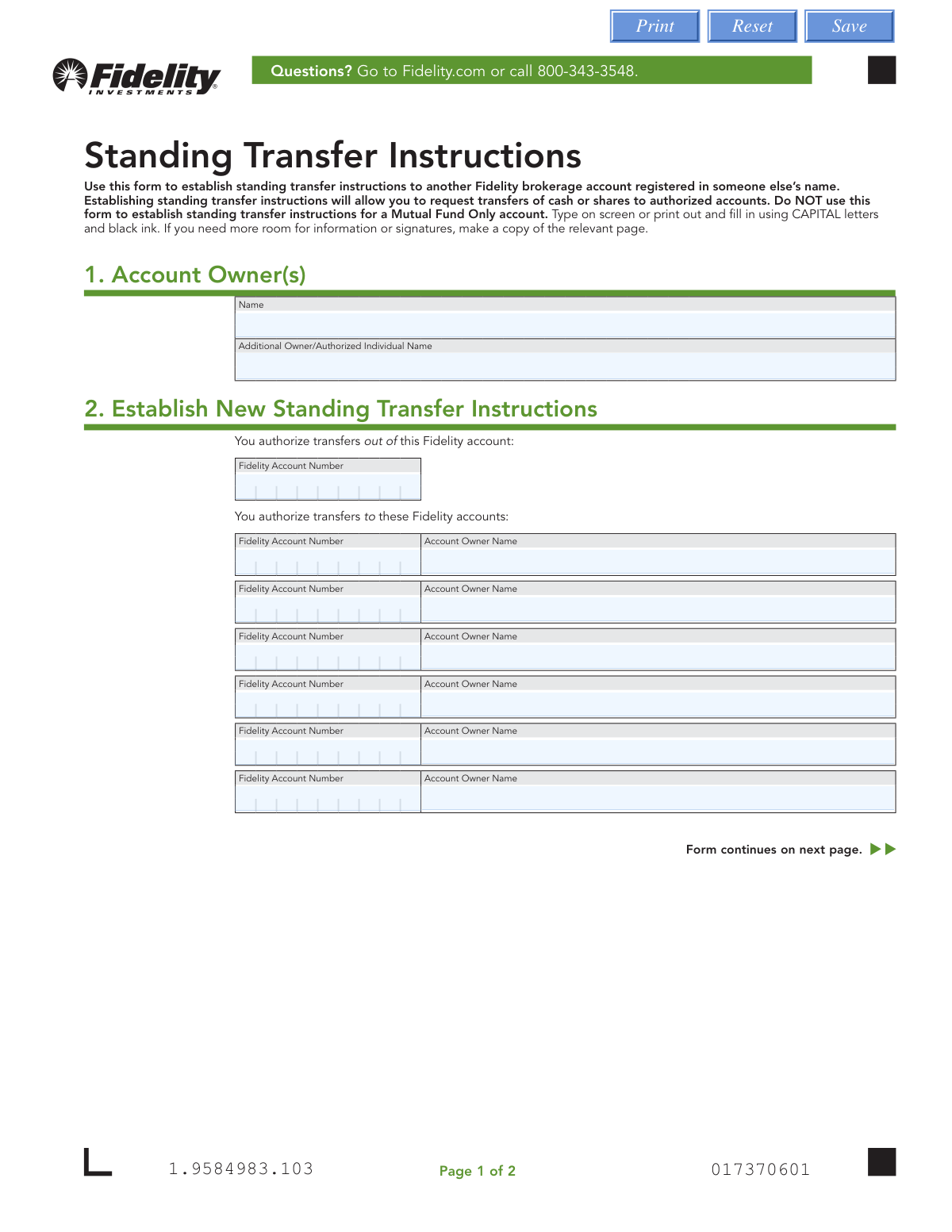
- For Internal Transfers: Use the Fidelity Investments Standing Transfer Instructions Form to move cash or shares from your brokerage account to up to six other Fidelity accounts. This is the standard choice for domestic transfers between different owners, though it usually requires a Medallion signature guarantee.
- For International Wires: If you have international trading enabled and need to pre-authorize future foreign currency transfers to a specific recipient bank, choose the Outgoing Foreign Currency Wire Standing Instructions.
Merrill Lynch Account Holders
Merrill clients should select a form based on their specific account type and the legal agreements required for their assets:
- Standard Brokerage Accounts: Use the Standing Letter of Authorization / Instruction Enrollment Form to set up recurring transfers or authorize the firm to move assets based on your verbal instructions.
- CMA and WCMA Accounts: If you are managing a Cash Management Account (CMA) or a Working Capital Management Account (WCMA), select the Standing Letter of Authorization/Instruction Enrollment Form and Agreement. This version includes the specific legal language and agreements necessary for these specialized cash management vehicles.
Determining the Type of Authorization
When completing the Merrill Lynch forms, you will need to decide between two specific types of instructions:
- Standing Letter of Instruction (STLOI): Choose this for fixed, recurring, or periodic transfers that happen automatically on a set schedule.
- Standing Letter of Authorization (STLOA): Choose this if you want the flexibility to initiate variable transfers at any time via a phone call or verbal request without needing to submit new paperwork for every transaction.
Form Comparison
| Form | Transfer Type | Destination | Trigger/Frequency | Primary Requirement |
|---|---|---|---|---|
| Fidelity Investments Standing Transfer Instructions Form | Cash or shares between brokerage accounts. | Up to six different Fidelity accounts in various names. | Pre-authorized instructions to streamline future asset movement. | Medallion signature guarantee or in-person Fidelity center completion. |
| Outgoing Foreign Currency Wire Standing Instructions | Foreign currency wire transfers for international trading. | Pre-authorized external recipient bank accounts. | Subsequent transactions once bank details are saved. | Fidelity account must be enabled for international trading. |
| Standing Letter of Authorization / Instruction Enrollment Form | Funds or securities to third-party accounts. | Third parties or other Merrill Lynch accounts. | Recurring periodic transfers or variable oral instructions. | Establishes Standing Letter of Instruction (STLOI) or Authorization (STLOA). |
| Standing Letter of Authorization/Instruction Enrollment Form and Agreement | Funds or securities from CMA or WCMA accounts. | Authorized third parties or linked financial accounts. | Automatic recurring transfers or on-demand verbal instructions. | Specific to Merrill Cash Management and Working Capital accounts. |
Tips for standing instruction forms
Ensure you select the correct authorization type: a Standing Letter of Instruction (STLOI) is for fixed, recurring transfers, while a Standing Letter of Authorization (STLOA) allows for on-demand transfers via verbal request. Selecting the wrong type may result in your bank rejecting transfer requests that don't match the established parameters.
Because standing instructions automate future payments, a single digit error in a routing or account number can lead to multiple failed transactions. Carefully cross-reference the recipient's banking details, especially for international or foreign currency wires where intermediary bank information may be required.
Many standing instruction forms, particularly those involving third-party transfers or high-value accounts, require a Medallion Signature Guarantee rather than a standard notary seal. Check the specific requirements for your Fidelity or Merrill account early to avoid having your paperwork rejected for improper authentication.
Filling out complex financial authorizations can be tedious, but AI-powered tools like Instafill.ai can complete these forms in under 30 seconds with high accuracy. This is a practical time-saver for managing multiple accounts, and your sensitive financial data stays secure throughout the automated filling process.
Brokerages use signature verification as a primary security layer for pre-authorized transfers. Ensure that the signature on your form matches the one your financial institution has on file to prevent delays in the enrollment and verification process.
When setting up recurring instructions, be explicit about the dollar amounts and the specific dates for execution. Providing vague instructions regarding 'periodic' transfers can lead to processing errors or unintended account overdrafts if the timing is not clearly defined.
Standing instructions often remain active indefinitely until specifically revoked. Periodically review your authorized transfers to ensure you are not maintaining active links to closed accounts or outdated third-party recipients, which helps maintain better control over your liquid assets.
Frequently Asked Questions
A standing instruction form is a legal document used to authorize a financial institution to perform recurring or future transfers of funds or securities between accounts. Instead of requesting a transfer each time, these forms establish a pre-authorized protocol for moving assets automatically or upon a simple verbal request.
You should use these forms if you plan to move money or securities between accounts frequently or on a recurring schedule. They are ideal for managing regular payments, funding secondary accounts, or facilitating quick transfers without needing to sign new paperwork for every individual transaction.
An STLOI is typically used for fixed, periodic transfers that occur automatically on a set schedule. In contrast, an STLOA establishes the authority for you to initiate variable transfers at any time through a verbal or electronic request using the pre-verified recipient details already on file.
Yes, specific forms in this category, such as those for outgoing foreign currency wires, are designed for international trading accounts. These allow you to pre-authorize recipient bank details and SWIFT codes, streamlining the process for future global transactions.
Many financial institutions require a Medallion signature guarantee for standing instruction forms to prevent fraud, particularly when transferring to third-party accounts. However, some firms may waive this requirement if the form is completed in person at an authorized investor center or through specific secure digital portals.
The number of accounts depends on the specific institution; for example, some forms allow you to link up to six different destination accounts on a single document. If you need to authorize transfers to more accounts than the form provides space for, you may need to submit multiple enrollment forms.
Yes, AI tools like Instafill.ai can fill these forms in under 30 seconds by accurately extracting data from your source documents and placing it into the correct fields. This technology helps ensure that sensitive information like account numbers and routing codes are transcribed without manual entry errors.
Completing these forms online with the help of AI is significantly faster than manual preparation, typically taking less than a minute. The system identifies the required fields and populates them automatically, allowing you to quickly move to the signature and submission phase.
You will generally need your primary account number, the recipient's account and routing numbers, and the full legal names of all account holders involved. For international instructions, you should also have the destination bank's BIC/SWIFT code and the specific currency type ready.
Yes, standing instructions can be modified or revoked at any time by submitting a new form or a formal written cancellation request to your financial institution. It is recommended to check with your broker or bank to see if they offer a digital dashboard to manage these authorizations more efficiently.
Glossary
- Form Complexity Index
- Instafill’s 0–100 measure of how much effort a form takes to complete, calculated deterministically from the form’s own structure rather than estimated. It combines the number of fillable fields (the largest factor), how difficult those fields are to complete based on their type, the number of pages that contain fields, the amount of conditional “fill-only-if” logic, and how many sections the form is divided into, then adds modifiers for tables and repeating lists, bundled instruction pages, and dense page layouts. A higher score means the form is harder to fill out by hand. The forms in this category have a median Form Complexity Index of 34/100 (Basic). See exactly how it is calculated.
- Standing Letter of Authorization (SLOA/STLOA)
- A legal agreement that gives a financial institution permission to move funds or securities from your account to a third party whenever you request it, typically through verbal or written instruction.
- Standing Letter of Instruction (SLOI/STLOI)
- A pre-authorized set of instructions for recurring, automatic transfers of a fixed amount or specific assets on a predetermined schedule.
- Medallion Signature Guarantee
- A special certification stamp provided by a financial institution that verifies the authenticity of a signature and the signer's legal authority to transfer securities.
- Indemnification
- A legal provision in which the account holder agrees to hold the financial institution harmless and compensate them for any losses incurred while executing the standing instructions.
- CMA / WCMA
- Abbreviations for Merrill Lynch’s Cash Management Account and Working Capital Management Account, which are specific types of investment and cash accounts used for these transfers.
- Foreign Currency Wire
- An electronic transfer of funds sent to an international bank where the money is converted into the local currency of the destination country.
- SWIFT/BIC Code
- A unique identification code for a specific bank used during international wire transfers to ensure the funds reach the correct financial institution.
- Third-Party Transfer
- The movement of funds or assets to an account that is not registered in the same name as the originating account, often requiring higher levels of authorization.