Yes! You can use AI to fill out ACH and Electronic Funds Transfer Instructions and Agreement
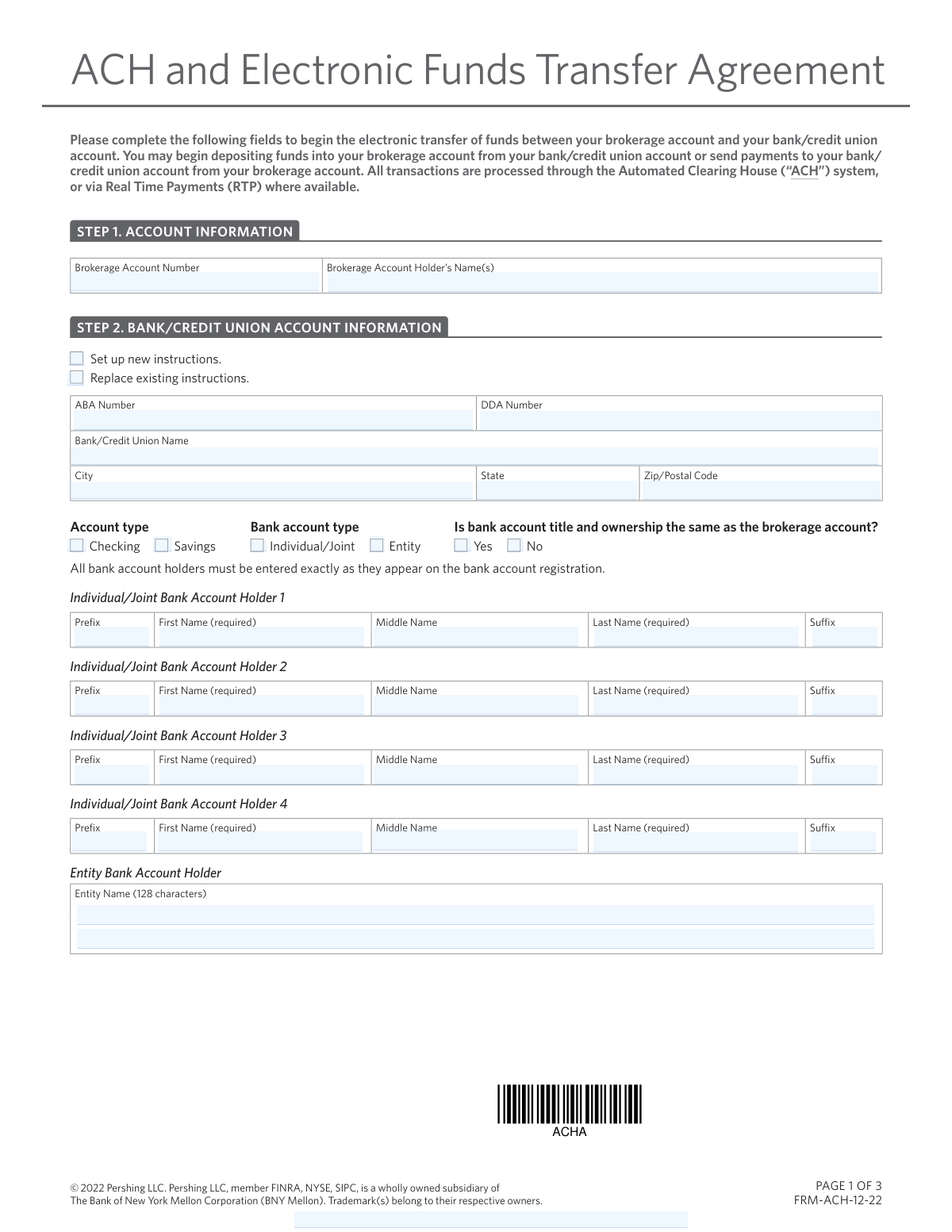
This form, provided by Pershing LLC, is an agreement to establish Automated Clearing House (ACH) and Real Time Payments (RTP) instructions, linking a brokerage account with a personal or entity bank account. It allows account holders to authorize deposits, withdrawals, and recurring payments electronically without needing additional paperwork for each transaction. Today, this form can be filled out quickly and accurately using AI-powered services like Instafill.ai, which can also convert non-fillable PDF versions into interactive fillable forms.
Our AI automatically handles information lookup, data retrieval, formatting, and form filling.
It takes less than a minute to fill out FRM-ACH-12-22 using our AI form filling.
Securely upload your data. Information is encrypted in transit and deleted immediately after the form is filled out.
Form specifications
| Form name: | ACH and Electronic Funds Transfer Instructions and Agreement |
| Number of pages: | 1 |
| Language: | English |
| Categories: | ACH forms, transfer forms, funds transfer forms |
Instafill Demo: How to fill out PDF forms in seconds with AI
How to Fill Out FRM-ACH-12-22 Online for Free in 2026
Are you looking to fill out a FRM-ACH-12-22 form online quickly and accurately? Instafill.ai offers the #1 AI-powered PDF filling software of 2026, allowing you to complete your FRM-ACH-12-22 form in just 37 seconds or less.
Follow these steps to fill out your FRM-ACH-12-22 form online using Instafill.ai:
- 1 Navigate to Instafill.ai and upload or select the ACH and Electronic Funds Transfer Agreement form.
- 2 Provide your brokerage account number and the exact account holder name(s) as they appear on your statements.
- 3 Enter your bank or credit union information, including the ABA/routing number, account number (DDA), bank name, and account type.
- 4 Select the type of transfer instructions you want to set up, such as standing instructions for future use or recurring periodic payments with specific frequencies and amounts.
- 5 Review all the information automatically populated by the AI to ensure accuracy across all sections.
- 6 Electronically sign and date the form in the designated signature section to authorize the agreement.
- 7 Download the completed form and return it to your investment professional or financial organization for processing.
Our AI-powered system ensures each field is filled out correctly, reducing errors and saving you time.
Why Choose Instafill.ai for Your Fillable FRM-ACH-12-22 Form?
Speed
Complete your FRM-ACH-12-22 in as little as 37 seconds.
Up-to-Date
Always use the latest 2026 FRM-ACH-12-22 form version.
Cost-effective
No need to hire expensive lawyers.
Accuracy
Our AI performs 10 compliance checks to ensure your form is error-free.
Security
Your personal information is protected with bank-level encryption.
Frequently Asked Questions About Form FRM-ACH-12-22
This form is used to establish a link between your Pershing brokerage account and your bank account, allowing you to transfer funds electronically via ACH or Real Time Payments (RTP).
You should complete this form if you want to authorize electronic fund transfers, such as one-time or recurring deposits and withdrawals, between your brokerage account and your bank or credit union.
You must provide your bank's ABA (routing number), your DDA (account number), the bank name, and the account type. It is critical that the bank account holder name(s) you enter match your bank records exactly.
Standing Instructions save your bank details for future on-demand transfers, while Recurring Instructions set up automatic, scheduled payments for a specific amount and frequency. You can select options in both sections if you want to set up a recurring payment and also save the bank info for later use.
If you do not select an option in Step 3 for Standing Instructions, your bank information will only be used for the specific recurring payment you established. It cannot be reused for other on-demand transfers in the future.
For transfers both into and out of your brokerage account (bidirectional), all owners of both the brokerage and bank accounts must sign. For withdrawal-only instructions, only the brokerage account owners need to sign.
Yes, you may need to provide supporting documents like trust agreements or bank letters to verify account ownership. Additionally, a separate IRA Distribution Form is required for withdrawals from a Pershing as Custodian Retirement Account.
Return the completed and signed form to your investment professional or financial organization. The request must be processed within 60 days of the date you sign it.
No, the form states that no advance notice is given to the bank account holder when funds are removed from the account according to the instructions you provide.
No, for distributions from a Pershing as Custodian Retirement Account, you must also complete and submit a separate IRA Distribution Form along with this one.
Yes, services like Instafill.ai use AI to accurately auto-fill form fields with your information, which can save you time and help prevent errors.
You can use a service like Instafill.ai to upload the PDF, which will convert it into a fillable format that you can complete and sign electronically from any device.
Services like Instafill.ai can convert flat, non-fillable PDFs into interactive forms. Simply upload the form to their platform to make it fillable online.
Compliance FRM-ACH-12-22
Validation Checks by Instafill.ai
1
ABA Routing Number Format and Validity
This check ensures the ABA Number field in Step 2 contains exactly nine digits. It is crucial for correctly routing funds to the specified bank. An incorrect or improperly formatted ABA number will cause the ACH transfer to fail, leading to delays and potential rejection fees.
2
Bank Account Number (DDA) Presence
Verifies that the DDA Number (bank account number) field in Step 2 is not empty. This number is essential for identifying the specific account for deposits or withdrawals. Failure to provide the DDA number makes it impossible to process any transaction, rendering the form submission invalid.
3
Bank Account Holder Information Consistency
This validation checks the logic for the bank account holder information in Step 2. If 'Entity' is selected as the bank account type, the 'Entity Name' field must be filled. If 'Individual/Joint' is selected, the 'First Name' and 'Last Name' for 'Individual/Joint Bank Account Holder 1' must be provided. This ensures the correct ownership details are captured based on the account type, which is critical for authorization and compliance.
4
Brokerage Account Number Completeness
Ensures the 'Brokerage Account Number' field in Step 1 is filled out. This number is the primary identifier for the user's account on the Pershing side of the transaction. Without this information, the system cannot link the ACH instruction to the correct brokerage account, and the setup request will be rejected.
5
Recurring Instruction Completeness
If any option is selected in 'Step 4. Recurring (Periodic) Instructions', this check verifies that the 'Frequency', 'Amount' (if applicable), and 'Start Date' (if applicable) are also filled out. These details are fundamental to defining a recurring payment schedule. An incomplete recurring instruction cannot be processed and will be rejected, preventing the automated transfers from being established.
6
Recurring Amount Field Logic
This check validates that the 'Dollar Amount' field in Step 4 is left blank if the selected instruction is 'Income distributions' or 'Periodic purchase of mutual funds (SRS)'. The form explicitly states these options do not require a dollar amount. Enforcing this rule prevents user error and ensures the instruction is processed correctly according to the specific rules for these transaction types.
7
Recurring Payment Start Date Validity
Validates that the 'Start Date' provided in Step 4 is a valid calendar date and is not in the past. A recurring payment cannot begin on a past date, and an invalid date format would cause a system error. This check ensures the instruction is actionable and prevents processing failures due to illogical or incorrectly formatted data.
8
Signature Date Timeliness
This check verifies that the signature date in Step 5 is present, is not a future date, and is within the last 60 days. The form instructions state that the request must be processed within 60 days of the signature. A date that is too old may render the authorization void, requiring the user to submit a new, freshly signed form.
9
Conditional Signature Requirement
Validates that the appropriate number of signatures are provided based on the instruction type and account ownership. For example, bi-directional instructions where bank and brokerage ownership differ require signatures from all parties on both accounts. This check is critical for ensuring proper authorization for fund movements and mitigating the risk of unauthorized transactions.
10
Bank Information Completeness for Standing Instructions
If any option in 'Step 3. Standing Instructions' is selected, this validation confirms that all required bank details in Step 2 (ABA Number, DDA Number, Bank Name, Account Type) are complete. Saving an instruction for future use is impossible without the complete bank account information. This check prevents the creation of incomplete and unusable standing instructions.
11
Retirement Account Distribution Prerequisite
If a 'Distribution Type' is selected in Step 4 and the brokerage account is identified as a retirement account where Pershing is the custodian, this check flags that a separate IRA Distribution Form is also required. While not a hard rejection, this serves as a critical notification to the user or processor. Failing to provide the additional form will halt the distribution request, causing significant delays.
12
Mutually Exclusive Recurring Instruction Types
Ensures that a user does not select options from both 'Distribution Type' and 'Contribution Type' in Step 4 for a single instruction set. These actions (moving money out of and into the brokerage account) are logically distinct and should be set up as separate instructions. This validation prevents ambiguity and potential processing errors that could arise from a conflicting request.
Common Mistakes in Completing FRM-ACH-12-22
People often enter the routing number found on a wire transfer form or deposit slip, not realizing that many banks use a different, specific ABA routing number for ACH transactions. This mistake leads to failed transfers and processing delays. To avoid this, always use the ACH-specific routing number, which is typically found on a personal check or by contacting your bank directly.
The form's signature requirements change based on the account ownership and the direction of the transfer (deposit, withdrawal, or bidirectional). Users frequently miss a required signature from a joint account holder, leading to the form's rejection. Carefully review Step 5 to determine if all parties on both the brokerage and bank accounts need to sign, and ensure all signatures are present before submission.
This error occurs when the name entered in Step 2 for the bank account does not exactly match the official bank account registration, or when the name in Step 1 doesn't match the brokerage account. People may use nicknames, omit middle initials, or forget to list all joint owners. This discrepancy can cause the ACH link to be rejected for security reasons, delaying your ability to transfer funds.
Users often misunderstand the difference between saving bank details for future use (Standing Instruction) and setting up an automatic, scheduled transfer (Recurring Instruction). A common mistake is setting up a recurring payment but failing to also check a box in Step 3, which prevents the bank information from being saved for future on-demand transfers. To avoid this, carefully select the appropriate options in both Step 3 and Step 4 if you need both capabilities.
In Step 4, the terms for payment frequency can be easily confused, particularly 'Semi-monthly' (twice a month) and 'Bi-monthly' (every other month). Selecting the wrong option results in funds being transferred at an unintended interval, which can disrupt financial planning. To prevent this, double-check the definition of each term and select the one that precisely matches your desired schedule.
The instructions explicitly state that a separate IRA Distribution Form is required for distributions from retirement accounts where Pershing is the custodian. People often overlook this note and assume this ACH form is sufficient, causing the withdrawal request to be rejected. Always confirm if your retirement account requires this additional form and complete it alongside the ACH agreement to ensure timely processing.
The form instructions specify that the request must be processed within 60 days of the signature date. It's common for individuals to sign the form but delay submitting it to their financial professional, causing it to expire. An expired form will be rejected, requiring you to fill out and sign a new one. To avoid this, submit the completed form immediately after signing.
When setting up transfers for business or trust accounts, the form requires separate supporting documentation (e.g., trust agreements, bank letters) to confirm signature authority. Applicants often forget to attach these crucial documents, leading to an incomplete application and significant processing delays. Always gather and include all required documentation for non-individual accounts as specified in the instructions.
In Step 2, the question 'Is bank account title and ownership the same as the brokerage account?' is frequently answered incorrectly. This simple 'Yes' or 'No' question has significant implications for the signature requirements in Step 5. An incorrect answer can lead to the form being returned for correction due to missing signatures, delaying the account linking process.
When setting up a recurring deposit or principal distribution in Step 4, users sometimes forget to enter the dollar amount or the start date. While these fields can be left blank for other options like 'Income Distributions', they are mandatory for setting up a periodic transfer of a specific amount. This omission makes the instruction invalid and prevents the recurring payment from being established.
Saved over 80 hours a year
“I was never sure if my IRS forms like W-9 were filled correctly. Now, I can complete the forms accurately without any external help.”
Kevin Martin Green
Your data stays secure with advanced protection from Instafill and our subprocessors

Robust compliance program
Transparent business model
You’re not the product. You always know where your data is and what it is processed for.
ISO 27001, HIPAA, and GDPR
Our subprocesses adhere to multiple compliance standards, including but not limited to ISO 27001, HIPAA, and GDPR.
Security & privacy by design
We consider security and privacy from the initial design phase of any new service or functionality. It’s not an afterthought, it’s built-in, including support for two-factor authentication (2FA) to further protect your account.
Fill out FRM-ACH-12-22 with Instafill.ai
Worried about filling PDFs wrong? Instafill securely fills ach-and-electronic-funds-transfer-instructions-and-agreement forms, ensuring each field is accurate.