Fill out payment authorization forms
with AI.
Payment authorization forms are essential tools for managing the flow of capital between financial institutions, insurance providers, and personal accounts. These documents serve as the legal bridge that allows organizations to automate recurring transactions, such as transferring investment dividends or paying insurance premiums. By establishing a formal agreement for electronic fund transfers (EFT), individuals can ensure their financial obligations are met on time and their investment income is routed efficiently without the need for manual checks or repetitive paperwork.
By continuing, you acknowledge Instafill's Privacy Policy and agree to get occasional product update and promotional emails.
About payment authorization forms
These forms are typically required by policyholders, investors, and retirees who want to streamline their financial management. For instance, a brokerage client might use an authorization form to automate dividend deposits, while an insurance policyholder might need one to set up automatic premium withdrawals from a checking account. Similarly, those managing retirement assets use specific authorizations to arrange interest-only payments from their accumulations. These documents are vital for anyone looking to maintain consistent cash flow or secure their benefits within the complex landscape of banking and investment forms.
Completing these financial forms accurately is crucial to avoid processing delays or potential security risks. Tools like Instafill.ai use AI to fill these forms in under 30 seconds, ensuring that sensitive data is handled accurately and securely. This approach eliminates the frustration of dealing with non-fillable PDFs and helps users submit their authorizations quickly so they can focus on their financial goals.
Every form on this page can be completed without typing. Instafill is form filling software that reads a PDF and fills it for you — including flat and scanned documents that carry no fillable fields at all.
Forms in This Category
The forms in this category have a median Form Complexity Index of 38/100 (Basic), measured across 8 forms by field count, input difficulty, length, conditional logic and structure. See how it is calculated.
| Form Name | Pages | FCI | |
|---|---|---|---|
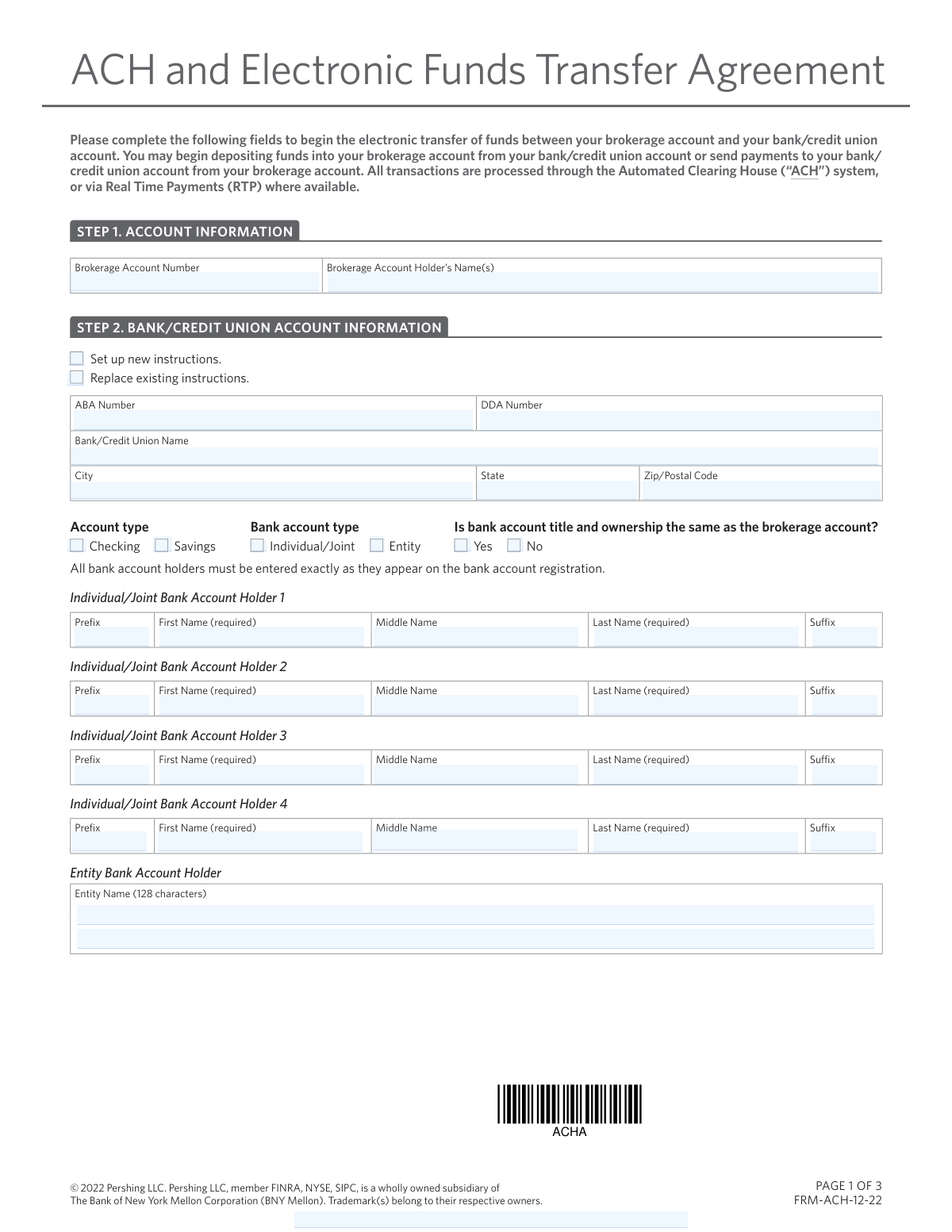
| 1. | ACH and Electronic Funds Transfer Instructions and Agreement | 1 | Basic 44 |
| 2. | ACH Authorization Agreement | 1 | Basic 38 |
| 3. | ACH Authorization Agreement (FRM-ACH-02-20) | 1 | – |
| 4. | Electronic Dividend and Interest Payment Authorization Form | 1 | – |
| 5. | Form F6776, Authorization of Interest-Only Payments (ERISA) | 1 | – |
| 6. | Form F7381, Authorization of Interest-Only Payments (Non ERISA) | 1 | – |
| 7. | TANN Corporation ACH/EFT Payment Authorization Form | 1 | Basic 34 |
| 8. | Transamerica Automatic Payment Authorization | 1 | – |
- Enterprise-grade security & data encryption
- 99%+ accuracy powered by AI
- 1,000+ forms from all industries
- Complete forms in under 60 seconds
How to Choose the Right Form
Choosing the right payment authorization form depends on whether you are looking to automate outgoing bill payments or manage the distribution of your investment income. These forms are essential for streamlining financial workflows and ensuring consistency across your banking and investment accounts.
For Managing Investment and Retirement Income
If your goal is to move earnings from an investment portfolio or retirement account into your daily spending account, look for forms tailored to income distribution:
- Electronic Dividend and Interest Payment Authorization Form: Select this form if you are a Charles Schwab client. It allows you to automate the transfer of dividends, interest, and money market payments directly to your bank account, which is ideal for those who want a regular income stream without manual transfers.
- Form F6776, Authorization of Interest-Only Payments (ERISA): This is a specialized TIAA form for participants in ERISA-governed retirement plans. Choose this if you are between age 55 and your Required Minimum Distribution (RMD) age and wish to receive interest payments while keeping your principal balance untouched.
For Automating Insurance Premiums
If you need to ensure that your insurance coverage remains active without having to remember monthly due dates, you require a form that authorizes withdrawals from your bank account:
- Transamerica Automatic Payment Authorization: Use this form if you are a Transamerica policyholder. It authorizes the company to pull premium payments directly from your checking or savings account, simplifying your financial management and preventing policy lapses.
Quick Selection Checklist
To ensure you pick the correct document, identify the following:
- The Flow of Funds: Are you sending money (Transamerica) or receiving money (Schwab/TIAA)?
- The Institution: Authorization forms are usually institution-specific. Make sure the form matches the company holding your assets or policy.
- Account Details: Have your routing number and account number ready, as all three forms require precise banking information to establish the electronic link.
Form Comparison
| Form | Primary Purpose | Institution | Payment Direction |
|---|---|---|---|
| Electronic Dividend and Interest Payment Authorization Form | Automates transfers of dividends and interest to external bank accounts | Charles Schwab | Outgoing funds from brokerage to personal bank account |
| Transamerica Automatic Payment Authorization | Authorizes automatic withdrawals for recurring insurance premium payments | Transamerica | Incoming payments from personal bank to insurance provider |
| Form F6776, Authorization of Interest-Only Payments (ERISA) | Withdraws interest earnings while preserving the retirement principal balance | TIAA | Retirement income distribution for ERISA plan participants |
Tips for payment authorization forms
Incorrect banking details are the primary cause of failed transfers or payment delays. Always double-check your routing and account numbers against a recent bank statement or a digital banking portal to ensure the funds reach the correct destination.
Financial institutions often reject authorization forms if the name on the bank account does not match the name on the investment or insurance policy. If you are using a joint account, ensure both owners provide the necessary signatures as required by the form instructions.
Many payment authorizations require a copy of a voided check or a bank verification letter to confirm the account's validity. Having these documents scanned and ready will prevent interruptions when you are ready to finalize and submit your authorization.
AI-powered tools like Instafill.ai can complete these complex financial forms in under 30 seconds with high accuracy. Your sensitive data stays secure during the process, providing a practical and time-saving solution for those managing multiple investment or insurance accounts.
Carefully select whether the authorization is for one-time transfers or recurring schedules like monthly dividends or premium withdrawals. Note the effective date to ensure your bank account has sufficient funds before the first automated transaction occurs.
For investment-related forms, be certain whether you are authorizing interest-only payments or drawing from the principal balance. Choosing the wrong option can significantly impact your long-term retirement strategy and your future tax liabilities.
Frequently Asked Questions
These forms legally authorize a financial institution, insurance company, or investment firm to move funds between accounts automatically. They are commonly used to set up recurring premium payments, transfer investment dividends to a bank, or manage interest distributions without manual intervention.
Policyholders, investors, and retirement plan participants often use these forms to automate their finances. For example, a Schwab client might use one to move dividends to a checking account, while a Transamerica policyholder uses it to ensure their insurance premiums are paid on time.
You will generally need your account or policy number, your bank's routing number, and your specific checking or savings account number. If the form involves a retirement plan like an ERISA account, you may also need details regarding your employer or the specific plan sponsor.
The correct form depends on whether you are paying money out, such as an insurance premium, or receiving income, such as dividends or interest. Look for forms labeled "Automatic Payment" for outgoing bills and "Dividend/Interest Authorization" for incoming transfers from your investments.
Yes, certain forms like the TIAA F6776 are specifically designed for interest-only payments, allowing participants to generate income while keeping the principal balance intact. This is a common strategy for individuals approaching retirement who want to manage cash flow without depleting their core savings.
Completed forms are usually sent directly to the financial institution managing the account, such as Charles Schwab, Transamerica, or TIAA. Submission methods vary by company but often include secure online portals, fax, or traditional mail to a specific processing center.
Yes, AI-powered tools like Instafill.ai can process these forms by accurately extracting data from your source documents and placing it directly into the correct fields. This technology can also turn static PDFs into interactive, fillable documents, making the completion process much more efficient.
Using AI tools can reduce the time spent on paperwork to under 30 seconds. By automating the data entry process, these services ensure high accuracy and eliminate the need to manually type in repetitive information like bank routing numbers or account details.
Electronic transfers are generally considered more secure because they reduce the risk of checks being lost, stolen, or altered in the mail. Automated systems also ensure that payments are made on time, which helps avoid late fees or the accidental lapse of insurance coverage.
Most financial institutions allow you to modify or revoke an authorization by submitting a new form or a written request. It is important to check with the specific provider regarding their notice period, as it may take a few business days for a cancellation to take effect.
ERISA forms are specifically for retirement plans governed by the Employee Retirement Income Security Act, which carries specific federal regulations and protections. Standard banking authorization forms are typically used for personal brokerage or savings accounts and are subject to different general banking laws.
Glossary
- Form Complexity Index
- Instafill’s 0–100 measure of how much effort a form takes to complete, calculated deterministically from the form’s own structure rather than estimated. It combines the number of fillable fields (the largest factor), how difficult those fields are to complete based on their type, the number of pages that contain fields, the amount of conditional “fill-only-if” logic, and how many sections the form is divided into, then adds modifiers for tables and repeating lists, bundled instruction pages, and dense page layouts. A higher score means the form is harder to fill out by hand. The forms in this category have a median Form Complexity Index of 38/100 (Basic). See exactly how it is calculated.
- ACH (Automated Clearing House)
- A national electronic network used for financial transactions in the United States, allowing for the automatic transfer of funds between bank accounts.
- EFT (Electronic Funds Transfer)
- The digital movement of money from one bank account to another, which includes transactions like direct deposits, wire transfers, and automated bill payments.
- Routing Number
- A nine-digit code that identifies a specific financial institution in the United States, used to ensure funds are withdrawn from or deposited into the correct bank.
- ERISA (Employee Retirement Income Security Act)
- A federal law that sets minimum standards for most voluntarily established retirement and health plans in private industry to protect the interests of participants.
- RMD (Required Minimum Distribution)
- The minimum amount that owners of employer-sponsored retirement plans and traditional IRAs must withdraw annually once they reach a specific age, typically 72 or 73.
- Principal
- The original sum of money invested or the remaining balance of a loan, separate from any interest or dividends that have accrued over time.
- Dividend
- A distribution of a portion of a company's earnings to its shareholders, which can be paid out as cash or reinvested into more stock.
- Premium
- The scheduled payment required to keep an insurance policy active, often authorized for automatic withdrawal to avoid a lapse in coverage.