Fill out ACH forms
with AI.
ACH forms are essential for managing electronic fund transfers across the Automated Clearing House network, providing the legal authorization needed to move money securely between bank accounts. These banking and financial forms serve as the foundation for modern electronic commerce, replacing physical checks with faster, more reliable digital transactions. By documenting the specific routing and account details required for a transfer, they ensure that funds reach the correct destination while protecting all parties involved in the transaction.
By continuing, you acknowledge Instafill's Privacy Policy and agree to get occasional product update and promotional emails.
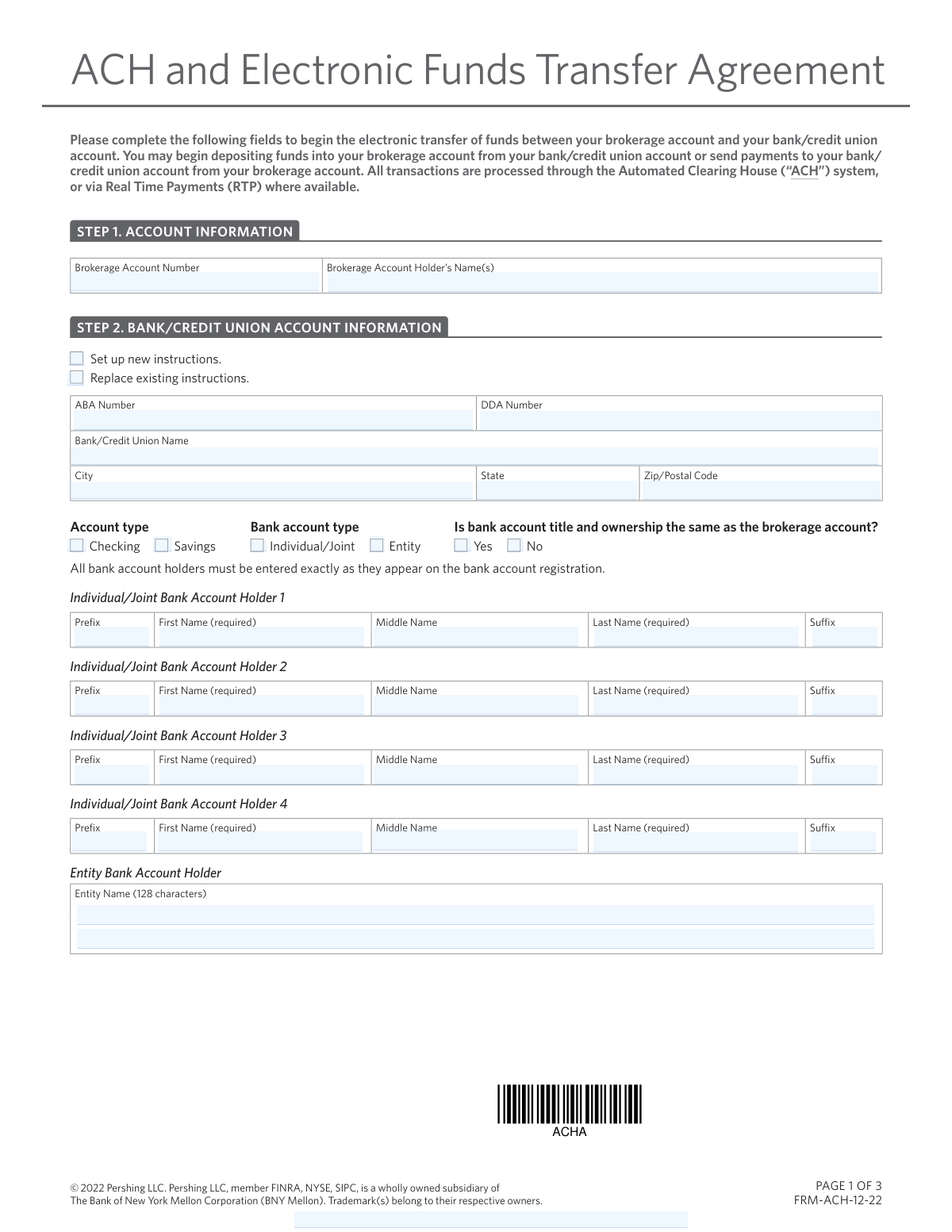
About ACH forms
A wide variety of professionals and individuals use these payment forms daily. Business owners often require them for vendor payments or payroll processing, while individuals might use them to set up recurring bill payments or direct deposits. For instance, an organization might use an ACH Funding Authorization Form to manage employee retirement contributions, or an applicant might submit Form G-1650 to authorize payments for government services. Because these documents involve sensitive financial information, accuracy is paramount to avoid transaction failures or processing delays.
Manually entering complex bank account and routing numbers into these forms can be time-consuming and increases the risk of manual errors. Tools like Instafill.ai use AI to fill these forms in under 30 seconds, ensuring your data is handled accurately and securely. This automated approach allows you to focus on your business or personal finances rather than the administrative burden of paperwork.
Every form on this page can be completed without typing. Instafill is form filling software that reads a PDF and fills it for you — including flat and scanned documents that carry no fillable fields at all.
Forms in This Category
The forms in this category have a median Form Complexity Index of 57/100 (Moderate), measured across 38 forms by field count, input difficulty, length, conditional logic and structure. See how it is calculated.
- Enterprise-grade security & data encryption
- 99%+ accuracy powered by AI
- 1,000+ forms from all industries
- Complete forms in under 60 seconds
How to Choose the Right Form
Selecting the correct form is essential for ensuring that electronic payments are processed correctly and legal or medical claims are not delayed. While this category focuses on Automated Clearing House (ACH) authorizations, it also includes several specialized financial and legal documents required for specific industries.
Direct Payment & ACH Authorizations
If your primary goal is to authorize an electronic transfer of funds from a bank account, look at these specific forms:
- Form G-1650, Authorization for ACH Transactions: Use this specifically for paying USCIS service fees related to immigration applications or petitions.
- ACH Funding Authorization Form: Choose this if you are a plan sponsor needing to authorize FASCore or MetLife to withdraw retirement plan contributions directly from a business account.
Retirement & Financial Transfers
For managing retirement assets or responding to financial security incidents, use the following:
- Direct Rollover Request (Appalachian Regional Healthcare, Inc.): Use this to move retirement savings from a voluntary plan into an IRA or a different employer’s plan without incurring tax penalties.
- Principal Financial Group Notice of Data Breach: This is used by individuals who have received a breach notification and need to enroll in credit monitoring services.
Healthcare & Professional Credentialing
These forms are required for medical practitioners or patients seeking specific insurance approvals:
- Oregon Practitioner Credentialing Application: Required for healthcare providers in Oregon to apply for hospital privileges or join health plan networks.
- Massachusetts Collaborative — CT/CTA/MRI/MRA Prior Authorization Form: Used by providers to prove medical necessity for advanced imaging to a patient's insurance carrier.
- T-RENA Teilnahme- und Leistungsnachweis: A specific German form used to document participation in rehabilitation aftercare services.
Legal, Probate & Workers' Compensation
For court-ordered actions or workplace injury claims, select the form that matches your jurisdiction:
- Form SC-100A, Other Plaintiffs or Defendants: An attachment for California Small Claims Court when there are more than two parties involved in a lawsuit.
- Inventory and Appraisal Attachment (DE-161, GC-041): Essential for California probate cases to itemize and value estate assets.
- Massachusetts DIA Form 110, Employee’s Claim: The standard form to initiate a disputed workers' compensation claim in Massachusetts.
Form Comparison
| Form | Purpose | Who Files It | Key Information Required |
|---|---|---|---|
| Form G-1650, Authorization for ACH Transactions | Authorizes electronic payments for USCIS application and petition processing fees. | Applicants or petitioners for USCIS services. | Bank account numbers and specific payment amount authorization. |
| ACH Funding Authorization Form | Establishes automated clearinghouse debits for retirement plan contributions. | Plan Sponsors managing company retirement plans. | Bank account details and authorization for recurring transfers. |
| Direct Rollover Request for Appalachian Regional Healthcare, Inc. Voluntary Plan | Requests direct transfer of retirement savings to another eligible account. | Retirement plan participants changing accounts. | Destination account details and specific distribution instructions. |
| Zwangsvollstreckung – Antrag auf Erlass eines Pfändungs- und Überweisungsbeschlusses (PfüB) | Seizes debtor assets from third parties like banks or employers. | Creditors holding a valid legal enforcement title. | Debtor details, creditor information, and third-party bank data. |
| Hauptantrag Bürgergeld (HA) | Applies for basic social security and income support in Germany. | Individuals seeking unemployment or financial assistance. | Personal income, assets, and household composition details. |
| Commonwealth of Massachusetts Department of Industrial Accidents Form 110, Employee’s Claim | Initiates a disputed workers' compensation claim for workplace injuries. | Employees or dependents seeking statutory benefits. | Injury details, wage information, and insurer identification. |
| Inventory and Appraisal Attachment (Judicial Council of California Form DE-161, GC-041) | Itemizes and values property within a decedent's probate estate. | Executors or administrators of a legal estate. | Detailed asset lists and professional appraisal values. |
| Form SC-100A, Other Plaintiffs or Defendants | Identifies additional parties in a California small claims lawsuit. | Plaintiffs or defendants involving multiple parties. | Legal names and contact information for additional litigants. |
| Oregon Practitioner Credentialing Application | Standardizes the credentialing process for Oregon healthcare practitioners. | Medical practitioners applying for facility privileges. | Education, licensure, work history, and liability insurance records. |
| ACORD 140 (2014/12), Property Section | Provides property underwriting details for commercial insurance applications. | Insurance agents and business property owners. | Building construction, protection details, and requested coverage limits. |
| T-RENA Teilnahme- und Leistungsnachweis | Documents participation in rehabilitation aftercare for insurance reimbursement. | Patients and their attending medical therapists. | Insurance numbers and verified attendance for treatment sessions. |
| Massachusetts Collaborative — CT/CTA/MRI/MRA Prior Authorization Form | Requests insurance approval for advanced medical imaging procedures. | Healthcare providers and clinical office staff. | Medical necessity documentation and specific imaging study details. |
Tips for ACH forms
Even a single transposed digit in your bank information can cause a payment to fail or be sent to the wrong account. Always double-check these numbers against a bank statement or a voided check before submitting your ACH authorization.
Financial institutions often reject ACH forms if the signature does not match the one they have on file for the account holder. If you are signing for a business, ensure you have the proper corporate authority to authorize electronic transfers.
Many organizations require a voided check to verify the account and routing numbers provided on the form. This simple step prevents clerical errors and ensures the funds are drawn from or deposited into the correct financial institution.
When setting up recurring ACH transfers, clearly specify if the amount is fixed or variable and the exact dates for the withdrawals. This prevents unexpected overdrafts and ensures you remain in compliance with your payment agreement.
AI-powered tools like Instafill.ai can complete complex ACH and financial forms in under 30 seconds with high accuracy. Your sensitive data stays secure during the process, making it a reliable way to handle multiple banking documents quickly.
Understand whether you are authorizing an ACH credit (money coming in) or an ACH debit (money going out). Selecting the wrong transaction type on a banking form can lead to significant delays in processing your financial requests.
Frequently Asked Questions
An ACH (Automated Clearing House) form is a legal document that grants a company or government agency permission to move funds electronically between bank accounts. These forms are commonly used for recurring payments, such as utility bills, or for one-time transactions like paying government filing fees or funding a retirement account.
The form you need depends on the organization you are paying or receiving money from. For instance, if you are paying immigration fees, you would use USCIS Form G-1650, whereas a business setting up retirement contributions would use an ACH Funding Authorization form specific to their plan provider.
Most ACH forms require your bank's name, the type of account (checking or savings), the 9-digit ABA routing number, and your specific account number. You must also provide the name of the account holder as it appears on bank records to ensure the transaction is not rejected.
Yes, AI tools like Instafill.ai can fill these forms in under 30 seconds by accurately extracting data from your source documents and placing it into the correct fields. This helps prevent common manual entry errors, such as transposing digits in a routing or account number.
When using AI-powered automation, the process of completing a standard ACH form is nearly instantaneous, often taking less than 30 seconds. The AI identifies the required fields and maps your information directly into the document, allowing for a much faster turnaround than manual typing.
While not always mandatory, many organizations request a voided check to verify the routing and account numbers provided on the form. This serves as a safeguard to ensure the electronic transfer is directed to the correct financial institution and account.
Submission instructions are usually found on the form itself or in the accompanying instructions. Generally, you submit the form directly to the entity that will be initiating the transaction, such as a utility company, a government agency like USCIS, or your employer's HR department.
An ACH debit authorization allows an organization to 'pull' or withdraw funds from your account, which is common for paying bills. An ACH credit authorization allows an organization to 'push' or deposit funds into your account, which is the standard method for payroll direct deposits.
Yes, most ACH forms allow you to specify whether the authorization is for a single transaction or a series of recurring payments. You should carefully check the box or section that defines the frequency and duration of the authorization to avoid unauthorized subsequent withdrawals.
If the banking information is incorrect, the transaction will fail, which may lead to late fees, returned item charges from your bank, or the rejection of a legal application. Using automated tools can help ensure accuracy by pulling data directly from official bank statements or records.
Glossary
- Form Complexity Index
- Instafill’s 0–100 measure of how much effort a form takes to complete, calculated deterministically from the form’s own structure rather than estimated. It combines the number of fillable fields (the largest factor), how difficult those fields are to complete based on their type, the number of pages that contain fields, the amount of conditional “fill-only-if” logic, and how many sections the form is divided into, then adds modifiers for tables and repeating lists, bundled instruction pages, and dense page layouts. A higher score means the form is harder to fill out by hand. The forms in this category have a median Form Complexity Index of 57/100 (Moderate). See exactly how it is calculated.
- ACH (Automated Clearing House)
- A nationwide electronic network used by financial institutions to process batches of credit and debit transactions, such as payroll, direct deposits, and automated bill payments.
- Routing Number (ABA Number)
- A nine-digit code printed on the bottom of a check that identifies a specific financial institution in the United States for electronic transfers.
- Account Number
- A unique sequence of numbers assigned to your personal or business bank account that, when combined with a routing number, allows funds to be directed to the correct destination.
- Direct Debit
- A financial transaction in which an authorized third party, such as a government agency or service provider, withdraws funds directly from your bank account.
- Authorization Agreement
- The legal section of an ACH form where the account holder provides written permission for a company or agency to initiate electronic fund transfers.
- Direct Deposit
- The electronic transfer of a payment directly from the payer's account to the recipient's bank account, commonly used for refunds, benefits, or salary.
- Voided Check
- A paper check with the word 'VOID' written across it, often required as an attachment to verify the accuracy of the banking information provided on an authorization form.
- Originator
- The entity or organization, such as USCIS or a retirement plan sponsor, that initiates an ACH transaction to either collect or distribute funds.