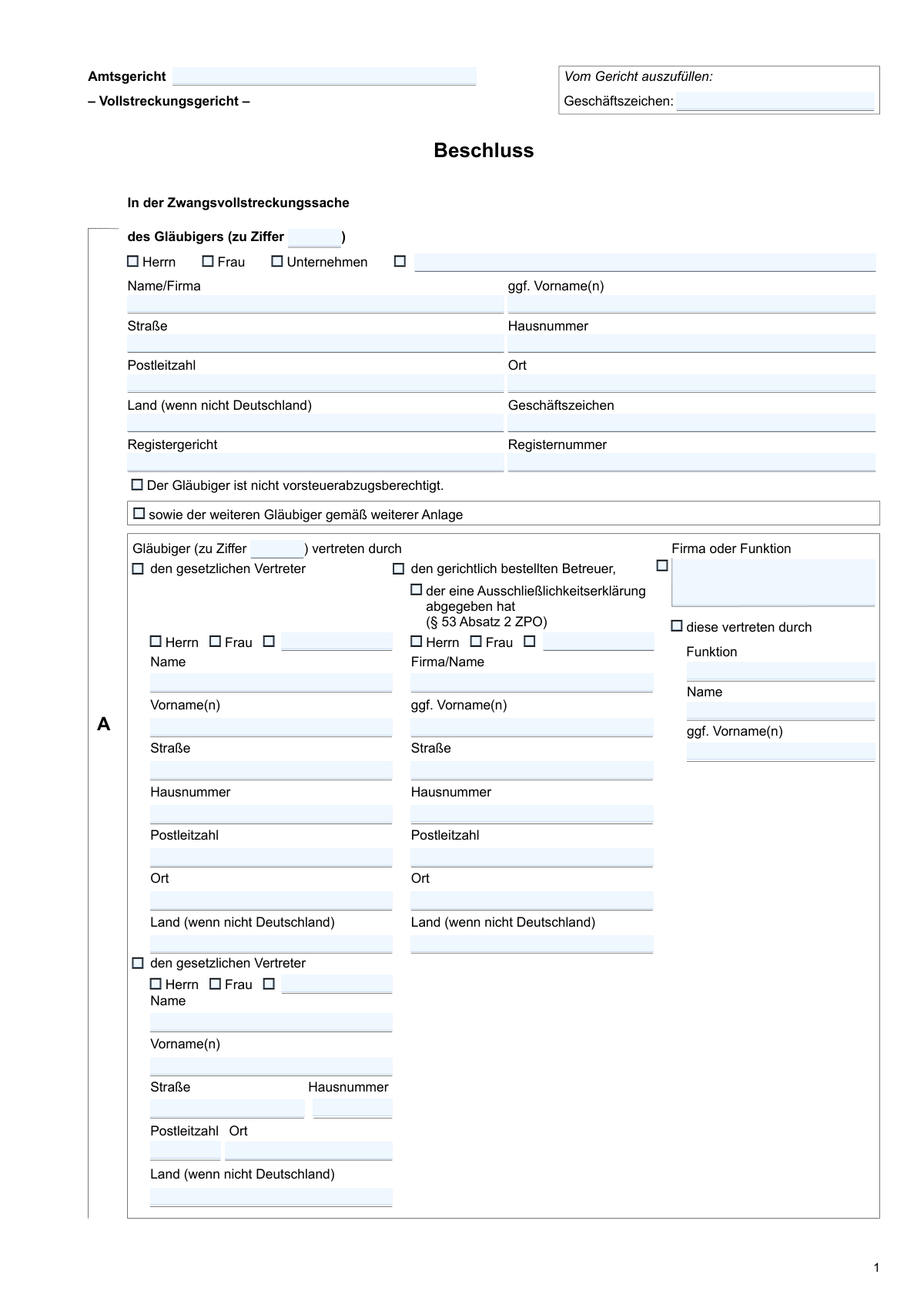
Yes! You can use AI to fill out Zwangsvollstreckung – Antrag auf Erlass eines Pfändungs- und Überweisungsbeschlusses (PfüB) nach §§ 828 ff. ZPO (mit Anlagen/Modulen für Gläubiger, Schuldner, Drittschuldner und Forderungen)

Der Antrag auf Erlass eines PfĂ€ndungs- und Überweisungsbeschlusses (PfĂŒB) ist ein gerichtliches Standardformular der Zwangsvollstreckung nach der Zivilprozessordnung (ZPO), das beim zustĂ€ndigen Amtsgericht eingereicht wird. Damit kann ein GlĂ€ubiger auf Grundlage eines Vollstreckungstitels Forderungen des Schuldners gegen Dritte (Drittschuldner, z. B. Arbeitgeber, Bank, SozialleistungstrĂ€ger) pfĂ€nden und sich diese Forderungen zur Einziehung oder an Zahlungs statt ĂŒberweisen lassen. Das Formular ist wichtig, weil unvollstĂ€ndige oder fehlerhafte Angaben (Parteidaten, Titel, Forderungsart, Drittschuldner, Bankverbindung, Zustellung) die Bearbeitung verzögern oder zur ZurĂŒckweisung fĂŒhren können. Heute kann dieses Formular schnell und korrekt mit KI-gestĂŒtzten Services wie Instafill.ai ausgefĂŒllt werden, die auch nicht-ausfĂŒllbare PDF-Versionen in interaktive, ausfĂŒllbare Formulare umwandeln können.
Our AI automatically handles information lookup, data retrieval, formatting, and form filling.
It takes less than a minute to fill out PfüB-Antrag (ZPO) using our AI form filling.
Securely upload your data. Information is encrypted in transit and deleted immediately after the form is filled out.

Form specifications

Form name: Zwangsvollstreckung – Antrag auf Erlass eines Pfändungs- und Überweisungsbeschlusses (PfüB) nach §§ 828 ff. ZPO (mit Anlagen/Modulen für Gläubiger, Schuldner, Drittschuldner und Forderungen)
Number of pages: 9
Language: English
main-image

Instafill Demo: filling out a legal form in seconds

How to Fill Out PfüB-Antrag (ZPO) Online for Free in 2026

Are you looking to fill out a PFÜB-ANTRAG (ZPO) form online quickly and accurately? Instafill.ai offers the #1 AI-powered PDF filling software of 2026, allowing you to complete your PFÜB-ANTRAG (ZPO) form in just 37 seconds or less.
Follow these steps to fill out your PFÜB-ANTRAG (ZPO) form online using Instafill.ai:
  1. 1 Instafill.ai öffnen und den „PfüB-Antrag (ZPO)“ auswählen oder das PDF/Scan des Formulars hochladen (auch nicht-ausfüllbare PDFs).
  2. 2 Gerichtsdaten eintragen: zuständiges Amtsgericht und Geschäftszeichen (falls bereits vorhanden) sowie ggf. weitere Verfahrensreferenzen.
  3. 3 Gläubigerdaten erfassen: Ziffer/Gläubiger-Referenz, Name/Firma, Anschrift, ggf. Registergericht/Registernummer, Geschäftszeichen sowie Angaben zur Vorsteuerabzugsberechtigung und zu weiteren Gläubigern (Anlage).
  4. 4 Vertretung klären und ausfüllen: gesetzlicher Vertreter oder gerichtlich bestellter Betreuer (inkl. Ausschließlichkeitserklärung nach § 53 Abs. 2 ZPO) und die dazugehörigen Personen-/Organisationsdaten (Anrede, Name, Funktion, Anschrift).
  5. 5 Schuldnerdaten erfassen: Ziffer/Zuordnung, Person/Unternehmen, Anschrift, Geburtsdaten (bei natürlichen Personen), ggf. Registerdaten, sowie Angaben zu weiteren Schuldnern (Anlage) und ggf. Vertreterdaten.
  6. 6 Drittschuldner/Forderungs-Module ausfüllen: Art der Forderung (z. B. Arbeitseinkommen, Geldleistungen nach SGB, Kontoguthaben/P‑Konto, Herausgabeansprüche), Beträge/Zeiträume, Vertrags-/Aktenzeichen, Zustellkosten, weitere Anordnungen und gewünschte Überweisung (zur Einziehung/an Zahlungs statt).
  7. 7 Auszahlungs-/Bankdaten und Verwendungszweck angeben (IBAN/BIC, Kontoinhaber: Gläubiger/Vertreter/Bevollmächtigter/abweichender Kontoinhaber), anschließend KI-Prüfung nutzen, Anlagen/Module ergänzen, final als druck-/einreichungsfähige Datei exportieren und beim Amtsgericht einreichen.

Our AI-powered system ensures each field is filled out correctly, reducing errors and saving you time.

Why Choose Instafill.ai for Your Fillable PfüB-Antrag (ZPO) Form?

Speed

Complete your PfüB-Antrag (ZPO) in as little as 37 seconds.

Up-to-Date

Always use the latest 2026 PfüB-Antrag (ZPO) form version.

Cost-effective

No need to hire expensive lawyers.

Accuracy

Our AI performs 10 compliance checks to ensure your form is error-free.

Security

Your personal information is protected with bank-level encryption.

Frequently Asked Questions About Form PfüB-Antrag (ZPO)

This form is used in a German court enforcement context to record key case details (court reference, court), identify creditors and debtors, and provide representation and payment (bank) information needed for processing.

Typically the creditor (GlĂ€ubiger) or the creditor’s authorized/legal representative completes it, because it requests creditor details, bank account information for payments, and references to the court case and parties.

Use the GeschĂ€ftszeichen exactly as shown on the court’s letters/orders for this matter. Enter it without changes so the court can match your submission to the correct file.

Enter the name of the local/district court responsible for the case (e.g., “Amtsgericht MĂŒnchen”). If you are unsure, check the header of the court document that contains the GeschĂ€ftszeichen.

“Ziffer” is the index number used to link entries across the form (e.g., creditor 1, debtor 1). Use the same number consistently wherever the form asks for the creditor or debtor “Ziffer” so the sections match correctly.

Check it when the creditor is represented by a statutory/legal representative (e.g., parent for a minor, managing director acting as legal representative, or another legally appointed representative). Then complete the representative’s name and address fields in the corresponding representative block.

Check “gerichtlich bestellten Betreuer” if a court-appointed guardian (Betreuer) represents the party. Only check the “AusschließlichkeitserklĂ€rung” box if that Betreuer has actually submitted an exclusivity declaration under § 53 Abs. 2 ZPO.

Select “Herrn” or “Frau” for an individual person, “Unternehmen” for a company/legal entity, and “Sonstige/Andere” only if none of those fit (then specify the correct designation in the free-text field). Use the same logic for both creditor and debtor sections.

Only fill in the country if the address is outside Germany. If the address is in Germany, leave the country field blank as instructed.

You generally provide the account holder name and IBAN (BIC is optional, especially if the IBAN starts with “DE”). You must also indicate whether the account belongs to the creditor, the legal representative, an authorized representative, or a different account holder (abweichender Kontoinhaber).

Enter a reference that clearly identifies the payment, such as an invoice number, claim reference, contract number, or the creditor’s internal GeschĂ€ftszeichen. This helps ensure payments are allocated to the correct case.

Use the checkboxes indicating additional creditors/debtors “gemĂ€ĂŸ weiterer Anlage” and attach a separate annex listing the extra parties. Make sure the annex uses consistent “Ziffer” numbering so the court can link entries.

Have the court’s GeschĂ€ftszeichen, the correct Amtsgericht name, full names and addresses for creditor/debtor, any register court/registration numbers for companies, and bank details (account holder, IBAN, and payment reference). If a Betreuer or legal representative is involved, have their appointment/authority details available.

Yes. Services like Instafill.ai can use AI to extract your information from documents and auto-fill the form fields accurately, reducing manual typing and common formatting mistakes (like address and IBAN entry).

Upload the PDF to Instafill.ai, add your source information (e.g., court letter, party details, bank info), and let the AI map and fill the fields; then review and export the completed form. If the PDF is flat/non-fillable, Instafill.ai can convert it into an interactive fillable form first and then auto-fill it.

Compliance PfüB-Antrag (ZPO)
Validation Checks by Instafill.ai

1
Court reference number (Geschäftszeichen) presence and allowed character set
Validates that the court’s GeschĂ€ftszeichen is provided and matches an expected pattern (typically alphanumeric with separators like '/', '-', and spaces) and is not only whitespace. This is critical for correctly routing and matching the submission to the court file. If the value is missing or contains disallowed characters, the submission should be rejected or flagged for manual review because downstream matching and indexing will likely fail.
2
Amtsgericht (District Court) completeness and plausibility
Checks that the Amtsgericht field is not empty and contains a plausible court designation (e.g., starts with 'Amtsgericht' or contains a known court location name) rather than a person name or address. This ensures the form is directed to the correct jurisdiction and prevents misfiling. If validation fails, the system should prompt for correction or route to exception handling to avoid sending the case to the wrong court.
3
Ziffer (reference index) numeric format and positive range across all Ziffer fields
Ensures every 'Ziffer' field (creditor, debtor, titles/attachments, etc.) is an integer and greater than zero, with no letters or decimals. Ziffer values are used as internal cross-references; non-numeric or zero/negative values break linkage between sections. If invalid, the submission should be blocked or the specific section should be marked incomplete until corrected.
4
Cross-field consistency of creditor Ziffer between sections
Validates that 'Ziffer 1 (GlĂ€ubiger‑Referenz)', 'Creditor reference (Ziffer) (Primary Creditor)', and 'Creditor reference (Ziffer) (Creditor Details)' are consistent when they refer to the same creditor entry. This prevents mismatched creditor identities across the form and avoids paying or addressing the wrong party. If inconsistencies are detected, the system should require the user to reconcile the Ziffer values or explicitly create separate creditor entries.
5
Exactly one creditor type selection (Herrn/Frau/Unternehmen/Sonstige) per creditor block
Checks that within each creditor identity block, exactly one of the type checkboxes is selected (male, female, company, or 'Sonstige'). This is important because it drives which name fields are required and how correspondence is addressed. If multiple or none are selected, the system should fail validation and request a single, unambiguous selection.
6
Conditional requirement: 'Sonstige' requires free-text designation
If 'Sonstige (Angabe im Freitextfeld)' is checked for a creditor or debtor, validates that the adjacent free-text field (salutation/entity type) is filled with a meaningful designation (not empty or a duplicate of 'Sonstige'). This ensures the legal form of the party is captured for correct addressing and legal clarity. If missing, the submission should be rejected because the party type is undefined.
7
Individual vs. company name rules (given name required only for natural persons)
Validates that 'Given name(s)' is present when 'Herrn' or 'Frau' is selected, and is blank (or at least not required) when 'Unternehmen' is selected. This prevents mixing personal-name structures with corporate entities and improves data quality for correspondence and identity matching. If the rule is violated, the system should prompt the user to correct the party type or adjust the name fields accordingly.
8
Address completeness for any active party/representative block
For any block that is activated by a corresponding checkbox (creditor, debtor, statutory representative, court-appointed guardian/Betreuer, organization representative), validates that Street, House number, Postal code, and City are all provided. Complete addresses are essential for service, correspondence, and enforcement actions. If any required address component is missing, validation should fail and highlight the missing fields.
9
German postal code (PLZ) format and country-dependent rules
If the 'Country (if not Germany)' field is blank (implying Germany), validates that PLZ is exactly 5 digits. If a non-Germany country is provided, allows non-German postal formats but still requires a non-empty postal code and country name. If the country/PLZ combination is inconsistent, the submission should be blocked to prevent undeliverable mail and incorrect jurisdiction assumptions.
10
Country field must be blank for Germany and required for foreign addresses
Checks that the 'Country (if not Germany)' field is empty when the address is in Germany, and is populated when the address is outside Germany (as indicated by user input or non-DE postal patterns). This standardizes address data and avoids redundant or conflicting country entries. If the country is incorrectly filled or missing, the system should request correction to ensure proper international addressing.
11
Representative selection logic: legal representative vs. court-appointed Betreuer exclusivity and dependencies
Validates that representation checkboxes follow logical dependencies: if 'der eine AusschließlichkeitserklĂ€rung abgegeben hat (§ 53 Abs. 2 ZPO)' is checked, then 'den gerichtlich bestellten Betreuer' must also be checked. It also checks that mutually exclusive representation modes (where the form design expects one) are not simultaneously selected unless explicitly allowed by business rules. If dependencies are violated, the submission should fail because the legal basis for representation is unclear.
12
Conditional requirement: Betreuer (§53 Abs.2 ZPO) right-column firm/function details
If 'Vertreten durch gerichtlich bestellten Betreuer (§ 53 Abs. 2 ZPO)' is marked Yes, validates that the right-column fields (Firm/Function, Function/Job Title, Representative Surname, Representative Given Name(s)) are completed and that 'diese vertreten durch' is checked when a firm/function is being represented by a named person. This ensures the chain of representation is legally and operationally clear. If incomplete, the system should block submission because the representative cannot be properly identified.
13
Salutation checkbox vs. salutation text consistency (Herr/Herrn/Frau/Unternehmen)
Checks that if a salutation checkbox (Herrn/Frau/Unternehmen) is selected, the corresponding salutation text field (Anrede/Salutation) matches the selection (e.g., 'Herr'/'Herrn' for male, 'Frau' for female) and is not contradictory. Consistent salutations prevent incorrect addressing in official correspondence. If inconsistent, validation should fail or auto-suggest the correct salutation and require confirmation.
14
Debtor date of birth (Geburtsdatum) format and plausibility
Validates that the debtor date of birth is in a valid date format (e.g., DD.MM.YYYY) and represents a plausible past date (not in the future and not unreasonably old, such as > 120 years). Date of birth is a key identifier for natural persons and helps avoid mistaken identity. If invalid, the system should reject the entry or require correction before submission.
15
Register court/number conditional requirement for companies
If 'Unternehmen' is selected for creditor or debtor and register information fields are present, validates that Registergericht and Registernummer are either both provided or both left blank (depending on whether registration is applicable), and that Registernummer follows a plausible pattern (e.g., includes HRB/HRA plus digits where expected). This improves legal entity identification and reduces ambiguity. If only one is provided or the format is implausible, the system should flag the submission for correction or manual verification.
16
Bank account ownership selection and required banking fields (IBAN/BIC/account holder)
Validates that exactly one account ownership checkbox is selected (creditor, legal representative, authorized representative, or different account holder) and that Account holder name, IBAN, and Payment reference are provided when any ownership option is selected. It also enforces that BIC is optional only for DE IBANs; for non-DE IBANs, BIC should be required or strongly recommended. If these checks fail, the submission should be blocked because payment execution and allocation may fail or be misdirected.

Common Mistakes in Completing PfüB-Antrag (ZPO)

Mixing up the court’s GeschĂ€ftszeichen with internal references

People often enter their own file number, an invoice number, or the creditor’s internal GeschĂ€ftszeichen in the court’s “GeschĂ€ftszeichen” field because the same term appears elsewhere on the form. This can prevent the court from correctly assigning the submission to the right case, causing delays or requests for clarification. Always copy the exact GeschĂ€ftszeichen as shown on the court’s correspondence (including separators like spaces, slashes, or hyphens). AI-powered tools like Instafill.ai can help by validating the expected format and keeping court vs. party references in the correct fields.

Entering the wrong Amtsgericht or using an incomplete court name

A frequent error is writing a city name only (e.g., “Berlin”) or the wrong court level (e.g., Landgericht instead of Amtsgericht), especially when multiple courts exist in the same region. This can lead to misrouting or rejection because the responsible court is not clearly identified. Use the official designation exactly (e.g., “Amtsgericht MĂŒnchen”) and match it to the case documents. Instafill.ai can reduce this by standardizing court names and flagging missing qualifiers like “Amtsgericht.”

Inconsistent or missing Ziffer (reference index) across sections

The form relies on “Ziffer” numbers to link creditors/debtors/attachments, but users often leave a Ziffer blank, reuse the same number for different parties, or enter a Ziffer that doesn’t match the creditor list. The consequence is broken cross-references, making it unclear which party a block of data belongs to and triggering follow-up questions. Keep a single numbering scheme and ensure every “Creditor reference (Ziffer)” and “Schuldner Ziffer” matches the corresponding entry. Instafill.ai can automatically propagate the same Ziffer to all linked fields and warn about duplicates.

Checking contradictory representation boxes (legal representative vs. Betreuer vs. exclusivity declaration)

Users often tick both “den gesetzlichen Vertreter” and “den gerichtlich bestellten Betreuer” without realizing these are different representation types, or they tick the exclusivity declaration box without selecting the court-appointed Betreuer. Contradictory selections can invalidate the representation information and may require resubmission or additional proof. Only select the representation type that actually applies, and only mark “AusschließlichkeitserklĂ€rung (§ 53 Abs. 2 ZPO)” if that declaration was truly submitted by the court-appointed representative. Instafill.ai can enforce conditional logic so incompatible boxes can’t be selected together.

Filling the wrong representative block (left/middle/right columns) or leaving required conditional fields empty

Because the form has multiple representative sections (individual legal representative, organization representative, and firm/function “diese vertreten durch”), people frequently enter names in the wrong column or forget to complete the dependent fields after checking a box. This results in incomplete representative identification (e.g., no surname, no function, or no address), which can block service of documents or payment processing. After selecting the correct representation checkbox, complete all fields in the corresponding block only, and leave unrelated blocks blank. Instafill.ai can guide users to the correct block and ensure all required conditional fields are completed.

Salutation and entity type mismatches (Herrn/Frau/Unternehmen/Sonstige)

A common mistake is selecting “Unternehmen” but entering a person’s given name, or selecting “Herrn/Frau” while entering a company name, or checking “Sonstige” without specifying the free-text designation. These inconsistencies can cause incorrect addressing in court correspondence and confusion about the party’s legal form. Choose exactly one entity type that matches the party and then enter only the fields that apply (e.g., given name only for natural persons). Instafill.ai can detect mismatches (company keywords vs. person fields) and prompt corrections.

Address formatting errors (street/house number swapped, missing PLZ, country filled incorrectly)

Users often put the full address into the street field, swap street and house number, omit the postal code, or fill “Country” with “Deutschland” even though the instruction says to leave it blank for German addresses. Incorrect addresses can lead to failed service, returned mail, or payment issues. Enter street name without house number, put the house number (including suffix like “12a”) in the house-number field, and only fill the country field if the address is outside Germany. Instafill.ai can normalize addresses and validate German PLZ formats (5 digits) and country rules.

IBAN/BIC mistakes and wrong account-holder selection

People frequently enter an incomplete IBAN, include typos in check digits, add extra spaces, or provide a BIC unnecessarily (or omit it when the IBAN is non-DE and the bank requires it). Another frequent issue is checking the wrong account-holder category (creditor vs. legal representative vs. authorized representative vs. different account holder), which can raise compliance questions or delay payment. Copy the IBAN exactly as issued, prefer no spaces, and ensure the account-holder name matches the selected account-holder type. Instafill.ai can validate IBAN structure/check digits and apply rules like “BIC optional for DE IBANs.”

Missing or vague payment reference (Verwendungszweck)

Users often leave the payment reference blank or write something generic like “Rechnung” without a unique identifier. This can cause incoming payments to be unassignable, leading to delays in crediting or disputes about whether payment was made. Provide a specific reference such as invoice number, contract number, claim reference, and/or the court GeschĂ€ftszeichen if appropriate. Instafill.ai can suggest consistent references and ensure the field is not left empty when bank details are provided.

Register details entered incorrectly or omitted for companies (Registergericht/Registernummer)

For corporate creditors/debtors, people often skip Registergericht/Registernummer, enter the wrong register type, or paste a VAT ID instead of the commercial register number. This can make it harder to uniquely identify the legal entity and may trigger requests for additional documentation. If the party is registered, enter the correct Registergericht and the exact Registernummer as shown in the Handelsregister excerpt. Instafill.ai can help by formatting register numbers consistently and flagging values that look like tax IDs rather than register entries.

Personal data errors for debtors (Geburtsdatum/Geburtsort) and date format issues

A frequent problem is using the wrong date format (e.g., MM/DD/YYYY instead of DD.MM.YYYY), leaving the date of birth blank for an individual debtor, or entering a district/region instead of the actual place of birth. Incorrect personal data can lead to misidentification, especially when names are common, and can slow enforcement steps. Use the German date format (DD.MM.YYYY) and enter the exact town/city of birth as known from official documents. Instafill.ai can enforce date formatting and highlight missing identity fields when “Herr/Frau” is selected.
Saved over 80 hours a year

“I was never sure if my IRS forms like W-9 were filled correctly. Now, I can complete the forms accurately without any external help.”

Kevin Martin Green

Your data stays secure with advanced protection from Instafill and our subprocessors

Robust compliance program

Transparent business model

You’re not the product. You always know where your data is and what it is processed for.

ISO 27001, HIPAA, and GDPR

Our subprocesses adhere to multiple compliance standards, including but not limited to ISO 27001, HIPAA, and GDPR.

Security & privacy by design

We consider security and privacy from the initial design phase of any new service or functionality. It’s not an afterthought, it’s built-in, including support for two-factor authentication (2FA) to further protect your account.

Fill out PfüB-Antrag (ZPO) with Instafill.ai

Worried about filling PDFs wrong? Instafill securely fills zwangsvollstreckung-antrag-auf-erlass-eines-pfndungs-und-berweisungsbeschlusses-pfb-nach-828-ff-zpo-mit-anlagenmodulen forms, ensuring each field is accurate.