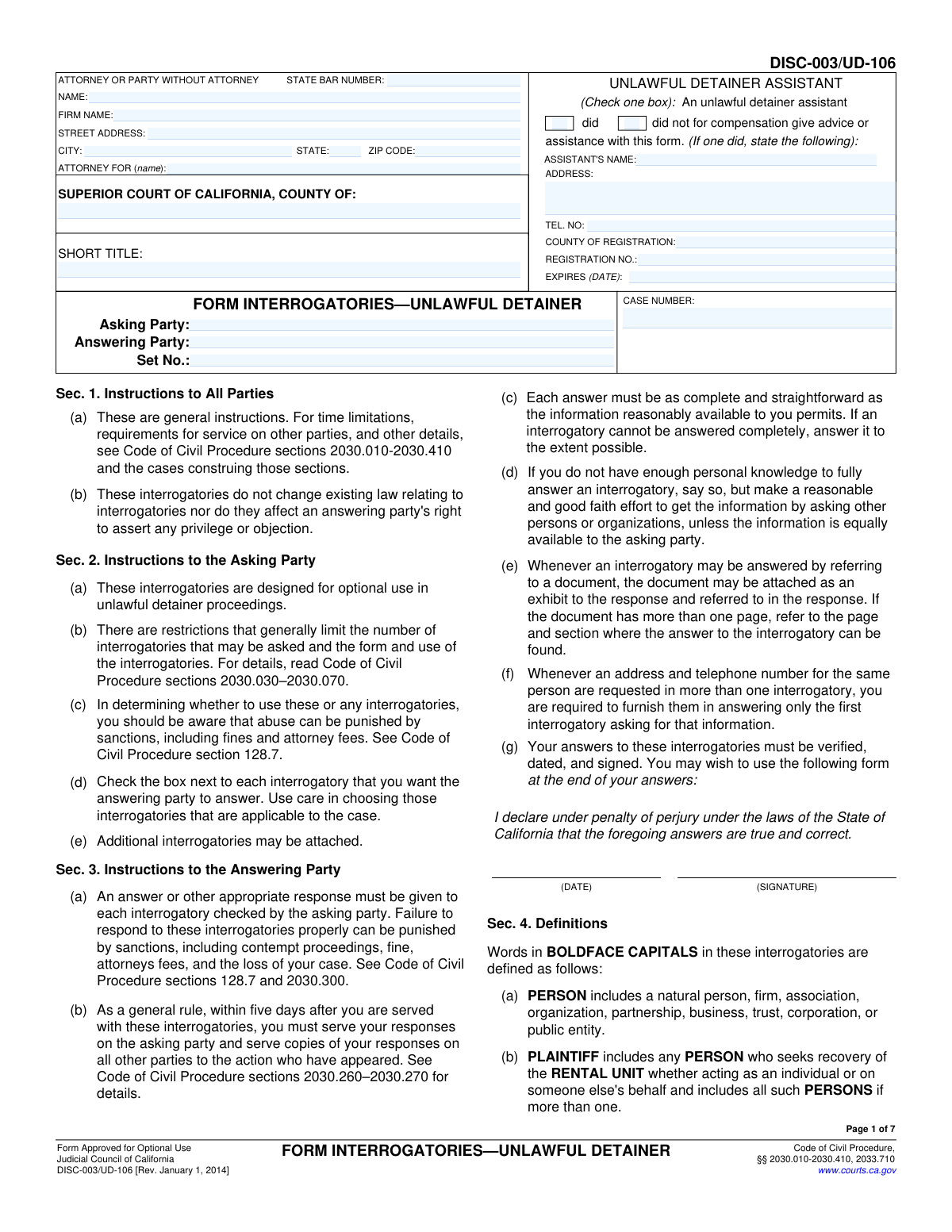
Yes! You can use AI to fill out Form DISC-003/UD-106, Form Interrogatories—Unlawful Detainer
Form DISC-003/UD-106 is a standard set of written questions (interrogatories) approved by the Judicial Council of California for use in unlawful detainer (eviction) cases. It allows either the landlord or the tenant to formally request information and documents from the other party as part of the legal discovery process, helping to build their case. Today, this form can be filled out quickly and accurately using AI-powered services like Instafill.ai, which can also convert non-fillable PDF versions into interactive fillable forms.
DISC-003/UD-106 is part of the
California court forms and unlawful detainer forms categories on Instafill.
Our AI automatically handles information lookup, data retrieval, formatting, and form filling.
It takes less than a minute to fill out DISC-003/UD-106 using our AI form filling.
Securely upload your data. Information is encrypted in transit and deleted immediately after the form is filled out.
Form specifications
| Form name: | Form DISC-003/UD-106, Form Interrogatories—Unlawful Detainer |
| Number of fields: | 85 |
| Number of pages: | 1 |
| Language: | English |
Instafill Demo: How to fill out PDF forms in seconds with AI
How to Fill Out DISC-003/UD-106 Online for Free in 2026
Are you looking to fill out a DISC-003/UD-106 form online quickly and accurately? Instafill.ai offers the #1 AI-powered PDF filling software of 2026, allowing you to complete your DISC-003/UD-106 form in just 37 seconds or less.
Follow these steps to fill out your DISC-003/UD-106 form online using Instafill.ai:
- 1 Navigate to Instafill.ai and upload or select the Form DISC-003/UD-106.
- 2 Enter the case details, including court information, party names, and case number, into the designated fields.
- 3 As the 'Asking Party', review the list of interrogatories and check the box next to each question you want the 'Answering Party' to answer.
- 4 Use the AI assistant for guidance on which questions are most relevant to your specific unlawful detainer claims or defenses.
- 5 If you are the 'Answering Party', provide complete and straightforward answers to each checked interrogatory in the spaces provided.
- 6 Review the entire form for accuracy and completeness, then securely download, print, or share the document for legal service.
Our AI-powered system ensures each field is filled out correctly, reducing errors and saving you time.
Why Choose Instafill.ai for Your Fillable DISC-003/UD-106 Form?
Speed
Complete your DISC-003/UD-106 in as little as 37 seconds.
Up-to-Date
Always use the latest 2026 DISC-003/UD-106 form version.
Cost-effective
No need to hire expensive lawyers.
Accuracy
Our AI performs 10 compliance checks to ensure your form is error-free.
Security
Your personal information is protected with bank-level encryption.
Frequently Asked Questions About Form DISC-003/UD-106
This form is a set of standard questions used in an eviction lawsuit (unlawful detainer) in California. It allows one party (e.g., the landlord) to ask the other party (e.g., the tenant) to provide information and evidence relevant to the case under oath.
The 'Asking Party' (either the landlord or tenant) selects which questions they want answered by checking the corresponding boxes. The 'Answering Party' is the person who receives the form and must provide written answers to the checked questions.
No, you only need to answer the questions that have been checked by the Asking Party. You must provide a complete answer or a valid legal objection for each checked item.
Generally, you must serve your written responses on the asking party within five days of receiving the form. It is crucial to comply with this deadline to avoid penalties.
Failure to respond properly can result in court-ordered sanctions. These may include fines, being ordered to pay the other party's attorney fees, or even losing your case entirely.
If you lack personal knowledge, you must state so in your answer but also make a reasonable and good-faith effort to find the information. This may involve asking other people or checking records available to you.
Yes, if a question can be answered by referring to a document like a lease, you can attach it as an exhibit. Be sure to reference the specific page and section where the answer can be found in your response.
Verifying your answers means you must sign and date a statement at the end of your responses, declaring under penalty of perjury that your answers are true and correct. The form provides the required legal language for this declaration.
The 'RENTAL UNIT' is the specific premises the plaintiff seeks to recover, such as an apartment. The 'PROPERTY' refers to the entire building or parcel of which the rental unit is a part, including any common areas.
This section is used when a tenant claims the landlord failed to keep the rental unit in a livable condition. The questions ask for details about code violations, needed repairs, inspections, and any communication with the landlord about these issues.
Yes, services like Instafill.ai use AI to auto-fill form fields accurately and save time. This can be particularly helpful for entering case information, names, and addresses consistently throughout the document.
You can use a service like Instafill.ai to easily complete this form online. Simply upload the PDF, and the platform will make it an interactive form where you can type your information directly into the fields.
If you have a non-fillable or 'flat' PDF, you can use a tool like Instafill.ai. It can convert the static document into an interactive, fillable form that you can easily complete on your computer, save, and print.
Compliance DISC-003/UD-106
Validation Checks by Instafill.ai
1
Conditional Requirement for Unlawful Detainer Assistant Information
This check verifies that if the 'did' checkbox is selected for the Unlawful Detainer Assistant, all corresponding fields (Assistant's Name, Address, Tel. No., County of Registration, Registration No., Expires Date) are completed. This is crucial for compliance and transparency, ensuring that any compensated assistance is properly documented as required by law. Failure to provide this information when required could render the form submission invalid or lead to legal challenges.
2
Assistant Registration Expiration Date Validity
Validates that the 'EXPIRES (DATE)' for the Unlawful Detainer Assistant is a valid, future date. This ensures the assistant's registration was active at the time the form was prepared. Submitting a form prepared by an assistant with an expired registration could invalidate the assistance provided and have legal consequences.
3
Attorney State Bar Number Format
Ensures the 'STATE BAR NUMBER' field contains a valid, numeric California State Bar number, which is typically up to 6 digits. This check is critical for verifying the attorney's credentials and their standing with the State Bar of California. An invalid or missing number prevents proper identification of the legal counsel of record.
4
Case Identification Completeness
This validation confirms that the 'CASE NUMBER', 'Asking Party', and 'Answering Party' fields are all filled out. These fields are essential for associating the document with the correct legal case and parties involved. An error or omission here could result in the document being misfiled or rejected by the court clerk.
5
Set Number Must Be a Positive Integer
Verifies that the 'Set No.' field contains a positive integer (e.g., 1, 2, 3). In legal discovery, parties may serve multiple sets of interrogatories, and this number is used to uniquely identify each set. A non-numeric or missing value would create ambiguity and could disrupt the discovery process.
6
Standardized Telephone Number Format
This check ensures that all telephone number fields (e.g., 'TEL. NO:', 'TelNoAsst', and any phone numbers in the answers) adhere to a standard 10-digit format. Consistent formatting is important for data integrity and ensures that contact information is usable without manual correction. Invalid formats can lead to communication failures between parties.
7
ZIP Code Format Validation
Validates that all ZIP code fields are entered in a proper 5-digit or 9-digit (ZIP+4) format. This is essential for ensuring mailability and accurate location data for attorneys, parties, and other persons identified in the form. Incorrect ZIP codes can lead to returned mail and significant delays in legal proceedings.
8
Ownership Percentage Range
For question 70.2(a), this check ensures the 'percentage of ownership' is a numerical value between 0 and 100. This prevents illogical entries and ensures the data is mathematically sound for legal purposes. An entry outside this range would be nonsensical and indicate a data entry error.
9
Chronological Date Verification for Property Acquisition
Validates that the date entered for question 70.2(b), 'date PLAINTIFF first acquired this ownership interest,' is a valid date that occurs in the past. A future or invalid date would be a logical impossibility and would indicate an error in the response. This check maintains the factual integrity of the timeline presented in the case.
10
Occupant Age Verification Logic
For question 70.13, this check validates that the provided 'birthdate' corresponds to an age of 17 years or older. The question explicitly excludes 'occupants' children under 17,' so this validation enforces that rule. This ensures the responses are consistent with the specific parameters of the interrogatory.
11
Conditional Question Logic for Defective Service
This validation enforces the form's instructions for section 72.0. If the answering party responds 'no' to question 72.1, the system will check that questions 72.2 and 72.3 are left blank. This prevents the submission of contradictory or unnecessary information and ensures the user follows the form's intended logical flow.
12
Superior Court County Validation
Ensures the 'COUNTY OF' field for the Superior Court of California contains a name from the official list of California's 58 counties. This prevents misspellings and invalid entries, which could cause the document to be rejected or misrouted. Correctly identifying the jurisdiction is a fundamental requirement for any court filing.
13
Currency Field Format Validation
This check verifies that any field representing a monetary value, such as the amount of a deposit in 70.8(c) or a rent payment in 71.3(a), is a valid number, optionally with two decimal places. This ensures that financial data is accurate and can be used for calculations or legal arguments regarding damages. Non-numeric characters would cause errors and misinterpretations.
14
Uniform Date Formatting
This validation ensures all date fields across the form and its answers follow a consistent format (e.g., MM/DD/YYYY). Uniformity is critical for preventing ambiguity and ensuring dates are interpreted correctly by both computer systems and human readers. Inconsistent formats can lead to misinterpretation of critical deadlines, events, and timelines.
Common Mistakes in Completing DISC-003/UD-106
Users often forget to fill in crucial identifying information at the top of the form, such as the 'Case Number', 'Asking Party', 'Answering Party', and 'Set No.'. This happens due to oversight when rushing to complete the substantive questions. Missing this information can lead to the document being rejected by the court clerk, misfiled, or considered invalid, causing significant delays in the legal discovery process. To avoid this, double-check that every field in the header is completed accurately before proceeding to the questions. AI-powered tools like Instafill.ai can help by flagging mandatory fields and ensuring they are filled before finalization.
The asking party is required to check the box next to each specific interrogatory they want the answering party to answer. A very common mistake is to draft the document but forget to check these boxes. If the boxes are not checked, the answering party has no legal obligation to respond to those questions, rendering the entire effort useless. To prevent this, the asking party must carefully review the form and mark every relevant question; using a digital tool can help ensure selections are saved correctly.
As per Instruction 3(g), the answering party's responses must be signed and dated under penalty of perjury. Forgetting this verification step is a critical error that invalidates the entire set of answers. This often occurs because the signature line is at the very end of a long document. An unverified response can be stricken by the court, and the party may face sanctions, including having facts deemed admitted against them. Always remember to print, sign, and date the final page of your responses.
Many questions, such as 71.2(c) and 71.8(d), require the party to not only identify a supporting 'DOCUMENT' but also state the name, ADDRESS, and telephone number of the 'PERSON' who has it. Parties frequently mention a document (e.g., 'the lease') but fail to provide the custodian's contact details. This incomplete response prevents the asking party from easily requesting the document in a subsequent production request. To avoid this, always provide the full contact information for whoever possesses the original or a copy of the document.
Section 4 of the form explicitly defines 'RENTAL UNIT' (the specific premises being recovered) and 'PROPERTY' (the entire building or parcel). A frequent mistake is using these terms interchangeably when answering questions like 70.6 ('Are there other rental units on the PROPERTY?'). This confusion leads to inaccurate or ambiguous answers that can weaken a party's position. Carefully read the definitions and apply them precisely throughout your responses to ensure clarity and accuracy.
Interrogatories with multiple sub-parts, like 70.8 regarding security deposits or 75.3 regarding repair notices, are often answered incompletely. A party might answer the main question but neglect to provide all the specific details requested in sub-parts (a), (b), (c), etc. This forces the asking party to file a motion to compel further responses, wasting time and money. To avoid this, address each sub-part of a question separately and completely, ensuring every piece of requested information is provided.
Parties representing themselves ('pro se' or 'pro per') often get confused by the attorney information block. They might leave their own contact information blank or incorrectly try to fill in fields like 'State Bar Number' or 'Firm Name'. This can cause confusion for the court and opposing party regarding who to serve documents on. A self-represented party should enter their own name, address, and phone number and leave the State Bar Number field blank. Using a smart form-filling tool like Instafill.ai can guide users to fill the correct fields based on whether they are an attorney or a self-represented party.
When asked about agreements not in writing (e.g., in question 70.11(b) or 78.1), parties often provide a vague summary like 'we agreed on repairs' instead of the required specifics. The form requires stating each part of the oral agreement, the date it was made, and the name, address, and phone number of each person who agreed to it. Failing to provide this detail makes the claim about the oral agreement difficult to substantiate and may render the answer non-responsive. Be as specific as possible about who said what, to whom, and when.
Instruction 3(e) allows a party to answer an interrogatory by referencing a document, but it requires specificity. A common error is to attach a lengthy document, like a 30-page lease, and simply state 'See attached lease' without directing the asking party to the specific page and section where the answer is located. This is an improper response. To avoid this, your answer must clearly state, for example, 'See attached Rental Agreement, page 3, section 5.1'.
The form defines 'ADDRESS' in Section 4(h) as the full street address, including city, state, and zip code. Throughout the form, parties are asked for addresses of various persons. A frequent data entry error is providing only a street name and number, omitting the city, state, and zip code. This makes the information incomplete and potentially useless for serving notices or contacting individuals. Advanced form-filling tools like Instafill.ai can help prevent this by validating address formats and ensuring all components are included.
Saved over 80 hours a year
“I was never sure if my IRS forms like W-9 were filled correctly. Now, I can complete the forms accurately without any external help.”
Kevin Martin Green
Your data stays secure with advanced protection from Instafill and our subprocessors

Robust compliance program
Transparent business model
You’re not the product. You always know where your data is and what it is processed for.
ISO 27001, HIPAA, and GDPR
Our subprocesses adhere to multiple compliance standards, including but not limited to ISO 27001, HIPAA, and GDPR.
Security & privacy by design
We consider security and privacy from the initial design phase of any new service or functionality. It’s not an afterthought, it’s built-in, including support for two-factor authentication (2FA) to further protect your account.
Fill out DISC-003/UD-106 with Instafill.ai
Worried about filling PDFs wrong? Instafill securely fills form-disc-003ud-106-form-interrogatoriesunlawful-detainer forms, ensuring each field is accurate.