Yes! You can use AI to fill out UD-155, Eviction Case (Unlawful Detainer) Stipulation

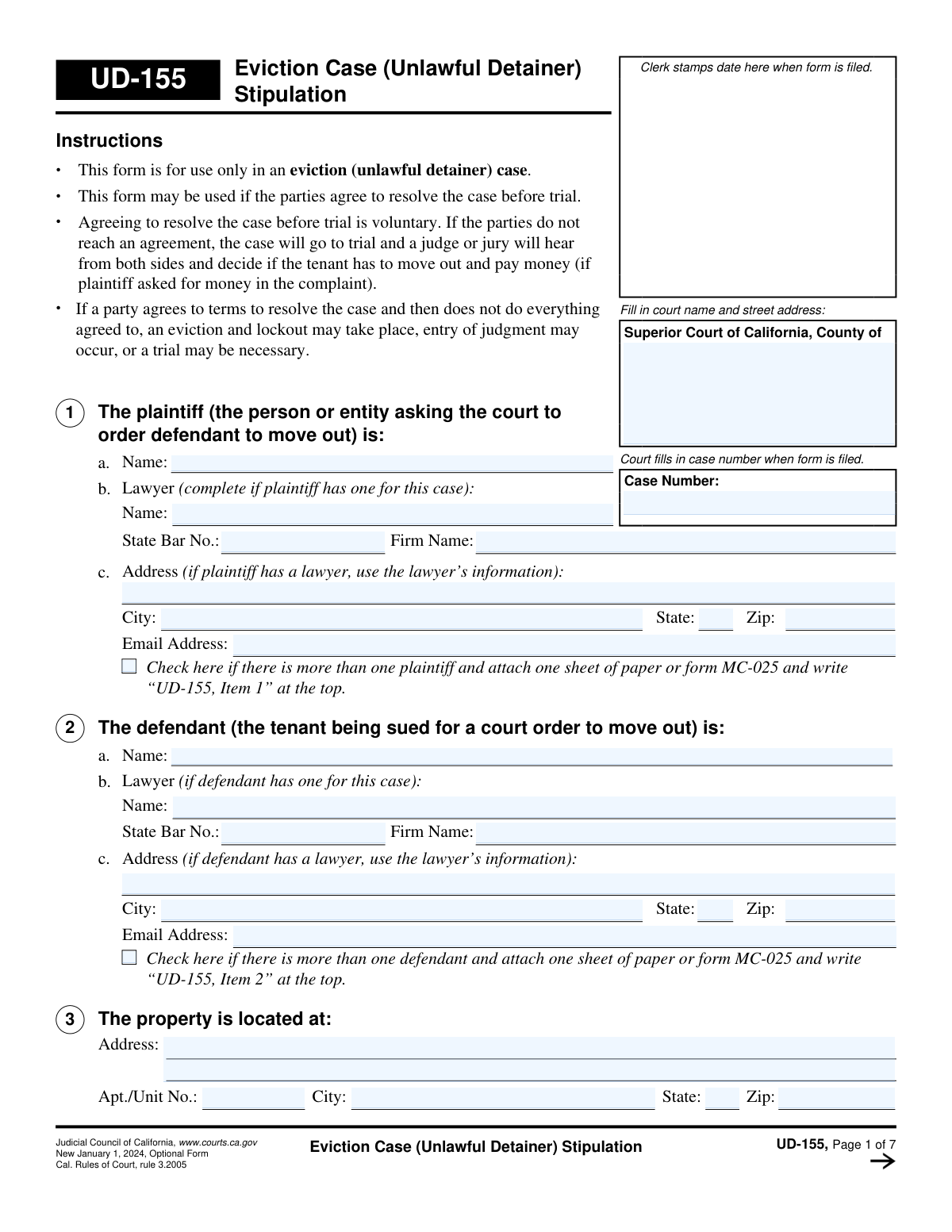
The UD-155, Eviction Case (Unlawful Detainer) Stipulation, is a legal document for parties in a California eviction lawsuit to create a binding agreement outside of a trial. This form allows a landlord (plaintiff) and tenant (defendant) to define terms for resolving the case, such as payment schedules, move-out dates, or conditions for remaining in the property, which then becomes a court order. Today, this form can be filled out quickly and accurately using AI-powered services like Instafill.ai, which can also convert non-fillable PDF versions into interactive fillable forms.
UD-155 is part of the California court forms, landlord tenant forms and unlawful detainer forms categories on Instafill.
Our AI automatically handles information lookup, data retrieval, formatting, and form filling.
It takes less than a minute to fill out UD-155 using our AI form filling.
Securely upload your data. Information is encrypted in transit and deleted immediately after the form is filled out.

Form specifications

Form name: UD-155, Eviction Case (Unlawful Detainer) Stipulation
Number of fields: 189
Number of pages: 1
Language: English
main-image

Instafill Demo: How to fill out PDF forms in seconds with AI

How to Fill Out UD-155 Online for Free in 2026

Are you looking to fill out a UD-155 form online quickly and accurately? Instafill.ai offers the #1 AI-powered PDF filling software of 2026, allowing you to complete your UD-155 form in just 37 seconds or less.
Follow these steps to fill out your UD-155 form online using Instafill.ai:
  1. 1 Navigate to Instafill.ai and upload or select the UD-155 Eviction Case Stipulation form.
  2. 2 Provide the court information, including the Superior Court county, and the case number if one has been assigned.
  3. 3 Use the AI assistant to enter the full legal names and contact information for the plaintiff(s) and defendant(s), including their lawyers if applicable.
  4. 4 Select the type of stipulation (e.g., Stipulation and Order, Stipulated Judgment) and the primary purpose of the agreement.
  5. 5 Detail the specific terms both parties have agreed to, such as payment plans for past due rent, a move-out date, repair commitments, and handling of the security deposit.
  6. 6 Carefully review all the auto-filled information, checked boxes, and specified terms to ensure they accurately reflect the settlement agreement.
  7. 7 Download the completed form, ready for the plaintiff and defendant to sign before filing it with the court.

Our AI-powered system ensures each field is filled out correctly, reducing errors and saving you time.

Why Choose Instafill.ai for Your Fillable UD-155 Form?

Speed

Complete your UD-155 in as little as 37 seconds.

Up-to-Date

Always use the latest 2026 UD-155 form version.

Cost-effective

No need to hire expensive lawyers.

Accuracy

Our AI performs 10 compliance checks to ensure your form is error-free.

Security

Your personal information is protected with bank-level encryption.

Frequently Asked Questions About Form UD-155

This form is used by a landlord (plaintiff) and tenant (defendant) to create a legally binding agreement to settle an eviction case before it goes to trial, outlining the terms both parties have agreed to.

No, using this form is completely voluntary. It is only for parties who mutually agree to resolve their case and want to avoid having a judge or jury decide the outcome.

A 'Stipulation and Order' makes your agreement a court order but doesn't enter a judgment, so the case remains open. A 'Stipulated Judgment' immediately ends the case with a formal judgment against the tenant, which can become public and impact their rental history.

A Conditional Judgment is an agreement where an eviction judgment is pre-approved by the court. If the tenant fails to meet specific conditions (like making a payment), the landlord can get the judgment entered without a full trial.

If the tenant violates the stipulation, the landlord can file an 'ex parte application' to ask the court for a quick hearing and enforce the agreement, which may result in an immediate eviction and entry of judgment.

Yes, in Item 10k, the parties can ask the court to 'bar access to the court record.' If the judge agrees, the case file becomes private and is not accessible to the public or most credit reporting agencies.

Item 10e provides options for the security deposit. You can agree to apply it to rent owed, have it returned to the tenant by a specific date, or have it handled according to California law within 21 days of moving out.

After it is signed by both parties, the form must be filed with the court clerk. A judge will then review the agreement and, if approved, sign it to make it an official and enforceable court order.

If the plaintiff (landlord) fails to comply with their agreed-upon terms, the defendant (tenant) can also file a request for a quick hearing to ask the court to enforce the stipulation, as described in Item 9.

Yes, Item 6b allows you to create a detailed payment plan, specifying the amount and due date for each payment the defendant agrees to make.

Yes, services like Instafill.ai use AI to accurately auto-fill form fields with your information. This can help you complete the form faster and with fewer errors.

You can upload the UD-155 PDF to the Instafill.ai platform. The service will make the document fillable online, allowing you to enter your information once and have it populate all the necessary fields automatically.

If you have a non-fillable or 'flat' PDF, you can use a tool like Instafill.ai. It can convert the document into an interactive, fillable form that you can easily complete and sign on your computer.

Compliance UD-155
Validation Checks by Instafill.ai

1
Stipulation Type Selection
This check ensures that exactly one option is selected in Item 4, either 'Stipulation and Order' (4a) or 'Stipulated Judgment' (4b). These options are mutually exclusive and define the fundamental nature of the agreement. If neither or both are selected, the form is ambiguous and cannot be processed by the court, leading to rejection.
2
Conditional Judgment Sub-Option Requirement
This validation checks that if 'Stipulation and Order' (4a) is selected, then one of its sub-options ('without Conditional Judgment' or 'with Conditional Judgment') must also be selected. This is a required clarification for how the stipulation will be handled if terms are violated. Failure to select a sub-option leaves the enforcement mechanism undefined and will halt processing.
3
Plaintiff and Defendant Name Requirement
Verifies that the name fields for both the plaintiff (Item 1a) and the defendant (Item 2a) are not empty. These fields are essential for identifying the legal parties involved in the stipulation. A submission without the names of the primary parties is legally insufficient and will be rejected for being incomplete.
4
Property Address Completeness
Ensures that the full address of the property in dispute (Address, City, State, Zip in Item 3) is completely filled out. This information is critical as it legally identifies the subject of the unlawful detainer action. An incomplete or missing property address would make any court order unenforceable and legally void.
5
Payment Amount Calculation in Item 6a
If Item 6a is checked, this validation confirms that the 'Total' amount is the correct sum of the 'Past Due Rent', 'Damages', 'Attorney Fees', and 'Court Costs' fields. This is crucial for ensuring the financial terms of the agreement are clear and arithmetically sound. A mismatch could lead to disputes over the amount owed and may invalidate the financial portion of the stipulation.
6
Payment Plan Detail Requirement
This check confirms that if the 'To follow a payment plan' box (Item 6b) is checked, at least one payment entry (Amount Due and Due Date) is provided in the corresponding schedule. An agreement for a payment plan is meaningless without the specific terms. If this validation fails, the form will be considered incomplete as the core details of the plan are missing.
7
Valid Move-Out Date
This validation ensures that if the defendant agrees to move out (Item 6c), the provided date is a valid calendar date and is not in the past. The move-out date is a critical deadline in the agreement. An invalid or past date makes the term nonsensical and unenforceable, requiring correction before the stipulation can be filed.
8
State Bar Number Format
Verifies that the State Bar Number fields (in Item 1b and 2b) contain only numeric characters. This number is a unique identifier for attorneys in California, and its correct format is necessary for verification. An incorrectly formatted number could prevent the court from confirming the attorney's standing and cause processing delays.
9
Lawyer Information Integrity
This check ensures that if a lawyer's name is provided in Item 1b or 2b, the corresponding State Bar Number field is also filled. Simply providing a name is not sufficient for court records; the State Bar Number is required for official identification. Failure to provide the number when a lawyer is listed will result in the form being returned for completion.
10
Stipulation Purpose Selection
This validation ensures that exactly one of the primary options in Item 5 ('Purpose of the Stipulation') is selected. This choice defines the overall goal of the agreement, such as the defendant staying or vacating the property. Without this selection, the core intent of the document is unknown, making it impossible to interpret and enforce.
11
Abandonment Date vs. Move-Out Date Consistency
This is a logical check that compares the 'abandoned personal items' date in Item 10d with the 'move out' date in Item 6c, if both are provided. The abandonment date must be on or after the move-out date. It is illogical for property to be considered abandoned before the tenant is required to have vacated. A failure indicates a logical conflict that must be resolved.
12
Conditional Judgment Section Consistency
This validation links the selection in Item 4a to the completion of Item 11. If 'with Conditional Judgment' is checked in 4a, this check ensures that key fields in Item 11 (e.g., 11a amount and date) are completed. Conversely, if 'without Conditional Judgment' is checked, Item 11 should be empty. This prevents contradictory or incomplete filings regarding the judgment conditions.
13
Repair Completion Date Requirement
This check verifies that if the plaintiff agrees to make repairs (Item 8e is checked), a completion date is specified in sub-item (1). An agreement to make repairs without a deadline is vague and difficult to enforce. The absence of a date would render this term of the stipulation ambiguous and likely require clarification before court approval.
14
Monetary Field Format
This validation scans all fields intended for dollar amounts (e.g., Items 6a, 8g, 8h, 11a) to ensure they contain valid numerical currency data. The values must be positive numbers and formatted correctly to prevent ambiguity in financial obligations. Non-numeric or improperly formatted entries can lead to misinterpretation of the settlement amount and cause the form to be rejected.

Common Mistakes in Completing UD-155

Misunderstanding the 'Type of Stipulation' (Item 4)

Parties, especially unrepresented tenants, often confuse a 'Stipulation and Order' with a 'Stipulated Judgment.' Selecting 'Stipulated Judgment' (4b) results in an immediate, final judgment against the defendant, which can appear on their record like a trial loss and allow for immediate lockout. This mistake happens due to the legal complexity and can lead to unintended, severe consequences. To avoid this, parties must carefully read the descriptions and understand that a 'Stipulation and Order' (4a) keeps the case open while the agreement is performed, which is often the intended path.

Forgetting to Request Sealing of the Court Record (Item 10k)

Tenants often overlook the option to request that the court 'bar access to the court record.' This is a critical mistake because an unsealed eviction filing can be found by tenant screening companies, making it difficult to find future housing, even if the case was settled amicably. To avoid this long-term negative impact, parties should almost always check box 10k to request the record be sealed as part of their agreement.

Incomplete or Incorrect Party Information (Items 1 & 2)

Fillers frequently forget to list all plaintiffs (e.g., all owners) or all defendants (e.g., all adult occupants), or fail to check the box for an attachment if more space is needed. This oversight can make the stipulation unenforceable against the unlisted individuals, leading to further legal complications. Always double-check that every person or legal entity involved is correctly named and that form MC-025 is attached if there are additional parties.

Ambiguous Payment Plan Details (Item 6b)

When creating a payment plan, parties often leave amounts, due dates, or payment delivery instructions blank or vague. This ambiguity makes it difficult to determine if a breach has occurred, rendering the agreement hard to enforce and leading to future court hearings. To prevent this, every payment amount must have a specific due date, and the fields for payment method and delivery must be filled out completely and clearly.

Calculation Errors in Total Amount Due (Item 6a)

Parties may incorrectly add the 'Past Due Rent,' 'Damages,' 'Attorney Fees,' and 'Court Costs' to arrive at the 'Total.' This simple math error can lead to disputes later about the correct amount owed or whether the agreement has been fulfilled. To avoid this, carefully calculate the total sum and double-check the math before signing. AI-powered form filling tools like Instafill.ai can perform these calculations automatically to ensure accuracy.

Omitting the Property's Apartment or Unit Number (Item 3)

It is very common for filers to list the street address of the property but forget to include the specific apartment or unit number. This oversight can create legal ambiguity, especially in a multi-unit building, as it doesn't precisely identify the premises subject to the stipulation. This could delay enforcement or create grounds for a legal challenge. Always include the full, complete address, including any apartment, unit, or suite number.

Contradictory Checkbox Selections

Due to the form's complexity, people sometimes check boxes that contradict each other, such as agreeing the defendant will both stay (Item 5a) and move out (Item 5c). Such contradictions make the agreement nonsensical and unenforceable, requiring clarification from the court and causing significant delays. To prevent this, review all selections to ensure they form a single, logical agreement before signing.

Failing to Specify Non-Eviction Breaches (Item 8i)

Parties may agree verbally that minor issues won't trigger an eviction but then fail to document this in the form. If Item 8i is left blank, the plaintiff could potentially seek an eviction for any small violation of the agreement. To avoid this, parties must clearly list the item numbers (from sections 6 and 10) for any terms that they agree will not result in a request for an eviction if breached.

Neglecting the Security Deposit Terms (Item 10e)

Parties often skip over the security deposit section, assuming it will be handled 'as usual' after the tenant moves out. Failing to select one of the options in Item 10e leaves the disposition of the deposit ambiguous within the context of the court-ordered stipulation. This can lead to separate, future disputes over the deposit's return or application. To create a comprehensive settlement, parties should explicitly agree on how the deposit will be handled and check the corresponding box.

Missing Signatures or Dates (Page 6)

A stipulation is not valid until it is signed and dated by all parties or their attorneys. Forgetting a signature or the date is a simple but critical error that invalidates the entire agreement, making it nothing more than a draft. Before filing, meticulously check that every required signature line is signed and dated by the correct person. If the form is a non-fillable PDF, tools like Instafill.ai can convert it to a fillable version that supports digital signatures and automatic dating.
Saved over 80 hours a year

“I was never sure if my IRS forms like W-9 were filled correctly. Now, I can complete the forms accurately without any external help.”

Kevin Martin Green

Your data stays secure with advanced protection from Instafill and our subprocessors

Robust compliance program

Transparent business model

You’re not the product. You always know where your data is and what it is processed for.

ISO 27001, HIPAA, and GDPR

Our subprocesses adhere to multiple compliance standards, including but not limited to ISO 27001, HIPAA, and GDPR.

Security & privacy by design

We consider security and privacy from the initial design phase of any new service or functionality. It’s not an afterthought, it’s built-in, including support for two-factor authentication (2FA) to further protect your account.

Fill out UD-155 with Instafill.ai

Worried about filling PDFs wrong? Instafill securely fills ud-155-eviction-case-unlawful-detainer-stipulation forms, ensuring each field is accurate.

Related forms by category

California court forms Judicial Council of California Form SC-105, Request for Court Order and Answer (Small Claims), Judicial Council of California Form SC-120, Defendant’s Claim and ORDER to Go to Small Claims Court (Small Claims), Judicial Council of California Form SER-001, Request for Sheriff to Serve Court Papers, Judicial Council of California Form SER-001, Request for Sheriff to Serve Court Papers, Affidavit for Collection of Personal Property California Probate Code Section 13100, Form POS-040, Proof of Service—Civil, Declaration of Facts of Death (California Superior Court), declaration-of-marriage-for-court-proceeding-california-family-law, ADOPT-200, Adoption Request, ADOPT-200, Stepparent Adoption Request, ADOPT-210, Adoption Agreement, ADOPT-310, Contact After Adoption Agreement, Judicial Council of California Form ADOPT-200, Adoption Request, Form ADR-107, Mediation Attendance Sheet, Form ADR-110, Order Appointing Referee, Form ADR-109, Stipulation or Motion for Order Appointing Referee, Form ADR-102, Request for Trial De Novo After Judicial Arbitration, Form ADR-108, Referee's Report (Code Civ. Proc., §§ 638, 639), Form ADR-106, Petition to Confirm, Correct, or Vacate Contractual Arbitration Award, Form ADR-104, Rejection of Award and Request for Trial After Attorney-Client Fee Arbitration · + 557 more →
landlord tenant forms Form UD-110, Judgment—Unlawful Detainer, Judicial Council of California, Form UD-110P, Judgment—Unlawful Detainer Partial Eviction Attachment, Form UD-115, Stipulation for Entry of Judgment (Unlawful Detainer), Form UD-116, Declaration for Default Judgment by Court (Unlawful Detainer—Civ. Proc., § 585(d)), Form UD-120, Verification by Landlord Regarding Rental Assistance—Unlawful Detainer, judicial-council-of-california-form-ud-110h-judgmentunlawful-detainer-habitable-premises-attachment
unlawful detainer forms Judicial Council of California Form UD-150, Request/Counter-Request to Set Case for Trial—Unlawful Detainer, Form UD-100, Complaint—Unlawful Detainer, Judicial Council of California Form UD-105, Answer—Unlawful Detainer, Judicial Council of California Form UD-105, Answer—Unlawful Detainer, Judicial Council of California Form UD-150, Request/Counter-Request to Set Case for Trial—Unlawful Detainer, Judicial Council of California Form UD-100, Complaint—Unlawful Detainer, Form UD-105, Answer—Unlawful Detainer, Form UD-101, Plaintiff's Mandatory Cover Sheet and Supplemental Allegations—Unlawful Detainer, Form SUM-130, Summons - Unlawful Detainer - Eviction, Form DISC-003/UD-106, Form Interrogatories—Unlawful Detainer, Form UD-110, Judgment—Unlawful Detainer, Judicial Council of California, Form UD-110P, Judgment—Unlawful Detainer Partial Eviction Attachment, Form UD-115, Stipulation for Entry of Judgment (Unlawful Detainer), Form UD-116, Declaration for Default Judgment by Court (Unlawful Detainer—Civ. Proc., § 585(d)), Form UD-120, Verification by Landlord Regarding Rental Assistance—Unlawful Detainer, judicial-council-of-california-form-ud-110h-judgmentunlawful-detainer-habitable-premises-attachment