Yes! You can use AI to fill out New Jersey Judiciary Landlord Tenant Procedures

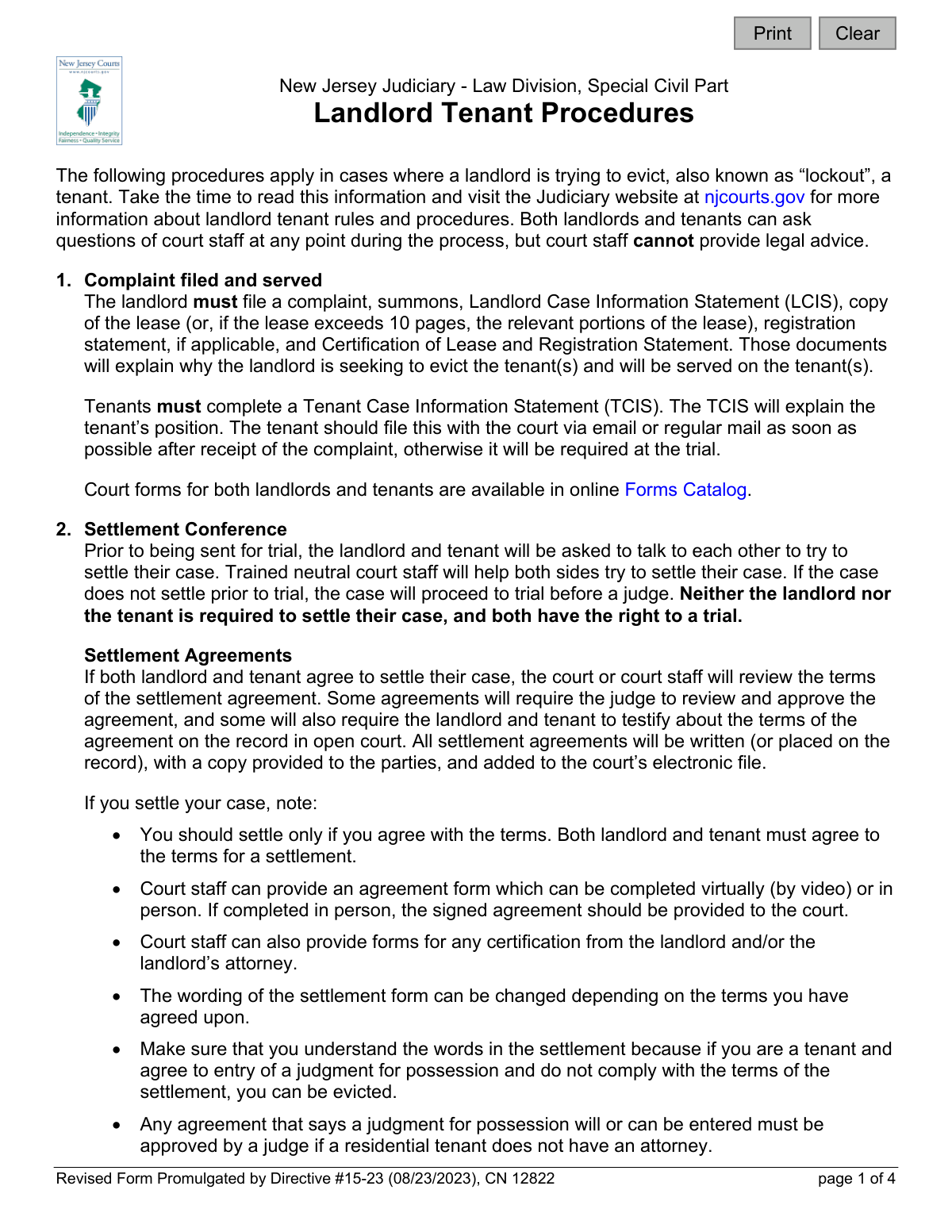
The New Jersey Landlord Tenant Procedures (CN 12822) is an official guide from the NJ Judiciary detailing the step-by-step process of an eviction, from filing a complaint to the execution of a warrant of removal. It is a critical resource for both landlords and tenants to understand their legal rights, responsibilities, and the procedures involved in an eviction case. Today, any related forms mentioned in this guide can be filled out quickly and accurately using AI-powered services like Instafill.ai, which can also convert non-fillable PDF versions into interactive fillable forms.
CN 12822 is part of the landlord tenant forms and New Jersey forms categories on Instafill.
Our AI automatically handles information lookup, data retrieval, formatting, and form filling.
It takes less than a minute to fill out CN 12822 using our AI form filling.
Securely upload your data. Information is encrypted in transit and deleted immediately after the form is filled out.

Form specifications

Form name: New Jersey Judiciary Landlord Tenant Procedures
Number of fields: 5
Number of pages: 1
Language: English
main-image

Instafill Demo: How to fill out PDF forms in seconds with AI

How to Fill Out CN 12822 Online for Free in 2026

Are you looking to fill out a CN 12822 form online quickly and accurately? Instafill.ai offers the #1 AI-powered PDF filling software of 2026, allowing you to complete your CN 12822 form in just 37 seconds or less.
Follow these steps to fill out your CN 12822 form online using Instafill.ai:
  1. 1 Navigate to Instafill.ai and upload the Landlord Tenant Procedures document or select it from the platform's template library.
  2. 2 Use the AI assistant to identify and highlight the fillable fields, such as the contact email and phone number at the end of the document.
  3. 3 Enter the required information for the local special civil part office into the designated fields.
  4. 4 If you are filling out an associated form like the Tenant Case Information Statement (TCIS), upload that form and let the AI guide you through each section.
  5. 5 Carefully review all the information you've entered for accuracy and completeness before finalizing the document.
  6. 6 Securely download, print, or share the completed document directly from the platform as needed for your records or for filing with the court.

Our AI-powered system ensures each field is filled out correctly, reducing errors and saving you time.

Why Choose Instafill.ai for Your Fillable CN 12822 Form?

Speed

Complete your CN 12822 in as little as 37 seconds.

Up-to-Date

Always use the latest 2026 CN 12822 form version.

Cost-effective

No need to hire expensive lawyers.

Accuracy

Our AI performs 10 compliance checks to ensure your form is error-free.

Security

Your personal information is protected with bank-level encryption.

Frequently Asked Questions About Form CN 12822

This document explains the official legal process for a landlord to evict a tenant in New Jersey. It outlines all the required steps, from filing the initial complaint to the final lockout, for both landlords and tenants to understand.

To begin an eviction, a landlord must file a complaint, summons, Landlord Case Information Statement (LCIS), a copy of the lease, a registration statement if applicable, and a Certification of Lease and Registration Statement.

The Tenant Case Information Statement (TCIS) is a form where you explain your position in the case. You should complete it and file it with the court as soon as possible after receiving the complaint.

At a settlement conference, the landlord and tenant meet with neutral court staff to try and resolve the case without a trial. You are not required to settle and have the right to proceed to trial if no agreement is reached.

If a tenant misses the trial date, a 'default' judgment may be entered, allowing the landlord to proceed with the eviction. If the landlord misses the date, the case may be 'dismissed'.

A landlord must wait at least three business days after a judgment to apply for a warrant of removal. The actual eviction (lockout) can then occur three business days after the warrant is served on the tenant.

No, it is illegal for a landlord to change your locks or shut off utilities to force you out. Only a special civil part officer can perform an eviction after a court has issued a judgment for possession and a warrant of removal.

Yes, a residential tenant can stop an eviction by paying all rent due and owing, plus costs, up to three business days after the eviction. You can also ask the court for relief, such as a hardship stay to get more time to move.

No, court staff can explain procedures and provide forms, but they are prohibited from providing legal advice. You should contact an attorney or Legal Services of New Jersey for legal help.

A warrant of removal is a court order that authorizes a special civil part officer to evict a tenant from the property. It is issued after a judgment for possession has been granted to the landlord.

Yes, you can use AI-powered services like Instafill.ai to help auto-fill forms like the Landlord or Tenant Case Information Statement. This can save time and help ensure the information is entered accurately.

To fill out your forms online, you can use a service like Instafill.ai. Simply upload the document to the platform, and its tools will help you complete all the necessary fields before you print and file it with the court.

If you have a flat, non-fillable PDF, you can use a platform like Instafill.ai to convert it into an interactive, fillable form. This allows you to easily type your information directly into the fields.

Compliance CN 12822
Validation Checks by Instafill.ai

1
Validates Email Address Format
Checks if the input in the 'questEmail' field adheres to the standard email format (e.g., [email protected]). This is crucial for ensuring the email is deliverable and the office can make contact. If the format is invalid, the user should be prompted to correct it before submission.
2
Validates US Phone Number Format
Ensures the 'questPh' field contains a number that can be parsed as a 10-digit US phone number, accommodating common formats like (XXX) XXX-XXXX, XXX-XXX-XXXX, and XXXXXXXXXX. This ensures the phone number is syntactically correct for follow-up contact. An invalid format should trigger an error message with examples of valid formats.
3
Requires At Least One Contact Method
Verifies that the user has provided at least one method of contact by filling in either the 'questEmail' field or the 'questPh' field. This is a critical business rule to ensure the office can respond to the user's query. If both fields are empty, the form submission should be blocked with a message indicating one must be completed.
4
Validates Extension is Paired with a Phone Number
Checks that if the 'questExt' field is filled, the 'questPh' field must also be filled. An extension is meaningless without a primary phone number. If this rule fails, the user should be alerted that a phone number is required to submit an extension.
5
Ensures Phone Extension is Numeric
Validates that the 'questExt' field contains only numeric digits. Alphanumeric characters or symbols are not valid for a phone extension. This prevents data corruption and ensures the extension can be dialed correctly by automated or manual systems.
6
Verifies 10-Digit Phone Number Length
After stripping all non-numeric characters (e.g., '(', ')', '-', ' '), this check confirms the 'questPh' field contains exactly 10 digits. This standardizes the data and validates it against the North American Numbering Plan standard. Numbers with more or fewer than 10 digits should be rejected.
7
Verifies Email Domain is Reachable
Performs a DNS lookup to check for a valid MX (Mail Exchange) record for the domain part of the email address in the 'questEmail' field. This helps prevent submissions with typos in the domain name (e.g., 'gmal.com' instead of 'gmail.com') and increases the likelihood of successful email delivery. Failure should result in a warning to the user to double-check their email address.
8
Validates Phone Extension Length
Ensures the phone extension entered in 'questExt' does not exceed a reasonable maximum length, such as 6 or 7 digits. This prevents erroneous data entry, like accidentally pasting a full phone number into the extension field. An overly long entry should be flagged as an error.
9
Validates Email Address Maximum Length
Checks that the total length of the email address in 'questEmail' does not exceed the standard limit (e.g., 254 characters). This prevents database errors and rejects nonsensical or malicious inputs. If the input is too long, the submission should be blocked.
10
Blocks Disposable Email Addresses
Compares the domain of the provided email address against a known list of disposable and temporary email providers. This is a business rule to ensure that the contact information is for a persistent inbox, which is important for official correspondence. If a disposable address is detected, the user should be asked to provide a permanent email address.
11
Validates North American Area Code
Checks if the first three digits of the 10-digit phone number in 'questPh' correspond to a valid, assigned area code within the North American Numbering Plan (NANP). This adds a layer of validation to catch invalid numbers that are formatted correctly but are not geographically possible. An invalid area code should trigger a validation error.
12
Sanitizes Inputs to Prevent Injection Attacks
Scans all text fields ('questEmail', 'questPh', 'questExt') for potentially malicious code, such as HTML tags or SQL commands. This is a critical security measure to prevent cross-site scripting (XSS) and SQL injection attacks. Any detected malicious patterns should cause the submission to be rejected immediately.

Common Mistakes in Completing CN 12822

Submitting an Incomplete Complaint Packet

Landlords often fail to include all required documents with their complaint, such as a copy of the lease, the property's registration statement, or the Landlord Case Information Statement (LCIS). This oversight can lead to significant delays or even the dismissal of the eviction case, forcing the landlord to restart the entire process. To prevent this, landlords should create a checklist based on court requirements and meticulously verify that every document is attached before filing.

Failing to File the Tenant Case Information Statement (TCIS)

Tenants frequently neglect to complete and file the Tenant Case Information Statement (TCIS) after receiving a complaint, often waiting until the trial date. This puts the tenant at a disadvantage, as it gives the court and landlord no prior notice of their defenses, such as improper service or disputes over the rent amount. Tenants should complete and file the TCIS as soon as possible to ensure their position is formally documented and considered.

Providing Inaccurate Data on Case Information Statements

Both landlords and tenants make data entry errors on their respective Case Information Statements (LCIS and TCIS), such as misstating the amount of rent owed, using incorrect dates, or misspelling names. These inaccuracies can undermine a party's credibility and complicate the case, potentially leading to an unfavorable ruling. It is crucial to double-check all figures and names against the lease and payment records before submission. AI-powered form-filling tools like Instafill.ai can help prevent these errors by validating data and ensuring correct formatting.

Agreeing to a Settlement Without Full Understanding

During a settlement conference, a party, especially a tenant without an attorney, may agree to terms they do not fully comprehend, particularly the entry of a 'judgment for possession'. This can result in an enforceable eviction if the tenant later fails to comply with the settlement terms. Before signing any agreement, individuals must ask court staff to clarify any confusing language and remember they have the right to a trial if they do not agree with the terms.

Missing the Scheduled Court Trial Date

A critical error for a tenant is failing to appear for their scheduled trial. This automatically results in a 'DEFAULT' judgment against them, allowing the landlord to proceed with obtaining a warrant of removal and executing the eviction. Tenants must prioritize their court date, as appearing in person or virtually is their only opportunity to present their case and defenses to a judge.

Using Outdated or Incorrect Court Forms

The Judiciary periodically revises its forms, but parties sometimes download outdated versions from unofficial websites. Submitting an old version of a complaint, TCIS, or motion can lead to its rejection by the court clerk, causing delays and requiring the party to refile using the correct document. To avoid this, always download the latest forms directly from the official NJ Courts website's 'Forms Catalog'.

Applying for a Warrant of Removal Too Soon

After securing a judgment for possession, landlords sometimes apply for the warrant of removal immediately, not realizing they must wait at least three business days. Filing the application prematurely will result in its rejection by the court, delaying the eviction process. Landlords must carefully count three full business days (excluding weekends and holidays) after the judgment is entered before submitting the application.

Not Exploring Post-Judgment Relief Options

Many tenants believe eviction is final once a judgment is entered and are unaware of their legal options. They may be eligible to apply for an 'orderly removal' for more time to move, a 'hardship stay' to delay the eviction for up to six months, or to have the case dismissed by paying all rent owed. Failing to explore these options can lead to a preventable eviction; tenants should immediately contact the court or legal aid to understand their rights after a judgment.

Attempting an Illegal 'Self-Help' Eviction

Some landlords, frustrated with the legal process, attempt to evict tenants themselves by changing the locks or shutting off utilities. This is illegal and can result in serious criminal and civil penalties for the landlord. The only legal way to evict a tenant is through a special civil part officer executing a court-issued warrant of removal.

Submitting an Incomplete or Illegible Lease

The landlord is required to file a copy of the lease, but a common mistake is submitting a copy that is blurry, has missing pages, or omits key clauses. An unreadable or incomplete lease prevents the judge from properly assessing the case, causing delays. If the original document is a flat, non-fillable PDF, a tool like Instafill.ai can convert it into a clean, fillable version, ensuring all submitted copies are legible and complete.

Failing to Keep Written Records of Agreements

Parties may make verbal agreements to resolve issues, such as a payment plan to stop an eviction, but fail to put them in writing. Verbal agreements are difficult to enforce and can be easily disputed, leaving the tenant vulnerable if the landlord denies the conversation. Any settlement or modification to the tenancy should be documented in a written agreement, signed by both parties, with a copy filed with the court.

Entering Incorrect Local Court Contact Information

The form provides blank spaces for the local special civil part office's email and phone number, which the user must find and fill in for their own reference. People often leave this blank or enter incorrect information, making it difficult to contact the court with questions later. It is essential to look up the correct contact details on the njcourts.gov website and accurately record them on the document for future use.
Saved over 80 hours a year

“I was never sure if my IRS forms like W-9 were filled correctly. Now, I can complete the forms accurately without any external help.”

Kevin Martin Green

Your data stays secure with advanced protection from Instafill and our subprocessors

Robust compliance program

Transparent business model

You’re not the product. You always know where your data is and what it is processed for.

ISO 27001, HIPAA, and GDPR

Our subprocesses adhere to multiple compliance standards, including but not limited to ISO 27001, HIPAA, and GDPR.

Security & privacy by design

We consider security and privacy from the initial design phase of any new service or functionality. It’s not an afterthought, it’s built-in, including support for two-factor authentication (2FA) to further protect your account.

Fill out CN 12822 with Instafill.ai

Worried about filling PDFs wrong? Instafill securely fills new-jersey-judiciary-landlord-tenant-procedures forms, ensuring each field is accurate.

Related forms by category

landlord tenant forms Form UD-110, Judgment—Unlawful Detainer, Judicial Council of California, Form UD-110P, Judgment—Unlawful Detainer Partial Eviction Attachment, Form UD-115, Stipulation for Entry of Judgment (Unlawful Detainer), Form UD-116, Declaration for Default Judgment by Court (Unlawful Detainer—Civ. Proc., § 585(d)), Form UD-120, Verification by Landlord Regarding Rental Assistance—Unlawful Detainer, UD-155, Eviction Case (Unlawful Detainer) Stipulation, Judicial Council of California Form UD-110H, Judgment—Unlawful Detainer Habitable Premises Attachment, Appendix XI-X, Verified Complaint - Residential Landlord Tenant, New Jersey Judiciary Application to Serve as a Landlord/Tenant Settlor (CN 12743), New Jersey Judiciary Civil Division Landlord/Tenant (LT) Trial Sheet
New Jersey forms State of New Jersey Alternate Benefit Program Withdrawal Request Acknowledgement Receipt, Horizon Blue Cross Blue Shield of New Jersey Applied Behavior Analysis Supplemental Information Form, State of New Jersey Application for Employment (Form DPF-663), New Jersey Judiciary Plea Form (Plea 01), Supplemental Plea Form for Certain Sexual Offenses: Megan’s Law/Parole Supervision for Life/Community Supervision for Life (Plea 05), Financial Questionnaire to Establish Indigency, New Jersey Judiciary Resource Family Information Form, Foreclosure Case Information Statement (FCIS) - Appendix XII-B2, New Jersey Judiciary Records Request Form, Superior Court of New Jersey, Application for Appeal and Order, FL Certification of Requested Background Checks for Kinship Legal Guardianship, Certification of Caregiver as to Knowledge of Identity and/or Location of Parents, FL Order Judgment for Kinship Legal Guardianship, New Jersey Judiciary Certification of Repair and Plea of Guilty, Uniform Summary Support Order (USSO), New Jersey Judiciary Volunteer Application (CN 10293), Application to Take the New Jersey Court Interpreter Oral Examination, New Jersey Judiciary Attorney Fee Arbitration Request, Order to Show Cause with Temporary Restraints Pursuant to Rule 4:52, Tax Court of New Jersey, State Tax Complaint · + 271 more →