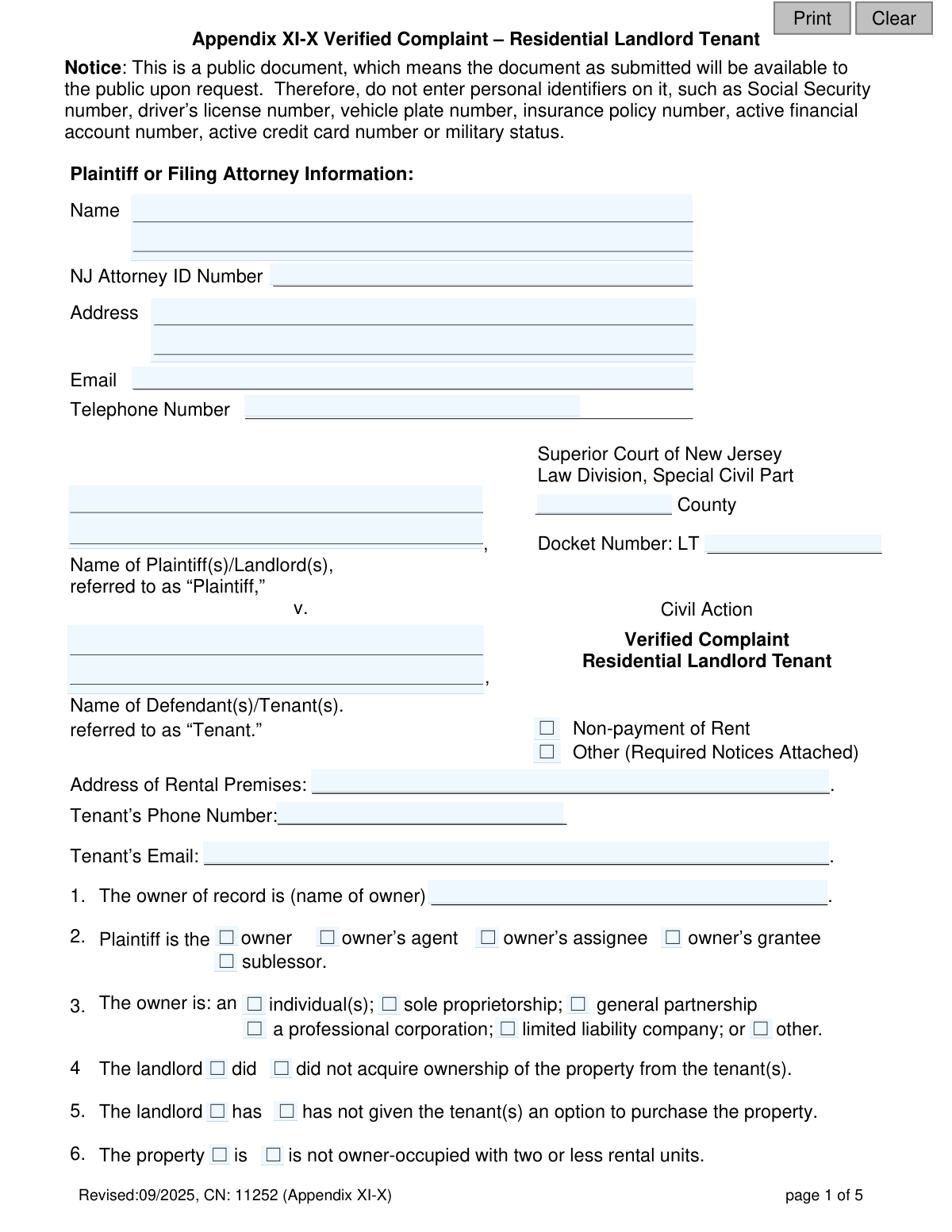
Yes! You can use AI to fill out Appendix XI-X, Verified Complaint - Residential Landlord Tenant
The New Jersey Appendix XI-X, Verified Complaint - Residential Landlord Tenant, is a legal document filed in the Superior Court of New Jersey to start an eviction lawsuit. It outlines the landlord's (plaintiff's) claims against the tenant (defendant), such as non-payment of rent or other lease violations, and requests a judgment for possession of the property. Today, this form can be filled out quickly and accurately using AI-powered services like Instafill.ai, which can also convert non-fillable PDF versions into interactive fillable forms.
Our AI automatically handles information lookup, data retrieval, formatting, and form filling.
It takes less than a minute to fill out Appendix XI-X using our AI form filling.
Securely upload your data. Information is encrypted in transit and deleted immediately after the form is filled out.
Form specifications
| Form name: | Appendix XI-X, Verified Complaint - Residential Landlord Tenant |
| Number of fields: | 169 |
| Number of pages: | 1 |
| Language: | English |
Instafill Demo: How to fill out PDF forms in seconds with AI
How to Fill Out Appendix XI-X Online for Free in 2026
Are you looking to fill out a APPENDIX XI-X form online quickly and accurately? Instafill.ai offers the #1 AI-powered PDF filling software of 2026, allowing you to complete your APPENDIX XI-X form in just 37 seconds or less.
Follow these steps to fill out your APPENDIX XI-X form online using Instafill.ai:
- 1 Navigate to Instafill.ai and upload or select the 'Verified Complaint - Residential Landlord Tenant (Appendix XI-X)' form.
- 2 Enter the Plaintiff/Landlord and Defendant/Tenant information, including names, addresses, and contact details.
- 3 Provide details about the rental property, the lease agreement (oral or written), and property registration status.
- 4 Specify the reason for the complaint, selecting either 'Non-payment of Rent' or 'Other' and providing necessary details and attachments.
- 5 If claiming non-payment, itemize the base rent due, any 'additional rent' like late fees, and calculate the total amount owed.
- 6 Review all the information auto-populated by the AI to ensure accuracy and completeness before proceeding.
- 7 Complete the Landlord Verification section, sign the document electronically, and download the final complaint for filing with the court.
Our AI-powered system ensures each field is filled out correctly, reducing errors and saving you time.
Why Choose Instafill.ai for Your Fillable Appendix XI-X Form?
Speed
Complete your Appendix XI-X in as little as 37 seconds.
Up-to-Date
Always use the latest 2026 Appendix XI-X form version.
Cost-effective
No need to hire expensive lawyers.
Accuracy
Our AI performs 10 compliance checks to ensure your form is error-free.
Security
Your personal information is protected with bank-level encryption.
Frequently Asked Questions About Form Appendix XI-X
This form is used by a landlord in New Jersey to file a legal complaint in the Superior Court to evict a residential tenant. It can be used for cases of non-payment of rent or for other violations of the lease agreement.
The landlord (plaintiff) or their authorized representative, such as an attorney or agent, must complete and file this form to formally begin the eviction process in court.
This form becomes a public document once filed. To protect privacy, you must not include sensitive information like Social Security numbers, driver's license numbers, or bank account numbers.
Select 'Non-payment of Rent' if the sole reason is unpaid rent. Select 'Other' for any other reason, such as lease violations or property damage, and be sure to attach copies of the required legal notices you sent to the tenant.
You can only include charges like late fees or attorneys' fees if your written lease agreement explicitly defines them as 'additional rent'. These charges must also be permitted by federal, state, and local laws.
You may need to attach a copy of the written lease, a rent ledger, and any legal notices served on the tenant. If the lease is over ten pages, you only need to attach the relevant portions.
This refers to a New Jersey law requiring most landlords to register their rental properties with the local municipality. You must indicate on the form whether the property is registered and if you have provided a copy of the registration to the tenant.
The total amount due is the sum of the unpaid base rent, any permissible 'additional rent' from the lease, and the court filing fees. If the trial date is after the next rent is due, that amount is also added.
This is a legally binding statement where you swear that the information in the complaint is true and based on your personal knowledge. Willfully providing false information in this section can lead to punishment.
Yes, services like Instafill.ai use AI to help you accurately auto-fill form fields from your saved information, which can save time and reduce the chance of errors.
Simply upload the Verified Complaint PDF to the Instafill.ai platform. It will become an interactive form, and you can use the AI tools to quickly populate the fields with landlord, tenant, and property details before downloading.
You can use a service like Instafill.ai, which is designed to convert non-fillable PDFs into interactive, fillable forms. This allows you to easily type your information into the required fields online.
You can still file this complaint. In question 11, you would simply check the box for 'oral lease' and proceed with filling out the rest of the form based on your verbal agreement.
Yes, in question 12 you must check the box indicating the tenancy is subsidized and specify the type of subsidy. You must also confirm that any required notices have been served on the appropriate housing authority and attach them to the complaint.
Compliance Appendix XI-X
Validation Checks by Instafill.ai
1
Exclusive Complaint Type Selection
This check ensures that the filer has selected either 'Non-payment of Rent' or 'Other', but not both. These options are mutually exclusive and define the entire basis of the complaint. If neither or both are selected, the form is ambiguous and cannot be processed correctly, leading to rejection.
2
Conditional Non-Payment Section Completion
If the 'Non-payment of Rent' checkbox is selected, this validation confirms that the corresponding financial details in sections 14 and 15 (base rent amount, due date, and itemized unpaid rent) are filled out. This is critical because the specific amounts owed form the core evidence for a non-payment case. Failure to provide these details would result in an incomplete and legally insufficient complaint.
3
Conditional 'Other' Reason Explanation
If the 'Other (Required Notices Attached)' checkbox is selected, this check verifies that the 'Reasons Other Than Non-Payment for Rent' section (field 24) contains an explanation. This section is mandatory for holdover cases to inform the tenant and the court of the specific lease violation or cause for eviction. An empty explanation would render the complaint invalid for failing to state a cause of action.
4
Written Lease Attachment Logic
This validation checks that if 'written lease' is selected in section 11, a selection is also made for whether the lease 'has' or 'has not' been attached. This ensures the filer explicitly states the status of this critical piece of evidence. Answering this question is vital for the court and the defendant to understand the contractual basis of the tenancy.
5
Additional Rent Justification
If the 'There is due from tenant “additional rent.”' box (section 18) is checked, this validation ensures that the box in section 17, 'are specified in the written lease as “additional rent,”' is also checked. This enforces the legal requirement that charges like late fees can only be claimed as rent if explicitly defined as such in the lease. A mismatch indicates a potentially invalid claim for additional rent.
6
Registration Exemption Explanation
This check verifies that if the property 'is' marked as exempt from registration in section 9, the corresponding text field 'If exempt, state specific exemption' is not empty. Landlord registration is a legal requirement in NJ, and any claim of exemption must be justified. Failure to provide a reason for exemption will cause the filing to be questioned or rejected for non-compliance.
7
Interpreter Language Specification
This validation ensures that if the 'Yes' box for 'An interpreter' is checked in the Landlord Verification section, the 'Indicate language' field is filled in. This is crucial for the court to arrange for the correct interpreter, ensuring the proceedings are fair and can proceed without delay. An empty language field would make the request for an interpreter impossible to fulfill.
8
Disability Accommodation Specification
This check confirms that if the 'Yes' box for 'An accommodation for a disability' is checked, the 'Required accommodation' field contains a description. This is essential for the court to provide necessary accommodations in compliance with the ADA. Leaving the description blank would prevent the court from taking action and could lead to access-to-justice issues.
9
Required Party and Premise Information
This validation ensures that the essential identifier fields, including 'Name of Plaintiff(s)/Landlord(s)', 'Name of Defendant(s)/Tenant(s)', and 'Address of Rental Premises', are not empty. These fields are fundamental to any legal action, as they identify the parties involved and the location in dispute. A complaint missing this information is fundamentally incomplete and cannot be docketed.
10
Validates Base Rent Subtotal
This check calculates the sum of all individual base rent amounts listed in section 15 and verifies that it matches the 'Total Base Rent Due from Tenant' field. This prevents mathematical errors in the complaint and ensures the subtotal for the primary debt is accurate. An incorrect total could lead to legal challenges and dismissal of the case.
11
Validates Additional Rent Subtotal
This validation calculates the sum of all late charges and 'Other' charges listed in section 18 and confirms it matches the 'Total Permissible Additional Rent Due' field. This ensures the accuracy of secondary charges being claimed. An incorrect calculation could invalidate the claim for those specific fees.
12
Verifies Final Total Amount Due Calculation
This check ensures the 'Total Amount Due' in section 20 is the correct sum of 'Total Base Rent Due from Tenant' (section 15), 'Total Permissible Additional Rent Due' (section 18), and 'filing fees' (section 19). This final calculation is the total amount the landlord is suing for and must be accurate for the judgment to be valid. Any discrepancy will result in a mathematically flawed and challengeable complaint.
13
Valid NJ Attorney ID Format
This check validates that if the 'NJ Attorney ID Number' field is filled, it conforms to the expected format for New Jersey attorney identification numbers. This helps verify the credentials of the filing attorney and ensures proper record-keeping by the court. An invalid ID could indicate a data entry error or an unauthorized person filing the complaint.
14
Valid Date Format for Next Rent Due
This validation ensures that the 'next rent is due' date in section 23 is entered in a valid date format (e.g., MM/DD/YYYY). This date is used to calculate the total amount required to dismiss the complaint, so its accuracy and proper format are essential for legal clarity. An invalid format would prevent the system from performing calculations and create confusion for the tenant.
Common Mistakes in Completing Appendix XI-X
Landlords frequently make arithmetic errors when calculating the total rent in Section 15 or the final amount due in Section 20. They may also mistakenly include rent portions paid by a housing authority, despite instructions to the contrary. These inaccuracies can lead to legal challenges and require amendments, delaying the eviction process. To avoid this, double-check all calculations and ensure you are only listing the portion of the rent the tenant is personally responsible for.
A common error is listing late fees or attorney's fees in Section 18 without confirming the written lease explicitly defines them as 'additional rent'. If these charges are not properly designated in the lease, they cannot be included in the amount required to avoid eviction for non-payment. This can result in the court striking these charges from the complaint. Always review the lease agreement carefully to confirm which fees qualify before including them.
The complaint requires attaching several documents under specific conditions, such as the written lease (Question 11), required legal notices (Question 13), and the rent ledger (Question 22). Forgetting to include these attachments is a frequent procedural error that can lead to the case being dismissed for being incomplete. Create a checklist of all required documents before filing to ensure the submission is complete and compliant.
The form's first page explicitly warns against including data like Social Security or driver's license numbers. Filers often overlook this notice and include sensitive information on the complaint or in attachments, making it public record. This creates a significant privacy risk. To avoid this, carefully review the complaint and all attachments to redact any prohibited personal identifiers before submission, as certified in the Landlord Verification section.
In Sections 1-3, the filer must correctly identify the legal owner of record and the plaintiff's relationship to the owner (e.g., owner, agent, LLC). Using an incorrect business name, listing a property manager as the owner, or failing to properly state the plaintiff's legal standing can be grounds for dismissal. Verify the exact legal name of the owner from the property deed and accurately describe the filer's capacity to sue.
This form contains dozens of mandatory checkboxes regarding the lease, property status, and registration (e.g., Questions 4-13). Filers often skip over these, leaving them blank, which creates ambiguity and can lead to the court clerk rejecting the form or a judge dismissing the case. AI-powered form-filling tools like Instafill.ai can help prevent this by highlighting required fields and ensuring all necessary selections are made before submission.
When filing for a reason other than non-payment (a 'holdover' case), Section 24 requires a detailed explanation. Filers often provide a vague or legally insufficient reason, failing to state the specific facts that justify the eviction. This can lead to the complaint being dismissed for failing to state a valid cause of action. The explanation should clearly and concisely describe the tenant's actions that violate the lease or the law.
The form requires two separate signatures: one from the filing attorney or pro se plaintiff (Page 4) and a verification from the landlord or an authorized partner/officer (Page 5). A common mistake is having the wrong person sign the verification or simply forgetting to sign one or both sections. An unsigned or improperly signed complaint is invalid and will be rejected by the court, halting the entire process.
Questions 7-9 address the Landlord Identity Law, which requires most rental properties to be registered. Landlords may incorrectly state their property is exempt or fail to provide the tenant with a copy of the registration. Filing an eviction complaint without being properly registered can result in the court postponing the case until the landlord complies, causing unnecessary delays and costs.
Many filers download a 'flat' or non-fillable version of the PDF and attempt to fill it out by hand, resulting in illegible handwriting or misaligned text. This can make it difficult for the court clerk and judge to read, potentially leading to rejection or delays. If the form is only available as a non-fillable PDF, tools like Instafill.ai can convert it into an interactive, fillable version, ensuring all entries are neat and correctly placed.
Saved over 80 hours a year
“I was never sure if my IRS forms like W-9 were filled correctly. Now, I can complete the forms accurately without any external help.”
Kevin Martin Green
Your data stays secure with advanced protection from Instafill and our subprocessors

Robust compliance program
Transparent business model
You’re not the product. You always know where your data is and what it is processed for.
ISO 27001, HIPAA, and GDPR
Our subprocesses adhere to multiple compliance standards, including but not limited to ISO 27001, HIPAA, and GDPR.
Security & privacy by design
We consider security and privacy from the initial design phase of any new service or functionality. It’s not an afterthought, it’s built-in, including support for two-factor authentication (2FA) to further protect your account.
Fill out Appendix XI-X with Instafill.ai
Worried about filling PDFs wrong? Instafill securely fills appendix-xi-x-verified-complaint-residential-landlord-tenant forms, ensuring each field is accurate.