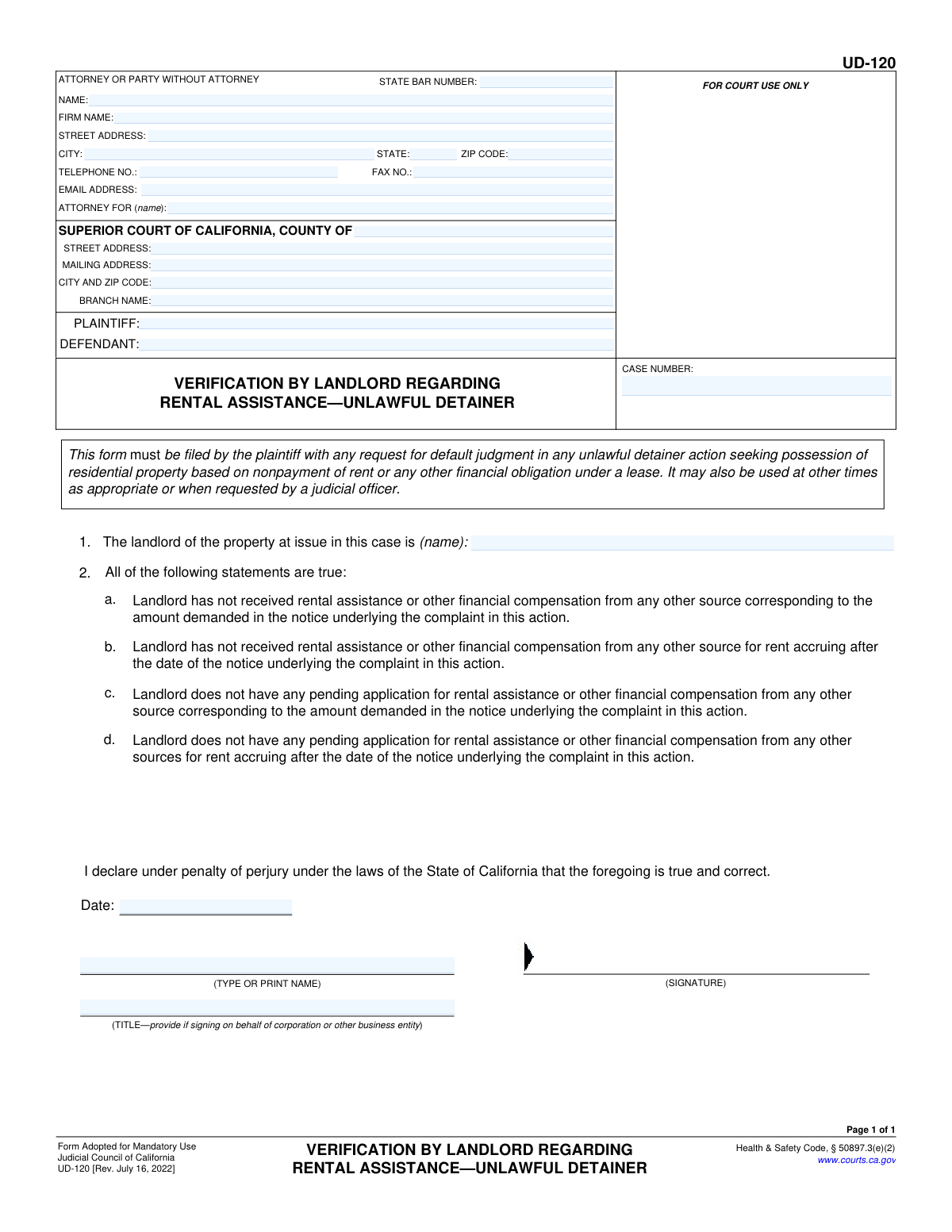
Yes! You can use AI to fill out Form UD-120, Verification by Landlord Regarding Rental Assistance—Unlawful Detainer

This is Form UD-120, a legal declaration required in California for landlords pursuing an unlawful detainer (eviction) action based on nonpayment of rent. The landlord must use this form to certify under penalty of perjury that they have not received or applied for rental assistance that would cover the amount demanded from the tenant. Today, this form can be filled out quickly and accurately using AI-powered services like Instafill.ai, which can also convert non-fillable PDF versions into interactive fillable forms.
Our AI automatically handles information lookup, data retrieval, formatting, and form filling.
It takes less than a minute to fill out UD-120 using our AI form filling.
Securely upload your data. Information is encrypted in transit and deleted immediately after the form is filled out.

Form specifications

Form name: Form UD-120, Verification by Landlord Regarding Rental Assistance—Unlawful Detainer
Number of fields: 24
Number of pages: 1
Language: English
main-image

Instafill Demo: How to fill out PDF forms in seconds with AI

How to Fill Out UD-120 Online for Free in 2026

Are you looking to fill out a UD-120 form online quickly and accurately? Instafill.ai offers the #1 AI-powered PDF filling software of 2026, allowing you to complete your UD-120 form in just 37 seconds or less.
Follow these steps to fill out your UD-120 form online using Instafill.ai:
  1. 1 Navigate to Instafill.ai and upload or select the UD-120 form.
  2. 2 Use the AI assistant to automatically populate your attorney or personal information, including name, address, and state bar number.
  3. 3 Enter the specific court and case information, such as the county, case number, and the names of the plaintiff and defendant.
  4. 4 Provide the name of the landlord in the designated field as required by item 1.
  5. 5 Carefully review the four declarations in item 2 to confirm their accuracy, as this is a statement made under penalty of perjury.
  6. 6 Date and sign the form. The AI tool will help you place your signature, typed name, and title in the correct fields.
  7. 7 Review the entire completed document for accuracy before downloading the final version for filing with the court.

Our AI-powered system ensures each field is filled out correctly, reducing errors and saving you time.

Why Choose Instafill.ai for Your Fillable UD-120 Form?

Speed

Complete your UD-120 in as little as 37 seconds.

Up-to-Date

Always use the latest 2026 UD-120 form version.

Cost-effective

No need to hire expensive lawyers.

Accuracy

Our AI performs 10 compliance checks to ensure your form is error-free.

Security

Your personal information is protected with bank-level encryption.

Frequently Asked Questions About Form UD-120

This form is a sworn declaration used by a landlord in an eviction case to verify to the court that they have not received or applied for rental assistance for the rent being claimed in the lawsuit.

The plaintiff (landlord) or their attorney must complete and file this form in an unlawful detainer (eviction) case that is based on the nonpayment of rent for a residential property.

This form is mandatory whenever you, as the landlord, request a default judgment against a tenant for nonpayment of rent. A judicial officer may also order you to file it at other times during the case.

You will need your court case information, including the case number, court name, and the names of the plaintiff and defendant. You must also know the status of any rental assistance you may have applied for or received.

You are declaring under penalty of perjury that you have not received any rental assistance for the amount demanded in the complaint, nor do you have any pending applications for such assistance.

If you have a pending application for rental assistance, you cannot truthfully sign this form. The statements in section 2 require you to confirm that you do not have any pending applications for the rent at issue.

The court will likely reject your request for a default judgment. Filing this form is a mandatory step to proceed with a default judgment in residential nonpayment cases.

The landlord (plaintiff) or their attorney must sign the form. If you are signing on behalf of a corporation or business entity, you must also provide your title.

You must file the completed and signed form with the clerk of the superior court where your unlawful detainer case was filed. It should be submitted along with your request for default judgment.

Yes, services like Instafill.ai use AI to accurately auto-fill form fields with your case and personal information, which can save time and help prevent errors.

Simply upload the UD-120 form to the Instafill.ai platform, and its AI will identify all the fillable fields. You can then enter your information once, and the tool will populate the entire form for you, ready for download or e-filing.

You can use a service like Instafill.ai, which can convert flat, non-fillable PDFs into interactive forms that you can easily fill out on your computer, saving you from having to print and fill by hand.

Compliance UD-120
Validation Checks by Instafill.ai

1
Validate Case Number Format
Verifies the Case Number field is populated and follows a format typical for California court cases. The case number is the primary identifier for the legal action, and an incorrect or missing number will cause the document to be rejected by the court clerk or misfiled. This check ensures the document can be correctly associated with its corresponding case file.
2
Conditional State Bar Number Requirement
Ensures that if the 'ATTORNEY FOR' field is filled, the 'STATE BAR NUMBER' field is also populated. For attorneys filing on behalf of a client, providing a valid State Bar Number is mandatory to prove they are licensed to practice. Failure to provide this number when required will result in the filing being rejected.
3
Consistency Check: Attorney For and Plaintiff
Validates that the name listed in the 'ATTORNEY FOR (name)' field is the same as the name in the 'PLAINTIFF' field. This check confirms that the person filing the form is legally representing the plaintiff in the case. A mismatch indicates a critical error that could invalidate the filing and requires correction before submission.
4
Consistency Check: Landlord and Plaintiff Name
Ensures the landlord's name entered in Item 1 matches the name listed for the 'PLAINTIFF' in the case caption. In an unlawful detainer action, the plaintiff is the landlord, so these names must be identical for the declaration to be valid. A discrepancy can lead to legal challenges and the rejection of the verification by the court.
5
Mandatory Plaintiff and Defendant Names
Checks that both the 'PLAINTIFF' and 'DEFENDANT' fields are filled out in the case caption. These names identify the parties involved in the lawsuit and are essential for the document's legal context. A form submitted without identifying both parties is fundamentally incomplete and will be rejected.
6
Mandatory Landlord Name in Item 1
Verifies that the text field for Item 1, which identifies the landlord, is not empty. The entire purpose of this form is for the landlord to make a specific declaration. Failing to name the landlord in this section makes the declaration legally meaningless and will result in the form being deemed insufficient.
7
Completeness of Signature Block
Confirms that the 'Date' and 'TYPE OR PRINT NAME' fields under the declaration are both completed. A declaration made under penalty of perjury is legally invalid without a date and the printed name of the signatory. An incomplete signature block will cause the court to reject the entire document.
8
Validate Signature Date Format and Logic
Checks that the 'Date' in the signature block is a valid date in a recognized format (e.g., MM/DD/YYYY) and is not a future date. The date establishes when the sworn statement was made, which is critical for legal purposes. An invalid, nonsensical, or future date would invalidate the declaration.
9
Completeness of Filer's Address
Verifies that if the 'NAME' field for the attorney or party is filled, the 'STREET ADDRESS', 'CITY', 'STATE', and 'ZIP CODE' fields are also completed. Court rules require a complete mailing address for service of documents and official communication. An incomplete address can lead to filing rejection or critical missed legal notices.
10
Mandatory Court County
Ensures that the 'COUNTY OF' field under the Superior Court heading is populated. This specifies the legal jurisdiction for the case and is a fundamental requirement for any court filing. A document without the county specified cannot be routed to the correct courthouse and will be rejected immediately.
11
Validate Telephone Number Format
Checks that the 'TELEPHONE NO.' field, if filled, contains a number in a valid format (e.g., 10 digits, possibly with dashes or parentheses). This ensures the court and opposing parties have a functional contact number for the filer. An improperly formatted number can hinder communication and cause procedural delays.
12
Validate Email Address Format
Verifies that if an email address is provided in the 'EMAIL ADDRESS' field, it conforms to the standard '[email protected]' format. Correct email formatting is crucial for successful electronic communication and service of documents. An invalid format could lead to failed deliveries of important legal notices.
13
Validate ZIP Code Format
Ensures the 'ZIP CODE' field contains a valid 5-digit or 9-digit (ZIP+4) numeric format. A valid ZIP code is essential for the timely and accurate delivery of mailed court documents. An incorrect format can lead to returned mail and missed deadlines.

Common Mistakes in Completing UD-120

Entering an Incorrect or Incomplete Case Number

Filers often mistype the case number or leave it blank, especially when handling multiple documents. The case number is the court's primary identifier for the legal action; an error can lead to the document being misfiled or rejected by the clerk. This causes significant delays in the unlawful detainer process, particularly in obtaining a default judgment. To prevent this, always double-check the case number against the initial complaint or other official court documents before filing.

Improperly Filling the Attorney/Party Information

Self-represented landlords (acting 'in pro per') frequently get confused by the header section designed for attorneys. They may leave it blank or fill it out incorrectly, not realizing they must enter their own name, address, and contact information. An incomplete or incorrect header can lead to rejection by the court clerk or missed communications. If you are self-represented, you must fill this section with your own information and list your name after 'ATTORNEY FOR'.

Using Inconsistent Plaintiff or Defendant Names

The plaintiff and defendant names on this form must match exactly how they appear on the original Summons and Complaint. People often use abbreviations, nicknames, or forget to include all named parties, which creates legal discrepancies and potential grounds for the filing to be challenged. Always refer to the initial court filings and copy the names precisely to ensure the document is legally consistent with the rest of the case file.

Incorrectly Identifying the Landlord in Item 1

The name in Item 1 must be the legal name of the landlord who is the plaintiff, not a property manager or agent unless they are the actual owner and plaintiff. If the property is owned by an LLC or corporation, that full legal name must be used. This mistake occurs due to confusion between legal ownership and management, and it can invalidate the verification, as the declaration must be made by the actual party of interest.

Falsely Attesting to No Rental Assistance in Item 2

This is the most critical mistake with severe consequences. A landlord might sign the form without realizing that a pending application with a local charity, or a partial payment received from a government program, counts as 'rental assistance or other financial compensation.' Signing this form falsely constitutes perjury, which carries legal penalties and can cause the entire eviction case to be dismissed. Before signing, a landlord must meticulously review all financial records and communications to confirm no funds have been received and no applications are pending from any source.

Omitting the Signer's Title for a Business Entity

When the landlord is a corporation, LLC, or other business entity, the individual signing the form must provide their title (e.g., 'President,' 'Managing Member'). This title demonstrates their legal authority to sign on behalf of the company. Forgetting the title can lead the court to question the validity of the declaration, causing delays or rejection of the filing. The signer must be an authorized person, and their title clarifies that authority.

Forgetting to Date or Sign the Declaration

An unsigned or undated declaration is invalid and will be immediately rejected by the court, halting the legal process. In the rush to complete paperwork, filers frequently overlook the date and signature fields at the bottom of the form. A declaration under penalty of perjury is incomplete without a signature and the date it was signed, so always perform a final check of these fields before submission.

Specifying the Incorrect Court Location or Branch

California's Superior Court system is divided by county and often has multiple branches. Filers may list the main county courthouse when the case is actually heard at a specific regional branch, or they might copy an address from a different case. Filing a document with the wrong court information can cause it to be lost or significantly delayed in reaching the correct department. The correct street address, mailing address, and branch name from the original complaint must be used.

Confusing the Signature and Printed Name Lines

It is a common data entry error for people to write their signature on the 'TYPE OR PRINT NAME' line and then print their name where the signature should go. This happens due to haste or not reading the field labels carefully. While sometimes overlooked, it is technically incorrect and can be grounds for rejection, as the signature is a unique legal mark and the printed name is for legibility. Using a guided form-filling tool can help prevent this by clearly delineating input fields.

Submitting a Poorly Hand-filled or Scanned Form

Court forms are often available as non-fillable PDFs, leading people to print and hand-write them. This can result in illegible entries, which may cause the court clerk to reject the form or misinterpret crucial information like names or case numbers. To ensure clarity and professionalism, it is best to use a tool to create a clean, typed document. AI-powered tools like Instafill.ai can convert a flat PDF into a fillable version, ensuring all entries are typed, legible, and properly formatted for submission.
Saved over 80 hours a year

“I was never sure if my IRS forms like W-9 were filled correctly. Now, I can complete the forms accurately without any external help.”

Kevin Martin Green

Your data stays secure with advanced protection from Instafill and our subprocessors

Robust compliance program

Transparent business model

You’re not the product. You always know where your data is and what it is processed for.

ISO 27001, HIPAA, and GDPR

Our subprocesses adhere to multiple compliance standards, including but not limited to ISO 27001, HIPAA, and GDPR.

Security & privacy by design

We consider security and privacy from the initial design phase of any new service or functionality. It’s not an afterthought, it’s built-in, including support for two-factor authentication (2FA) to further protect your account.

Fill out UD-120 with Instafill.ai

Worried about filling PDFs wrong? Instafill securely fills form-ud-120-verification-by-landlord-regarding-rental-assistanceunlawful-detainer forms, ensuring each field is accurate.

Related forms by category

California court forms Judicial Council of California Form SC-105, Request for Court Order and Answer (Small Claims), Judicial Council of California Form SC-120, Defendant’s Claim and ORDER to Go to Small Claims Court (Small Claims), Judicial Council of California Form SER-001, Request for Sheriff to Serve Court Papers, Judicial Council of California Form SER-001, Request for Sheriff to Serve Court Papers, Affidavit for Collection of Personal Property California Probate Code Section 13100, Form POS-040, Proof of Service—Civil, Declaration of Facts of Death (California Superior Court), declaration-of-marriage-for-court-proceeding-california-family-law, ADOPT-200, Adoption Request, ADOPT-200, Stepparent Adoption Request, ADOPT-210, Adoption Agreement, ADOPT-310, Contact After Adoption Agreement, Judicial Council of California Form ADOPT-200, Adoption Request, Form ADR-107, Mediation Attendance Sheet, Form ADR-110, Order Appointing Referee, Form ADR-109, Stipulation or Motion for Order Appointing Referee, Form ADR-102, Request for Trial De Novo After Judicial Arbitration, Form ADR-108, Referee's Report (Code Civ. Proc., §§ 638, 639), Form ADR-106, Petition to Confirm, Correct, or Vacate Contractual Arbitration Award, Form ADR-104, Rejection of Award and Request for Trial After Attorney-Client Fee Arbitration · + 557 more →
California rental forms California Association of REALTORS® (C.A.R.) Form LR, Residential Lease or Month-to-Month Rental Agreement (Revised 12/19), California/National Apartment Association Official Form B-15, Rental Application for Residents and Occupants (May 2015) with Application Agreement, Form FL-220, Response to Petition to Determine Parental Relationship (Uniform Parentage), Form FL-200, Petition to Determine Parental Relationship (Uniform Parentage)
landlord tenant forms Form UD-110, Judgment—Unlawful Detainer, Judicial Council of California, Form UD-110P, Judgment—Unlawful Detainer Partial Eviction Attachment, Form UD-115, Stipulation for Entry of Judgment (Unlawful Detainer), Form UD-116, Declaration for Default Judgment by Court (Unlawful Detainer—Civ. Proc., § 585(d)), UD-155, Eviction Case (Unlawful Detainer) Stipulation, judicial-council-of-california-form-ud-110h-judgmentunlawful-detainer-habitable-premises-attachment
unlawful detainer forms Judicial Council of California Form UD-150, Request/Counter-Request to Set Case for Trial—Unlawful Detainer, Form UD-100, Complaint—Unlawful Detainer, Judicial Council of California Form UD-105, Answer—Unlawful Detainer, Judicial Council of California Form UD-105, Answer—Unlawful Detainer, Judicial Council of California Form UD-150, Request/Counter-Request to Set Case for Trial—Unlawful Detainer, Judicial Council of California Form UD-100, Complaint—Unlawful Detainer, Form UD-105, Answer—Unlawful Detainer, Form UD-101, Plaintiff's Mandatory Cover Sheet and Supplemental Allegations—Unlawful Detainer, Form SUM-130, Summons - Unlawful Detainer - Eviction, Form DISC-003/UD-106, Form Interrogatories—Unlawful Detainer, Form UD-110, Judgment—Unlawful Detainer, Judicial Council of California, Form UD-110P, Judgment—Unlawful Detainer Partial Eviction Attachment, Form UD-115, Stipulation for Entry of Judgment (Unlawful Detainer), Form UD-116, Declaration for Default Judgment by Court (Unlawful Detainer—Civ. Proc., § 585(d)), UD-155, Eviction Case (Unlawful Detainer) Stipulation, judicial-council-of-california-form-ud-110h-judgmentunlawful-detainer-habitable-premises-attachment