Yes! You can use AI to fill out New Jersey Judiciary Civil Division Landlord/Tenant (LT) Trial Sheet

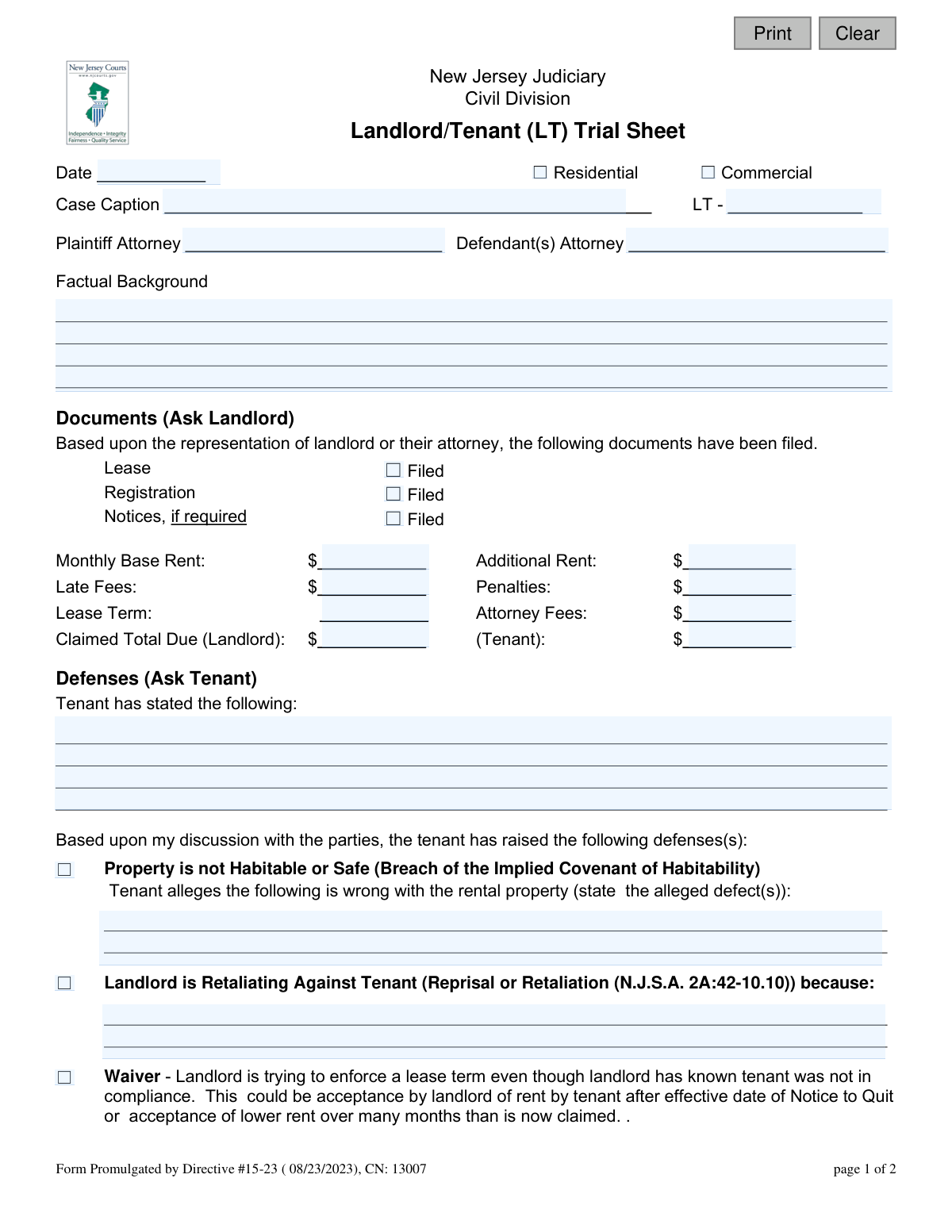
The Landlord/Tenant (LT) Trial Sheet is a document promulgated by the New Jersey Judiciary to streamline court proceedings in landlord-tenant disputes. It serves as a worksheet to organize the case's factual background, confirm the filing of essential documents like the lease and notices, detail the rent amounts claimed, and list any legal defenses raised by the tenant. Today, this form can be filled out quickly and accurately using AI-powered services like Instafill.ai, which can also convert non-fillable PDF versions into interactive fillable forms.
LT Trial Sheet is part of the civil court forms, landlord tenant forms and New Jersey forms categories on Instafill.
Our AI automatically handles information lookup, data retrieval, formatting, and form filling.
It takes less than a minute to fill out LT Trial Sheet using our AI form filling.
Securely upload your data. Information is encrypted in transit and deleted immediately after the form is filled out.

Form specifications

Form name: New Jersey Judiciary Civil Division Landlord/Tenant (LT) Trial Sheet
Number of fields: 49
Number of pages: 1
Language: English
main-image

Instafill Demo: How to fill out PDF forms in seconds with AI

How to Fill Out LT Trial Sheet Online for Free in 2026

Are you looking to fill out a LT TRIAL SHEET form online quickly and accurately? Instafill.ai offers the #1 AI-powered PDF filling software of 2026, allowing you to complete your LT TRIAL SHEET form in just 37 seconds or less.
Follow these steps to fill out your LT TRIAL SHEET form online using Instafill.ai:
  1. 1 Navigate to Instafill.ai and upload or select the Landlord/Tenant (LT) Trial Sheet.
  2. 2 Use the AI assistant to populate case details such as the date, case caption, docket number, and attorney information.
  3. 3 Provide a summary of the factual background of the landlord-tenant dispute in the designated section.
  4. 4 Indicate which documents have been filed (Lease, Registration, Notices) and enter all financial details, including base rent, additional rent, fees, and the total amount claimed by the landlord.
  5. 5 Check the boxes corresponding to the defenses the tenant is raising, such as habitability issues or improper registration, and provide narrative explanations where required.
  6. 6 List the names of witnesses for both the plaintiff (landlord) and the defendant (tenant).
  7. 7 Review all the information entered with the AI's assistance to ensure accuracy and completeness before printing the sheet for the trial.

Our AI-powered system ensures each field is filled out correctly, reducing errors and saving you time.

Why Choose Instafill.ai for Your Fillable LT Trial Sheet Form?

Speed

Complete your LT Trial Sheet in as little as 37 seconds.

Up-to-Date

Always use the latest 2026 LT Trial Sheet form version.

Cost-effective

No need to hire expensive lawyers.

Accuracy

Our AI performs 10 compliance checks to ensure your form is error-free.

Security

Your personal information is protected with bank-level encryption.

Frequently Asked Questions About Form LT Trial Sheet

This form is a summary sheet used by the New Jersey Judiciary during a trial. It helps the court organize the key facts, financial claims, and legal defenses from both the landlord and the tenant to streamline the proceedings.

This form is typically completed by court staff, a mediator, or a judge during the trial or a settlement conference. They will ask the landlord and tenant questions to gather the necessary information.

No, you do not need to file this form before your court date. It is an internal court document used on the day of the trial, not a form for parties to submit in advance.

You should be prepared to confirm you have filed the lease, property registration, and any required notices. You will also need to state the exact amounts for base rent, additional rent, fees, and the total amount you claim is due.

The form lists common defenses such as unsafe living conditions (habitability), landlord retaliation, disputes over the rent amount, and the landlord's failure to register the property. You can explain your specific situation for any defense that applies.

A 'Waiver' defense argues that the landlord gave up their right to enforce a lease rule because they knowingly ignored your non-compliance in the past. An example is a landlord accepting lower rent for many months and then suddenly suing for the full amount.

If the landlord has not properly registered the rental property as required by New Jersey law, it can be used as a defense by the tenant. The court may dismiss the eviction case until the landlord complies with registration requirements.

The form has a specific section, 'Tenant Does Not Owe the Amount Landlord Claims Is Due,' where you can state your case. You can specify if you believe the base rent, arrears, or fees are incorrect, or if the amount claimed is supposed to be paid by a subsidy program.

Base rent is the standard monthly payment for the rental unit. Additional rent can include other charges specified in the lease, such as utilities, parking fees, or late charges that are contractually defined as rent.

The form advises you to notify the court as soon as possible if you need an interpreter or contact the local ADA coordinator for any disability-related accommodations. You can find contact information on the New Jersey Courts website.

Yes, while this form is filled out in court, you can use AI services like Instafill.ai to organize your own documents beforehand. It can help you extract key figures from your lease and notices so you have all your facts ready for the trial.

You can upload your case documents, like the lease agreement or notices to quit, to Instafill.ai. The AI can help you auto-fill a practice copy of the form to organize your arguments and financial details, ensuring you are fully prepared to answer the court's questions.

Services like Instafill.ai can convert flat, non-fillable PDFs into interactive forms that you can type into. This can be useful for organizing your information for personal preparation before you go to court.

Compliance LT Trial Sheet
Validation Checks by Instafill.ai

1
Ensures Trial Date is Valid
This validation checks that the 'Date' field ('confDt') contains a properly formatted date. It also ensures the date is not in the future, as a trial sheet would be for a current or past event. This prevents data entry errors and ensures the record's chronological accuracy.
2
Requires Case Type Selection
Validates that exactly one of the 'Residential' or 'Commercial' checkboxes ('caseType') is selected. This is a mandatory classification that determines which regulations and statutes may apply to the case. Failure to select a case type would result in an incomplete record and potential processing delays.
3
Case Caption Completeness
This check ensures the 'Case Caption' field ('captionName') is not empty. The caption is the primary textual identifier of the case (e.g., 'Landlord Name v. Tenant Name') and is essential for all legal and administrative processing. A missing caption makes the form unusable.
4
Docket Number Format
Verifies that the 'LT -' docket number field ('docketNum') contains a value and that it conforms to the expected format, likely numeric. The docket number is a unique identifier for the case within the court system. An invalid or missing number would prevent the form from being correctly filed and associated with the case record.
5
Valid Currency for Monetary Fields
This check applies to all monetary fields, including 'Monthly Base Rent', 'Additional Rent', 'Late Fees', and 'Claimed Total Due'. It ensures that all entries are non-negative numerical values. This is critical for financial accuracy and to prevent calculation errors or invalid claims.
6
Claimed Total Due Consistency
Validates that the 'Claimed Total Due (Landlord)' field ('ttlDueLandlord') is a positive number if any other rent or fee fields have been entered. This ensures that if a landlord is itemizing costs, they also state the total amount being claimed in the action. A zero or empty total with itemized costs is a logical contradiction.
7
Conditional Requirement for Habitability Defense
If the 'Property is not Habitable' defense checkbox ('tenDef1') is selected, this validation ensures the corresponding description field ('tenDefDesc1') is not empty. The court needs the specific details of the alleged defects to evaluate this defense. Failure to provide details renders the checked defense unsubstantiated.
8
Conditional Requirement for Retaliation Defense
If the 'Landlord is Retaliating Against Tenant' defense checkbox ('tenDef2') is selected, this validation requires the associated text field ('tenDefDesc2') to be filled out. The tenant must state the reason for their belief of retaliation for the claim to be considered. An empty description makes the defense incomplete.
9
Conditional Requirement for Rent Control Defense
When the 'Rent increase is improper under governing rent control ordinance' checkbox ('tenDef4c') is ticked, this check verifies that the municipality name ('tenDef4cMuni1', 'tenDef4cMuni2') is provided. The specific ordinance is tied to the municipality, so this information is essential for verifying the claim. The defense is invalid without it.
10
Conditional Requirement for Incorrect Rent Defense
If the tenant checks the box for 'Base rent is incorrect' ('tenDef6a'), this validation ensures a value is entered into the 'should be $' field ('tenDef6aAmt'). Simply stating the rent is wrong is insufficient; the tenant must provide the amount they believe to be correct. This is necessary to understand the scope of the dispute.
11
Conditional Requirement for Incorrect Arrears Defense
If the tenant checks the box for 'Arrears are incorrect' ('tenDef6b'), this validation ensures a value is entered into the 'should be $' field ('tenDef6bAmt'). This provides a clear, quantifiable basis for the tenant's dispute regarding back-rent owed. Without a corrected amount, the claim is vague and difficult to adjudicate.
12
Conditional Requirement for Illegal Occupancy Defense
When the 'Illegal Occupancy' defense checkbox ('tenDef7') is selected, this validation ensures the corresponding description field ('tenDefDesc7') is not empty. The tenant must provide the basis for their statement that the occupancy is illegal. This information is critical for the court to investigate and rule on a potentially serious issue.
13
Conditional Requirement for 'Other' Defense
If the 'Other' defense checkbox ('tenDef8') is selected, this validation ensures the accompanying narrative field ('tenDefDesc8') is filled in. This is a catch-all category, so a description is mandatory to explain the nature of the unlisted defense. An empty description would make the selection meaningless.
14
Specificity for 'Tenant Does Not Owe' Defense
This check ensures that if the main 'Tenant Does Not Owe the Amount Landlord Claims Is Due' checkbox ('tenDef6') is selected, at least one of the sub-options (e.g., 'Base rent is incorrect', 'Arrears are incorrect') is also checked. This forces the tenant to specify the nature of the monetary dispute rather than making a generic, non-specific claim. The parent checkbox is not useful without a specific child selection.

Common Mistakes in Completing LT Trial Sheet

Entering an Incorrect or Incomplete Docket Number

Parties often mistype the docket number, such as LT-12345-23, or omit the year suffix, due to simple typos or referencing old paperwork. An incorrect docket number can lead to filing delays, confusion in court records, and the document being associated with the wrong case, potentially causing a default judgment. To avoid this, carefully copy the full docket number from the official court summons or complaint, ensuring every letter, number, and dash is accurate.

Miscalculating the 'Claimed Total Due'

Landlords frequently make arithmetic errors when adding up base rent, additional rent, late fees, and penalties to arrive at the 'Claimed Total Due'. This undermines the landlord's credibility and can lead to parts of their claim being dismissed by the court. Always use a calculator to double-check your math and ensure each individual fee is correctly justified by the lease agreement before entering the final total.

Listing Vague or Unspecific Habitability Defects

When claiming a breach of habitability, tenants often use general statements like 'the apartment needs repairs' or 'it's unsafe.' These descriptions are too vague to constitute a valid legal defense and can result in the defense being disregarded. Tenants should list specific, actionable problems with dates and locations, such as 'persistent leak under kitchen sink since June 1st' or 'no heat in the bedroom for the first week of December.'

Confusing Base Rent with Other Charges

A common error is lumping all charges together or entering amounts in the wrong fields, such as including late fees in the 'Monthly Base Rent' box. This complicates the accounting, obscures the true amount of rent in arrears, and can lead to disputes over the validity of the charges. Carefully separate the base monthly rent from any additional charges like utilities, penalties, or attorney fees as specified in the lease and enter them in their designated fields.

Failing to Substantiate a Retaliation Claim

A tenant might check the box for a retaliation defense but only write that the landlord is 'trying to get rid of them.' This fails to establish the necessary legal link between a protected action they took (e.g., calling a housing inspector) and the landlord's adverse action (e.g., the eviction filing). To avoid this, clearly state the protected action and its date, followed by the retaliatory action the landlord took and its date to show a clear cause-and-effect relationship.

Disputing an Amount Owed Without Providing a Corrected Figure

Tenants often check the box for 'Tenant Does Not Owe the Amount Landlord Claims Is Due' but then fail to fill in the fields for what they believe the correct rent or arrears should be. This weakens their position from a specific dispute to a general denial, making it harder for the court to assess their claim. If you dispute a charge, you must provide your own calculation in the appropriate field and be prepared to explain how you arrived at that number.

Providing a Vague or Emotional Factual Background

Instead of a concise summary of events, parties may write a long, disorganized narrative filled with personal feelings or irrelevant details. This makes it difficult for the judge or mediator to quickly grasp the core issues of the dispute and can fail to highlight the facts that support your case. To prevent this, outline the key dates and events chronologically and stick to objective facts about the tenancy, the dispute, and the amounts owed.

Incorrectly Confirming Documents as 'Filed'

A landlord might incorrectly check that the lease, registration, or required notices have been filed with the court when they have not, often due to disorganization. This is a formal representation to the court, and a mistake can have serious consequences, including dismissal of the case. It is crucial to physically verify that all necessary documents have been submitted to and accepted by the court clerk before checking these boxes.

Forgetting to Specify Municipality for Rent Control Defense

A tenant may check a box indicating a rent control ordinance is in place but then forget to write the name of the specific municipality in the provided blank space. Rent control laws are highly localized, and failing to name the town or city makes the defense impossible to verify or apply. This oversight renders the defense incomplete and ineffective, so always specify the exact municipality whose ordinance you are referencing.

Leaving Attorney Fields Blank When Self-Represented

Parties representing themselves (pro se) sometimes leave the 'Plaintiff Attorney' or 'Defendant(s) Attorney' fields blank, creating ambiguity for court staff. The proper way to fill this out is to write 'Pro Se' or 'Self-Represented' in the appropriate field. This clarifies your status for the court from the outset and prevents confusion. AI-powered tools like Instafill.ai can help by suggesting correct legal terminology and ensuring all fields are completed properly, and can even make flat PDFs like this one fillable.
Saved over 80 hours a year

“I was never sure if my IRS forms like W-9 were filled correctly. Now, I can complete the forms accurately without any external help.”

Kevin Martin Green

Your data stays secure with advanced protection from Instafill and our subprocessors

Robust compliance program

Transparent business model

You’re not the product. You always know where your data is and what it is processed for.

ISO 27001, HIPAA, and GDPR

Our subprocesses adhere to multiple compliance standards, including but not limited to ISO 27001, HIPAA, and GDPR.

Security & privacy by design

We consider security and privacy from the initial design phase of any new service or functionality. It’s not an afterthought, it’s built-in, including support for two-factor authentication (2FA) to further protect your account.

Fill out LT Trial Sheet with Instafill.ai

Worried about filling PDFs wrong? Instafill securely fills new-jersey-judiciary-civil-division-landlordtenant-lt-trial-sheet forms, ensuring each field is accurate.

Related forms by category

civil court forms Petition for Leave to Proceed In Forma Pauperis (Court of Common Pleas of Lehigh County, Pennsylvania, Civil Division), Designation of Record on Appeal (Civil) (Maricopa County Justice Courts, Arizona) (Form APP 8150-702), Certificate of Service (Civil Court Claim), Pfändungs- und Überweisungsbeschluss (Garnishment and Transfer Order) – German Civil Enforcement Court Form, AOPC 308A, Civil Complaint, Form MC 03, Answer, Civil, Form POS-040, Proof of Service—Civil, ONTARIO Form 8: Application (General), Form ATJ 601.9, Application for Waiver of Court Fees (Civil), Nevada Justice / Municipal Civil Court Cover Sheet, Form MC 01, Summons, Form MC 10, Judgment, Civil, Form MC 99, Motion and Affidavit to Set Aside Default (Civil), Form MC 281a, Civil Mediator Application, Ex Parte Motion and Order to Renew Civil Judgment, AO 88B, Subpoena to Produce Documents, Information, or Objects or to Permit Inspection of Premises in a Civil Action, Form APP-031A, Application for Extension of Time to File Brief (Civil Case), Civil Appeal Case Information Statement, Form APP-014, Appellant's Proposed Statement on Appeal (Unlimited Civil Case), form-app-015-respondents-proposed-corrections-toadditions-to-appellants-proposed-settled-statement-unlimited-civil-case · + 94 more →
landlord tenant forms Form UD-110, Judgment—Unlawful Detainer, Judicial Council of California, Form UD-110P, Judgment—Unlawful Detainer Partial Eviction Attachment, Form UD-115, Stipulation for Entry of Judgment (Unlawful Detainer), Form UD-116, Declaration for Default Judgment by Court (Unlawful Detainer—Civ. Proc., § 585(d)), Form UD-120, Verification by Landlord Regarding Rental Assistance—Unlawful Detainer, UD-155, Eviction Case (Unlawful Detainer) Stipulation, Judicial Council of California Form UD-110H, Judgment—Unlawful Detainer Habitable Premises Attachment, Appendix XI-X, Verified Complaint - Residential Landlord Tenant, New Jersey Judiciary Application to Serve as a Landlord/Tenant Settlor (CN 12743), New Jersey Judiciary Landlord Tenant Procedures
New Jersey forms State of New Jersey Alternate Benefit Program Withdrawal Request Acknowledgement Receipt, Horizon Blue Cross Blue Shield of New Jersey Applied Behavior Analysis Supplemental Information Form, State of New Jersey Application for Employment (Form DPF-663), New Jersey Judiciary Plea Form (Plea 01), Supplemental Plea Form for Certain Sexual Offenses: Megan’s Law/Parole Supervision for Life/Community Supervision for Life (Plea 05), Financial Questionnaire to Establish Indigency, New Jersey Judiciary Resource Family Information Form, Foreclosure Case Information Statement (FCIS) - Appendix XII-B2, New Jersey Judiciary Records Request Form, Superior Court of New Jersey, Application for Appeal and Order, FL Certification of Requested Background Checks for Kinship Legal Guardianship, Certification of Caregiver as to Knowledge of Identity and/or Location of Parents, FL Order Judgment for Kinship Legal Guardianship, New Jersey Judiciary Certification of Repair and Plea of Guilty, Uniform Summary Support Order (USSO), New Jersey Judiciary Volunteer Application (CN 10293), Application to Take the New Jersey Court Interpreter Oral Examination, New Jersey Judiciary Attorney Fee Arbitration Request, Order to Show Cause with Temporary Restraints Pursuant to Rule 4:52, Tax Court of New Jersey, State Tax Complaint · + 271 more →