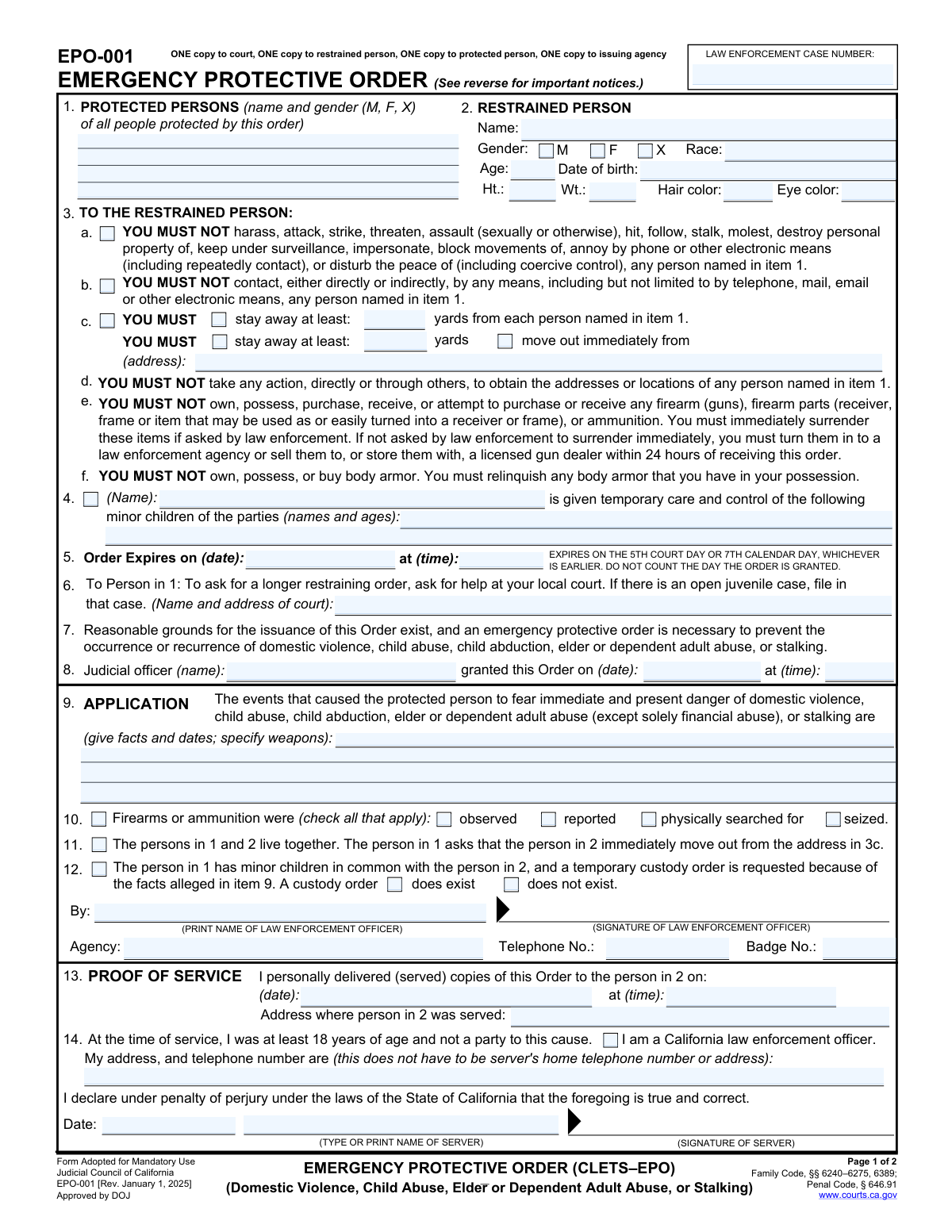
Yes! You can use AI to fill out Form EPO-001, Emergency Protective Order (CLETS–EPO) (Domestic Violence, Child Abuse, Elder or Dependent Adult Abuse, or Stalking)
California Form EPO-001, the Emergency Protective Order, is a short-term restraining order requested by a law enforcement officer on behalf of a person in immediate danger of domestic violence, child abuse, elder abuse, or stalking. It is granted by a judicial officer and provides immediate legal protection, typically lasting for five court days or seven calendar days, giving the protected person time to seek a longer-term restraining order from the court. Today, this form can be filled out quickly and accurately using AI-powered services like Instafill.ai, which can also convert non-fillable PDF versions into interactive fillable forms.
Our AI automatically handles information lookup, data retrieval, formatting, and form filling.
It takes less than a minute to fill out EPO-001 using our AI form filling.
Securely upload your data. Information is encrypted in transit and deleted immediately after the form is filled out.
Form specifications
| Form name: | Form EPO-001, Emergency Protective Order (CLETS–EPO) (Domestic Violence, Child Abuse, Elder or Dependent Adult Abuse, or Stalking) |
| Number of fields: | 65 |
| Number of pages: | 1 |
| Language: | English |
Instafill Demo: How to fill out PDF forms in seconds with AI
How to Fill Out EPO-001 Online for Free in 2026
Are you looking to fill out a EPO-001 form online quickly and accurately? Instafill.ai offers the #1 AI-powered PDF filling software of 2026, allowing you to complete your EPO-001 form in just 37 seconds or less.
Follow these steps to fill out your EPO-001 form online using Instafill.ai:
- 1 Navigate to Instafill.ai and upload or select the California Emergency Protective Order Form EPO-001.
- 2 Use the AI assistant to input the full names and genders of all individuals to be protected by the order in Item 1.
- 3 Provide the complete identifying information for the restrained person in Item 2, including name, physical description, and date of birth.
- 4 Detail the specific events, facts, and dates that justify the need for the order in the application section (Item 9), specifying any weapons involved.
- 5 Indicate the specific protections being requested, such as no-contact provisions, stay-away distances, and temporary child custody orders in Items 3 and 4.
- 6 As the requesting law enforcement officer, complete your information, including name, agency, and badge number, and sign the application.
- 7 After the judicial officer grants the order, review the completed form for accuracy before printing copies for the court, the restrained person, the protected person, and the issuing agency.
Our AI-powered system ensures each field is filled out correctly, reducing errors and saving you time.
Why Choose Instafill.ai for Your Fillable EPO-001 Form?
Speed
Complete your EPO-001 in as little as 37 seconds.
Up-to-Date
Always use the latest 2026 EPO-001 form version.
Cost-effective
No need to hire expensive lawyers.
Accuracy
Our AI performs 10 compliance checks to ensure your form is error-free.
Security
Your personal information is protected with bank-level encryption.
Frequently Asked Questions About Form EPO-001
This form is a short-term court order requested by a law enforcement officer to provide immediate protection for individuals in danger of domestic violence, child abuse, elder abuse, or stalking. It is granted by a judicial officer in emergency situations.
A law enforcement officer completes the application portion of the form based on the facts of the situation. A judicial officer then reviews it and, if granted, signs the order.
An EPO is very short-term, expiring on the 5th court day or the 7th calendar day after it is issued, whichever comes first. To get longer-term protection, you must file for a restraining order at your local courthouse.
You must go to the court listed in item 6 of the form as soon as possible to file for a longer-term restraining order. The EPO is only a temporary measure to ensure your immediate safety.
The form requires the names and descriptive information of the protected and restrained persons, the facts and dates of the incident causing fear, and whether any weapons were involved. The law enforcement officer will gather this information.
Violating any of the conditions of the order is a crime. The restrained person can be arrested, charged with a criminal offense, and face fines or jail time.
The restrained person must immediately give any firearms, firearm parts, or ammunition to law enforcement if asked, or otherwise turn them in to police or a licensed gun dealer within 24 hours. They must then file a receipt with the court as proof of compliance.
Yes, if requested due to the facts of the case, a judge can grant temporary care and control of minor children to the protected person, as specified in item 4 of the form. This is only for the duration of the EPO.
A law enforcement officer must personally deliver (serve) a copy of the signed order to the restrained person. The officer then completes the 'Proof of Service' section on the form.
No, this emergency form is completed by law enforcement. However, for the subsequent court forms you must file for a longer-term restraining order, services like Instafill.ai can use AI to help you auto-fill the required fields accurately and save time.
You can use a service like Instafill.ai to complete the necessary court forms for a longer-term order. Simply upload the form to their platform to fill it out interactively from any device.
If you have a non-fillable PDF, you can use a tool like Instafill.ai to convert it into an interactive, fillable form. This makes it easy to enter your information digitally before printing.
This is a broad term that includes actions that destroy the mental or emotional calm of the protected person. It can cover conduct like coercive control, making excessive noise, or other behaviors intended to annoy or frighten.
Compliance EPO-001
Validation Checks by Instafill.ai
1
Ensures Expiration Date is Logically Correct
Validates that the expiration date and time in Item 5 are no later than the 5th court day or 7th calendar day after the order grant date in Item 8, whichever is earlier. This is a critical legal requirement of an Emergency Protective Order. An incorrect expiration date could render the order unenforceable or provide a false sense of security to the protected person.
2
Verifies Chronological Integrity of Dates and Times
Checks that the Order Granted date/time (Item 8) occurs before or at the same time as the Proof of Service date/time (Item 13), and that both occur before the Order Expiration date/time (Item 5). This validation ensures the sequence of events is logical and legally sound. A failure indicates a data entry error that could invalidate the order's timeline.
3
Validates Consistency Between Restrained Person's Age and Date of Birth
Compares the 'Date of birth' provided in Item 2 with the 'Age' field to ensure they are consistent. This check helps prevent data entry errors and confirms the accuracy of identifying information for the restrained person, which is critical for law enforcement databases like CLETS. A mismatch would require manual correction to ensure the correct individual is identified.
4
Requires at Least One Protected Person
Ensures that the 'PROTECTED PERSONS' field in Item 1 is not empty and contains the name of at least one individual. An Emergency Protective Order cannot be issued without a designated person to protect. If this field is blank, the form is incomplete and legally meaningless.
5
Mandates Restrained Person's Identifying Information
Validates that the Restrained Person's 'Name' and 'Date of birth' in Item 2 are completed. This information is essential for positive identification and for entering the order into the California Law Enforcement Telecommunications System (CLETS). Without this data, law enforcement cannot effectively identify the restrained person or enforce the order.
6
Validates 'Move Out' Order Completeness
Checks that if the 'move out immediately from' box is checked in Item 3c, the corresponding address field is filled out. It also cross-references that Item 11 ('The persons in 1 and 2 live together') is checked, providing the justification for the move-out order. An incomplete move-out order is unenforceable and fails to provide the intended protection.
7
Ensures Child Custody Details are Provided When Requested
Verifies that if a temporary custody order is requested in Item 12, then Item 4 is fully completed with the custodian's name and the names and ages of the minor children. A request for custody without specifying the children and the temporary custodian is incomplete and cannot be granted. This ensures the order is clear and actionable regarding the children's safety.
8
Requires Factual Basis for the Order
Ensures the application text field in Item 9, which details the events causing fear, is not empty. This narrative provides the 'reasonable grounds' and factual basis required for a judicial officer to issue the order. An order without a documented justification is legally deficient and subject to challenge.
9
Validates 'Stay Away' Distance Specification
Checks that if either 'stay away' checkbox is marked in Item 3c, the corresponding 'yards' field is populated with a positive numerical value. An order to 'stay away' without a specified distance is ambiguous and unenforceable. This validation ensures the terms of the order are clear and precise for both the restrained person and law enforcement.
10
Verifies Requesting Officer's Information is Complete
Ensures that the fields for the law enforcement officer's printed name, agency, and badge number are all filled out. This information is crucial for record-keeping, accountability, and verifying the legitimacy of the request for the EPO. Missing information can delay processing or raise questions about the form's origin.
11
Validates Proof of Service Date
Checks that the service date in Item 13 is not before the order grant date in Item 8. An order cannot be legally served before it has been officially granted by a judicial officer. This check prevents logical impossibilities and ensures the proof of service is valid.
12
Ensures Court Information is Provided
Validates that the court name and address field in Item 6 is completed. This information is vital for the protected person, as it directs them to the correct courthouse to file for a longer-term restraining order before the EPO expires. Failure to provide this information could jeopardize the protected person's ability to secure ongoing protection.
13
Restrained Person Date of Birth Format
Validates that the 'Date of birth' field for the restrained person in Item 2 is in a valid date format (e.g., MM/DD/YYYY) and represents a date in the past. This is a fundamental data quality check to ensure the information is parseable and sensible. Incorrectly formatted dates can cause system errors and issues with record matching in law enforcement databases.
14
Law Enforcement Case Number Presence
Ensures that the 'LAW ENFORCEMENT CASE NUMBER' field at the top of the form is not empty. This number links the protective order to the official police report and investigation. Without a case number, tracking the order and associating it with the underlying incident becomes difficult for the courts and law enforcement agencies.
Common Mistakes in Completing EPO-001
In a high-stress situation, an applicant may focus only on themselves and forget to include other household members, especially children, in Item 1. This has severe consequences, as anyone not explicitly named on the form is not legally protected by the order's provisions. To avoid this, carefully consider every person at risk and ensure their full name and gender are listed. AI-powered form fillers can help by creating checklists to ensure all relevant parties are included before finalizing.
This occurs when the applicant is unsure of exact details or the officer enters estimates for the restrained person's physical description in Item 2. Inaccurate or missing data like date of birth, height, weight, or hair color makes it extremely difficult for law enforcement to positively identify the correct individual for enforcement. Always provide the most complete information available, and cross-reference the age with the date of birth to ensure they are consistent.
The rule in Item 5, which states the order expires on the 5th court day or 7th calendar day (whichever is earlier), is complex and easily miscalculated. An incorrect date can lead the protected person to believe they are safe when the order has already expired, creating a dangerous false sense of security. To prevent this, one must carefully count calendar days and court business days, excluding the day the order is granted, or use a tool with built-in date calculation logic.
The application in Item 9 requires a detailed account of events, but officers or applicants may write a brief or conclusory summary. A weak narrative that lacks specific facts, dates, direct quotes, and details about weapons can result in the order being denied or make it much harder to obtain a long-term restraining order later. It is crucial to be as specific as possible to clearly establish the 'immediate and present danger' required by law.
A common mistake is checking a box for a stay-away order in Item 3c but failing to write in the specific distance in yards or the complete address for a move-out order. This renders the order vague and unenforceable, as there is no clear boundary for the restrained person to violate. Always double-check that every selected order has its corresponding quantitative value (e.g., '100 yards') or full address filled in completely.
People often list children in Item 4 for temporary custody but forget to also list them in Item 1 as protected persons. This creates a dangerous gap where a custody order exists, but the child is not explicitly protected from harassment, contact, or abuse under the EPO's terms. To ensure full protection, any child involved must be listed in both Item 1 (Protected Persons) and Item 4 (Custody) if both situations apply.
Item 6, which specifies the court where the protected person can file for a long-term order, is sometimes left blank. This leaves the victim without clear direction during a critical and short timeframe, potentially causing them to miss the deadline to extend their protection. The issuing officer must always fill in the full name and address of the correct local courthouse to facilitate the next legal steps.
The serving officer may fail to meticulously complete the Proof of Service section (Item 13), omitting the exact date, time, or address where service occurred. This critical error can be used by the restrained person to challenge the order's validity in court, claiming they were never properly notified. A valid service is the cornerstone of enforcement, so every field in this section must be filled out accurately and legibly.
Since this form is often filled out by hand in the field, illegible handwriting is a frequent problem for names, addresses, and officer details. This can lead to data entry errors when entering the order into the CLETS system and cause confusion for court clerks and other officers trying to read and enforce the order. Using a digital tool like Instafill.ai, which can convert a flat PDF into a fillable form, ensures all entries are typed and perfectly legible, preventing these issues.
In Item 10, the officer must indicate the status of firearms related to the incident. Sometimes, no boxes are checked, leaving it ambiguous whether firearms were present, searched for, or seized. This lack of information can impact the enforcement of the firearm restrictions in Item 3e and affect safety planning for the protected person. It is essential to check all applicable boxes to create a clear record of any firearm involvement.
Saved over 80 hours a year
“I was never sure if my IRS forms like W-9 were filled correctly. Now, I can complete the forms accurately without any external help.”
Kevin Martin Green
Your data stays secure with advanced protection from Instafill and our subprocessors

Robust compliance program
Transparent business model
You’re not the product. You always know where your data is and what it is processed for.
ISO 27001, HIPAA, and GDPR
Our subprocesses adhere to multiple compliance standards, including but not limited to ISO 27001, HIPAA, and GDPR.
Security & privacy by design
We consider security and privacy from the initial design phase of any new service or functionality. It’s not an afterthought, it’s built-in, including support for two-factor authentication (2FA) to further protect your account.
Fill out EPO-001 with Instafill.ai
Worried about filling PDFs wrong? Instafill securely fills form-epo-001-emergency-protective-order-cletsepo-domestic-violence-child-abuse-elder-or-dependent-adult-abuse-or forms, ensuring each field is accurate.