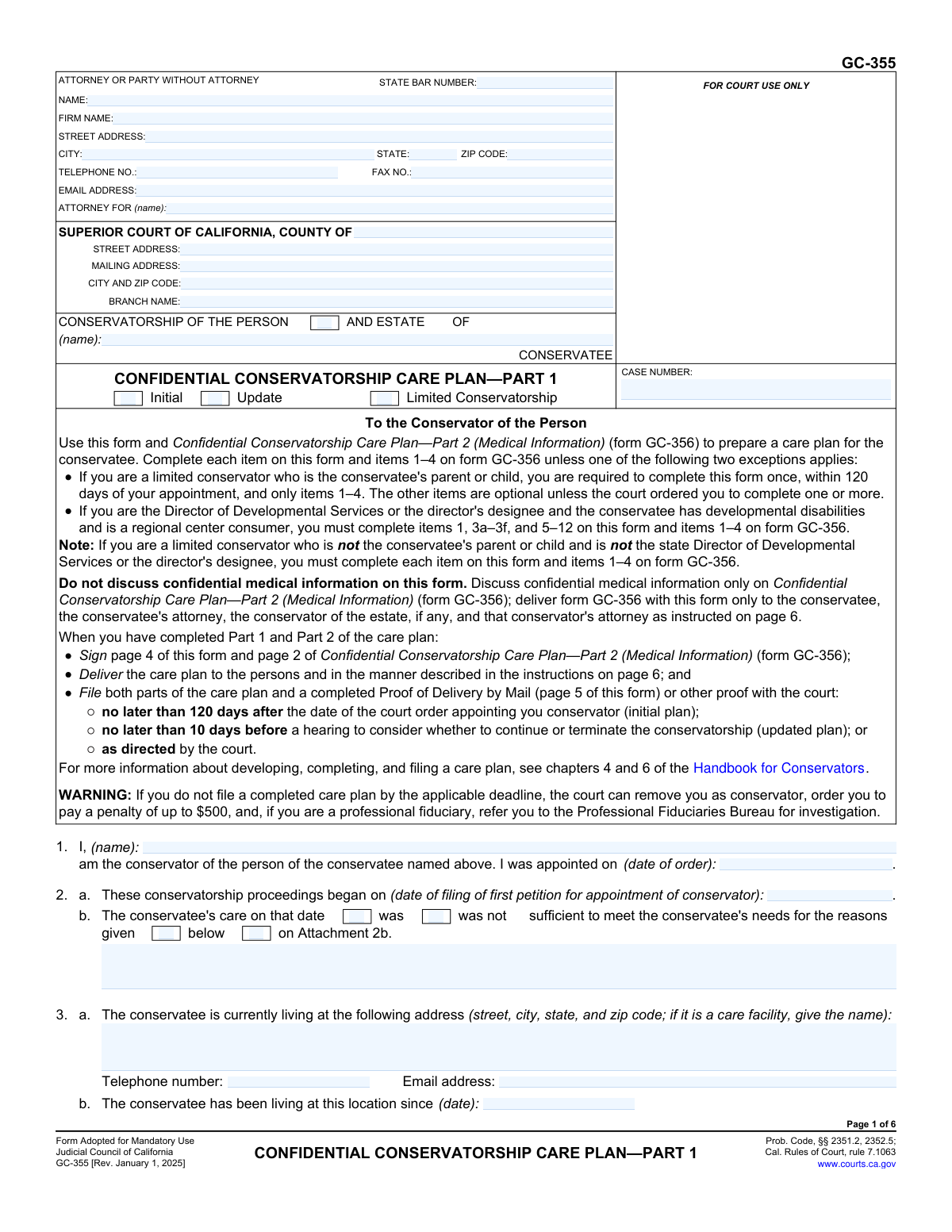
Yes! You can use AI to fill out Form GC-355, Confidential Conservatorship Care Plan—Part 1
The California Form GC-355, Confidential Conservatorship Care Plan—Part 1, is a mandatory court document filed by a conservator of the person. It details the conservatee's living situation, care services, social activities, and visitation plans to ensure their needs are met under the court's supervision. This form, along with Part 2 (GC-356), provides a comprehensive overview for the court. Today, this form can be filled out quickly and accurately using AI-powered services like Instafill.ai, which can also convert non-fillable PDF versions into interactive fillable forms.
Our AI automatically handles information lookup, data retrieval, formatting, and form filling.
It takes less than a minute to fill out GC-355 using our AI form filling.
Securely upload your data. Information is encrypted in transit and deleted immediately after the form is filled out.
Form specifications
| Form name: | Form GC-355, Confidential Conservatorship Care Plan—Part 1 |
| Number of fields: | 187 |
| Number of pages: | 6 |
| Language: | English |
More forms in CAR forms
Instafill Demo: How to fill out PDF forms in seconds with AI
How to Fill Out GC-355 Online for Free in 2026
Are you looking to fill out a GC-355 form online quickly and accurately? Instafill.ai offers the #1 AI-powered PDF filling software of 2026, allowing you to complete your GC-355 form in just 37 seconds or less.
Follow these steps to fill out your GC-355 form online using Instafill.ai:
- 1 Navigate to Instafill.ai and upload your Form GC-355, or select it from the library of official California court forms.
- 2 Instafill.ai's AI will scan the document, identifying all required fields for the conservator, conservatee, court, and case information.
- 3 Answer a series of straightforward questions about the conservatee's residence, care needs, social activities, and visitation plans.
- 4 The AI will use your responses to accurately populate all sections of the GC-355, including checking the correct boxes and filling in detailed descriptions.
- 5 Review the completed care plan for accuracy, make any necessary edits, and then electronically sign the document directly on the platform.
- 6 Easily manage and attach any required supplemental documents, such as professional evaluations or additional pages, and prepare the Proof of Delivery section.
- 7 Download the finalized, court-ready PDF of your Confidential Conservatorship Care Plan to file with the Superior Court and serve on the required parties.
Our AI-powered system ensures each field is filled out correctly, reducing errors and saving you time.
Why Choose Instafill.ai for Your Fillable GC-355 Form?
Speed
Complete your GC-355 in as little as 37 seconds.
Up-to-Date
Always use the latest 2026 GC-355 form version.
Cost-effective
No need to hire expensive lawyers.
Accuracy
Our AI performs 10 compliance checks to ensure your form is error-free.
Security
Your personal information is protected with bank-level encryption.
Frequently Asked Questions About Form GC-355
This form, along with Part 2 (GC-356), is used by the conservator of the person to create a detailed care plan for the conservatee. It informs the court about the conservatee's living situation, care needs, social activities, and overall well-being.
The appointed conservator of the person must complete this form. There are slightly different, reduced requirements for limited conservators who are the conservatee's parent or child, and for the Director of Developmental Services.
The initial care plan must be completed, delivered to the required parties, and filed with the court no later than 120 days after the date of the court order appointing you as conservator.
If you do not file a completed care plan by the deadline, the court can remove you as conservator, order you to pay a penalty of up to $500, and potentially report you to the Professional Fiduciaries Bureau if you are a professional.
Form GC-355 (Part 1) covers general care plan information like residence and social activities. Form GC-356 (Part 2) is for confidential medical information and must be handled with greater privacy.
Both Part 1 and Part 2 must be sent to the conservatee, their attorney, and the conservator of the estate. Other relatives (like a spouse or children) should only receive a copy of Part 1 (GC-355), not the confidential medical information in Part 2.
This is a mandatory section where you declare under penalty of perjury that you have mailed copies of the care plan to all the required individuals. You must complete, sign, and file this page with the court as proof of service.
Most conservators must complete every item. However, if you are a limited conservator who is the conservatee's parent or child, you are only required to complete items 1-4 unless the court orders otherwise.
You should provide estimates for the expenses you have information for. If you do not have access to the information needed for other expenses, you can indicate this by checking the box in item 11b.
You should check the box in Item 7 and attach a copy of the professional's evaluation. However, you must still complete and file both Part 1 (GC-355) and Part 2 (GC-356) of the care plan.
Yes, services like Instafill.ai use AI to accurately auto-fill form fields, which can save you time and help prevent errors. This is useful for entering repetitive information like names, addresses, and the case number throughout the document.
Simply upload the GC-355 PDF to the Instafill.ai platform. Its AI will make the form interactive, allowing you to type your answers directly into the fields and then download the completed, fillable PDF for printing and filing.
If you have a non-fillable or 'flat' PDF, you can use a service like Instafill.ai to instantly convert it into an interactive, fillable form. This allows you to type your information neatly instead of having to print and fill it out by hand.
Compliance GC-355
Validation Checks by Instafill.ai
1
Case Number Presence and Format
This check verifies that the 'Case Number' field is not empty and conforms to the expected format for the jurisdiction. A valid case number is essential for the court clerk to correctly file the document and associate it with the existing conservatorship case. If the case number is missing or invalid, the document will be rejected, causing delays in the legal process.
2
Mutually Exclusive Care Plan Status
Validates that only one of the checkboxes for 'Initial' or 'Update' is selected at the top of the form. A care plan cannot be both the first one and an update simultaneously. This check prevents ambiguity about the nature of the filing. If both are selected, the system should prompt the user to choose only one.
3
Appointment and Petition Date Logic
This validation ensures the dates entered are logically consistent. The 'date of order' of appointment (Item 1) must be on or after the 'date of filing of first petition' (Item 2a). An appointment cannot be ordered before the legal proceedings have even begun. This check prevents data entry errors that would make the timeline of events legally impossible.
4
Conditional Explanation for Insufficient Care
If the user checks the box in Item 2b indicating that the conservatee's care 'was not' sufficient when proceedings began, this validation ensures an explanation is provided. The user must either fill in the text box or check the 'on Attachment 2b' box. This is a mandatory explanation required by the court to understand the circumstances leading to the conservatorship.
5
Conditional Explanation for Restrictive Residence
This check is triggered if the user selects 'is not' the least restrictive residence in Item 3e. It verifies that an explanation for why a more restrictive environment is necessary is provided, either in the text box or on Attachment 3e. This is critical for protecting the conservatee's rights and ensuring the court understands the justification for limiting their freedom.
6
Conditional Personal Residence Address
If Item 3g(2) is checked, indicating the conservatee's current residence is not their 'personal residence', this validation ensures the address of the actual personal residence is filled out. This information is legally significant for determining rights and making future decisions about the conservatee's property and living arrangements. Failure to provide it leaves the record incomplete.
7
Mutually Exclusive Residence Scenarios
Verifies that only one of the primary residence scenarios in Item 4 is selected: 4a (living in personal residence), 4b(1) (will return to personal residence), or 4b(2) (will not return). These three options are mutually exclusive and describe the fundamental status of the conservatee's housing. Selecting more than one would create a logical contradiction in the care plan.
8
Mutually Exclusive 'No Care' Selection
This validation ensures that if 'No care or assistance' (Item 5a) is checked, no other checkboxes in Item 5 (b through j) are selected. It is logically inconsistent to state there is no care while also specifying types of care being provided. This check prevents contradictory information and ensures the clarity of the care plan.
9
Conditional Caregiver Hours Entry
If the checkbox 'for ___ hours per day' in Item 5c is selected, this validation confirms that the corresponding text field contains a valid number. The number should be within a logical range, such as greater than 0 and less than 24. This ensures that a vague selection is quantified, which is necessary for the court to assess the level of care being provided.
10
Conditional Plan for Insufficient Care
When Item 6b is checked, stating that the 'current care and treatment are not sufficient', this validation ensures that at least one of the subsequent checkboxes is selected to indicate where the new plan is described. It also checks that the corresponding description is provided. Simply stating care is insufficient without detailing the corrective plan makes the submission incomplete and unacceptable to the court.
11
Mutually Exclusive Living Arrangement
This check validates that in Item 8a, the user has not selected both 'I live with the conservatee' (8a(1)) and 'I plan to visit the conservatee' (8a(2)). These two statements are mutually exclusive. This check prevents a logical conflict in describing the conservator's physical proximity and interaction plan with the conservatee.
12
Attachment Count Consistency
This validation cross-references the number entered in Item 12 ('Number of pages attached') with the actual number of 'Attachment' checkboxes selected throughout the form. The entered number must match the count of unique attachments referenced (e.g., Attachment 2b, 3e, 4a). This ensures the filed document is complete and that the clerk and judge know exactly how many attachments to expect.
13
Signature and Mailing Date Chronology
Verifies that the 'Date Mailed' in the Proof of Delivery section (page 5, item 4a) is on or after the signature 'Date' on page 4. A document cannot be mailed before it has been signed by the declarant. This check ensures the chronological integrity of the legal declaration and its service.
14
Proof of Delivery Completeness
Ensures that the 'Proof of Delivery by Mail' section on page 5 is fully completed if the form is being filed. This includes the declarant's address, the mailing method, date, place, and a signature. It also requires that at least the mandatory recipients (conservatee and their attorney) are listed. An incomplete proof of delivery can invalidate the filing and lead to sanctions for failure to properly serve all required parties.
Common Mistakes in Completing GC-355
This form (GC-355) explicitly prohibits discussing confidential medical details, which must be placed on the separate GC-356 form. Filers often overlook this distinction and include sensitive health information in sections 5, 6, or as attachments, violating the conservatee's privacy. This can lead to court rejection of the filing and potential sanctions. To avoid this, strictly separate non-medical care plan details (GC-355) from medical information (GC-356).
The Proof of Delivery on page 5 is a legal declaration that is frequently filled out incorrectly. Common errors include forgetting to list all required recipients, failing to distinguish who receives the confidential GC-356 form, or omitting the signature and date. An invalid proof of service can nullify the entire filing, causing significant delays. Carefully follow the instructions on page 6 to ensure every required person is listed and served correctly.
Filers often confuse the conservatee's current physical location (Item 3a) with their legal 'personal residence' (Item 3g), which is where the conservatee believed they lived permanently when the proceedings began. Incorrectly identifying this can have significant legal consequences, especially regarding the potential sale of a home. Carefully read the definitions in Item 3g to make the correct determination, as this distinction is crucial for the court.
Many sections, such as 3e (least restrictive residence) and 4b (return plan), require detailed explanations, not just checked boxes. Filers often provide short, conclusory statements without the required supporting facts, which can lead to court inquiries, delays, or denial of requests. To avoid this, always provide a full, factual narrative for any item requiring an explanation, attaching extra pages if necessary.
The form relies on checkboxes to indicate that further details are provided in a text box or on a separate attachment (e.g., 'on Attachment 3f'). A frequent error is writing details on an attachment but forgetting to check the corresponding box on the form, or vice-versa. This makes the form confusing and appear incomplete, potentially causing the court clerk to reject it. Always ensure that for every attachment used, the correct box is checked on the main form.
The top section of the first page, containing attorney, court, and case information, must be perfect for proper filing. People often forget to enter the Case Number on every page where it's required or use the wrong court address. These simple errors can cause the clerk's office to reject the document upon submission. AI-powered form filling tools like Instafill.ai can prevent this by saving and auto-populating correct case information consistently across all pages.
In complex sections like Item 3 (Residence) and Item 5 (Care), filers sometimes select conflicting options, such as checking both 'No care or assistance' (5a) and '24-hour care' (5c). Such contradictions signal a lack of care in completing the form and will require clarification, delaying the plan's approval. Review all selections to ensure they present a logical and consistent picture of the conservatee's situation.
The form has different, simplified requirements for specific types of limited conservators (e.g., a parent or child of the conservatee). These filers may unnecessarily complete the entire form, while a general conservator might mistakenly follow the simpler rules, resulting in an incomplete filing. It is crucial to read the instructions on page 1 carefully to determine exactly which items must be completed based on your specific role as a conservator.
This form requires at least two separate signatures: the conservator's signature on page 4 and the declarant's signature on the Proof of Delivery on page 5. Forgetting to sign or date either section is a common and critical error that renders the document legally invalid. An unsigned filing will be immediately rejected by the court, forcing a complete refiling.
Parties often find a flat, non-fillable PDF of the form online and fill it out by hand, resulting in illegible or misaligned text that is difficult for the court to process. This can lead to data entry errors by the clerk or requests for a clearer submission. To avoid this, use tools like Instafill.ai which can convert flat PDFs into interactive, fillable forms, ensuring a clean, typed, and professional submission that is easy to read and file.
In Item 5c, when indicating the conservatee receives help from 'Personal caregivers,' the form provides sub-options for 'for ___ hours per day' or '24-hour care.' A common mistake is to check the main 'Personal caregivers' box without specifying the duration of care. This ambiguity leaves the court unable to assess the adequacy of the care plan, so you must complete the sub-options to provide a clear picture of the support level.
Saved over 80 hours a year
“I was never sure if my IRS forms like W-9 were filled correctly. Now, I can complete the forms accurately without any external help.”
Kevin Martin Green
Your data stays secure with advanced protection from Instafill and our subprocessors

Robust compliance program
Transparent business model
You’re not the product. You always know where your data is and what it is processed for.
ISO 27001, HIPAA, and GDPR
Our subprocesses adhere to multiple compliance standards, including but not limited to ISO 27001, HIPAA, and GDPR.
Security & privacy by design
We consider security and privacy from the initial design phase of any new service or functionality. It’s not an afterthought, it’s built-in, including support for two-factor authentication (2FA) to further protect your account.
Fill out GC-355 with Instafill.ai
Worried about filling PDFs wrong? Instafill securely fills form-gc-355-confidential-conservatorship-care-planpart-1 forms, ensuring each field is accurate.