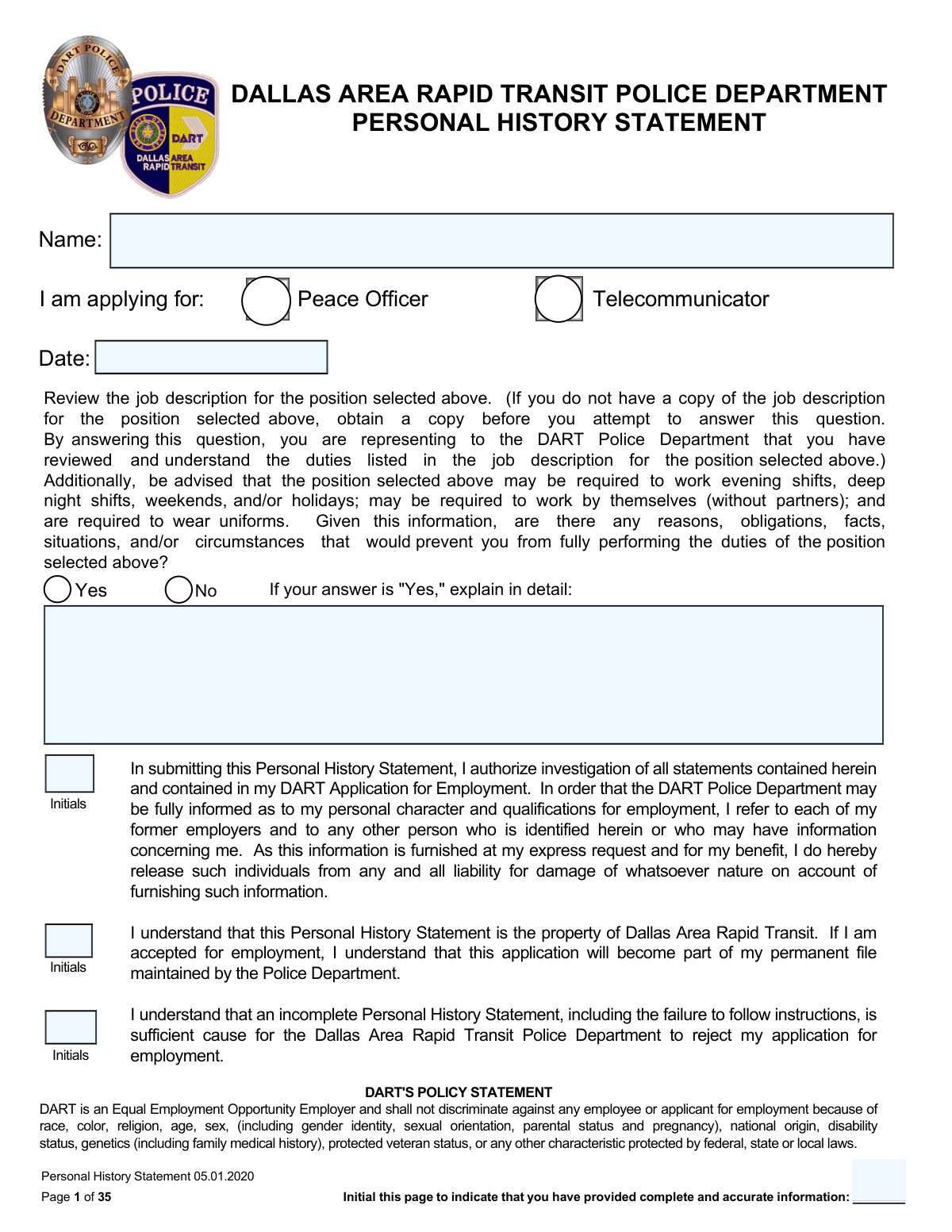
Yes! You can use AI to fill out Dallas Area Rapid Transit Police Department Personal History Statement (Peace Officer / Telecommunicator)

The Dallas Area Rapid Transit (DART) Police Department Personal History Statement is an official governmental document required as part of the hiring process for Peace Officer and Telecommunicator positions within the DART Police Department in Texas. The form collects extensive personal background information across 12 sections, including personal identification, family and references, education, residential history, employment history, military service, financial status, legal history, drug use, motor vehicle records, social media presence, and DART acquaintances, all of which are used to conduct a thorough background investigation to determine an applicant's suitability for employment. Because this is a governmental document, all responses must be truthful and complete, as deliberate omissions or misstatements can result in disqualification or criminal consequences. Today, applicants can fill out this complex, multi-section form quickly and accurately using AI-powered services like Instafill.ai, which can also convert non-fillable PDF versions into interactive fillable forms.
Our AI automatically handles information lookup, data retrieval, formatting, and form filling.
It takes less than a minute to fill out DART PD Personal History Statement using our AI form filling.
Securely upload your data. Information is encrypted in transit and deleted immediately after the form is filled out.

Form specifications

Form name: Dallas Area Rapid Transit Police Department Personal History Statement (Peace Officer / Telecommunicator)
Number of pages: 34
Language: English
Categories: law enforcement forms
main-image

Instafill Demo: filling out a legal form in seconds

How to Fill Out DART PD Personal History Statement Online for Free in 2026

Are you looking to fill out a DART PD PERSONAL HISTORY STATEMENT form online quickly and accurately? Instafill.ai offers the #1 AI-powered PDF filling software of 2026, allowing you to complete your DART PD PERSONAL HISTORY STATEMENT form in just 37 seconds or less.
Follow these steps to fill out your DART PD PERSONAL HISTORY STATEMENT form online using Instafill.ai:
  1. 1 Navigate to Instafill.ai and upload the DART PD Personal History Statement PDF or select it from the available form library to begin filling it out online.
  2. 2 Complete the introductory section by entering your full name, the position you are applying for (Peace Officer or Telecommunicator), the date, your TCOLE PID number if applicable, and confirming your ability to perform the duties of the position; then initial all three authorization statements.
  3. 3 Work through Sections 1 and 2 by providing your personal identification details (name, SSN, DOB, driver's license, address, physical description, and academy history), law enforcement agency application history, and complete contact information for all immediate family members, in-laws, former spouses, siblings, children, and 7–10 personal references.
  4. 4 Complete Sections 3 through 5 by listing all high schools, colleges, and trade/vocational schools attended along with any academic disciplinary history; all residences and housemates from the past 10 years or since age 17; and a full chronological employment history for the past 10 years including all jobs, periods of unemployment, and answers to workplace conduct questions (Questions 18–28).
  5. 5 Fill out Sections 6 through 8 covering your military service history and discharge status; detailed financial information including income, expenses, debts, and any bankruptcies or garnishments; and your complete legal history including all arrests, convictions, civil lawsuits, undetected acts (misdemeanors and felonies), and recreational drug use history.
  6. 6 Complete Sections 9 through 11 by entering your motor vehicle operation history (driver's licenses, traffic citations, accidents, insurance information), disclosing any gang affiliations or anger-related incidents, listing all social media accounts and websites, and identifying any acquaintances within the DART Police Department.
  7. 7 Review the entire form for completeness and accuracy, use Section 12 (Additional Space) for any overflow information, initial each page as required, and then submit the completed Personal History Statement along with all required supporting documents (Social Security card, proof of citizenship, driver's license, transcripts, DD-214, and proof of insurance) through DART's Workday Candidate Home portal.

Our AI-powered system ensures each field is filled out correctly, reducing errors and saving you time.

Why Choose Instafill.ai for Your Fillable DART PD Personal History Statement Form?

Speed

Complete your DART PD Personal History Statement in as little as 37 seconds.

Up-to-Date

Always use the latest 2026 DART PD Personal History Statement form version.

Cost-effective

No need to hire expensive lawyers.

Accuracy

Our AI performs 10 compliance checks to ensure your form is error-free.

Security

Your personal information is protected with bank-level encryption.

Frequently Asked Questions About Form DART PD Personal History Statement

The Personal History Statement is a comprehensive background investigation form required by the Dallas Area Rapid Transit (DART) Police Department for applicants seeking positions as Peace Officers or Telecommunicators. It is used to evaluate your suitability for employment and becomes part of your permanent file if you are hired.

After your Personal History Statement is reviewed and approved, you will need to upload the following: Social Security card, proof of U.S. citizenship (birth certificate, Naturalization papers, or U.S. passport), valid Texas or other U.S. state driver's license, high school transcript or GED certificate, college/university transcript (only required with a GED), DD-214 or other military discharge documents (if applicable), and proof of current automobile liability insurance.

Not necessarily — there are very few automatic bases for rejection, and prior misconduct, terminations, or arrests are usually not automatically disqualifying on their own. However, deliberately withholding or misrepresenting information is the number one reason applicants fail background investigations, so it is critical to be fully honest and transparent on this form.

Yes. Section 8 requires you to disclose ALL detentions or arrests, whether or not they resulted in a conviction, as well as all convictions, diversion programs, and citations (excluding traffic tickets). This includes offenses in any state or jurisdiction, including those punishable under the Uniform Code of Military Justice.

You must meet all five requirements: (1) be a U.S. citizen, (2) have a high school diploma or a GED plus at least 12 college credit hours, (3) never have been convicted of or placed on probation/deferred adjudication for a Class A misdemeanor or felony, (4) not have been convicted of or placed on probation for a Class B misdemeanor within the last 10 years, and (5) never have had a military court martial resulting in a dishonorable or misconduct-based discharge.

You must list ALL jobs from the last ten years, including part-time, temporary, self-employment, and volunteer positions, starting with your most current job. You must also list all periods of unemployment exceeding 30 days, and if you have military experience, include all military service assignments and reserve duty.

You must provide 7 to 10 personal references who know you well, such as social and family friends, co-workers, or military acquaintances. You may NOT include relatives, supervisors, co-workers who are listed elsewhere in the form, or housemates.

Yes. Section 8 includes questions about both detected and undetected drug use. You must disclose any recreational use of non-prescribed drugs within the past three years, as well as any prior use at any time in your life. You must also disclose any involvement in selling, manufacturing, purchasing, furnishing, cultivating, or carrying drugs for another person.

An incomplete Personal History Statement is sufficient cause for DART Police Department to reject your application entirely. If a question does not apply to you, write 'N/A' in the space provided. If you need more space for an answer, attach additional sheets and clearly reference the section and question number.

You must submit the Personal History Statement and all required supporting documents by logging into your account on DART's Workday site and going to your 'Candidate Home' page, the link for which is in the upper right corner. If you have questions, contact [email protected] or call (214) 749-5951.

Yes. Section 10 asks whether you have ever had a social media site (such as Facebook, Instagram, or Snapchat) and requires you to list all social media sites, blogs, and/or websites you have created, along with the website URL and your username for each.

No. In accordance with the Americans with Disabilities Act (ADA), applicants are not expected or required to reveal any medical or disability-related information at this stage of the hiring process, prior to receiving a conditional offer of employment.

Yes — AI-powered services like Instafill.ai can help you accurately auto-fill the many fields in this lengthy 35-page form, saving you significant time and reducing the risk of errors or omissions. Instafill.ai can also convert non-fillable PDF versions of this form into interactive fillable forms, making the process even easier.

Simply visit Instafill.ai, upload your copy of the DART Police Department Personal History Statement PDF, and the AI will guide you through completing each section accurately. If your PDF is a flat, non-fillable version, Instafill.ai can convert it into an interactive fillable form so you can type your responses directly into the document.

Yes. Each page of the Personal History Statement includes a line at the bottom asking you to initial the page to confirm that you have provided complete and accurate information. You must also provide your initials three separate times on the first page to acknowledge the authorization statements regarding investigation, ownership of the document, and completeness requirements.

Compliance DART PD Personal History Statement
Validation Checks by Instafill.ai

1
Ensures Exactly One Position Is Selected (Peace Officer or Telecommunicator)
Validates that the applicant has selected one and only one position — either Peace Officer or Telecommunicator — on both the cover page and the TCOLE section. Selecting both or neither creates an ambiguous application that cannot be properly routed or evaluated. If validation fails, the form should be flagged as incomplete and the applicant prompted to select exactly one position before submission.
2
Validates Social Security Number Format
Checks that the Social Security Number (SSN) entered in Section 1 follows the standard U.S. format of nine digits, typically formatted as XXX-XX-XXXX, with no letters or special characters other than hyphens. The SSN is a critical identifier used throughout the background investigation process, and an incorrectly formatted or incomplete SSN can delay or invalidate the investigation. If the format is invalid or the field is blank, the form must be rejected and the applicant notified to provide a correctly formatted SSN.
3
Validates Date of Birth Is a Real, Past Date in Correct Format
Confirms that the Date of Birth field in Section 1 contains a valid calendar date in MM/DD/YYYY format, that the date is not in the future, and that the resulting age is consistent with eligibility for law enforcement employment (typically at least 18–21 years old). An invalid or future date of birth would indicate a data entry error or potential falsification. If validation fails, the form should be flagged and the applicant required to correct the entry.
4
Ensures Ability-to-Perform-Duties Explanation Is Provided When 'Yes' Is Selected
Checks that if the applicant selects 'Yes' to indicate there are reasons or circumstances that would prevent them from fully performing the duties of the selected position, the explanation field is not left blank. This conditional requirement is critical because the explanation provides DART Police Department with the information needed to evaluate whether the limitation is accommodable or disqualifying. If 'Yes' is checked but no explanation is provided, the form should be flagged as incomplete and submission blocked until the explanation is filled in.
5
Verifies All Three Authorization Statement Initials Are Provided
Validates that all three initials fields on the authorization and acknowledgment statements on Page 1 have been completed by the applicant. These initials serve as the applicant's acknowledgment of the investigation authorization, the ownership of the document, and the completeness requirement — all of which carry legal significance. Missing any one of the three initials renders the authorization incomplete, and the form should not be accepted for processing.
6
Validates Driver License Number Format and Expiration Date Consistency
Checks that the Driver License Number in Section 1 is non-empty and consistent with the format used by the indicated issuing state (e.g., Texas DL numbers follow a specific alphanumeric pattern), and that the expiration date is a valid future or recent date in MM/DD/YYYY format. A valid, unexpired driver's license is required for employment as a peace officer or telecommunicator, and discrepancies between the license number, state, and expiration date may indicate an error or falsification. If the license is expired or the format is invalid, the form should be flagged for review.
7
Ensures Minimum of Seven References Are Provided in Section 2
Validates that the applicant has completed at least seven reference entries in Section 2, as the instructions explicitly require 7–10 references. Each reference entry must include at minimum the reference's name and at least one contact method (phone or email) to be considered complete. Providing fewer than seven references or leaving required contact fields blank within a reference entry should trigger a validation error, as an insufficient number of references impairs the background investigator's ability to conduct a thorough character assessment.
8
Checks That References Are Not Relatives, Supervisors, or Others Listed Elsewhere on the Form
Validates that the names provided in the References section (Section 2-L) do not duplicate names already entered as relatives (parents, siblings, spouse, children, in-laws) or as supervisors and co-workers in the Employment section. The instructions explicitly prohibit listing relatives, supervisors, co-workers, housemates, or other individuals already identified elsewhere on the form as references. If a duplicate name is detected across these sections, the form should flag the conflict and prompt the applicant to replace the disqualified reference.
9
Validates Residence History Covers Full Ten-Year Period Without Gaps
Checks that the 'From' and 'To' dates across all residence entries in Section 4 collectively span the full ten-year period prior to the application date (or back to age 17, whichever is more recent), with no unexplained gaps between consecutive addresses. Gaps in residential history are a red flag during background investigations and may indicate an attempt to conceal a prior address. If a gap of more than 30 days is detected between consecutive residence dates, the form should be flagged and the applicant prompted to account for the missing period.
10
Ensures Employment History Covers Full Ten-Year Period and Accounts for All Unemployment Gaps
Validates that the combined date ranges of all employer entries and unemployment period entries in Section 5 cover the full ten-year period prior to the application date without unexplained gaps exceeding 30 days, as the instructions require all unemployment periods in excess of 30 days to be listed. Unaccounted gaps in employment history are a significant concern in law enforcement background investigations and may suggest concealment of relevant activity. If a gap exceeding 30 days is found between consecutive employment or unemployment entries, the form should be flagged and the applicant required to add the missing period with an appropriate reason.
11
Validates That 'Yes' Answers to Legal/Criminal History Questions Include Required Explanations
Checks that for every 'Yes' response to any question in Section 8 (Legal), including questions about arrests, detentions, convictions, civil lawsuits, restraining orders, probation, and undetected acts (Questions 5–51), a corresponding explanation has been provided in the designated explanation fields. The form explicitly requires detailed explanations including dates, agencies, charges, and dispositions for all affirmative legal disclosures. If a 'Yes' is selected without a corresponding explanation, the form should be flagged as incomplete and the applicant required to provide the missing details before submission.
12
Validates That Drug Use Disclosure Is Internally Consistent
Checks that if the applicant answers 'Yes' to having used non-prescribed drugs within the past three years (Section 8, Question 52), the drug detail fields (drug name, number of uses, most recent date used, and circumstances) are completed for at least one drug entry. Additionally, if the applicant checks the 'I have never used any prescription or non-prescription drug recreationally' option under Question 53, this should be flagged as inconsistent with a 'Yes' answer to Question 52. Inconsistencies between these related fields may indicate an error or deliberate misrepresentation, which is grounds for disqualification.
13
Ensures Current Vehicle Insurance Policy Is Not Expired
Validates that the expiration date entered for each vehicle insurance policy listed in Section 9 is a current or future date, confirming that the applicant's vehicle liability insurance is active at the time of application. Proof of current automobile liability insurance is listed as a required document to be uploaded, and an expired policy would not satisfy this requirement. If any listed insurance policy expiration date is in the past, the form should flag the entry and prompt the applicant to update the information with a current, valid policy.
14
Validates TCOLE PID Number Is Provided Only When Applicant Claims Prior Licensure
Checks that if the applicant indicates they are already licensed by the Texas Commission on Law Enforcement, the TCOLE PID number field is completed with a non-empty, numerically valid value. Conversely, if the applicant does not claim prior TCOLE licensure, the PID field should be left blank and not populated with placeholder text. An inconsistency — such as claiming prior licensure without providing a PID, or providing a PID without claiming prior licensure — should trigger a validation warning for manual review by the background investigator.
15
Ensures All Page Initials Are Completed Throughout the Form
Validates that the 'Initial this page to indicate that you have provided complete and accurate information' field at the bottom of each applicable page of the Personal History Statement has been filled in. These per-page initials serve as the applicant's attestation of accuracy and completeness for each section, and missing initials on any page may indicate the applicant did not review or complete that section. If any page initial field is blank, the form should be flagged as incomplete and the applicant directed to initial all required pages before the form can be accepted.
16
Validates That Divorce Date Is After Marriage Date for Former Spouses
Checks that for each former spouse or cohabitant listed in Section 2 (entries H and I), the recorded divorce or separation date is chronologically after the recorded marriage or relationship start date. A divorce date that precedes or equals the marriage date is logically impossible and indicates a data entry error that could undermine the accuracy of the background investigation. If such a date inconsistency is detected, the form should flag the specific former spouse entry and require the applicant to correct the dates before submission.

Common Mistakes in Completing DART PD Personal History Statement

Omitting aliases, nicknames, or maiden names

Applicants frequently forget to list all names they have ever been known by, including nicknames, maiden names, hyphenated names, or names used in other countries. Background investigators search records under every name provided, so omitting a name can cause records to be missed or, worse, appear as a deliberate concealment. This is one of the most common reasons applications are flagged for dishonesty. List every name you have ever used, no matter how informal or brief the usage, including names used on social media. Tools like Instafill.ai can prompt you to review all name fields before submission to ensure nothing is overlooked.

Failing to initial every page as required

The form explicitly requires applicants to initial the bottom of every single page (35 pages total) to confirm the information on that page is complete and accurate. Many applicants miss pages, especially in the middle of the document, because they are focused on answering questions and forget the initials requirement. An incomplete set of page initials can be treated as an incomplete application and result in automatic disqualification. Before submitting, go back through every page and confirm your initials appear at the bottom.

Leaving gaps in the 10-year employment history

The form requires ALL jobs, including part-time, temporary, self-employment, volunteer work, and periods of unemployment exceeding 30 days. Applicants commonly skip short-term or informal jobs, freelance work, or periods between jobs, creating unexplained gaps in their timeline. Background investigators will notice these gaps and may interpret them as deliberate omissions, which is a leading cause of disqualification. Account for every period of time, and use the 'Period of Unemployment' entries with the appropriate reason checked (student, between jobs, travel, etc.) to fill any gaps.

Providing incomplete or inaccurate addresses throughout the form

The instructions explicitly state that ALL addresses must be complete, including street type (Street, Drive, Road), directional markers (East, West), and apartment or unit numbers, and that errors will not be viewed favorably. Applicants frequently enter partial addresses, omit apartment numbers, use P.O. Boxes for residence addresses (which is prohibited), or fail to verify addresses for family members, references, and former employers. Incomplete addresses delay or derail the background investigation. Personally verify every address before entering it, and never use a P.O. Box for a residential address. Instafill.ai can help validate address formats and flag incomplete entries automatically.

Misunderstanding the 'Undetected Acts' questions and answering dishonestly or incompletely

Sections 8's 'Undetected Acts' questions (questions 15–51) ask about acts that were never reported, arrested for, or charged — meaning applicants cannot rely on 'I was never caught' as a reason to answer 'No.' Many applicants misread these questions as asking only about arrests or convictions, and answer 'No' when they should answer 'Yes.' The form is a governmental document, and lying on it carries criminal consequences. Read each question carefully: it asks whether you committed the act, not whether you were caught. Answer honestly, as the form notes that prior misconduct is usually not automatically disqualifying, but deliberate omissions are.

Failing to list all law enforcement agency applications in the past 10 years

The form requires applicants to list ALL law enforcement agencies they have applied to in the last ten years, regardless of the outcome — including applications where they withdrew, were disqualified, failed a step, or were simply placed on a list. Applicants often omit agencies where they did not advance far in the process or where the outcome was unfavorable, assuming it won't be discovered. Background investigators routinely cross-check with other agencies, and omissions are treated as dishonesty. List every agency, complete all status checkboxes accurately, and provide disqualification reasons where applicable.

Providing too few or ineligible references

The form requires 7 to 10 references who know the applicant well, but explicitly prohibits listing relatives, supervisors, co-workers, housemates, or anyone already listed elsewhere on the form. Applicants frequently submit fewer than 7 references, list relatives or current supervisors, or list people who appear elsewhere in the form (such as former employers). This results in an incomplete application. Prepare a list of 7–10 qualifying references — such as social friends, former classmates, community members, or military acquaintances — before starting the form, and verify their current contact information and addresses.

Entering incomplete or vague explanations for 'Yes' answers

Throughout the form, many questions require a detailed explanation if answered 'Yes' (e.g., disciplinary actions at work, financial issues, legal incidents, military discipline). Applicants often write vague responses like 'minor issue' or 'resolved' without providing dates, names of employers or agencies, circumstances, and outcomes. The form instructs applicants to be 'as complete, honest, and specific as possible.' Vague explanations raise red flags and may prompt investigators to assume the applicant is hiding something. For every 'Yes' answer requiring explanation, include the date, location, names of parties involved, what happened, and how it was resolved.

Incorrectly handling the TCOLE PID number field

The form instructs applicants who are already licensed by the Texas Commission on Law Enforcement to enter their TCOLE PID number, and those who are not licensed to leave the field blank. Many unlicensed applicants enter 'N/A' or '0' in this field, while some licensed applicants forget to include their PID or enter an incorrect number. Entering incorrect data in this field can cause delays in verifying existing licensure or create confusion about the applicant's licensing status. If you are not yet licensed, leave the field completely blank; if you are licensed, locate your exact PID number from your TCOLE records before completing the form.

Omitting or misreporting financial history including debts, collections, and bankruptcies

Section 7 asks detailed questions about financial history, including bankruptcies, collections, repossessions, wage garnishments, tax delinquencies, gambling debts, and court-ordered payments. Applicants often omit older financial issues, assume minor debts are irrelevant, or forget about student loan defaults or child support arrears. Financial irresponsibility is a significant concern for law enforcement positions because it can indicate vulnerability to corruption. Answer every financial question honestly and completely, and if you answered 'Yes' to any of questions 4–17, provide a thorough explanation including dates, amounts, and the current status of the issue.

Failing to list all residences for the past 10 years or since age 17

Section 4 requires a complete list of every address where the applicant has lived for the past 10 years or since age 17, whichever is longer, including the names of all housemates and property managers. Applicants frequently skip short-term residences (such as temporary housing, college dorms, or stays with family), omit apartment numbers, or fail to provide the county field. Missing residences create gaps that investigators must explain, and omitting housemates means those individuals cannot be interviewed as part of the background check. Compile a complete chronological list of all addresses before starting this section, and verify all landlord and housemate contact information.

Not reading the job description before answering the duty-performance question

The very first substantive question on the form asks whether any reasons, obligations, or circumstances would prevent the applicant from fully performing the duties of the selected position, and explicitly states that applicants must review the job description before answering. Many applicants answer 'No' without having actually read the job description, or fail to disclose legitimate scheduling conflicts (such as childcare obligations, second jobs, or religious observances) that could affect their ability to work evenings, nights, weekends, or holidays. Answering without reading the job description is a misrepresentation. Obtain and read the full job description for the position selected before answering this question, and if any genuine conflicts exist, disclose them honestly with a full explanation.
Saved over 80 hours a year

“I was never sure if my IRS forms like W-9 were filled correctly. Now, I can complete the forms accurately without any external help.”

Kevin Martin Green

Your data stays secure with advanced protection from Instafill and our subprocessors

Robust compliance program

Transparent business model

You’re not the product. You always know where your data is and what it is processed for.

ISO 27001, HIPAA, and GDPR

Our subprocesses adhere to multiple compliance standards, including but not limited to ISO 27001, HIPAA, and GDPR.

Security & privacy by design

We consider security and privacy from the initial design phase of any new service or functionality. It’s not an afterthought, it’s built-in, including support for two-factor authentication (2FA) to further protect your account.

Fill out DART PD Personal History Statement with Instafill.ai

Worried about filling PDFs wrong? Instafill securely fills dallas-area-rapid-transit-police-department-personal-history-statement-peace-officer-telecommunicator forms, ensuring each field is accurate.