How EightAI grew from 350 to 1,250 providers by filling insurance credentialing forms through an API
EightAI keeps doctors' and nurses' professional profiles up to date across federal, state, insurance and billing databases. Its clients include independent practice associations (IPAs) with hundreds or thousands of providers, and every one of those providers has credentialing forms to file with insurers. After an in-house attempt to automate those forms failed, EightAI connected Instafill.ai to its own provider data and grew from 350 to 1,250 providers under management.
At a glance
- Company EightAI
- Industry Healthcare technology
- Forms Insurance credentialing, billing onboarding, provider verification
- Integration Instafill.ai API through n8n
-
Results
350 → 1,250 providers under management
100+ insurers, with no extra staff
1 conversion per form, then filled by API - Catalog forms Healthcare Professional Credentialing Application, Practitioner Information and Credentialing Form
- Form categories Credentialing forms, Healthcare provider forms, Healthcare forms
The challenge
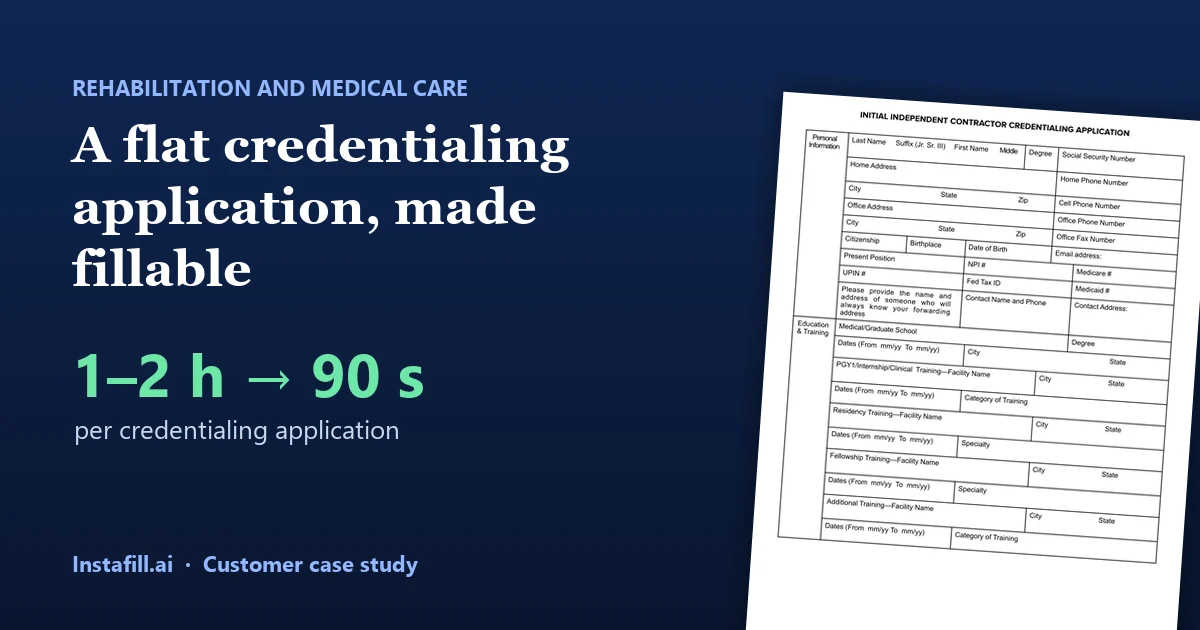
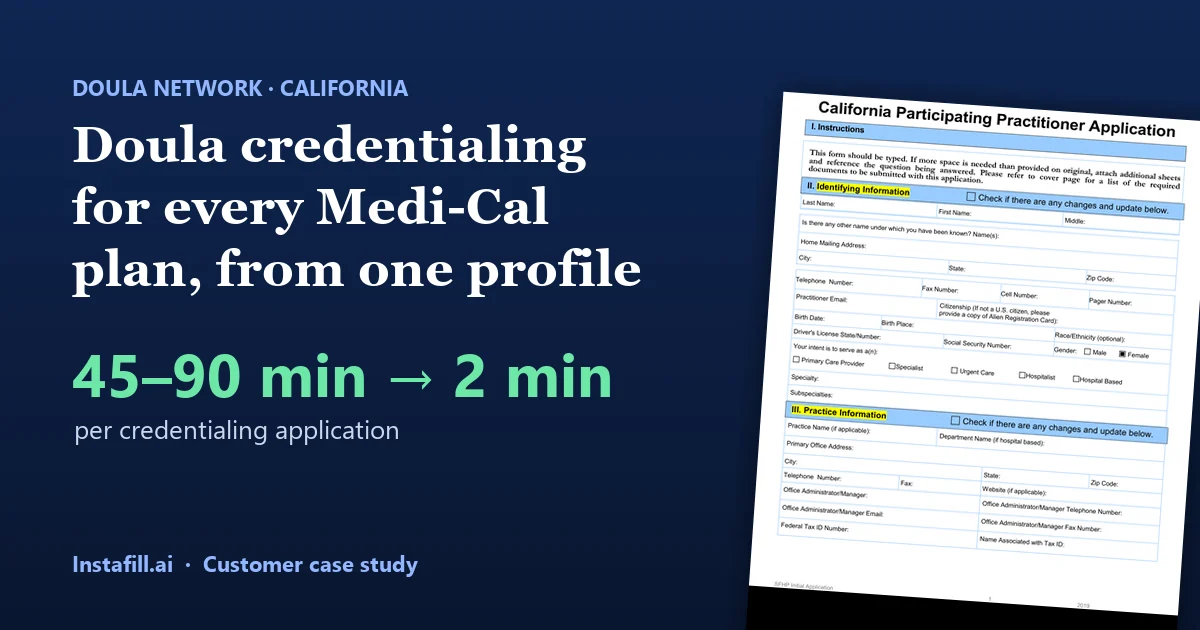
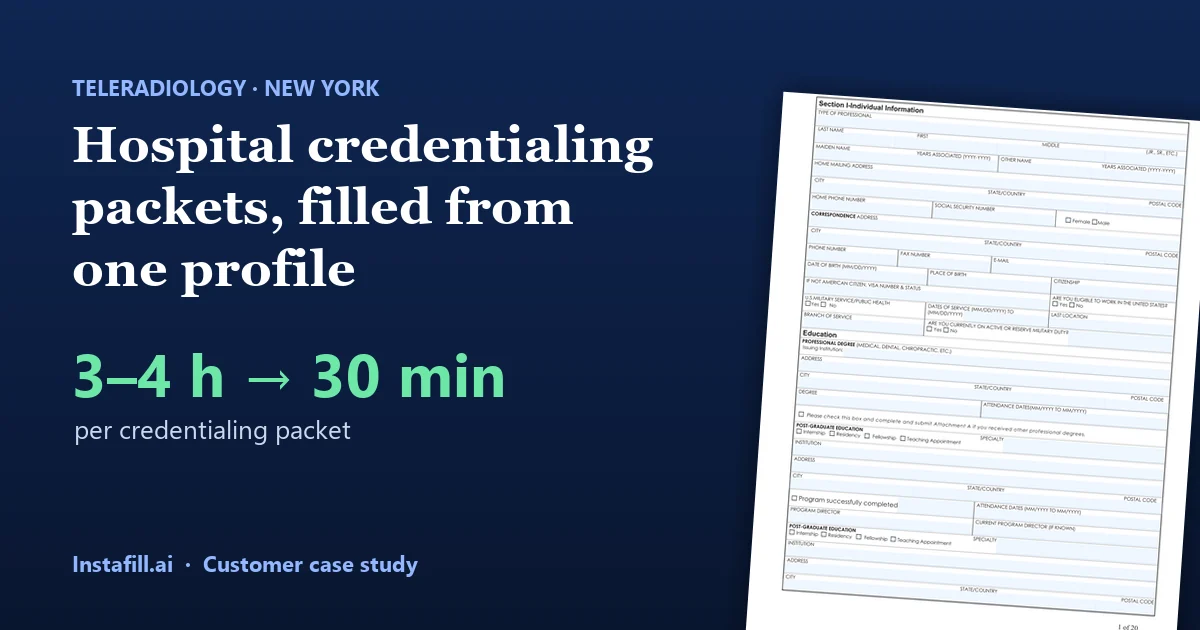
A credentialing form asks for dozens of fields: licenses, certifications, education and work history. A doctor repeats the same basics for 10–15 insurers, often again every two to three years. Beyond that come billing company onboarding forms when a practice outsources its revenue cycle management, service provider verification forms when it orders supplies or equipment, and credential verification for each specialty, from physicians and dentists to nurses and acupuncturists. Each form asks for the same core information in a slightly different layout, and most arrive as flat PDFs, typed by hand for every submission. Typical examples are payer packets like TriWest's individual provider credentialing application.
The errors are expensive. A misspelled name or a wrong address gives an insurer grounds to reject a claim, delaying payment by 2–3 weeks, and such errors contribute to an industry-wide claim denial rate of 30–40%.
EightAI spent two months trying to build the automation itself: converting the PDFs to images, running OCR and overlaying text boxes. Complex layouts, inconsistent formatting, checkboxes, rotated pages and signatures kept it from ever reaching the accuracy it needed. Meanwhile EightAI had 350 customers and 900 more ready to join, and processing their forms by hand would have meant hiring.
The solution
EightAI's CEO, Bo Nam, found Instafill.ai through a ChatGPT suggestion. He signed up, uploaded a complex 53-page PDF and had it filled with high accuracy.
Setting up each form is a one-time job of a few hours. The flat document is turned into a fillable PDF with flat-to-fillable conversion, and any broken fields are fixed and form-specific rules are set, such as for rotated pages or missing checkboxes, through field editing.
Filling then runs without anyone typing. EightAI's provider data sits in Google Firebase, and n8n workflows send it to the Instafill.ai REST API, which fills each form by preset rules, for example using the practice address rather than the billing address. A person still reviews each form before it is submitted.
The results
| Before | With Instafill.ai | |
|---|---|---|
| Providers under management | 350 | 1,250 |
| Flat credentialing PDFs | Typed by hand for every submission | Converted once, then filled by API |
| In-house automation | Two months, never accurate enough | Not needed |
| Adding insurers | More forms meant more staff | 100+ insurers without extra staff |
With the forms automated, Bo announced the service to the 900 customers onboarding the following week. "Before I wasn't going to tell the new customers that we can do this, but now I think we can do it."
Form filling became EightAI's most valued service. "When we fill out forms for them, they love it," Bo said. Doctors otherwise pay a billing company one full-time salary for every 30 doctors just to handle credentialing forms. Correct data from the start also means fewer of the errors that give insurers grounds to deny claims.
"When I found your service, I almost cried. We spent two months trying to re-engineer something like DocuSign to make this work and it was maddening. Your solution – I cannot tell you how good it is."
— Bo Nam, CEO, EightAI