Fill out business credit forms
with AI.
Business credit forms are the paperwork businesses use to establish trade credit relationships, apply for commercial financing or leases, and document tax-exempt purchasing status. These forms serve a practical but critical function: they give lenders, suppliers, and vendors the financial and legal information they need to extend credit or approve tax-exempt transactions. Getting them right matters — errors or omissions can delay credit approvals, trigger unexpected sales tax charges, or create compliance headaches down the line.
By continuing, you acknowledge Instafill's Privacy Policy and agree to get occasional product update and promotional emails.
About business credit forms
The forms in this category are typically needed by business owners, purchasing managers, accountants, and finance teams. You might be completing a supplier's credit application to open a net-30 trade account, applying for commercial equipment financing, or providing a resale certificate to avoid paying sales tax on inventory you plan to resell. For example, a manufacturer purchasing packaging materials for resale would need both a credit application and a multijurisdiction exemption certificate like the WestRock form, while a business seeking equipment financing would work through a commercial lease application like the one included here.
These forms often involve dense legal language, multiple sections, and state-specific requirements — which is why tools like Instafill.ai use AI to fill them out accurately in under 30 seconds, reducing the risk of mistakes and saving significant time for busy professionals.
Every form on this page can be completed without typing. Instafill is form filling software that reads a PDF and fills it for you — including flat and scanned documents that carry no fillable fields at all.
Forms in This Category
The forms in this category have a median Form Complexity Index of 68/100 (Complex), measured across 1 forms by field count, input difficulty, length, conditional logic and structure. See how it is calculated.
| Form Name | Pages | FCI | |
|---|---|---|---|
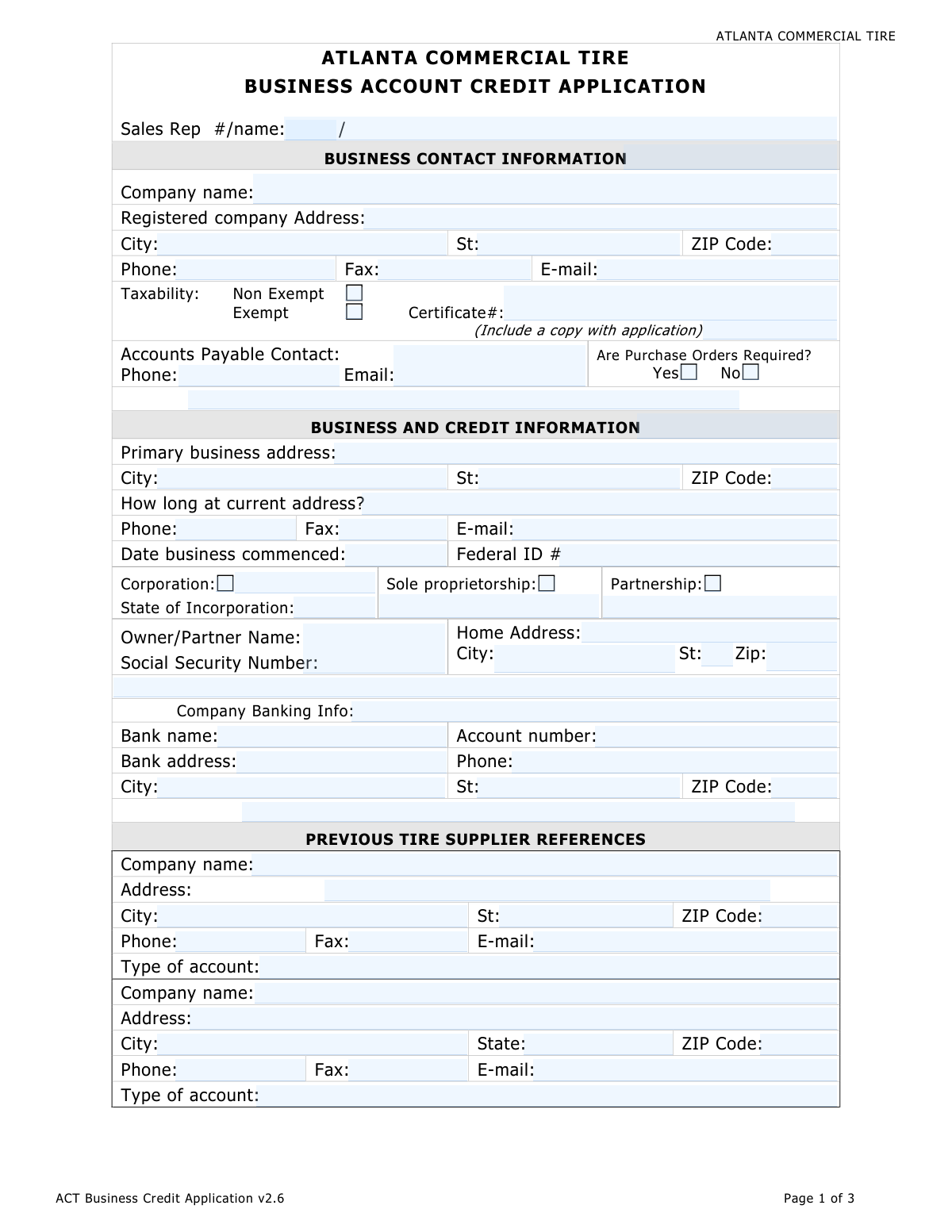
| 1. | Atlanta Commercial Tire Business Account Credit Application v2.6 | 3 | Complex 68 |
- Enterprise-grade security & data encryption
- 99%+ accuracy powered by AI
- 1,000+ forms from all industries
- Complete forms in under 60 seconds
How to Choose the Right Form
Not all business credit forms serve the same purpose. Here's how to quickly identify which one fits your situation.
Applying for Trade Credit with a Supplier?
If you're a business customer looking to establish a credit account with WestRock (a packaging and paper products supplier), choose the WestRock Credit Application and Uniform Sales & Use Tax Exemption/Resale Certificate — Multijurisdiction. This packet is ideal if you:
- Need to open a trade credit account with WestRock specifically
- Purchase goods for resale and want to avoid paying sales tax at checkout
- Operate across multiple states and need a single multijurisdiction exemption certificate
It bundles two critical documents — the credit application and the Multistate Tax Commission's resale/exemption certificate — so you can handle both credit setup and tax compliance in one submission.
Applying for Commercial Equipment Financing or a Lease?
If you need financing or a lease for commercial equipment, the Commercial and Lease Application (Rev. 02/2023) is the right choice. This form is designed for businesses that:
- Are seeking equipment financing or a commercial lease (not a supplier credit account)
- Need to provide guarantor or business owner information for underwriting
- Must acknowledge ECOA disclosures, credit report authorizations, and state-specific provisions
This is a lender-facing application, not a vendor credit form, making it distinct from the WestRock packet.
Quick Comparison
| Need | Form to Use |
|---|---|
| Supplier trade credit + sales tax exemption | WestRock Credit Application |
| Equipment financing or commercial lease | Commercial and Lease Application |
Both forms can be completed online using AI-powered tools on Instafill.ai, saving time and reducing errors before submission.
Form Comparison
| Form | Purpose | Who Files It | When to Use |
|---|---|---|---|
| WestRock Credit Application and Uniform Sales & Use Tax Exemption/Resale Certificate — Multijurisdiction | Establish trade credit and claim sales tax exemption for resale | Businesses purchasing from WestRock seeking credit terms | Opening a WestRock account or buying goods for resale |
| Commercial and Lease Application (Commercial Credit Application) (Rev. 02/2023) | Apply for commercial equipment financing or lease | Businesses and guarantors seeking equipment financing | Applying for commercial equipment loan or lease agreement |
Tips for business credit forms
Business credit forms typically require bank account details, trade references, and basic financial figures. Having your EIN, recent bank statements, and a list of trade references on hand before you begin will prevent you from stopping mid-form to track down information.
Lenders and creditors use your exact legal business name and entity type (LLC, corporation, sole proprietor, etc.) to pull credit reports and verify registrations. A mismatch between what you enter and your official state registration can delay approval or trigger additional verification steps.
On resale and tax exemption certificates like the Multijurisdiction form, each state requires its own valid seller's permit or registration number. Entering an incorrect or expired number can invalidate your exemption claim and expose your business to unexpected sales tax liability.
Creditors will contact the trade references you list, and an unresponsive reference can slow down your credit decision significantly. Give your references a heads-up so they're prepared to respond quickly and accurately when contacted.
AI-powered tools like Instafill.ai can complete business credit and tax exemption forms with high accuracy in under 30 seconds — a real time-saver when you're juggling multiple applications. Your data stays secure throughout the process, and Instafill.ai can even convert non-fillable PDF versions into interactive forms you can edit and submit easily.
Most business credit applications require a signature from an owner, officer, or authorized representative — and some require personal guarantor information as well. Confirm who in your organization has signing authority before completing the form to avoid having to restart or amend the application.
Combination packets — like a credit application bundled with a resale certificate — serve two distinct purposes, and each section has different compliance implications. Read through the entire packet before filling anything in so you understand which sections apply to your business type and which states you need to cover.
Retain a copy of every submitted credit application and tax exemption certificate, as you may need to resubmit them, reference your listed references, or prove exemption status during a sales tax audit. Organizing these documents by vendor or creditor makes them easy to locate when needed.
Frequently Asked Questions
Business credit forms are used by companies to apply for trade credit, commercial financing, or equipment leasing from vendors, lenders, or suppliers. They collect key information about your business — such as ownership details, financials, and references — so the creditor can assess your creditworthiness and establish account terms.
You would use the WestRock Credit Application and Uniform Sales & Use Tax Exemption/Resale Certificate (Multijurisdiction). This packet handles both the credit application and any applicable sales tax exemption in a single submission, streamlining the account setup process.
The Commercial and Lease Application (Rev. 02/2023) is designed for businesses seeking commercial equipment financing or lease arrangements. It collects business details, guarantor information, and required authorizations to support the underwriting process.
A resale certificate (or sales tax exemption certificate) allows a business to purchase goods for resale without paying sales tax at the point of purchase. Including it alongside a credit application — as in the WestRock packet — ensures that qualifying buyers are not incorrectly charged sales tax from the start of the business relationship.
The Multistate Tax Commission's Uniform Sales & Use Tax Exemption/Resale Certificate (Multijurisdiction) is designed to cover multiple states in a single document, though not all states accept it. You should verify which states in your transactions accept the multijurisdiction certificate and whether any require their own state-specific form.
Most business credit applications require your company's legal name, address, ownership and officer details, financial information, and bank and trade references. Some forms also require your business registration numbers, tax ID, and authorized signatures from owners or officers.
Lenders and creditors often require a personal guarantor — typically an owner or principal — to reduce their risk when extending credit to a business, especially for smaller or newer companies. The guarantor agrees to be personally responsible for the debt if the business defaults.
By signing, you typically authorize the creditor to pull your business (and sometimes personal) credit reports, share your information with affiliates or financing partners, and contact you through various channels. Applications like the Commercial and Lease Application also include Equal Credit Opportunity Act notices and any applicable state-specific disclosures.
Yes — AI-powered tools like Instafill.ai can fill out business credit forms in under 30 seconds by accurately extracting and placing data from your source documents. This reduces manual data entry errors and speeds up the application process, which is especially helpful when completing multi-page forms like the Commercial and Lease Application.
Manually completing a business credit form can take 15–30 minutes depending on the complexity and how readily available your business information is. Using an AI tool like Instafill.ai, the same forms can be populated in under 30 seconds, with data accurately extracted from existing business documents.
Submission instructions vary by form and creditor. The WestRock credit application is submitted directly to WestRock for account setup, while the Commercial and Lease Application is submitted to the financing company identified on the form. Always follow the specific submission instructions provided by the requesting organization.
Common mistakes include leaving required fields blank, providing inconsistent business names or tax IDs, omitting authorized signatures, and failing to include supporting documents like financial statements or state registration numbers. Double-checking all entries before submission helps prevent delays in credit approval or tax exemption processing.
Glossary
- Form Complexity Index
- Instafill’s 0–100 measure of how much effort a form takes to complete, calculated deterministically from the form’s own structure rather than estimated. It combines the number of fillable fields (the largest factor), how difficult those fields are to complete based on their type, the number of pages that contain fields, the amount of conditional “fill-only-if” logic, and how many sections the form is divided into, then adds modifiers for tables and repeating lists, bundled instruction pages, and dense page layouts. A higher score means the form is harder to fill out by hand. The forms in this category have a median Form Complexity Index of 68/100 (Complex). See exactly how it is calculated.
- Trade Credit
- An arrangement where a supplier allows a business customer to purchase goods or services now and pay later, typically within 30, 60, or 90 days. Business credit applications are used by suppliers to evaluate whether to extend this type of credit.
- Resale Certificate
- A document a buyer provides to a seller that certifies the purchased goods will be resold to end customers, allowing the buyer to make the purchase without paying sales tax. Each state has its own acceptance rules for these certificates.
- Sales & Use Tax Exemption
- A legal exemption that allows qualifying businesses to buy certain goods or services without paying state sales tax, typically because the items will be resold or used in a tax-exempt manner.
- Multijurisdiction Certificate
- A single standardized tax exemption or resale certificate accepted by multiple states, eliminating the need to complete a separate certificate for each state where you do business. The Multistate Tax Commission (MTC) publishes a widely used version.
- MTC (Multistate Tax Commission)
- A U.S. intergovernmental agency that helps states administer tax laws uniformly. It publishes the Uniform Sales & Use Tax Exemption/Resale Certificate used across participating states.
- Trade References
- Other businesses or suppliers that have previously extended credit to your company and can vouch for your payment history. Credit applications typically ask for two to three trade references to help assess creditworthiness.
- Guarantor
- An individual (often a business owner or officer) who personally agrees to repay a business debt if the business itself fails to do so. Commercial credit applications frequently require a personal guarantor, especially for small businesses.
- NMLS ID
- A unique identifier assigned through the Nationwide Multistate Licensing System, used to identify licensed financial service companies and individuals. You may see it on commercial lending or lease applications as a regulatory disclosure.
- ECOA (Equal Credit Opportunity Act)
- A U.S. federal law that prohibits lenders from discriminating against credit applicants based on race, color, religion, national origin, sex, marital status, age, or other protected characteristics. Credit applications include ECOA notices to inform applicants of their rights.
- Underwriting
- The process a lender or supplier uses to evaluate the financial risk of extending credit or financing to a business applicant, based on factors like credit history, financials, and references.