Fill out clinical practice forms
with AI.
Clinical practice forms are essential administrative tools used within healthcare systems to manage professional credentials, operational standards, and patient safety protocols. These documents serve as the formal record for verifying a practitioner's qualifications, professional indemnity, and adherence to continuing education requirements. By maintaining rigorous documentation, healthcare facilities can ensure that all medical personnel operate within their specific expertise and follow established governance frameworks.
By continuing, you acknowledge Instafill's Privacy Policy and agree to get occasional product update and promotional emails.
About clinical practice forms
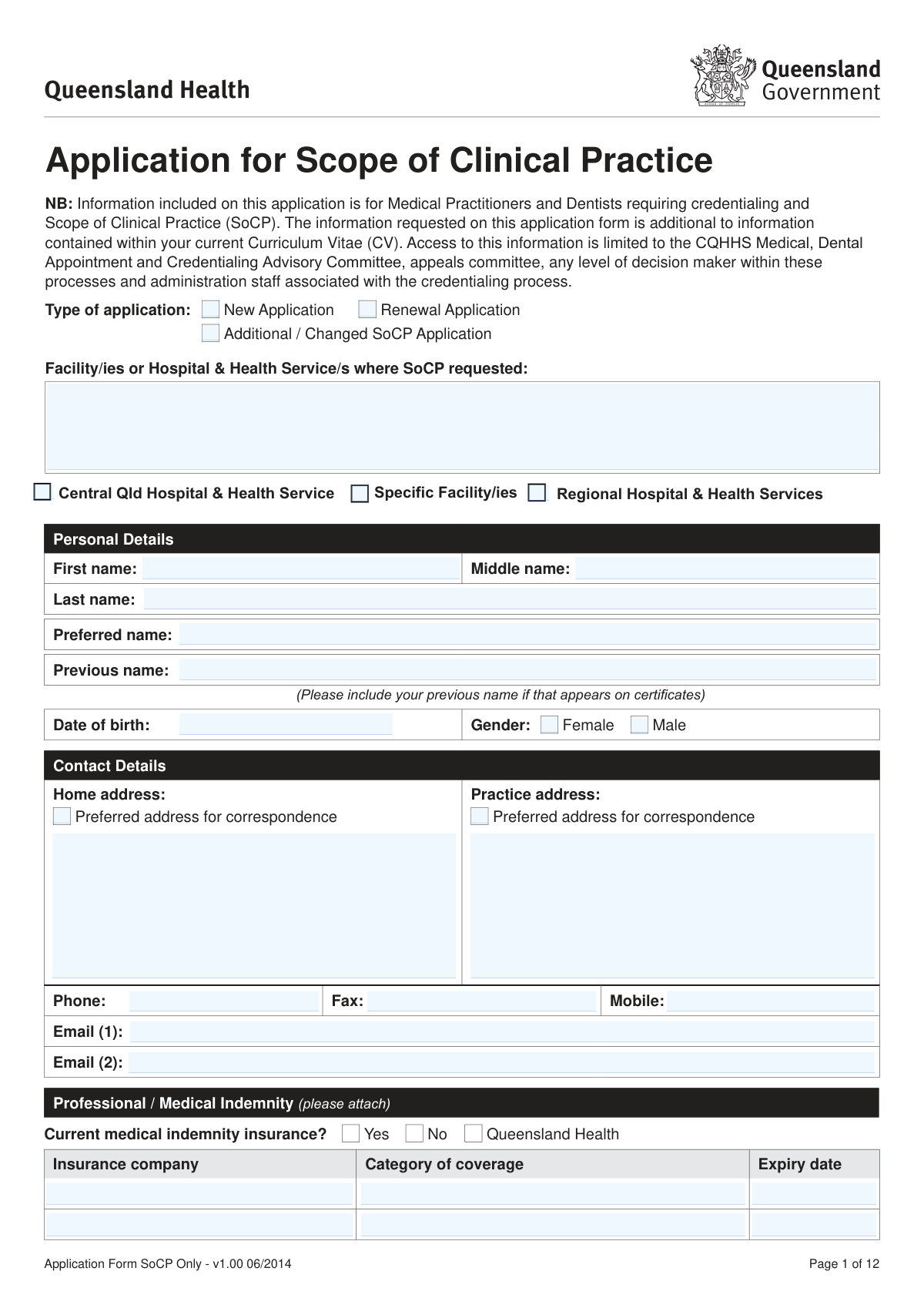
Typically, these forms are required by medical practitioners, dentists, and healthcare administrators during the credentialing and re-credentialing process. For instance, an Application for Scope of Clinical Practice (SoCP) is a critical document used to assess and approve the specific clinical activities a practitioner is permitted to perform at a given facility. Whether you are joining a new health service or updating your current clinical boundaries, these forms require precise details regarding your regulatory history, CPD participation, and peer references.
Completing such detailed paperwork manually can be a significant administrative drain on a clinician's schedule. Tools like Instafill.ai use AI to fill these forms in under 30 seconds, handling complex data accurately and securely to streamline the onboarding and compliance process.
Every form on this page can be completed without typing. Instafill is form filling software that reads a PDF and fills it for you — including flat and scanned documents that carry no fillable fields at all.
Forms in This Category
The forms in this category have a median Form Complexity Index of 83/100 (Very Complex), measured across 1 forms by field count, input difficulty, length, conditional logic and structure. See how it is calculated.
| Form Name | Pages | FCI | |
|---|---|---|---|
| 1. | Application for Scope of Clinical Practice (SoCP) – Application Form SoCP Only (v1.00 06/2014) | 12 | Very Complex 83 |
- Enterprise-grade security & data encryption
- 99%+ accuracy powered by AI
- 1,000+ forms from all industries
- Complete forms in under 60 seconds
How to Choose the Right Form
Selecting the correct clinical practice documentation is a critical step in maintaining professional compliance and ensuring patient safety. In this category, the focus is on formal credentialing and defining the boundaries of medical services within specific healthcare networks.
Defining Your Clinical Scope
The primary document available here is the Application for Scope of Clinical Practice (SoCP) – Application Form SoCP Only (v1.00 06/2014). This form is specifically designed for medical practitioners and dentists seeking to define or update their authorized clinical boundaries within Queensland Health facilities, such as the Central Queensland Hospital and Health Service.
When to Use This Form
You should select this form if you are a healthcare professional in the following scenarios:
- Initial Credentialing: You are applying for a position or visiting rights at a nominated facility and need to establish your initial scope of practice.
- Scope Review: You are an existing practitioner requesting a change or expansion to your currently approved clinical activities.
- Periodic Re-credentialing: You need to provide updated evidence of your ongoing competence and qualifications to maintain your current status.
What You Will Need
Before you begin filling out the Application for Scope of Clinical Practice (SoCP) using Instafill’s AI tools, ensure you have the following information ready to streamline the process:
- Professional Evidence: Current registration details, specialist qualifications, and recent Continuing Professional Development (CPD) records.
- Quality & Safety Data: Documentation of participation in quality improvement activities and current professional indemnity insurance coverage.
- References: Contact details for recent peer referees who can attest to your clinical performance.
- Mandatory Declarations: Relevant information regarding your regulatory history, any past investigations, and health status as it relates to your ability to practice safely.
Using this specific form ensures that the credentialing committee has a comprehensive view of your professional standing, supplementing the general information found in a standard CV with the specific governance data required by Queensland Health.
Form Comparison
| Form | Primary Purpose | Target Practitioners | Key Requirements | Clinical Governance |
|---|---|---|---|---|
| Application for Scope of Clinical Practice (SoCP) – Application Form SoCP Only (v1.00 06/2014) | Defines and approves specific clinical activities a practitioner is authorized to perform. | Medical practitioners and dentists seeking credentialing within Queensland Health facilities. | Evidence of qualifications, CPD, indemnity coverage, and mandatory safety declarations. | Assists credentialing committees in determining clinical boundaries and ensuring patient safety. |
Tips for clinical practice forms
Ensure you have digital copies of your current registration, medical qualifications, and professional indemnity insurance ready. Having these documents organized beforehand prevents the need to pause and search for specific details while completing the application.
Be precise when listing the specific clinical activities and procedures you are requesting permission to perform. Avoid vague descriptions to ensure the credentialing committee understands your exact expertise and authorized boundaries without needing further clarification.
Choose referees who have directly observed your clinical work within the last two to three years. Ensure their contact information is current, as delays in reference checks are a common cause of bottlenecks in the credentialing process.
Accuracy in the regulatory history and health condition sections is critical for patient safety and governance. Disclose all relevant information honestly to avoid administrative issues or potential delays during the review and approval process.
Clinical practice forms often require evidence of recent CPD participation and quality improvement activities. Keeping a categorized log of your training throughout the year makes it much easier to populate these sections accurately and quickly.
AI-powered tools like Instafill.ai can complete these complex forms in under 30 seconds with high accuracy. This is a real time-saver for practitioners dealing with multiple credentialing documents, and your sensitive professional data stays secure during the process.
Ensure all dates, qualifications, and employment history on the form align perfectly with your curriculum vitae. Inconsistencies between your application and your CV can trigger additional queries from the committee and slow down your authorization.
Frequently Asked Questions
Clinical practice forms are essential documents used by healthcare organizations to evaluate and define the specific medical or dental activities a practitioner is authorized to perform. These forms ensure that clinicians possess the necessary qualifications, training, and experience to provide safe patient care within a specific facility.
These forms are typically required for medical practitioners and dentists seeking to work within a health service, such as those governed by Queensland Health. Both new applicants and existing staff members looking to renew or amend their clinical privileges must complete these documents to maintain their standing.
While professional registration confirms a practitioner is licensed to practice nationally, the Scope of Clinical Practice (SoCP) defines the specific procedures and treatments they are permitted to perform at a particular hospital or clinic. It is a localized assessment of a clinician's specific competencies and the facility's ability to support those activities.
You should generally have your current Curriculum Vitae (CV), proof of professional registration, evidence of Continuing Professional Development (CPD) participation, and professional indemnity insurance details ready. Additionally, you will likely need contact information for recent peer referees who can verify your clinical skills and conduct.
Practitioners should submit these forms during their initial appointment, when their current credentials are due for renewal, or if they wish to expand their authorized clinical activities. Significant changes in health status or regulatory standing may also necessitate a review and update of a practitioner's scope of practice.
These declarations are mandatory for patient safety and organizational governance. They allow credentialing committees to assess any potential risks and ensure that all practitioners meet the high ethical and professional standards required to work in clinical environments.
Yes, you can use AI tools like Instafill.ai to fill out clinical practice forms by uploading your source documents, such as a CV or previous applications. The AI accurately extracts relevant professional data and places it into the corresponding fields, reducing the manual effort required for complex credentialing paperwork.
Using traditional manual entry, these forms can take a significant amount of time, but AI-powered tools can complete them in under 30 seconds. This technology ensures that data from your qualifications and experience is transferred precisely to the form, minimizing the risk of administrative errors.
Completed forms are usually submitted to the Medical Services department or the Credentialing and Scope of Clinical Practice Committee of the specific health facility where you intend to practice. It is important to follow the specific submission instructions provided by the health service or hospital board to ensure timely processing.
Once submitted, the application is reviewed by a credentialing committee that examines your qualifications, references, and declarations. They then provide a recommendation to a decision-maker, such as a Health Service Chief Executive, who officially approves or denies the requested scope of clinical practice.
Glossary
- Form Complexity Index
- Instafill’s 0–100 measure of how much effort a form takes to complete, calculated deterministically from the form’s own structure rather than estimated. It combines the number of fillable fields (the largest factor), how difficult those fields are to complete based on their type, the number of pages that contain fields, the amount of conditional “fill-only-if” logic, and how many sections the form is divided into, then adds modifiers for tables and repeating lists, bundled instruction pages, and dense page layouts. A higher score means the form is harder to fill out by hand. The forms in this category have a median Form Complexity Index of 83/100 (Very Complex). See exactly how it is calculated.
- Scope of Clinical Practice (SoCP)
- The specific range of clinical activities, procedures, and treatments a healthcare professional is authorized to perform within a particular health facility based on their training and competence.
- Credentialing
- The formal process of verifying a practitioner’s qualifications, experience, and professional standing to ensure they are fit to provide safe medical or dental services.
- Continuing Professional Development (CPD)
- A mandatory requirement for health practitioners to engage in ongoing learning and skill updates to maintain their registration and ensure clinical standards are met.
- Professional Indemnity Insurance
- Coverage that protects practitioners against legal liability for claims of negligence or breach of duty arising from their professional clinical services.
- Peer Reference
- A formal evaluation from a colleague in the same field who can verify the applicant's clinical performance, technical skills, and professional behavior.
- Clinical Boundaries
- The defined limits of a practitioner’s authority, specifying which patient groups they can treat and which complex procedures require additional oversight or referral.
- Regulatory History
- A record of a practitioner's standing with licensing boards, including any past investigations, restrictions, or disciplinary actions taken by health authorities.
- Mandatory Declaration
- A legally binding section of the form where the applicant must disclose sensitive information, such as criminal history or health conditions, that could impact patient safety.