Fill out environmental health forms
with AI.
Environmental health forms are essential for maintaining public safety and hygiene standards across various specialized industries. These documents serve as the primary communication channel between local health departments and the professionals whose work directly impacts community well-being. By standardizing the collection of data regarding sanitation protocols, facility safety, and professional qualifications, these forms ensure that all practitioners operate within legal frameworks designed to prevent the spread of infectious diseases and minimize environmental hazards.
By continuing, you acknowledge Instafill's Privacy Policy and agree to get occasional product update and promotional emails.
About environmental health forms
This category is particularly relevant for individuals in the personal care and body art sectors, such as those seeking practitioner licenses or facility permits. For instance, tattoo artists, piercers, and permanent cosmetic specialists must often submit detailed body art forms to demonstrate compliance with regulations like the California Safe Body Art Act. These applications typically require evidence of specialized training, vaccination records, and strict adherence to bloodborne pathogen standards, making them a vital necessity for both new applicants and those renewing their professional credentials.
Completing these regulatory documents accurately is crucial for staying compliant with local health codes and avoiding delays in licensure. Tools like Instafill.ai use AI to fill these forms in under 30 seconds, handling sensitive data accurately and securely to streamline the administrative process for busy professionals. This technology ensures that even non-fillable PDF versions are easily managed, allowing practitioners to focus on their services rather than paperwork.
Every form on this page can be completed without typing. Instafill is form filling software that reads a PDF and fills it for you — including flat and scanned documents that carry no fillable fields at all.
Forms in This Category
The forms in this category have a median Form Complexity Index of 45/100 (Basic), measured across 1 forms by field count, input difficulty, length, conditional logic and structure. See how it is calculated.
| Form Name | Pages | FCI | |
|---|---|---|---|
| 1. | Contra Costa Environmental Health Division Body Arts Practitioner Application | 3 | Basic 45 |
- Enterprise-grade security & data encryption
- 99%+ accuracy powered by AI
- 1,000+ forms from all industries
- Complete forms in under 60 seconds
How to Choose the Right Form
Environmental health forms cover a wide range of public safety regulations, but on this page, the focus is on documentation required for the body art industry. In Contra Costa County, maintaining a valid registration is a legal requirement for anyone performing skin-penetrating procedures to ensure public safety and compliance with state laws.
For Body Art Professionals in Contra Costa County
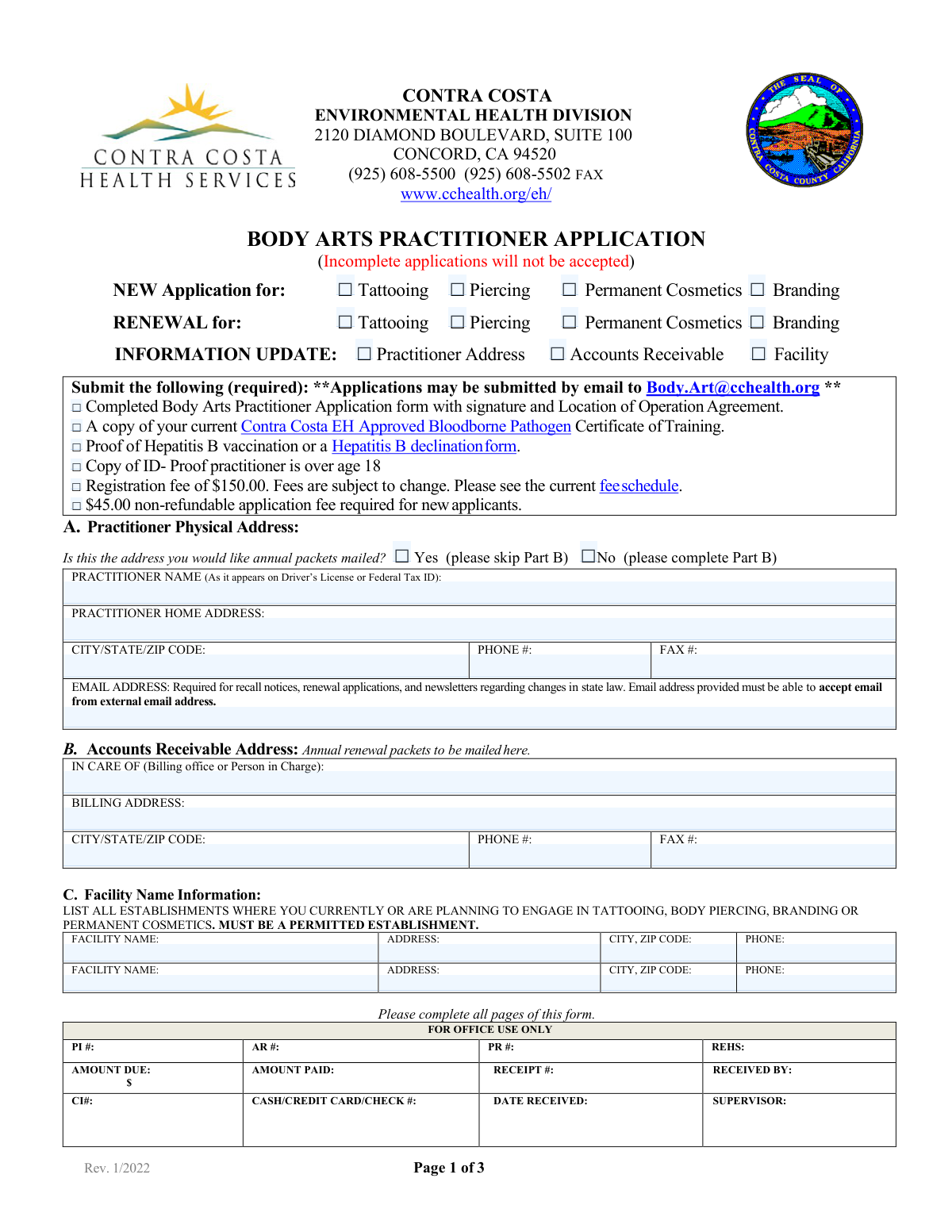
The primary form in this category is the Contra Costa Environmental Health Division Body Arts Practitioner Application. This document is essential for individuals specializing in several specific areas of body modification, including:
- Tattooing: Both traditional and modern ink application techniques.
- Body Piercing: Standard and specialized piercings involving skin penetration.
- Permanent Cosmetics: Services such as microblading, permanent eyeliner, and lip blushing.
- Branding: Specific body modification techniques categorized under the Safe Body Art Act.
Key Requirements for Your Application
To choose and complete this form correctly, ensure you meet the prerequisites mandated by the California Safe Body Art Act. You will typically need to provide:
- Proof of Training: Evidence of completed Bloodborne Pathogens training from an approved provider.
- Vaccination Records: Proof of Hepatitis B vaccination, evidence of immunity, or a formal signed declination.
- Age Verification: You must be at least 18 years of age and provide a valid government-issued photo ID.
Why This Form is Necessary
This specific environmental health form ensures that all practitioners operate under sanitary conditions, protecting both the artist and the client from infections. Whether you are an independent contractor or an employee at a licensed facility, you must maintain an individual practitioner registration with the county.
Streamline Your Submission
Filling out government applications can be complex. By using Instafill.ai, you can complete the Contra Costa Environmental Health Division Body Arts Practitioner Application quickly and accurately. Our AI-powered platform helps you navigate the fields efficiently, ensuring that your submission is professional and complete, which helps avoid delays in your registration process.
Form Comparison
| Form | Primary Purpose | Key Requirements | Scope of Services |
|---|---|---|---|
| Contra Costa Environmental Health Division Body Arts Practitioner Application | Official registration for body art practitioners operating in Contra Costa County, California. | Requires proof of age, Hepatitis B vaccination status, and bloodborne pathogen training. | Includes tattooing, permanent cosmetics, body piercing, and branding activities. |
Tips for environmental health forms
Before starting your application, ensure you have digital copies of your bloodborne pathogen training certificate and Hepatitis B vaccination records. Having these documents ready prevents delays since environmental health forms strictly require proof of compliance with the California Safe Body Art Act.
AI-powered tools like Instafill.ai can complete these complex forms in under 30 seconds with high accuracy by extracting data from your existing documents. Your sensitive personal and professional data stays secure during the process, making it an efficient way to handle multiple environmental health registrations.
Most practitioner applications require you to list the licensed body art facility where you will be working. Double-check that the shop’s health permit is current and that the facility name matches the official records held by the Environmental Health Division.
Missing a single signature or date can lead to an immediate rejection of your application by the county office. Carefully review the practitioner statement sections to ensure every required field is signed, as these represent your legal agreement to follow health and safety standards.
Environmental health departments often update their fee schedules annually. Before submitting, check the official department website to confirm the current registration fee to ensure your payment matches the latest requirements.
Ensure the name, address, and date of birth provided on the form exactly match your government-issued photo identification. Discrepancies between your ID and the application can cause administrative bottlenecks during the background verification process.
Body art registrations typically require annual or biennial renewals. Save a completed copy of your initial application to use as a reference for future filings, ensuring consistency in your professional history and training dates across multiple years.
Frequently Asked Questions
Environmental health forms are used by local government agencies to regulate activities that impact public health and safety. These forms often cover areas like food safety, hazardous materials, water quality, and body art services to ensure compliance with state and local laws.
Individuals who perform services such as tattooing, body piercing, permanent makeup, or branding must file these forms with their local environmental health department. These filings are necessary to register as a professional practitioner and demonstrate adherence to health standards.
Registration ensures that all practitioners follow the California Safe Body Art Act or similar local regulations designed to prevent the spread of bloodborne pathogens. It verifies that the artist has received proper training, is vaccinated, and operates in a sanitary environment.
Applicants often need to provide proof of completion for a Bloodborne Pathogens Exposure Control Training course and evidence of Hepatitis B vaccination or a formal declination. Additionally, valid government-issued identification is typically required to verify the applicant's identity.
These forms are generally submitted to the local County Environmental Health Division where the services will be performed. Submissions may be handled in person, by mail, or through digital portals depending on the specific county's administrative procedures.
Yes, you can use AI-powered tools like Instafill.ai to complete these forms quickly by extracting data from your existing documents. This technology ensures that information is placed accurately in the correct fields, reducing the risk of manual entry errors.
Using traditional manual entry can take significant time, but AI tools like Instafill.ai can fill these forms in under 30 seconds. This efficiency allows practitioners to focus more on their professional services rather than administrative paperwork.
Operating without proper registration from the Environmental Health Division is a violation of state law and can lead to fines, penalties, or the closure of the business. Maintaining current registration is essential for legal operation and consumer safety.
Yes, most environmental health registrations and permits for body art practitioners must be renewed on a regular basis, often annually. This ensures that the practitioner’s training and health records remain up to date with the latest safety standards.
While a general practitioner application often covers multiple services, specific forms may exist for facility permits or mobile body art units. It is important to check the local environmental health department's requirements to ensure you are using the correct form for your specific business model.
Glossary
- Form Complexity Index
- Instafill’s 0–100 measure of how much effort a form takes to complete, calculated deterministically from the form’s own structure rather than estimated. It combines the number of fillable fields (the largest factor), how difficult those fields are to complete based on their type, the number of pages that contain fields, the amount of conditional “fill-only-if” logic, and how many sections the form is divided into, then adds modifiers for tables and repeating lists, bundled instruction pages, and dense page layouts. A higher score means the form is harder to fill out by hand. The forms in this category have a median Form Complexity Index of 45/100 (Basic). See exactly how it is calculated.
- Body Art Practitioner
- An individual who performs procedures such as tattooing, body piercing, branding, or the application of permanent cosmetics.
- Bloodborne Pathogens (BBP)
- Infectious microorganisms in human blood that can cause disease in humans, such as Hepatitis B, Hepatitis C, and HIV.
- California Safe Body Art Act
- A state law that sets the standards for the body art industry to protect both the practitioner and the client from health risks.
- Hepatitis B Vaccination (HBV)
- A series of shots required for body art practitioners to prevent the spread of the Hepatitis B virus, which is easily transmitted through blood.
- Infection Prevention and Control Plan (IPCP)
- A written document that outlines the specific procedures a facility follows to prevent the spread of infections and diseases.
- Cross-contamination
- The unintentional transfer of bacteria or other harmful microorganisms from one surface, tool, or person to another.
- Permanent Cosmetics
- A specialized form of tattooing that applies pigments to the skin to mimic the appearance of makeup, such as eyeliner or eyebrow shading.
- Sharps Container
- A puncture-resistant, leak-proof container used for the safe disposal of needles and other sharp instruments used during body art procedures.