Fill out EU agency forms
with AI.
This category encompasses a specialized range of documentation required by various public and semi-public agencies. While many forms relate to housing and retirement management—specifically those overseen by the Housing Agency Retirement Trust (HART)—others cover interagency requests for status changes or specialized medical service authorizations. These forms are essential for maintaining legal compliance, securing financial distributions, and ensuring that specific benefits, such as behavioral health services or retirement rollovers, are processed without administrative delays.
By continuing, you acknowledge Instafill's Privacy Policy and agree to get occasional product update and promotional emails.
About EU agency forms
Typically, these documents are needed by employees of public agencies, healthcare providers, or individuals navigating complex regulatory environments. For instance, a staff member transitioning from a housing agency might use a 457(b) Distribution Form to manage their savings, while a behavior analyst might complete a Medicaid assessment to secure therapy for a patient. Because these documents often involve sensitive financial data or legal status—such as the Interagency Record of Request—accuracy is paramount to avoid the denial of benefits or the mismanagement of retirement assets.
Completing these documents manually can be a time-consuming process prone to clerical errors. Tools like Instafill.ai use AI to fill these agency forms in under 30 seconds, handling the data accurately and securely to ensure your submissions meet agency standards. This streamlined approach allows professionals and individuals to focus on their core responsibilities rather than administrative paperwork.
Every form on this page can be completed without typing. Instafill is form filling software that reads a PDF and fills it for you — including flat and scanned documents that carry no fillable fields at all.
Forms in This Category
The forms in this category have a median Form Complexity Index of 56/100 (Moderate), measured across 8 forms by field count, input difficulty, length, conditional logic and structure. See how it is calculated.
- Enterprise-grade security & data encryption
- 99%+ accuracy powered by AI
- 1,000+ forms from all industries
- Complete forms in under 60 seconds
How to Choose the Right Form
Navigating agency paperwork can be complex, especially when dealing with retirement funds, medical authorizations, or international status changes. To find the correct document, identify which agency you are interacting with and the specific nature of your request.
Housing Agency Retirement Trust (HART) Forms
If you are a participant in a HART retirement plan, your choice depends on whether you are moving funds, withdrawing them, or updating your account details:
- Consolidating Funds: Use the Housing Agency Retirement Trust Transfer/Rollover Form to move money from an outside 401(k), 403(b), or IRA into your HART account.
- Withdrawing Rollover Funds: If you specifically need to take money out of a rollover account you previously established, use Form #190, Request to Withdraw a Rollover Account.
- Leaving Employment: If you are terminating your employment and need to distribute your 457(b) funds, select The Housing Agency Retirement Trust 457(b) Deferred Compensation Plan Request For Distribution Form.
- Updating Heirs: To change who receives your assets in the event of your death, use the 457b Deferred Compensation Plan Change of Beneficiary Designation Form.
Healthcare & Medical Necessity
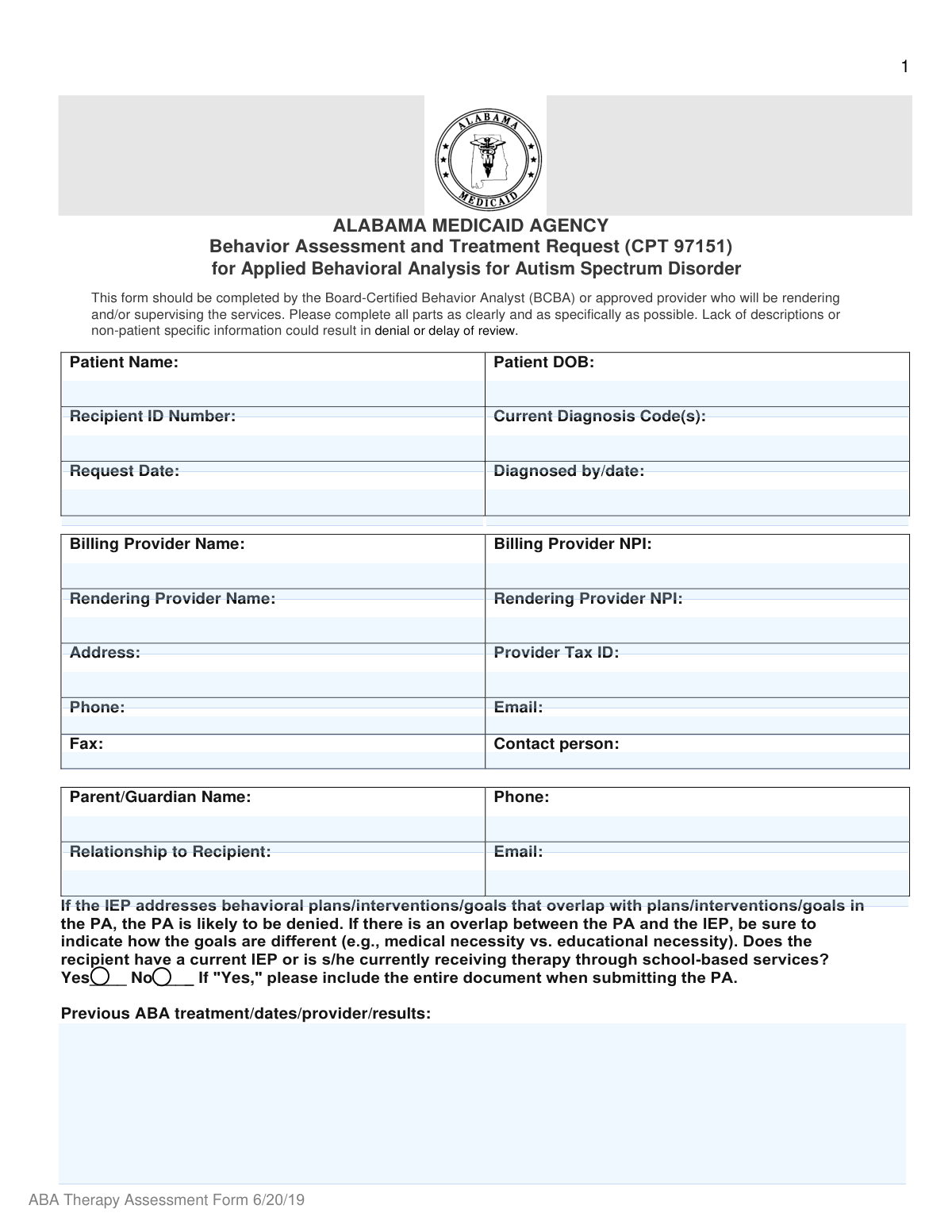
For healthcare providers in Alabama working with pediatric patients, the Alabama Medicaid Agency ABA Therapy Assessment Form (6/20/19) is the required document. This form is used by Board-Certified Behavior Analysts (BCBAs) to request authorization for Applied Behavioral Analysis (ABA) services for patients with Autism Spectrum Disorder, ensuring the medical necessity is clearly documented for Medicaid reimbursement.
International & Diplomatic Status
If you are a dependent of an A, G, or NATO visa holder, you will likely need Form I-566, Interagency Record of Request. This form is specifically used to coordinate between the Department of State and USCIS to request employment authorization or to change/adjust your legal status while in the United States.
Form Comparison
| Form | Purpose | Target Audience | Key Requirements | Jurisdiction |
|---|---|---|---|---|
| Form I-566, Interagency Record of Request | Requesting employment authorization or change of status for foreign official dependents | Dependents of A, G, or NATO visa holders | Diplomatic status verification and personal identification information | United States |
| European Public Prosecutor’s Office (EPPO) Application Form | Applying for specific job vacancies and professional roles within the office | Job candidates seeking employment at the EPPO agency | Professional history, language proficiency, and selection criteria responses | European Union |
Tips for EU agency forms
Whether you are filing for Medicaid or retirement benefits, ensure that your Social Security Number, employee ID, or case number is typed correctly. Agencies often use automated systems to match forms to records, and a single digit error can lead to an immediate rejection or significant processing delays.
When completing retirement or housing trust forms for withdrawals or rollovers, pay close attention to the tax withholding sections. Selecting a direct rollover to an IRA versus a cash payment can have significant tax consequences, so ensure your selection aligns with your financial goals before submitting.
For specialized agency forms like behavior assessments or medical necessity requests, avoid using generic language. Reviewers look for patient-specific data, measurable goals, and clear baselines to approve services, so ensure every field reflects the unique circumstances of the applicant.
You can significantly reduce the administrative burden by using AI-powered tools like Instafill.ai to complete these agency forms in under 30 seconds with high accuracy. These tools intelligently map your data to the correct fields while ensuring your sensitive personal information stays secure throughout the process.
When updating beneficiary designations or interagency records, always include contingent options where allowed. This ensures that your assets or legal status requests are protected even if your primary contact or beneficiary is unavailable, preventing future legal complications for your heirs or dependents.
Forms involving interagency requests or employment authorization often rely on strict timelines. Verify that your start dates, termination dates, and current status periods are accurate to ensure you remain in compliance with agency regulations and maintain your legal eligibility for benefits.
Frequently Asked Questions
EU agency forms are official documents used to interact with various decentralized bodies of the European Union, such as the European Medicines Agency (EMA) or the European Aviation Safety Agency (EASA). They facilitate specific administrative processes, including regulatory filings, grant applications, and professional certifications within the EU framework.
These forms are required by individuals, businesses, and legal entities operating within or interacting with the EU. This includes professionals seeking specific operating licenses, companies reporting regulatory data, and individuals applying for employment or benefits managed by EU-level organizations.
The correct form depends on your specific objective, such as requesting a permit, reporting compliance data, or changing your legal status. You should consult the official website of the relevant agency to ensure you are using the document designated for your specific procedure and jurisdiction.
Submission methods vary by agency; many now prefer electronic submission through dedicated portals or secure email systems. Always review the filing instructions included with the form to confirm whether you must submit the document digitally or mail a physical copy to a specific administrative office.
Most agency forms require supporting documentation such as proof of identity, professional certifications, financial records, or technical data relevant to the request. Providing incomplete documentation is a common reason for processing delays, so it is vital to review the checklist provided with each form before submission.
Yes, you can use AI tools like Instafill.ai to complete these forms quickly and efficiently. These tools can accurately extract relevant data from your source documents and place it into the correct fields on the form in under 30 seconds, reducing the risk of manual entry errors.
Processing times vary widely depending on the agency and the complexity of the request, ranging from a few business days to several months. Many agencies provide online tracking systems where you can monitor the status of your application using a reference number provided upon submission.
Many EU agencies now accept electronic signatures, particularly those that comply with eIDAS regulations for secure digital identification. However, some specific high-security or legal forms may still require a handwritten signature and physical mailing, so check the specific agency guidelines first.
Submitting an outdated version can lead to administrative delays or an immediate rejection of your application. It is important to download the most recent version of the form from a reliable source or use a platform that maintains up-to-date templates to ensure compliance with current regulations.
While manual entry can be time-consuming, using an AI-powered service like Instafill.ai allows you to fill out most agency forms in under 30 seconds. The technology ensures accuracy by automatically mapping information from your existing documents directly into the form's required fields.
While English is the primary working language for many EU agencies, official forms are frequently available in all official languages of the European Union. You should verify if the agency requires the form to be submitted in a specific language or if a translated version is acceptable for your specific filing.
For standard administrative requests, individuals and businesses can usually complete the forms themselves without professional help. However, for complex regulatory or legal matters, consulting with a specialist or legal advisor may be beneficial to ensure all technical and legal requirements are met correctly.
Glossary
- Form Complexity Index
- Instafill’s 0–100 measure of how much effort a form takes to complete, calculated deterministically from the form’s own structure rather than estimated. It combines the number of fillable fields (the largest factor), how difficult those fields are to complete based on their type, the number of pages that contain fields, the amount of conditional “fill-only-if” logic, and how many sections the form is divided into, then adds modifiers for tables and repeating lists, bundled instruction pages, and dense page layouts. A higher score means the form is harder to fill out by hand. The forms in this category have a median Form Complexity Index of 56/100 (Moderate). See exactly how it is calculated.
- Rollover
- The transfer of funds from one retirement account to another, typically used to consolidate savings without incurring immediate taxes or penalties.
- 457(b) Plan
- A tax-deferred retirement savings plan available to employees of state and local governments and certain non-profit organizations.
- Beneficiary Designation
- The legal naming of individuals or entities who are entitled to receive your account assets in the event of your death.
- Deferred Compensation
- An arrangement where a portion of an employee's earnings is set aside to be paid at a later date, usually after retirement, to provide tax benefits.
- ABA (Applied Behavior Analysis)
- A therapeutic approach used to improve social, communication, and learning skills through positive reinforcement, commonly used for individuals with Autism Spectrum Disorder.
- CPT Code
- Current Procedural Terminology codes are a standardized set of five-digit numbers used by healthcare providers to bill insurance for specific medical services.
- NATO Dependent
- A family member of a foreign military official stationed in the United States under the North Atlantic Treaty Organization who may require specific work authorization.
- Interagency Record
- A document used to coordinate and track requests between different government departments, such as the Department of State and Homeland Security.