Fill out Florida contractor forms
with AI.
Florida contractor forms are official documents required by the state's Department of Business and Professional Regulation (DBPR) and its Construction Industry Licensing Board (CILB) to obtain, maintain, or update contractor licenses and certifications. These forms play a critical role in ensuring that contractors operating across Florida meet the state's legal, financial, and professional standards before they're permitted to perform contracting work. Getting them right matters — incomplete or incorrect submissions can lead to processing delays, deficiency notices, or outright denial of licensure.
By continuing, you acknowledge Instafill's Privacy Policy and agree to get occasional product update and promotional emails.
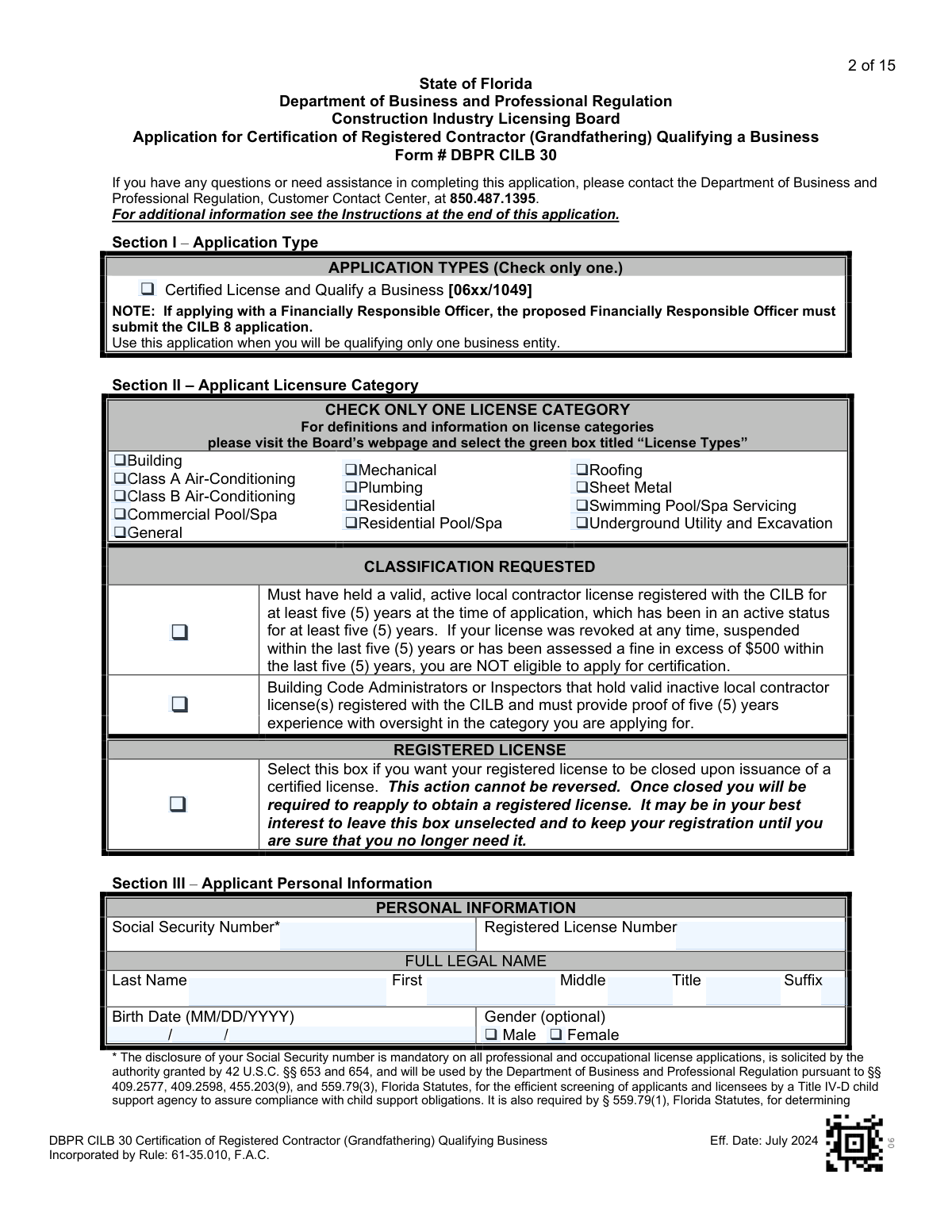
About Florida contractor forms
These forms are typically needed by contractors seeking initial certification, those qualifying a business entity for statewide contracting privileges, or professionals updating their credentials after a change in business structure. A form like the DBPR CILB 6-A, for example, is used by certified general contractors who want to simultaneously apply for state certification and qualify a business to operate under their license — a process that requires detailed personal, financial, employment, and background information from multiple parties.
Because these applications are often lengthy and involve complex multi-section requirements, accuracy is essential. Tools like Instafill.ai use AI to help applicants fill out these forms in under 30 seconds, reducing the risk of errors and making the process significantly more manageable for busy contractors and their administrative teams.
Every form on this page can be completed without typing. Instafill is form filling software that reads a PDF and fills it for you — including flat and scanned documents that carry no fillable fields at all.
Forms in This Category
The forms in this category have a median Form Complexity Index of 87/100 (Very Complex), measured across 2 forms by field count, input difficulty, length, conditional logic and structure. See how it is calculated.
- Enterprise-grade security & data encryption
- 99%+ accuracy powered by AI
- 1,000+ forms from all industries
- Complete forms in under 60 seconds
How to Choose the Right Form
With only one form currently in this category, choosing is straightforward — but understanding *when* and *why* you need it is key to avoiding costly mistakes.
Who Should Use DBPR CILB 6-A
The DBPR CILB 6-A, Application for Certified General Contractor Who is Qualifying a Business is the right form if you meet all of the following criteria:
- You are a certified general contractor in Florida (or applying to become one)
- You want to qualify a single business entity to perform contracting work statewide
- You are applying for initial certification — not a renewal or change of qualifying agent
When This Form Does NOT Apply
Skip this form if your situation is different:
- Renewing an existing license — CILB has separate renewal forms for that
- Changing the qualifying agent for an already-licensed business — a different DBPR form is required
- Applying as a registered (not certified) contractor — registered contractors operate at the local level and use different applications
- Qualifying multiple businesses — CILB 6-A covers only one business entity per application
What to Have Ready Before You Start
This is a detailed, multi-section form. Before filling it out, gather:
- Personal identification and employment history
- Business ownership and entity formation documents
- Proof of insurance coverage
- Financial responsibility documentation
- Background disclosure information for all owners
Tips for Completing This Form
Errors or omissions on DBPR CILB 6-A can lead to delays, deficiency notices, or outright denial of licensure. Using an AI-powered tool like Instafill.ai can help you fill out each section accurately — especially useful if your copy is a non-fillable PDF that needs to be converted into an interactive format first.
Form Comparison
| Form | Purpose | Who Files It | When to Use |
|---|---|---|---|
| DBPR CILB 6-A, Application for Certified General Contractor Who is Qualifying a Business | Apply for statewide certified general contractor license and qualify a business | Certified general contractors qualifying a single Florida business entity | When seeking initial statewide certification while qualifying a business |
Tips for Florida contractor forms
The DBPR CILB 6-A requires detailed employment history, insurance certificates, financial data, and business ownership information. Collecting these documents in advance — including proof of experience and liability coverage — prevents you from leaving critical sections incomplete or submitting inaccurate details.
This form qualifies a specific business entity to perform contracting work statewide, so the business name, ownership percentages, and registration details must match your official Florida state records exactly. Even minor discrepancies between your form and state business filings can trigger a deficiency notice and delay your license.
The application includes background disclosure questions for both the applicant and authorized business representatives. Failing to disclose past violations, judgments, or disciplinary actions — even minor ones — is considered a more serious issue than the underlying incident itself, and can result in denial.
The CILB requires specific types and minimum amounts of insurance coverage for certification. Make sure your general liability and workers' compensation policies are active and meet Florida's current thresholds before submitting, as outdated or insufficient coverage is a common reason for deficiency notices.
The DBPR CILB 6-A is a lengthy, multi-section form that's easy to fill out incorrectly. AI-powered tools like Instafill.ai can complete it in under 30 seconds with high accuracy, and your data stays secure throughout the process — a real time-saver when you're juggling licensing requirements alongside active construction work.
Older versions of DBPR forms are sometimes distributed as non-fillable PDFs, making it tempting to handwrite responses — which can reduce legibility and increase processing errors. Services like Instafill.ai can convert these into interactive fillable forms, ensuring your submission is clean and easy for reviewers to process.
Before sending your application to the DBPR, save or print a full copy of every page, including attachments and supporting documents. If the board issues a deficiency notice or requests additional information, having your original submission on hand makes it much faster to identify and correct the issue.
Frequently Asked Questions
Florida contractor forms are official state documents used to apply for, renew, or modify contractor licenses and business qualifications in Florida. They are issued by agencies such as the Department of Business and Professional Regulation (DBPR) and the Construction Industry Licensing Board (CILB). These forms ensure that contractors meet the state's legal, financial, and professional requirements before performing contracting work.
DBPR forms are official documents issued by Florida's Department of Business and Professional Regulation, the agency that oversees licensing for a wide range of professions and businesses, including contractors. The Construction Industry Licensing Board (CILB) operates under the DBPR and issues forms specific to contractor licensing. Submitting the correct DBPR form is required to initiate or update your contractor license status in Florida.
The DBPR CILB 6-A form is required for any certified general contractor in Florida who wants to apply for initial statewide certification and simultaneously qualify a business entity to perform contracting work. Both the individual contractor and the business they are qualifying must be represented in the application. This form is not for license renewals or adding additional business qualifications — it is specifically for new certification combined with business qualification.
In Florida, contractor certification is the individual license that allows a person to legally perform contracting work statewide. Qualifying a business means that a licensed contractor takes legal and professional responsibility for the work performed by a specific business entity. The DBPR CILB 6-A form handles both processes simultaneously, making it the appropriate form when a contractor is seeking initial certification and wants to qualify a business at the same time.
Completed Florida contractor forms are typically submitted to the Department of Business and Professional Regulation (DBPR), either by mail, in person at a DBPR service center, or through the DBPR's online portal if available. It is important to check the most current submission instructions on the official DBPR website, as submission methods and addresses may change. Including all required supporting documents and fees with your application helps avoid processing delays.
Florida contractor applications generally require supporting documentation such as proof of insurance, financial statements, employment history records, background disclosure information, and business entity documents. The specific requirements vary by form type and license category, so applicants should review the checklist provided with the form. Missing or incomplete documentation is one of the most common reasons for application delays or deficiencies.
Processing times for Florida contractor applications can vary depending on application volume, completeness of the submission, and whether additional information is requested. The DBPR may issue a deficiency notice if required documents or information are missing, which can extend the timeline. Applicants are encouraged to check the DBPR's website or contact them directly for current processing time estimates.
Yes, AI-powered tools like Instafill.ai allow you to fill out Florida contractor forms, including the DBPR CILB 6-A, online quickly and accurately. These tools can extract and place data from your source documents into the correct form fields in under 30 seconds, significantly reducing the chance of errors or omissions. Instafill.ai can also convert non-fillable PDF versions of these forms into interactive, fillable formats.
Using an AI tool like Instafill.ai, you can complete a Florida contractor form such as the DBPR CILB 6-A in under 30 seconds by uploading your source documents and letting the AI accurately extract and populate the required fields. This is significantly faster than manually entering information across the form's many sections. The result is a completed, ready-to-submit form with reduced risk of data entry mistakes.
Yes, certified contractor licenses issued by the CILB under the DBPR are valid throughout the entire state of Florida, which is one of the key advantages of state certification over local registration. This means a certified general contractor can perform qualifying work for a business anywhere in Florida without needing separate local licenses. However, contractors should always verify local permit and inspection requirements, as municipalities may have additional rules.
Errors or omissions on Florida contractor applications like the DBPR CILB 6-A can result in the DBPR issuing a deficiency notice, which pauses processing until the issue is corrected. In more serious cases, an incomplete or inaccurate application may be denied outright. To avoid these outcomes, it is important to review all sections carefully before submitting and to use tools or resources that help ensure accuracy.
Yes, the DBPR CILB 6-A is designed for qualifying a single business entity. If a certified contractor wants to qualify additional businesses, separate applications or forms may be required for each additional entity. Contractors should consult the DBPR or CILB guidelines to determine the correct forms needed for qualifying multiple business entities.
Glossary
- Form Complexity Index
- Instafill’s 0–100 measure of how much effort a form takes to complete, calculated deterministically from the form’s own structure rather than estimated. It combines the number of fillable fields (the largest factor), how difficult those fields are to complete based on their type, the number of pages that contain fields, the amount of conditional “fill-only-if” logic, and how many sections the form is divided into, then adds modifiers for tables and repeating lists, bundled instruction pages, and dense page layouts. A higher score means the form is harder to fill out by hand. The forms in this category have a median Form Complexity Index of 87/100 (Very Complex). See exactly how it is calculated.
- DBPR
- The Florida Department of Business and Professional Regulation, the state agency responsible for licensing and regulating contractors, businesses, and professions across Florida.
- CILB
- The Construction Industry Licensing Board, a board within DBPR that oversees the licensing, examination, and discipline of construction contractors in Florida.
- Qualifying Agent
- A licensed contractor who takes legal and financial responsibility for all construction work performed by a business entity, effectively 'qualifying' that business to operate under their license.
- Certified General Contractor
- A contractor who holds a state-issued Florida certification allowing them to perform a wide range of construction work anywhere in the state, as opposed to a registered contractor who is limited to specific counties or municipalities.
- Statewide Certification
- A Florida contractor license that is valid throughout the entire state, issued by DBPR/CILB, rather than a local or county-level registration.
- Business Entity Qualification
- The process by which a licensed contractor formally associates their license with a specific company (such as an LLC or corporation), legally authorizing that business to perform contracting work in Florida.
- Financial Responsibility
- A licensing requirement in which applicants must demonstrate they can meet financial obligations, typically by disclosing credit history, bankruptcies, liens, and other financial data on the application.
- Deficiency
- A notice issued by DBPR indicating that a submitted application is incomplete or contains errors, requiring the applicant to provide additional information before the application can be processed.
- Background Disclosure
- A section of contractor applications requiring applicants to disclose past criminal convictions, disciplinary actions, or license revocations, which DBPR uses to evaluate an applicant's fitness for licensure.