Fill out real estate tax forms
with AI.
Real estate tax forms are official documents used by property owners, landlords, and investors to report financial information related to their properties for tax assessment and appeal purposes. In New York City, these forms play a particularly important role — property owners who believe their assessed value is inaccurate must submit detailed supporting documentation to the NYC Tax Commission as part of a formal appeal. Forms like the TC201, which requires two years of income and expense data for rent-producing properties, give tax authorities the financial picture they need to evaluate whether an assessment is fair.
By continuing, you acknowledge Instafill's Privacy Policy and agree to get occasional product update and promotional emails.
About real estate tax forms
These forms are typically needed by landlords, real estate investors, and property managers who own income-generating buildings — from small residential rentals to larger mixed-use or commercial properties. They're most commonly filed during assessment appeal cycles, and missing a deadline or submitting incomplete information can seriously affect the outcome of an appeal.
Because these forms often require precise financial figures and must meet strict formatting requirements, accuracy matters as much as timeliness. Tools like Instafill.ai use AI to fill these forms in under 30 seconds, handling the data accurately and securely — a practical time-saver during what can already be a stressful filing period.
Every form on this page can be completed without typing. Instafill is form filling software that reads a PDF and fills it for you — including flat and scanned documents that carry no fillable fields at all.
Forms in This Category
The forms in this category have a median Form Complexity Index of 75/100 (Complex), measured across 1 forms by field count, input difficulty, length, conditional logic and structure. See how it is calculated.
| Form Name | Pages | FCI | |
|---|---|---|---|
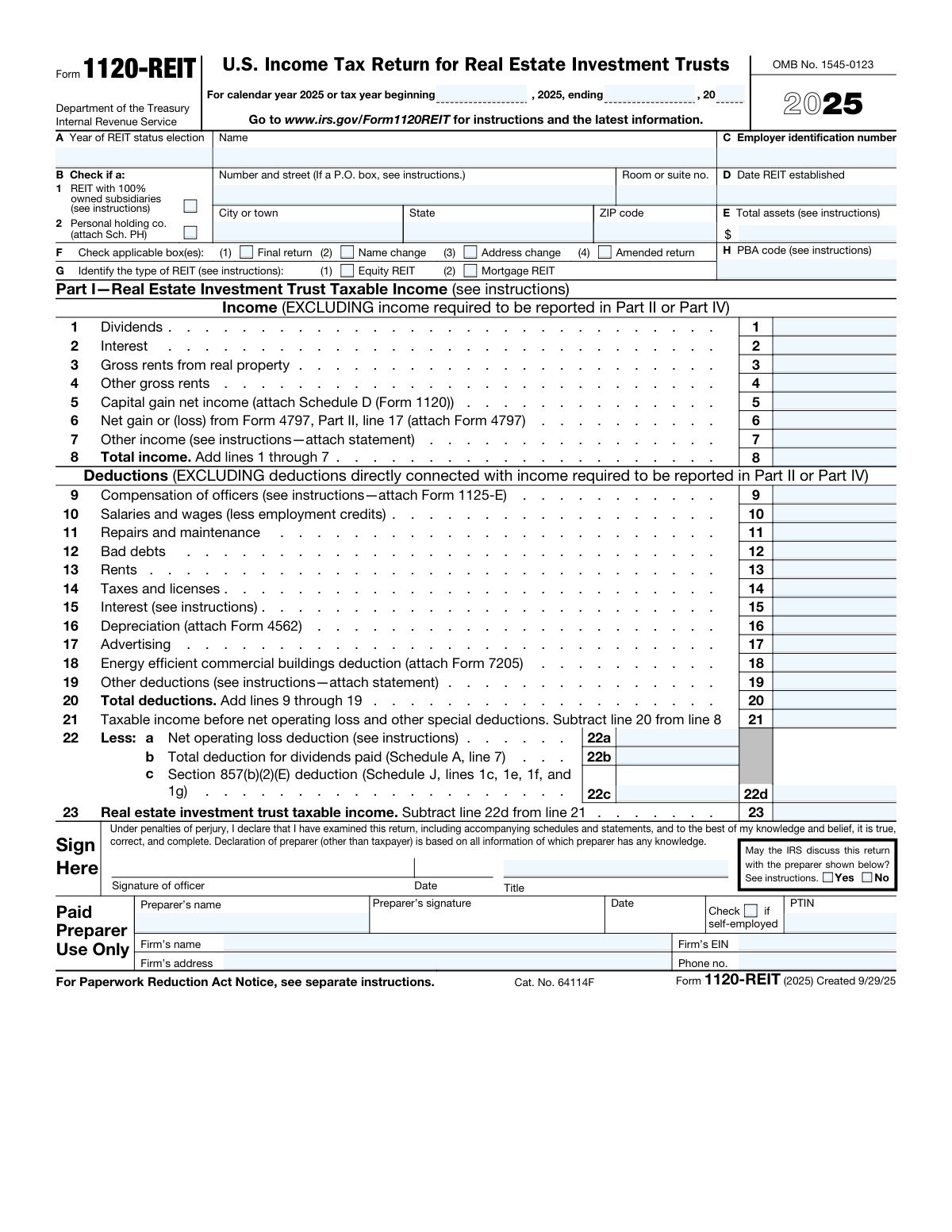
| 1. | Form 1120-REIT, U.S. Income Tax Return for Real Estate Investment Trusts | 5 | Complex 75 |
- Enterprise-grade security & data encryption
- 99%+ accuracy powered by AI
- 1,000+ forms from all industries
- Complete forms in under 60 seconds
How to Choose the Right Form
With only one form in this category, the decision is straightforward — but it's important to confirm this is the right form for your specific situation before you begin.
Who Should Use TC201
TC201, Income and Expense Schedule for Rent-Producing Property is designed for:
- NYC property owners who are appealing their property's assessed value with the New York City Tax Commission
- Owners of rent-producing properties — including residential rental buildings and nonresidential income-generating properties
- Those filing for the 2026/27 assessment year
Key Things to Know Before You Start
- TC201 cannot be filed on its own. It must be attached to your main Tax Commission assessment appeal application. If you don't have that application ready, complete it first.
- You'll need two years of financial data, including detailed income and expense figures, lease information, and occupancy breakdowns.
- The form covers both residential and nonresidential occupancy, so have your rent rolls and operating statements on hand.
Is This Form Right for You?
- ✅ Use TC201 if you own a rent-producing property in New York City and are challenging your assessed value
- ❌ Skip this form if your property is owner-occupied or not income-producing — a different schedule will apply
- ❌ This form is not valid for prior assessment years, so confirm you're filing for 2026/27
Tips for Accurate Completion
TC201 requires precise financial reporting — errors or omissions can affect the outcome of your appeal. Using an AI-powered tool like Instafill.ai can help you fill out the form accurately, and can convert non-fillable PDF versions into interactive forms for easier completion.
Form Comparison
| Form | Purpose | Who Files It | When to Use |
|---|---|---|---|
| TC201, Income and Expense Schedule for Rent-Producing Property | Report income and expenses to support property assessment appeal | NYC property owners of rent-producing properties | Filing assessment appeal for 2026/27 tax year |
Tips for real estate tax forms
The TC201 is not a standalone form — it must be filed together with your assessment appeal application to the NYC Tax Commission. Submitting it separately renders it invalid, which could jeopardize your appeal. Double-check that all required documents are bundled before submission.
TC201 requires income and expense figures for two consecutive years, so collect your rent rolls, operating statements, and expense receipts before you start filling out the form. Trying to locate financial records mid-form leads to errors and delays. Having everything organized upfront makes the process significantly smoother.
The Tax Commission uses the data on TC201 to determine whether your property's assessed value is justified, so underreporting or overreporting figures can work against you. Cross-reference your numbers with actual lease agreements, bank statements, and tax records. Consistency between your reported figures and supporting documents is key.
TC201 requires separate reporting for residential and nonresidential spaces, including specific lease terms and tenant details. Property owners often forget to include commercial tenant information or leave lease expiration dates blank. Review each section carefully to ensure all occupancy types are fully documented.
AI-powered tools like Instafill.ai can fill out complex forms like the TC201 quickly and accurately, saving you significant time — especially if you're managing multiple properties or appeals. Your data stays secure throughout the process, and the tool can even convert non-fillable PDF versions into interactive forms. It's a practical time-saver for property owners navigating NYC's tax commission process.
NYC tax forms are updated annually, and using a prior year's version of TC201 can result in your appeal being rejected. Confirm that the form you're using is valid for the current assessment year (e.g., 2026/27) before filling it out. Always download the latest version from an official or trusted source.
Once you submit your TC201 and appeal application, retain copies of everything — including your reported income figures, expense breakdowns, and lease summaries. If the Tax Commission requests clarification or a hearing is scheduled, having your original submission on hand is essential. Digital copies stored securely are easiest to retrieve quickly.
Frequently Asked Questions
Real estate tax forms in New York City are used by property owners to report financial and property information to city tax authorities, often as part of assessment appeals or compliance filings. They help the NYC Tax Commission evaluate whether a property's assessed value accurately reflects its income-generating potential and market conditions.
Owners of rent-producing properties — including residential and nonresidential buildings — who are appealing their property's assessed value with the NYC Tax Commission are typically required to submit an Income and Expense schedule. This applies to landlords and property managers whose buildings generate rental income and who believe their assessment is incorrect.
The TC201 is an official NYC Tax Commission schedule that property owners must attach to their assessment appeal application to report detailed income and expense data for rent-producing properties. It is required for the 2026/27 assessment year and covers two years of financial information, including lease details and occupancy data.
No — the TC201 is not valid if filed separately. It must be attached to the main assessment appeal application submitted to the NYC Tax Commission. Filing it alone will not be accepted or processed.
You will generally need two years of financial records for your property, including rental income, operating expenses, lease details, and occupancy information for both residential and nonresidential units. Having accurate and organized financial records before you begin filling out the form will make the process significantly faster.
The NYC Tax Commission uses the income and expense data you report to determine whether your property's assessed value is appropriate. Inaccurate or incomplete information could result in an unsuccessful appeal or an assessment that does not reflect your property's actual financial performance.
The TC201 must be submitted to the New York City Tax Commission as part of your assessment appeal application. The Tax Commission accepts filings through its official process, and property owners should check the NYC Tax Commission's website for the most current submission instructions and deadlines.
Yes — NYC property tax assessment appeals are subject to specific filing deadlines set by the Tax Commission each year. Missing these deadlines can disqualify your appeal, so it's important to check the Tax Commission's official calendar for the current assessment year's cutoff dates.
Yes — AI-powered tools like Instafill.ai can fill out forms like the TC201 in under 30 seconds by accurately extracting and placing data from your source documents. Instafill.ai can also convert non-fillable PDF versions of these forms into interactive, fillable formats, making the process faster and less error-prone.
Manually completing detailed income and expense schedules can take considerable time, especially when gathering two years of financial data. Using AI tools like Instafill.ai, the form-filling process itself can be completed in under 30 seconds, with data accurately extracted and placed from your existing financial documents.
While it is not always legally required to hire a tax professional, many property owners choose to work with an attorney or accountant familiar with NYC property tax law, especially for complex properties or significant assessment disputes. Ensuring your income and expense data is accurate and complete is critical regardless of who fills out the form.
Errors or omissions on forms like the TC201 can undermine your assessment appeal, as the Tax Commission relies on this data to evaluate your property's value. It's important to review all figures carefully before submission, and using AI-assisted tools can help reduce data entry mistakes during the filing process.
Glossary
- Form Complexity Index
- Instafill’s 0–100 measure of how much effort a form takes to complete, calculated deterministically from the form’s own structure rather than estimated. It combines the number of fillable fields (the largest factor), how difficult those fields are to complete based on their type, the number of pages that contain fields, the amount of conditional “fill-only-if” logic, and how many sections the form is divided into, then adds modifiers for tables and repeating lists, bundled instruction pages, and dense page layouts. A higher score means the form is harder to fill out by hand. The forms in this category have a median Form Complexity Index of 75/100 (Complex). See exactly how it is calculated.
- Assessed Value
- The dollar value assigned to a property by a government assessor, used as the basis for calculating property taxes. Property owners who believe this value is too high can appeal to the Tax Commission.
- Tax Commission
- The New York City Tax Commission is an independent agency that hears and decides appeals from property owners who dispute the assessed value of their property set by the NYC Department of Finance.
- Assessment Appeal
- A formal request by a property owner to have their property's assessed value reviewed and potentially reduced. The TC201 must be attached to this application for rent-producing properties.
- TC201
- The official NYC Tax Commission Income and Expense Schedule required for rent-producing properties, submitted alongside an assessment appeal application to provide two years of financial data.
- Rent-Producing Property
- Any property that generates rental income from residential or nonresidential tenants, such as apartment buildings, mixed-use buildings, or commercial spaces.
- Assessment Year
- The specific fiscal year for which a property's value is being assessed and taxed. For example, the 2026/27 assessment year refers to the tax period beginning July 1, 2026.
- Income and Expense Schedule
- A detailed financial report listing a property's gross income (rents collected) and operating expenses (maintenance, utilities, insurance, etc.) used to help determine the property's market value.
- Nonresidential Occupancy
- Portions of a property leased to commercial tenants such as retail stores, offices, or businesses, as opposed to residential tenants who use the space as a home.
- Net Operating Income (NOI)
- The total rental income a property earns minus its operating expenses, excluding mortgage payments. Tax assessors often use NOI to estimate a property's market value.
- Capitalization Rate (Cap Rate)
- A percentage used by assessors to convert a property's net operating income into an estimated market value. A higher cap rate generally results in a lower assessed value.