Yes! You can use AI to fill out ACORD 129, Vehicle Schedule (2009/11)

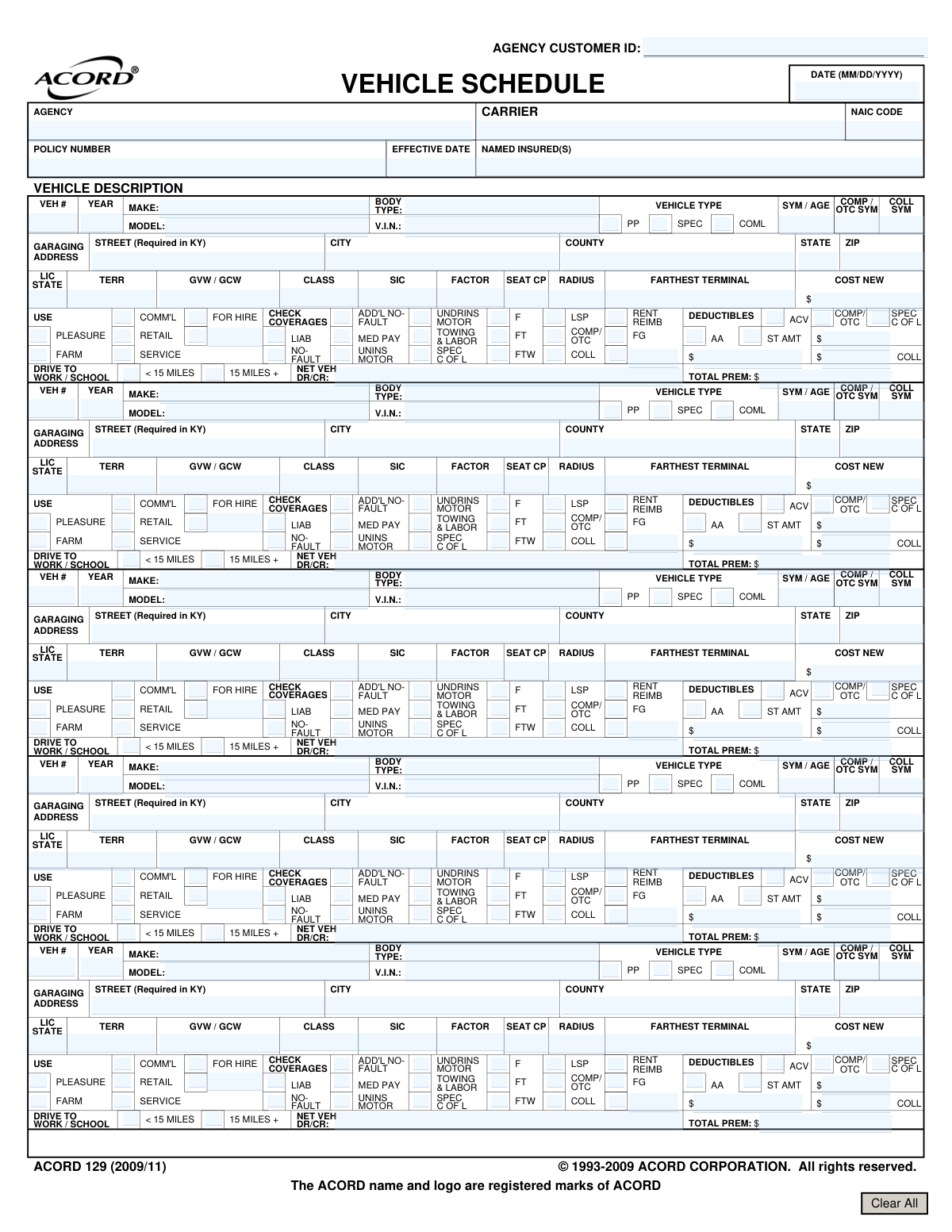
ACORD Form 129, also known as the Vehicle Schedule, is a standardized document in the insurance industry used to provide detailed information about each vehicle being insured under a policy. It captures essential data such as vehicle identification number (VIN), make, model, garaging address, usage, and the specific coverages and deductibles requested for each vehicle. Today, this form can be filled out quickly and accurately using AI-powered services like Instafill.ai, which can also convert non-fillable PDF versions into interactive fillable forms.
ACORD 129 is part of the commercial insurance forms category on Instafill.
Our AI automatically handles information lookup, data retrieval, formatting, and form filling.
It takes less than a minute to fill out ACORD 129 using our AI form filling.
Securely upload your data. Information is encrypted in transit and deleted immediately after the form is filled out.

Form specifications

Form name: ACORD 129, Vehicle Schedule (2009/11)
Number of fields: 334
Number of pages: 1
Language: English
main-image

Instafill Demo: How to fill out PDF forms in seconds with AI

How to Fill Out ACORD 129 Online for Free in 2026

Are you looking to fill out a ACORD 129 form online quickly and accurately? Instafill.ai offers the #1 AI-powered PDF filling software of 2026, allowing you to complete your ACORD 129 form in just 37 seconds or less.
Follow these steps to fill out your ACORD 129 form online using Instafill.ai:
  1. 1 Navigate to Instafill.ai and upload or select the ACORD 129 Vehicle Schedule form.
  2. 2 Enter the basic policy information at the top, including the agency, carrier, named insured, and policy number.
  3. 3 For each vehicle to be insured, input its description: year, make, model, body type, and the full Vehicle Identification Number (V.I.N.).
  4. 4 Provide the garaging address where each vehicle is kept, its primary use (e.g., pleasure, commercial), and other rating factors like radius of operation.
  5. 5 Select the desired insurance coverages for each vehicle by checking the appropriate boxes (e.g., Liability, Collision, Comprehensive) and specify the deductible amounts.
  6. 6 Use the AI assistant to ensure all required fields, such as the garaging street address in KY, are completed correctly.
  7. 7 Review the entire schedule for accuracy, then save, download, or share the completed ACORD 129 form.

Our AI-powered system ensures each field is filled out correctly, reducing errors and saving you time.

Why Choose Instafill.ai for Your Fillable ACORD 129 Form?

Speed

Complete your ACORD 129 in as little as 37 seconds.

Up-to-Date

Always use the latest 2026 ACORD 129 form version.

Cost-effective

No need to hire expensive lawyers.

Accuracy

Our AI performs 10 compliance checks to ensure your form is error-free.

Security

Your personal information is protected with bank-level encryption.

Frequently Asked Questions About Form ACORD 129

This form is used to list the specific details of each vehicle to be insured under an auto policy. It helps the insurance carrier accurately calculate premiums and define coverage for your fleet or personal vehicles.

An insurance agent usually completes this form with information provided by the policyholder (the named insured). It's a standard document used when applying for or updating a commercial or personal auto insurance policy.

'COML' stands for Commercial and is for vehicles used for business purposes. 'PP' stands for Private Passenger and is for personal vehicles used for commuting, pleasure, or farm activities.

The V.I.N. is a unique 17-character code for your vehicle. You can find it on your vehicle's registration card, insurance card, or on the driver's side dashboard viewable through the windshield.

ACV stands for Actual Cash Value. It represents the market value of your vehicle right before a loss, and it's typically the maximum amount an insurance company will pay for a covered claim, minus your deductible.

If you need to insure more vehicles than there are spaces on a single page, you will need to complete and attach additional ACORD 129 Vehicle Schedule forms.

You must provide the full physical address where each vehicle is primarily parked or stored overnight. This location is a key factor in determining your insurance rates.

These are rating codes used by the insurance company to calculate the premium. They relate to the vehicle's characteristics, Gross Vehicle Weight (GVW), and the geographic territory (TERR), and are usually filled in by your agent.

The 'COMP/OTC' (Comprehensive/Other Than Collision) deductible applies to non-accident damage like theft or hail, while the 'COLL' (Collision) deductible applies to damage from a crash with another object or vehicle.

You will need the year, make, model, body type, and V.I.N. for each vehicle. You'll also need the garaging address and an idea of the coverages and deductibles you want.

Yes, AI-powered services like Instafill.ai can help by accurately auto-filling form fields from your existing documents, which saves time and helps prevent errors.

You can use Instafill.ai to make any PDF fillable. Simply upload the Vehicle Schedule form to the platform to fill it out, sign, and share it digitally from any device.

Instafill.ai can convert flat, non-fillable PDFs into interactive forms. Upload your document, and the tool will make the fields fillable so you can easily complete it online.

Compliance ACORD 129
Validation Checks by Instafill.ai

1
V.I.N. Standard Format and Checksum Validation
This check ensures the Vehicle Identification Number (V.I.N.) is exactly 17 characters long and contains only valid alphanumeric characters, excluding I, O, and Q. It can also validate the internal checksum digit to confirm authenticity. This is critical for accurately identifying the vehicle for rating and claims processing, and an invalid VIN will lead to incorrect policy rating and rejection by state DMVs.
2
Vehicle Year Plausibility Check
This validation verifies that the 'YEAR' field is a valid four-digit number that is not in the future and is not unreasonably old (e.g., earlier than 1981, when 17-digit VINs became standard). This ensures the vehicle data is logical and helps in correctly determining the vehicle's age, value, and applicable rating factors. An illogical year could lead to significant miscalculations in premium and coverage eligibility.
3
Core Vehicle Description Completeness
This validation confirms that for every vehicle entry, the core identifying fields ('YEAR', 'MAKE', 'MODEL', and 'V.I.N.') are all populated. These fields are the minimum required information to uniquely identify a vehicle for rating, underwriting, and registration purposes. Submitting a schedule with a vehicle missing any of this core information will lead to an immediate rejection for being incomplete.
4
Conditional Garaging Street Address Requirement for KY
This check enforces the requirement that the 'STREET' field within the 'GARAGING ADDRESS' section must be filled out if the 'STATE' is 'KY' (Kentucky). This is a state-specific regulatory requirement for proper vehicle location and rating. Failure to provide a street address in Kentucky will result in an incomplete and non-compliant submission, likely causing the policy application to be rejected.
5
Standard MM/DD/YYYY Date Format
This check ensures that all date fields, such as 'DATE' and 'EFFECTIVE DATE', adhere to the strict MM/DD/YYYY format. It validates that the month is between 01-12, the day is valid for the given month and year, and the year is a four-digit number. Proper date formatting is essential for record-keeping and determining policy terms, and incorrect formats can cause processing to fail.
6
NAIC Code Format Validation
This validation verifies that the 'NAIC CODE' is a 5-digit numeric value. The NAIC code is a unique identifier for a specific insurance carrier, and its accuracy is crucial for regulatory reporting and inter-company communications. An incorrect or improperly formatted code could lead to misidentification of the carrier and processing failures.
7
Currency Field Numeric Format
This check validates that all monetary fields, including 'COST NEW', 'ACV / AAST AMT', and various 'DEDUCTIBLES', contain only valid positive numeric currency values. This is fundamental for calculating premiums and determining coverage limits accurately. Non-numeric or negative values would cause calculation errors and invalidate the financial data on the form.
8
Coverage and Deductible Consistency Check
This validation ensures that if a monetary value is entered in a deductible field (e.g., 'COLL' or 'COMP/OTC'), the corresponding coverage ('COMP/COLL' or 'OTC') is also checked. It prevents situations where a deductible is specified for a coverage that has not been selected. This logical check ensures the policy schedule is clear and unambiguous, preventing confusion during policy issuance and claims.
9
GVW/GCW Requirement for Commercial Vehicles
This check ensures that the 'GVW / GCW' (Gross Vehicle/Combination Weight) field is populated if the 'VEHICLE TYPE' is 'COML' or the 'USE' is 'COMM'L'. A vehicle's weight is a primary rating factor for commercial auto insurance, impacting liability and physical damage premiums. Missing weight information for a commercial vehicle will result in an incomplete rating and prevent the generation of an accurate quote.
10
Conflicting Vehicle Use Check
This validation flags submissions where conflicting 'USE' categories are selected for the same vehicle, such as checking both 'PLEASURE' and 'FOR HIRE'. While a vehicle may have secondary uses, for rating purposes a primary classification is needed and these two are mutually exclusive from a risk perspective. This check prevents ambiguity in underwriting and ensures the vehicle is rated based on its highest-risk usage.
11
Garaging Address ZIP Code Format
This check validates that the 'ZIP' code in the 'GARAGING ADDRESS' section is in a valid 5-digit (NNNNN) or 9-digit (NNNNN-NNNN) format. The ZIP code is critical for determining the correct rating territory, which significantly influences the policy premium. An invalid or malformed ZIP code will prevent accurate rating and could lead to compliance issues.
12
Logical Value Check for Cost New vs. ACV
This validation performs a logical comparison to ensure the 'COST NEW' value is greater than or equal to the 'ACV / AAST AMT' value for the same vehicle. The original cost of a vehicle when new should not be less than its current actual cash value, accounting for depreciation. This check helps catch data entry errors, ensuring the values used for determining coverage limits are reasonable.
13
Commercial Radius Requirement
This check validates that the 'RADIUS' field is completed when the vehicle's 'USE' is designated as 'COMM'L' or 'FOR HIRE'. The operational radius is a critical factor in determining the risk and premium for commercial vehicles, as it indicates how far the vehicle travels from its base. Missing this information makes it impossible to accurately assess risk and finalize the policy premium.

Common Mistakes in Completing ACORD 129

Entering an Incorrect or Incomplete V.I.N.

The Vehicle Identification Number (V.I.N.) is a unique 17-character code, and transcription errors like mistaking the letter 'O' for the number '0' are frequent. An incorrect V.I.N. can lead to the wrong vehicle being insured, inaccurate premium calculations, and significant delays or denial of a claim. Always double-check the V.I.N. against the vehicle's registration or the sticker on the driver-side door jamb. AI-powered tools like Instafill.ai can help prevent this by automatically validating the V.I.N. format and checksum.

Using a Mailing Address for the Garaging Location

Applicants often list their P.O. Box or primary mailing address instead of the physical address where the vehicle is principally kept overnight. Insurance premiums are heavily influenced by the garaging location's risks, such as theft and accident rates. Listing the wrong address can be considered misrepresentation, potentially leading to policy cancellation or claim denial. Ensure you provide the exact street address, city, county, and zip code where the vehicle is parked most of the time.

Misclassifying the Vehicle's Primary Use

It is common to incorrectly categorize a vehicle's use, such as marking 'Pleasure' when it is also used for 'Service' or 'For Hire' activities like deliveries or ride-sharing. The type of use is a critical factor in determining risk and premium. If an accident occurs while the vehicle is being used for a non-disclosed commercial purpose, the claim may be denied entirely. Be sure to select the category that accurately reflects all intended uses of the vehicle.

Confusing 'Cost New' with 'Actual Cash Value' (ACV)

People frequently mix up 'Cost New,' which is the vehicle's original purchase price, with 'ACV,' its current market value after depreciation. Entering an inflated ACV will not guarantee a higher payout in a total loss but can increase your premium unnecessarily, as the insurer will determine the final ACV at the time of the claim. To avoid this, enter the original sticker price in the 'Cost New' field and a realistic current market value for the 'ACV'.

Providing Incorrect Gross Vehicle Weight (GVW/GCW)

For commercial vehicles, applicants may guess the GVW/GCW or mistakenly enter the empty (curb) weight instead of the fully loaded maximum weight. This figure is a primary rating factor for commercial auto policies, and an incorrect value will result in an inaccurate premium. This error can also lead to compliance issues, so it's crucial to find the correct GVW/GCW on the manufacturer's data plate, typically located in the vehicle's door jamb.

Underestimating the Farthest Radius of Operation

Drivers may understate the 'Farthest Terminal Radius' to obtain a lower premium, not accounting for all regular and occasional long-distance trips. This radius defines the normal operating territory, and insurers use it to assess risk. If a loss occurs significantly outside the declared radius, the insurance company may investigate for misrepresentation and could deny the claim. Always provide a realistic maximum distance the vehicle will travel from its garaging location.

Omitting the Garaging Address County

The form explicitly asks for the County of the garaging address, but this field is often left blank. Many insurance companies use counties to define rating territories, so this information is not optional for calculating an accurate premium. Forgetting to include the county will delay the quoting process, as the agent will have to contact you for the missing information. Tools like Instafill.ai can auto-complete full addresses, including the county, to prevent this omission.

Selecting Financially Unmanageable Deductibles

To lower their premium, individuals sometimes select high deductibles for Comprehensive (COMP/OTC) and Collision (COLL) coverage without considering their ability to pay this amount out-of-pocket. While a higher deductible reduces your insurance cost, it also increases your financial responsibility in the event of a claim. Before finalizing, carefully assess your finances and choose a deductible amount you can comfortably afford to pay on short notice.

Using Non-Standard Body Type Descriptions

The 'Body Type' field requires a specific, often abbreviated code for accurate vehicle classification and rating (e.g., 'PU' for pickup, 'CV' for cargo van). Applicants often write in general terms like 'Truck' or 'Van,' which are too vague and require clarification, delaying the application. It is best to use the standard abbreviation found on your vehicle registration or ask your agent for the correct code. If the form is a non-fillable PDF, a tool like Instafill.ai can convert it to a smart, fillable version with dropdowns for such fields.

Incomplete or Ambiguous Coverage Selection

The 'CHECK COVERAGES' section contains numerous options (LIAB, NO-FAULT, MED PAY, etc.) with minimal space. Users may check boxes without understanding what each coverage entails or fail to specify required limits, leading to an incomplete or incorrect policy structure. This can result in being underinsured or paying for unnecessary coverage. It is vital to discuss each coverage option with your agent to ensure your policy meets your specific needs and legal requirements.
Saved over 80 hours a year

“I was never sure if my IRS forms like W-9 were filled correctly. Now, I can complete the forms accurately without any external help.”

Kevin Martin Green

Your data stays secure with advanced protection from Instafill and our subprocessors

Robust compliance program

Transparent business model

You’re not the product. You always know where your data is and what it is processed for.

ISO 27001, HIPAA, and GDPR

Our subprocesses adhere to multiple compliance standards, including but not limited to ISO 27001, HIPAA, and GDPR.

Security & privacy by design

We consider security and privacy from the initial design phase of any new service or functionality. It’s not an afterthought, it’s built-in, including support for two-factor authentication (2FA) to further protect your account.

Fill out ACORD 129 with Instafill.ai

Worried about filling PDFs wrong? Instafill securely fills acord-129-vehicle-schedule-200911 forms, ensuring each field is accurate.